


 Top Rated Course

We may not have the course you’re looking for. If you enquire or give us a call on +44 1344 203 999 and speak to our training experts, we may still be able to help with your training requirements.
How Big Data and AI Work Together Explained
The Knowledge Academy 03 April 2026Wondering how Big Data and AI are transforming the world? They are the forefront of technological advancement, enabling businesses to analyse massive datasets. This blog delves into their applications, key technologies, and the profound impact they're having across multiple industries, shaping the future of innovation.

Training Outcomes Within Your Budget!
We ensure quality, budget-alignment, and timely delivery by our expert instructors.
Table of Contents
Imagine a world where vast amounts of data are seamlessly analysed to predict trends, optimise operations, and enhance decision-making processes. This is the power of combining Big Data and AI. So, are you curious about how companies leverage this dynamic duo to gain a competitive edge? Or how these technologies are revolutionising healthcare, finance, and beyond? Read ahead to delve into the fascinating interplay of these technologies and discover how they are paving the way for a smarter, data-driven future.
Table of Contents
1) What is Big Data?
2) What is Artificial Intelligence?
3) How are AI and Big Data Related?
4) How AI is Used in Big Data?
5) Examples of AI and Big Data
6) Applications of Big Data and Artificial Intelligence
7) Conclusion
What is Big Data?
Before we discuss the differences between Artificial Intelligence and Big Data, we will first explore What is Big Data and AI – beginning with the former. Big Data refers to the vast amount of data that is generated, collected, and stored by organisations. This data can come from various sources, such as social media, sensors, devices, and customer interactions.
Big Data is characterised by its 4 Vs - Volume, Velocity, Variety, and Veracity. Volume refers to the amount of data. Velocity represents the speed at which data is processed and generated, Variety denotes the different types and formats of data, and Veracity indicates the reliability and accuracy of the data.
What is Artificial Intelligence?
Artificial Intelligence, often abbreviated as AI, is a branch of Computer Science that creates artificially intelligent machines capable of performing tasks, which usually require human intelligence. AI systems are designed to mimic different human cognitive functions, that include learning, reasoning, problem-solving, and decision-making.
AI can generally be classified into two categories: Narrow AI and General AI. Narrow AI refers to AI systems that are designed to do specific tasks, while General AI refers to AI systems that possess human-level intelligence and can do any intellectual task that a human being can do.
How are AI and Big Data Related?
AI and Big Data are closely intertwined, each enhancing the capabilities of the other. Big Data provides the vast volumes of structured and unstructured data that Artificial Intelligence (AI) needs to learn and make predictions. Conversely, AI processes and analyses this data, uncovering valuable insights that drive decision-making. Let’s explore their relationship in detail:
a) Data Volume: Big Data refers to the massive amounts of data generated daily, which AI uses to train its models.
b) Pattern Recognition: AI algorithms analyse Big Data to figure out patterns, trends, and correlations that are not easily detectable by humans.
c) Enhanced Accuracy: The more data AI has, the more accurate and reliable its predictions and insights become.
d) Efficiency: AI processes and analyses Big Data quickly, providing timely insights that drive decision-making and innovation.
e) Mutual Enhancement: Big Data provides the raw material for AI, while AI enhances the value of Big Data by extracting meaningful information.
Join our Big Data Analysis Course and gain the knowledge to excel in the fast-paced world of Data Analytics!
How AI is Used in Big Data?
AI is extensively used in Big Data to unlock its full potential. Here are some key ways AI is applied:
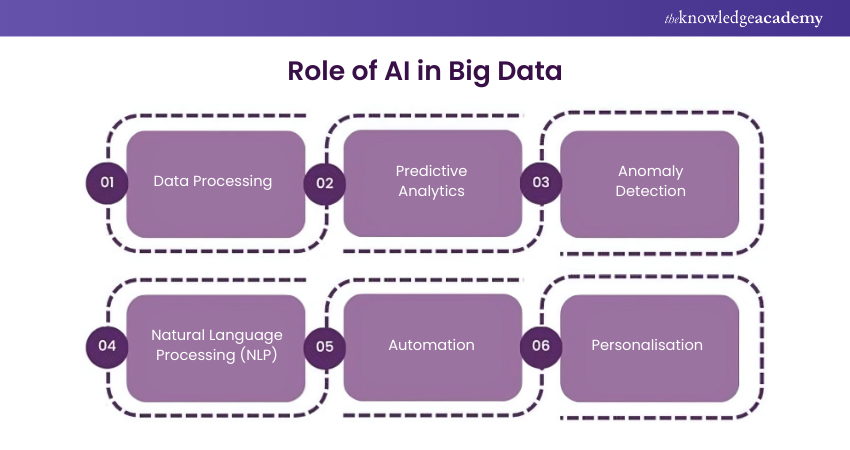
a) AI algorithms can efficiently and quickly process large amounts of data, making it easier to handle Big Data.
a) AI utilises historical data to predict trends and behaviours, helping businesses make informed decisions.
b) AI can identify unusual patterns or outliers in data, which is crucial for fraud detection and cybersecurity.
c) AI can analyse and interpret human language, thereby making it possible to extract insights from unstructured data like text and social media posts.
d) AI automates repetitive tasks, including data cleaning and preparation, freeing up human resources for more strategic activities.
e) AI analyses user data to provide personalised recommendations and experiences, enhancing customer satisfaction and engagement.
Examples of AI and Big Data
Many organisations have harnessed the power of machine learning-enhanced Big Data Analytics, utilising Big Data and AI in various innovative ways. Let’s explore some examples:
1) Netflix: Netflix employs Machine Learning (ML) algorithms to gain a deeper understanding of each user, offering more personalised recommendations. This not only keeps users engaged on their platform for longer but also enhances the overall customer experience.
2) Google: Google leverages Big Data Machine Learning to deliver highly valuable and personalised experiences across its products. This includes predictive text in emails and optimised directions for users navigating to specific locations.
3) Starbucks: Starbucks utilises Big Data, AI, and Natural Language Processing (NLP) to craft personalised emails based on customers’ past purchases. Instead of sending a few dozen generic emails each month, Starbucks uses its “digital flywheel” with AI capabilities to generate over 400,000 personalised weekly emails.
Secure your place in the future of analytics with our Advanced Data Analytics Training– join us now!
Applications of Big Data and Artificial Intelligence
Big Data has numerous applications across various industries, including:
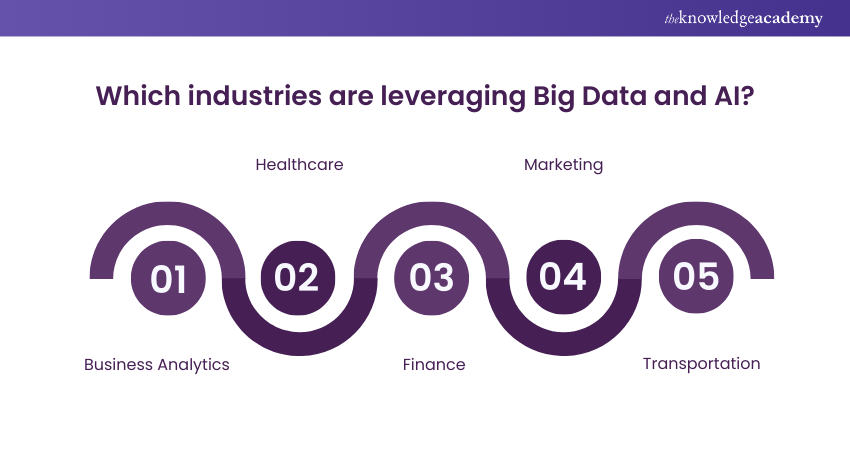
1) Big Data enables organisations to analyse customer behaviour, market trends, and operational efficiency to make data-driven, informed decisions and gain a competitive advantage.
2) Big Data Analytics can be used to improve patient outcomes, identify disease patterns, optimise treatment plans, and predict public health trends.
3) Big Data is utilised in financial institutions for fraud detection, risk assessment, algorithmic trading, and customer segmentation.
4) Big Data helps marketers understand consumer preferences, personalise marketing campaigns, and measure the effectiveness of advertising strategies.
5) Big Data is used to optimise transportation systems, improve traffic management, and enhance logistics operations.
AI has diverse applications and is transforming various industries, including:
1) Natural Language Processing: AI-powered systems can understand and process human language, enabling applications such as chatbots, voice assistants, and language translation.
2) Image Recognition: AI algorithms can analyse and interpret images, leading to applications like facial recognition, object detection, and self-driving cars.
3) Robotics: AI enables the development of autonomous robots capable of performing tasks in industries like manufacturing, healthcare, and agriculture.
4) Virtual Assistants: AI-powered virtual assistants like Siri, Alexa, and Google Assistant can understand and respond to voice commands, provide information, and perform tasks.
5) Autonomous Vehicles: AI plays a crucial role in self-driving cars by interpreting sensor data, making real-time decisions, and ensuring safe navigation.
Conclusion
Big Data and AI are a dynamic duo, drawing actionable insights from raw data and driving innovation across industries. By working together, they unlock new possibilities, streamline operations, and enhance decision-making. Explore the Big Data and Artificial Intelligence (AI) world and watch your potential soar!
Transform your career by joining our Data Science Analytics Course– sign up now and stay ahead in the tech world!
Frequently Asked Questions
Can AI Replace Big Data?

AI cannot replace Big Data; instead, they complement each other. Big Data provides the vast datasets needed for AI algorithms to make informed decisions, while AI enhances the analysis and interpretation of Big Data, driving more accurate insights.
What is Big Data in Artificial Intelligence?
Big Data in Artificial Intelligence (AI) denotes the massive volumes of structured and unstructured data analysed by AI systems to identify patterns, make predictions, and automate processes. AI relies on Big Data to train models, enabling smarter decision-making and improved outcomes.
What are the Other Resources and Offers Provided by The Knowledge Academy?
The Knowledge Academy takes global learning to new heights, offering over 3,000+ online courses across 490+ locations in 190+ countries. This expansive reach ensures accessibility and convenience for learners worldwide.
Alongside our diverse Online Course Catalogue, encompassing 17 major categories, we go the extra mile by providing a plethora of free educational Online Resources like Blogs, eBooks, Interview Questions and Videos. Tailoring learning experiences further, professionals can unlock greater value through a wide range of special discounts, seasonal deals, and Exclusive Offers.
What is The Knowledge Pass, and How Does it Work?
The Knowledge Academy’s Knowledge Pass, a prepaid voucher, adds another layer of flexibility, allowing course bookings over a 12-month period. Join us on a journey where education knows no bounds.
What are the Related Courses and Blogs Provided by The Knowledge Academy?
The Knowledge Academy offers various Big Data and Analytics Trainings, including the Big Data Analysis Training, Hadoop Administration Training, and Data Science Analytics Course. These courses cater to different skill levels, providing comprehensive insights into What is OpenAI.
Our Data, Analytics & AI Blogs cover a range of topics related to Big Data and Artificial Intelligence, offering valuable resources, best practices, and industry insights. Whether you are a beginner or looking to advance your Data Analytics and Artificial Intelligence (AI) skills, The Knowledge Academy's diverse courses and informative blogs have got you covered.

The Knowledge Academy


Global Training Provider
The Knowledge Academy is a world-leading provider of professional training courses, offering globally recognised qualifications across a wide range of subjects. With expert trainers, up-to-date course material, and flexible learning options, we aim to empower professionals and organisations to achieve their goals through continuous learning.

Upcoming Data, Analytics & AI Resources Batches & Dates
Date
 Hadoop Big Data Certification
Hadoop Big Data Certification
Thu 10th Sep 2026
Hadoop Big Data Certification
Thu 10th Dec 2026

 If you wish to make any changes to your course, please


