


 Top Rated Course

We may not have the course you’re looking for. If you enquire or give us a call on +44 1344 203 999 and speak to our training experts, we may still be able to help with your training requirements.
What are the Top 8 CISSP Domains?
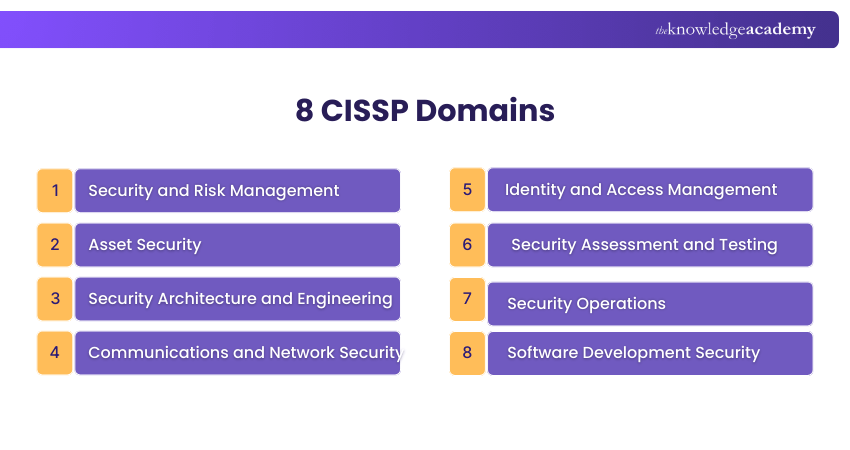
John Davies 13 July 2026The 8 CISSP Domains are Security & Risk Management, Asset Security, Security Architecture, Network Security, Identity Management, Security Testing, and Operations. They align security controls with business objectives and regulatory expectations. Overall, they help protect the confidentiality, integrity, and availability of information.

Training Outcomes Within Your Budget!
We ensure quality, budget-alignment, and timely delivery by our expert instructors.
Table of Contents
Related Courses

So, you’ve decided to dive into the world of CISSP? Good choice! Think of it as the master plan for cybersecurity professionals. At its core lies a powerful framework made up of eight well-structured domains, your roadmap to securing systems, data, and networks.
CISSP Domains are like puzzle pieces that, when put together, give you a 360-degree view of modern security practices. Whether you're starting your journey or want a refresher, understanding these domains is a game-changer. Let’s explore the terrain and see how each piece fits into the big picture of cyber defence.
Table of Contents
1) What is CISSP?
2) The 8 CISSP Domains Explained
3) CISSP Domain List and Examination Weights Across
4) Prerequisites and Exam Qualifications for CISSP Certifications
5) What are the Domains in Cyber Security?
6) What is the Hardest CISSP Domain?
7) Conclusion
What is CISSP?
Certified Information Systems Security Professional (CISSP) is a globally recognised certification offered by the International Information System Security Certification Consortium (ISC)². It validates that a professional has the knowledge and practical understanding required to design, implement, and manage an organisation’s Information Security frameworks effectively.
With the help of CISSP, individuals demonstrate their ability to handle security challenges, support compliance requirements, and protect organisational data against evolving cyber threats. It encourages professionals to follow best practices and ethical standards in protecting information assets.

The 8 CISSP Domains Explained
The CISSP certification is structured around eight core domains that together form a complete foundation of cybersecurity knowledge. Each domain focuses on a different aspect of protecting information. The candidate must prove their expertise in all the Domains of CISSP. Let us understand the CISSP 8 Domains in depth:
1) Security and Risk Management
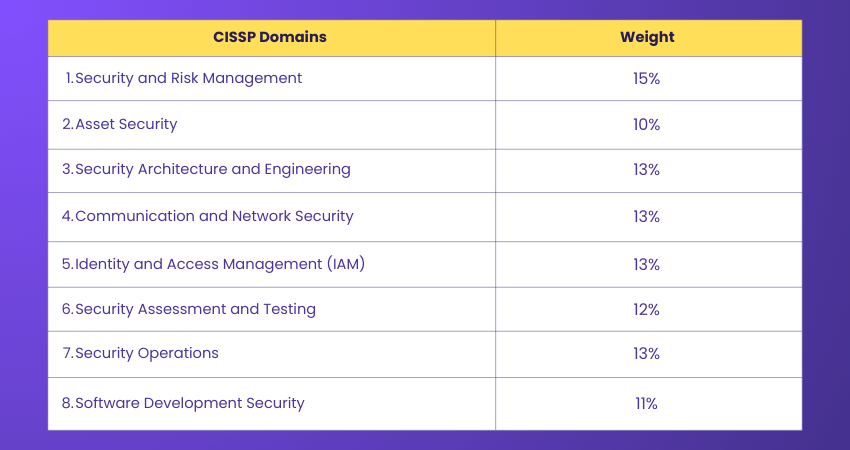
This CISSP domain forms the foundation and provides an overview of the key principles of Information Systems Security Management. The CISSP exam typically allocates 16% weight to this domain. It comprises the following:
1) Understand professional ethics
2) Security governance principles and concepts
3) Compliance and other requirements
4) Understanding legal and regulatory issues in the context of Information security
5) Personnel security policies and procedures
6) Risk-based management concepts
2) Asset Security
This CISSP Domain focuses on data protection, management, and safety controls. The content derived from this domain accounts for approximately 10% of the CISSP Exam. It encompasses the responsibilities associated with various roles in data management, information ownership and processing, privacy concerns, and limitations. It includes the following:
1) Data lifecycle management
2) Data security controls
3) Information and Asset Retention
4) Compliance requirements
Arm yourself with expertise - Register for Chief Information Security Officer Training today!
3) Security Architecture and Engineering
Security Architecture and Engineering addresses up to 13% of the CISSP Exam. This domain deals with designing and building secure systems. Professionals understand how security models, encryption methods, and trusted computing principles are used to create resilient and reliable infrastructures. This domain covers:
1) Research, implement and manage engineering processes using secure design principles
2) Understanding the fundamental concepts of security models
3) Understanding security capabilities and controls based on security requirements
4) Assessing and mitigating vulnerabilities in security systems
5) Methods of Cryptanalytic attacks
6) Designing and facilitating security controls
4) Communications and Network Security
This CISSP Domain implicates multilayer protocols to establish and maintain network security. It includes about 13% of the content for the CISSP Exam. It instructs on the capacity to build trustworthy network security and communication channels.
The questions on communication networks, diverse network design characteristics, media transmission, and wireless communications will be conferred to the candidates appearing in the exam. Communications and Network security includes
1) Assessing and implementing secure design principles
2) Protecting network components
3) Methods to implement secure communication channels
5) Identity and Access Management
The Identity and Access Management domain includes about 13% of the content in the CISSP Exam. This domain aids Information Security professionals in better understanding how to limit users' access to data information. It comprises the following:
1) Methods to control physical and logical access to assets
2) Identification and authentication of people, devices, and services.
3) Centralised third-party identification service
4) Implement authentication systems
5) Identity and access provisioning lifecycle
6) Security Assessment and Testing
This CISSP domain covers the methods and tools used to evaluate the security of processes and identify flaws in design or code, as well as potential vulnerabilities. It also includes techniques such as vulnerability assessments and penetration testing to detect risks. This domain comprises 12% of the CISSP Exam. It focuses on:
1) Disaster recovery and security control testing
2) Awareness training for the client
3) Vulnerability assessment and penetration testing
4) Business continuity plans
5) Conduct or facilitate security audits
7) Security Operations
Security Operations deals with the everyday protection and monitoring of IT environments. It includes incident response, logging, monitoring, disaster recovery, and backup management. You can learn how to detect attacks quickly and respond effectively to minimise damage. This domain comprises 13% of the Exam modules. It covers:
1) Understand and abide by the investigations
2) Configuration Management
3) Logging and monitoring activities
4) Securing resources
5) Vulnerability management
6) Apply foundational security operations concepts
7) Applying resource protection techniques
8) Conduct Incident Management
9) Implement and test a disaster recovery
10) Manage and implement personnel safety and security
11) Planning Business continuity
8) Software Development Security
This topic covers CISSP security operations, involving about 10% of the content in the CISSP Exam. Software Development Security conducts a detailed study of software security systems comprising the following:
1) Security integration in the Software Development Life Cycle (SDLC)
2) Detect and apply security controls
3) Assessing software's security impact
4) Apply secure coding guidelines and standards
Enhance your Cybersecurity skills with our ISSMP Training - Join now!
CISSP Domain List and Examination Weights Across
Here is a table explaining the CISSP Domain List along with their examination weightage:
Prerequisites and Exam Qualifications for CISSP Certifications
If you're aiming to become a CISSP-certified professional, here’s what you need to know about the eligibility and exam format.
Prerequisites of CISSP
To apply for the CISSP exam, you must have at least five years of cumulative and paid work experience in Information Security. Your experience should cover at least two or more of the eight CISSP Domains.
However, you can reduce the work experience requirement by one year if you meet any one of the following conditions:
1) You’ve completed a four-year college degree in Computer Science, Information Technology (IT) or related fields.
2) An approved credential from the (ISC)² approved list.
3) Relevant part-time work and internships can be counted toward fulfilling the experience requirement.
Examination Plan of Action
The CISSP Exam is a Computerised Adaptive Testing (CAT) that evaluates both theoretical knowledge and practical decision-making skills across all eight domains. You can prepare an effective study plan by clearly understanding the nature of the exam. Key exam details include:
1) Exam Duration: 3 hours
2) Number of Questions: 100 to 150 questions
3) Question Format: Multiple-choice and advanced question types
4) Passing Score: 700 out of 1000 points
5) Languages Available: English, Chinese, German, Japanese, and Spanish
What are the Domains in Cyber Security?
Cyber security domains are specialised areas within information security that focus on protecting systems, networks, and data from threats and unauthorised access. Each domain represents a different responsibility, ranging from managing organisational risk to securing applications and monitoring daily operations. Some common cyber security domains include:
1) Security and risk management
2) Network security
3) Application security
4) Identity and Access Management (IAM)
5) Cloud security
6) Security operations and incident response
7) Cryptography and data protection
8) Governance, Risk, and Compliance (GRC)
9) Penetration testing and vulnerability management
What is the Hardest CISSP Domain?
No domain in the CISSP Exam is inherently the hardest, as the level of difficulty mainly varies based on a candidate’s background and experience. However, some may find Security Architecture and Engineering and Software Development Security the most challenging.
This is due to the reason that they include technical concepts such as cryptography, security models, hardware security, secure coding practices, testing methods, and the secure software development lifecycle (SDLC). It requires both theoretical understanding and the ability to apply security controls in real-world architectures.
Conclusion
The eight CISSP Domains together create a complete framework for understanding modern information security. Mastering these domains strengthens your decision-making, improves risk awareness, and supports the protection of critical business data. For anyone aiming to build a long-term career in cybersecurity leadership, understanding these domains is an essential step forward.
Secure your future in Information Security with CISSP Courses – Begin now!
Frequently Asked Questions
Why Are the CISSP Domains Important?

The CISSP Domains are crucial because they incorporate the essential areas of cybersecurity knowledge. These domains guide professionals in implementing comprehensive security measures. It ensures organisations can protect data, manage risks, and comply with industry standards.
How Many Times Can You Fail CISSP?
You can attempt the CISSP exam up to four times within a 12-month period. After each failed attempt, a mandatory waiting period applies:
1) 30 days after the first attempt
2) 60 days after the second attempt
3) 90 days after the third and subsequent attempts

John Davies


Cyber Security Governance & Assurance Specialist
John Davies is a cybersecurity expert specialising in governance, risk management, and compliance. With over 15 years in the field, he has led enterprise-wide security programmes across finance, healthcare and public sector organisations. His content provides practical guidance on building secure environments, managing risk and aligning with regulatory frameworks.


 If you wish to make any changes to your course, please


