


 Top Rated Course

We may not have the course you’re looking for. If you enquire or give us a call on + 1-866 272 8822 and speak to our training experts, we may still be able to help with your training requirements.
Facilitation Techniques: An Overview
The Knowledge Academy 26 March 2026Facilitation Techniques are structured methods like brainstorming, round-robin, and parking lot to guide discussions, boost participation, and drive clear decisions. They help teams collaborate effectively, manage group dynamics, and ensure productive outcomes in meetings, workshops, and problem-solving sessions.

Training Outcomes Within Your Budget!
We ensure quality, budget-alignment, and timely delivery by our expert instructors.
Table of Contents
Unproductive meetings and scattered discussions often slow down team progress and decision-making. The key to turning conversations into meaningful outcomes lies in using the right Facilitation Techniques that encourage participation and keep discussions focused.
In this blog, we explore practical methods that help teams collaborate effectively, generate ideas, and reach clear decisions. These top 13 Facilitation Techniques are designed to improve engagement, streamline communication, and drive better results in any team setting.
Table of Contents
1) What is Facilitation?
2) What are Facilitation Techniques
3) Top 13 Facilitation Techniques
4) How do Facilitation Techniques Support Innovation?
5) Conclusion
What is Facilitation?
The process of helping people or a group of individuals to participate in decision-making successfully and applying a non-threatening and positive approach to realise their goals is known as Facilitation. It is used in diverse settings, including conferences, workshops, team meetings, social gatherings within the community and strategic planning sessions. It is also a skill that enables sound decision-making and a deepen bond among team members.

What are Facilitation Techniques
Facilitation Techniques are organisational strategies employed by trainers, facilitators and moderators to guide discussions, facilitate participants and manage meetings or workshops to attain their desired results. Such strategies would facilitate group dynamics management, promote teamwork, and ensure that discussions remain relevant and effective.
They may also be used not only for the content to be discussed but also to achieve certain goals in a session. Facilitation skills are more in demand in the current virtual world, as they assist the facilitator to cope with internet communication effectively and provide well-arranged and stimulating sessions.
Gain essential skills to manage facilities operations efficiently and professionally with our Facilities Management Course- Join today!
Top 13 Facilitation Techniques
A good facilitation process assists in keeping the teams on track and also motivating them to participate and attain significant results. Here are some top facilitation Techniques a facilitator can utilise to improve team collaboration:
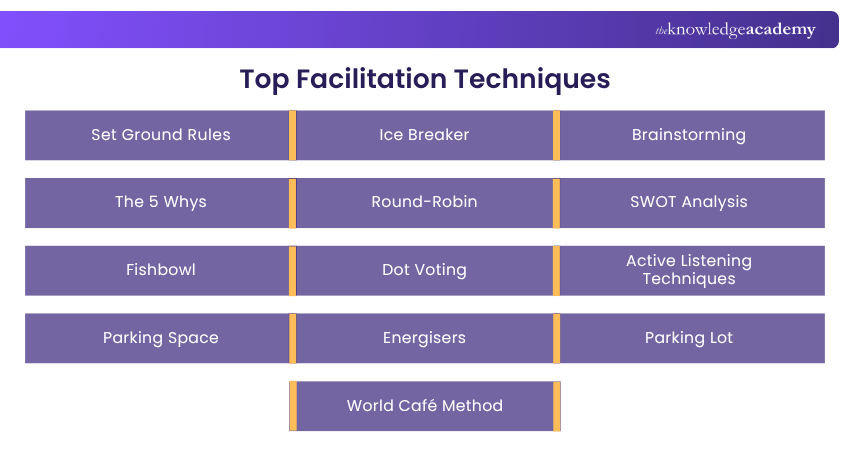
1) Set Ground Rules
Ground rules are part of creating clear expectations in the way behaviour, communication, and participation can be expected during a particular session. It makes sure that everyone recognises how the discussion is going to be implemented and what they expect.
These rules provide an organised and respectful atmosphere, which minimises the possibility of misunderstandings or disturbance. They also serve a purpose of prevention of drift since the conversation stays on course with the goals of the session.
All in all, clear ground rules ensure there is accountability, people are active, and discussion is productive and well-organised throughout the session.
2) Ice Breaker
Short activities meant to facilitate interactions between the participants in a session and relieve initial hesitations are icebreakers. They assist people to be more at ease with each other, especially in new or unfamiliar group settings.
Icebreakers provide an environment of open communication by ensuring that the interaction is facilitated at an early stage. This will give more willing participants to share ideas and give contributions to discussions.
Ice Breakers, therefore, can make team dynamics better, facilitate the session, and provide the right mood for the whole session.
3) Brainstorming
One Facilitation Techniques which is very popular is brainstorming, which invites the participants to come up with as many ideas as possible without evaluating them at the same time. It encourages innovation and will enable people to think without knowing that they will be criticised.
This method concentrates on the quantity, and after that, the teams get time to discuss a wide range of views and innovative solutions. Ideas can subsequently undergo improvements and scrutiny on their viability and effect.
Brainstorming assists in opening up the collective thinking, enhances teamwork, and contributes to an effective solution of problems.
4) The 5 Whys
The root cause of a problem is determined by means of the 5 Whys technique through the application of why repeated at every level of the problem, to find the core of the problem. This style enables the teams to go beyond the superficial problems and their underlying causes.
It also promotes in-depth thought and proper analysis of problems so that the identified solutions combat the real problem as opposed to the symptoms of the problem. This creates better and long-term results.
The 5 Whys technique assists organisations in avoiding similar problems in the past and enhancing the overall decision-making process by focusing on root causes.
5) Round-Robin
Round-robin is a facilitation method that is organised in a way that each participant is given an equal opportunity to contribute in a sequential manner. This will make sure that everyone is heard, and they will not be dominated by the more outspoken members.
It makes an inclusive space where the less vocal individuals can feel at ease to express their views. This increases even-handed and diversified input in discussions.
Round-robin is a more efficient modification that helps to increase involvement, equal participation, and quality of group decision-making since a wide variety of perspectives is involved.
6) SWOT Analysis
The SWOT (Strength, Weakness, Opportunity, and Threat) Analysis is a Facilitation tool used to understand an organisation's strengths and weaknesses. As a Facilitator, you can guide participants through a SWOT analysis session to gain deeper insights into the subject matter.
Providing participants with structured SWOT Analysis worksheets helps you analyse the process and ensure that all aspects are thoroughly considered. The worksheet typically consists of four sections. Each section is dedicated to strengths, weaknesses, opportunities, and threats. Within each section, participants are encouraged to list relevant factors.
Moreover, using a whiteboard or flipchart to draw the four SWOT quadrants can improve the visual aspect of the analysis. As participants share their strengths, weaknesses, opportunities, and threats, you can record their points on the whiteboard in their respective quadrants.
7) Fishbowl
The fishbowl method will entail the use of a small number of participants who discuss a topic in an inner circle, whereas the related environment is observed by an outer circle. It is a structure that aids in concentrating on major discussions and enables one to learn extensively.
The outer circle participants are then able to turn in to participate in the discussion, thus guaranteeing greater participation. It is particularly applicable whenever the researcher needs to study intricate issues in a systematic and orderly way.
Fishbowl promotes active listening, minimises interruptions and levels the playing field to provide deep and extensive conversations and sharing of knowledge.
8) Dot Voting
Dot voting is a basic method of decision-making, in which members utilise the dots or markers by voting on the ideas or options. It aids in making a decision fast, depending on group preference.
The voters have a restricted number of votes, and this promotes the use of reason when voting as opposed to voting blindly. This will make sure that the best ideas emerge.
Dot voting makes it easy to make decisions, is more fair and enables teams to be able to reach a solution without protracted discussions.
9) Active Listening
Active listening is one of the crucial Techniques Facilitation that every Facilitator should master. You can create a supportive and understanding environment by engaging in active listening Techniques . It encourages participants to share their thoughts and feelings openly. Here are some practical active listening tools to enhance your Facilitation:
a) Reflective listening: Students will learn the reflective listening technique through paraphrasing or restating the speaker’s key points. They will do so to demonstrate their understanding and validate the speaker’s perspective. When the participants feel that they are listened to and appreciated, it will affect their active participation in the dialogue.
b) Paraphrasing: Paraphrasing is the process of recasting the type of participant's statements by utilizing your own vocabulary but maintaining the same meaning. This method will not only help you to be sure that you understood the speaker’s message correctly, but also will prevent misreadings.
c) Non-verbal cues: The non-verbal communication such as facial expressions allow speaker to convey attention and engagement without distracting the speaker. Non-verbal cues such as nodding or maintaining eye contact and body language can also be influential to keep the participants engaged in the ongoing discussion.
10) Parking Space
Facilitating the provision of parking space is a facilitation strategy to hold aside off-topic ideas or questions in a discussion that are temporarily put aside. It allows one not to lose significant points and, at the same time, makes the session focused.
These are recorded in a special section, which is later revisited when time permits. This assists in keeping the conversation running without any unnecessary interferences.
Parking area enhances time management, maintains dialogue organisation, and ensures that none of the contributions goes unnoticed.
11) Energisers
Energisers are brief interactive games that are used to stimulate energy and wake up an attendee after a long period of activity. They assist in eliminating boredom and revitalise attention.
Such activities can be performed as a form of movement, speedy games, or even discussions which are light and arouse activity within the group.
Energisers can be useful in terms of encouraging people to take part in the event, staying enthusiastic, and making sure that the teams remain alert and productive during the session.
12) Parking Lot
Parking lot is a process or method, not unlike that of parking space, where the unrelated ideas or concerns are recorded and later tackled. It also assists in ensuring that deliberations are within the principal objective.
With the visualisation of such points, the members of the discussion feel listened to without derailing the session. It also helps in making sure that precious inputs are not forgotten.
The parking lot technique helps facilitate an organised manner, enhances concentration and facilitates effective handling of time and discussions.
13) World Café Method
The World café method is one of the engaging Facilitation Techniques designed to promote meaningful and collaborative conversations among participants. It creates a relaxed and informal atmosphere that encourages open dialogue and the sharing of various perspectives. To set the stage for the world café method, follow these steps:
a) Arrange the seating in small groups around café-style tables.
b) Each table should have enough space for participants to interact and share ideas comfortably.
c) Consider decorating the tables with tablecloths, markers, and paper, giving them a café-like ambience.
d) Encourage participants to switch tables at specific intervals.
e) Allow participants to build on previous conversations and help them gain fresh perspectives.
Learn to plan, develop, and manage successful products effectively with our Product Management Course- Sign in now!
How do Facilitation Techniques Support Innovation?
Facilitation methods are very important in encouraging innovation by providing an atmosphere in which ideas are shared freely and discussed in an effective way. They assist in organising the discussions and promote innovative thinking and teamwork. The support of Facilitation Techniques in innovation is as follows:
• Encourage open idea sharing without fear of judgement
• Promote diverse perspectives and collaborative thinking
• Structure discussions to move ideas from concept to action
• Help identify and solve problems creatively
• Improve engagement and participation across teams
• Enable faster and more effective decision-making
Learn the basics of coffee beans and roasting with our beginner-friendly Barista Course
Conclusion
Facilitation Techniques are essential for guiding productive discussions and improving team collaboration. They help structure conversations, encourage participation, and ensure clear, outcome-driven decisions. By applying the right techniques, teams can enhance creativity, communication, and efficiency. Ultimately, effective facilitation leads to stronger collaboration and better organisational results.
Build practical industry-ready skills and stay competitive in your field with our Industry Training – Sign in today!
Frequently Asked Questions
What are the Four Cs of Facilitation?

The four Cs of Facilitation are:
a) Context
b) Clarity
c) Consultation
d) Consensus
What are the Three Ps of Facilitation?
The three Ps of Facilitation are:
a) Purpose
b) Process
c) People
What are the Other Resources and Offers Provided by The Knowledge Academy?
The Knowledge Academy takes global learning to new heights, offering over 3,000+ online courses across 490+ locations in 190+ countries. This expansive reach ensures accessibility and convenience for learners worldwide.
Alongside our diverse Online Course Catalogue, encompassing 17 major categories, we go the extra mile by providing a plethora of free educational Online Resources like Blogs, eBooks, Interview Questions and Videos. Tailoring learning experiences further, professionals can unlock greater value through a wide range of special discounts, seasonal deals, and Exclusive Offers.
What is the Knowledge Pass, and How Does it Work?
The Knowledge Academy’s Knowledge Pass, a prepaid voucher, adds another layer of flexibility, allowing course bookings over a 12-month period. Join us on a journey where education knows no bounds.
What are Related Courses and Blogs Provided by The Knowledge Academy?
The Knowledge Academy offers various Industry Courses, including the Facilities Management Course, and the Product Management Training Course. These courses cater to different skill levels, providing comprehensive insights into What is Facilitation.
Our Business Skills Blogs cover a range of topics related to Facilitation Techniques, offering valuable resources, best practices, and industry insights. Whether you are a beginner or looking to advance your Facilitation skills, The Knowledge Academy's diverse courses and informative blogs have got you covered.

The Knowledge Academy


Global Training Provider
The Knowledge Academy is a world-leading provider of professional training courses, offering globally recognised qualifications across a wide range of subjects. With expert trainers, up-to-date course material, and flexible learning options, we aim to empower professionals and organisations to achieve their goals through continuous learning.

Upcoming Business Skills Resources Batches & Dates
Date
 Facilitation Skills Training
Facilitation Skills Training
Fri 17th Jul 2026
Facilitation Skills Training
Fri 13th Nov 2026

 If you wish to make any changes to your course, please


