Who should attend this ISO 21001 Foundation Training?
The ISO 21001 Foundation Course is suitable for a range of individuals who are interested in or involved with Educational Organisations Management Systems (EOMS) and want to gain a foundational understanding of ISO 21001:2018. Here are some of the professionals who can benefit from attending this ISO 21001 Training:
- Education Administrators
- School Principals and Directors
- Quality Assurance Managers in Education
- Academic Coordinators
- Teachers and Educators
- Education Consultants
- Professionals in Educational Organisations
Prerequisites of the ISO 21001 Foundation Training
There are no formal prerequisites for attending this ISO 21001 Foundation Course.
ISO 21001 Foundation Training Course Overview
ISO 21001 is an educational management standard that aims to standardise the management of educational organisations to ensure their proper working. The main purpose of this standard is to establish the support system for the acquisition and development of competence through teaching, learning, and research.
Proficiency in ISO 21001 is vital for professionals in the education sector, including Administrators, Quality Managers, and Auditors. This expertise enables them to implement and manage educational quality management systems effectively. Mastery of this standard is particularly important for those aiming to elevate their institutions' educational quality and compliance with international standards.
This 1-day ISO 21001 Foundation Training by The Knowledge Academy equips delegates with a comprehensive understanding of the standard's requirements. They will also gain a deep understanding of the process of educational management, SWOT analysis, and many more. Our expert trainers with years of teaching experience will conduct ISO 21001 Training Course and help delegates to gain a comprehensive understanding of the concepts.
Course Objectives
- To understand educational management and its principles for effective analysis
- To gain in-depth knowledge of planning, organising, directing, and controlling the organisation
- To understand the different levels of management and their functions
- To learn how to do SWOT analysis for effective and strategic planning
- To acquire skills to do efficient controlling and evaluation for effective management
- To learn the importance of strategic plans for the development of organisation
After completing this ISO 21001 Certification, delegates will be able to formulate plans for effective management and strategic planning. They will also be able to do a SWOT analysis for proper evaluation of threats and opportunities.
Skills You Will Gain from ISO 21001 Foundation Training
ISO 21001 Foundation Training equips professionals with a solid understanding of the Educational Organization Management System (EOMS) standard, helping learners to support, implement and interpret ISO 21001 requirements within educational environments.
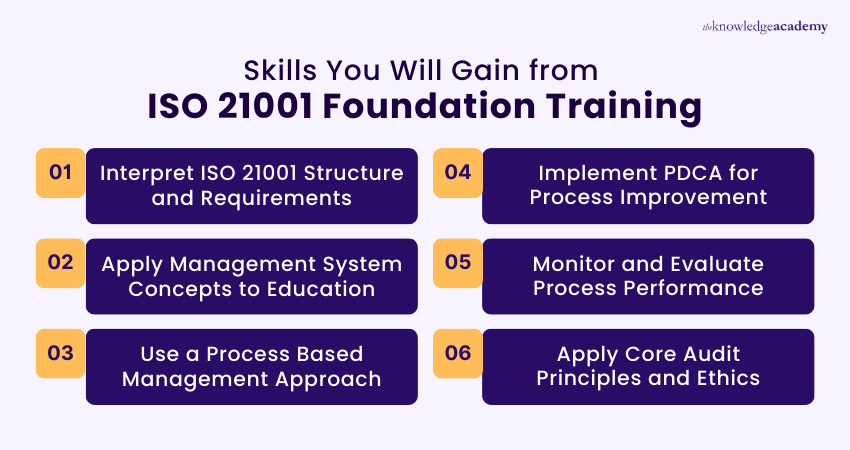
Here are some valuable skills learners will acquire with this training:
- Interpret ISO 21001 Structure and Requirements: Develop the ability to identify the purpose, scope, terms and structure of ISO 21001 and explain how each clause applies within an educational organisation.
- Apply Management System Concepts to Education: Gain the skill to assess educational organisations as managed systems and align management system elements with organisational objectives.
- Use a Process Based Management Approach: Learn how to map educational processes, define inputs and outputs, identify controls and apply a process based approach to improve consistency and outcomes.
- Implement PDCA for Process Improvement: Build the capability to apply the Plan-Do-Check-Act (PDCA) cycle at process level and monitor performance to support continual improvement.
- Monitor and Evaluate Process Performance: Acquire skills to measure process effectiveness, analyse interactions between processes and support system level optimisation.
- Apply Core Audit Principles and Ethics: Develop the ability to apply fundamental audit principles including ethical conduct, professional behaviour and confidentiality in audit activities.




 If you miss out, enquire to get
yourself
on the waiting list for the next day!
If you miss out, enquire to get
yourself
on the waiting list for the next day!













 If you wish to make any changes to your course, please


