


 Top Rated Course

We may not have the course you’re looking for. If you enquire or give us a call on + 1-866 272 8822 and speak to our training experts, we may still be able to help with your training requirements.
Lean vs Agile: How They Differ and When to Use Each?
James Smith 25 February 2026Lean vs Agile refers to two management methodologies focused on efficiency and adaptability, each with distinct principles, practices, and applications. Lean boosts efficiency in stable environments, while Agile suits projects that need feedback and adaptability. Understanding their differences help organisations adopt the right approach.

Training Outcomes Within Your Budget!
We ensure quality, budget-alignment, and timely delivery by our expert instructors.
Table of Contents
Organisations want to work faster, reduce waste, and deliver better business outcomes, but this requires choosing the right approach to work. This is where Lean vs Agile becomes an important comparison. Both methods improve efficiency and create value, yet they are different from each other. Understanding how each approach works helps teams manage projects effectively and respond to changing demands confidently.
The right choice depends on your goals, work environment, and how much flexibility your project requires. Some teams need structured processes, while others require rapid adaptation and continuous feedback. In this blog, you will explore Lean vs Agile, their differences, their principles, their benefits, and more.
Table of Contents
1) What is Lean Methodology?
2) What is Agile Methodology?
3) Differences Between Lean and Agile
4) Core Principles of Lean and Agile
5) Choosing Between Lean and Agile
6) Pros and Cons of Lean
7) Pros and Cons of Agile
8) Conclusion
What is Lean Methodology?
Lean Methodology is a systematic approach focused on achieving smooth and efficient flow in processes. Its primary aim is to deliver maximum customer value by improving products, services, and how work is done. A key principle of Lean is eliminating inefficiencies that do not add value, such as unnecessary meetings, tasks, documentation, and avoiding multitasking.
Lean also encourages organisations to view work from a broader perspective in order to optimise overall business processes. At the same time, it emphasises respect for people by providing employees with the right tools, trusting their expertise, and giving them the autonomy to perform their tasks effectively.

What is Agile Methodology?
Agile Methodology is a systematic approach focused on building better products through flexibility, collaboration, and continuous improvement. It centres on developing high-quality solutions that meet changing customer needs. It gained global recognition with the Agile Manifesto for software development and is associated with creating digital products.
Agile focuses more on development than production and places strong importance on people, culture, and mindset. It encourages teamwork, feedback, and the ability to adapt to change. Over the years, it has evolved into various techniques and frameworks, helping teams deliver work in structured yet flexible ways.
Differences Between Lean and Agile
Here are the differences between Lean and Agile:
1) Scope
Lean and Agile can be applied at different levels within an organisation.
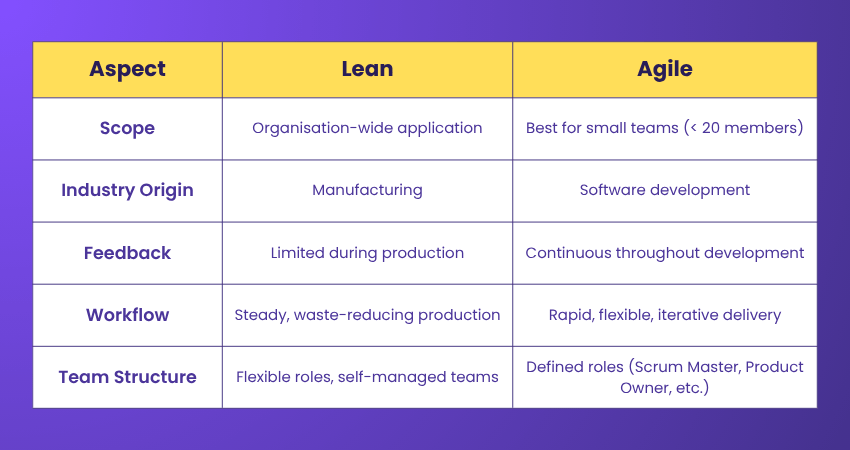
The Agile approach is for smaller teams, like for a team of fewer than 20 members. Continuous communication and feedback are necessary for Agile development benefits from a smaller group.
In contrast, Lean can be implemented organisation-wide, as its core principles, such as staff empowerment and waste elimination, can be applied across various functions and departments.
2) Industry Preference
Lean and Agile originated in different industries and suit different types of work environments.
Agile originated in the software development space, where products evolve through multiple iterations based on client feedback. The initial product often changes significantly before reaching its final form.
Lean, on the other hand, originated in manufacturing, where the end product is typically predefined. Its structured approach is well suited for industries focused on producing physical goods with consistent quality and minimal waste.
3) Role of Feedback
Feedback plays a different role in each methodology.
Agile actively encourages ongoing customer and stakeholder feedback throughout the development process, making it a central part of the workflow.
In Lean, most feedback is gathered before production begins. Once the demand for a product is validated, the focus shifts to efficient delivery. While not as feedback-intensive as Agile, Lean still promotes employee involvement and empowerment, which can boost motivation and engagement.
4) Workflow and Production
Although both methodologies aim for speed and efficiency, their approaches differ.
Agile focuses on the rapid delivery of functional software in small increments, allowing teams to pivot quickly.
Lean, however, is structured around steady production flows with fewer product variants. Once demand is established, production continues until small batch sizes of goods are delivered—emphasising consistency and waste reduction.
Become a Certified Lean Practitioner, streamline workflows and eliminate waste confidently by registering for the Certified Lean Practitioner Course now!
5) Role Definition and Structure
Both approaches value the contribution of the workforce, but they differ in structure.
Agile teams often have clearly defined roles, such as Product Owner, Scrum Master, and Developers, which support coordination and accountability.
Lean is less rigid in terms of roles, allowing for self-organised teams where responsibilities are distributed based on collaboration and shared goals. However, this lack of formal structure can make Lean more challenging to integrate into an organisation’s culture without strong leadership and buy-in.
Lead process improvements with proven Lean skills with Certified Lean Practitioner Course now!
Core Principles
Lean vs Agile are based on core principles that guide how teams deliver value, improve performance, and respond to change. Let’s look at their key principles below:
1) Lean Principles
Lean, developed from the Toyota Production System, focuses on maximising value while reducing waste. It is built on five key principles as mentioned below:
1) Define Value: Organisations identify what customers truly need and are willing to pay for. This ensures resources are focused on activities that create meaningful business value.
2) Map the Value Stream: It analyses every step required to design, deliver, and produce a service or product. It helps organisations identify waste, such as delays and remove non-value activities.
3) Create Flow: After waste is removed, work moves continuously through the value stream with minimal delays. This creates a seamless workflow with enhanced speed, consistency, and productivity.
4) Establish Pull: Work is produced when there is actual customer demand, often through Just-in-time (JIT) systems. This is useful for preventing overproduction, reducing excess inventory, and ensuring efficient resource usage.
5) Seeks Perfection: Continuous improvement is a central part of Lean. Organisations participate in regular review of processes, problem-solving, and make incremental improvements to reduce waste and enhance quality.
2) Agile Principles
Agile is built on 12 principles of the Agile Manifesto, which emphasise flexibility, collaboration, and continuous delivery. Let’s look at them below:
1) Customer Satisfaction: Deliver value outcomes proactively and continuously keep customers satisfied throughout the process.
2) Welcome Change: Accept and respond to changing requirements at any stage to deliver better and more relevant solutions.
3) Frequent Delivery: Work is delivered in small increments over short timeframes. This enables teams to test progress, collect feedback, and make improvements.
4) Collaboration: Agile encourages cooperation between stakeholders, customers, and development teams. Continuous communication ensures alignment and quicker problem resolution.
5) Motivated Individuals: Projects are built around capable and motivated people. Teams are given the support, tools, and trust they need to take ownership of their work.
6) Face-to-face Communication: Face-to-face conversation is the most efficient and effective method of conveying information within a development team. This clear interaction improves team understanding and speed.
7) Working Results: Progress is measured by delivering functional and usable outcomes rather than relying solely on documentation. While documentation still has value, working solutions are considered the primary indicator that real customer value is being delivered.
8) Sustainable Development: Agile promotes a steady and manageable pace of work. Maintaining balance prevents burnout and helps teams remain productive for the long term.
9) Technical Excellence: Continuous focus on quality, design, and best practices helps to maintain flexibility and makes future changes easier to implement.
10) Simplicity: Agile teams focus on doing what is necessary. Avoiding unnecessary complexity saves valuable time, reduces rework, and improves efficiency.
11) Self-organising Teams: Teams are empowered to decide how to complete their work. This autonomy encourages innovation, accountability, and effective problem-solving.
12) Reflection and Adjustment: Teams regularly review their performance and identify ways to improve. Learning from experience refines processes and becomes effective over time.
Help your team work smarter and faster with Agile for Teams Training today!
Choosing Between Lean and Agile
Choosing between Lean and Agile depends on your organisational needs and the nature of the work. Lean focuses on improving the processes that produce results, while Agile concentrates on improving the product through flexibility and continuous feedback. Since both aim to maximise customer value and improve efficiency, organisations can benefit from combining both approaches.
In practice, better processes often lead to better products, which is why Agile teams can gain value from applying Lean principles, such as reducing waste and improving workflows. The important thing to decide is whether your priority is optimising the process (Lean) or enhancing the product (Agile). It is recommended to utilise them together to drive the most effective business result.
Pros and Cons of Lean
Lean improves efficiency and process quality, but it may not suit every environment or project type. Let’s look at the key pros and cons of Lean below to help you differentiate between Lean vs Agile:
1) Pros of Lean
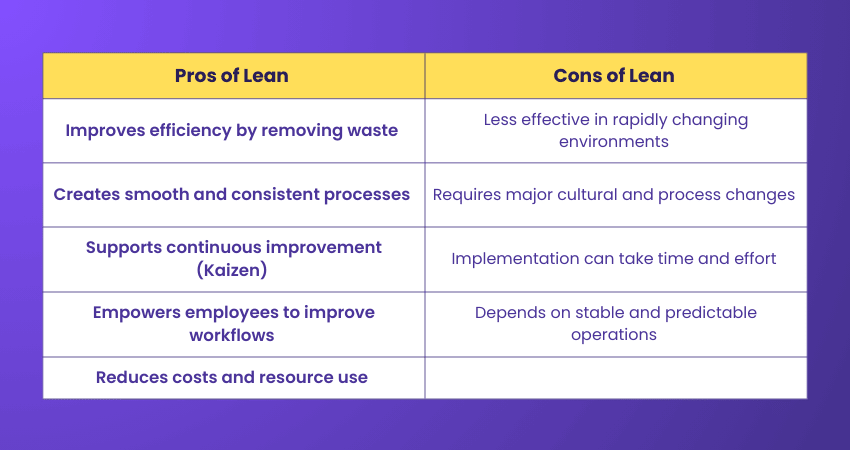
1) Improves Efficiency: Lean removes unnecessary steps and delays, helping teams move work faster and more smoothly.
2) Waste Reduction: It minimises waste time, materials, and efforts by focusing only on activities that add business value.
3) Continuous Improvement Culture: Lean encourages ongoing evaluation and small improvements to enhance performance.
4) Employee Empowerment: Employees are trusted to identify issues and suggest improvements, boosting employee engagement and innovation.
5) Consistent Processes: Workflows are standardised to maintain the quality and predictability of performance.
2) Cons of Lean
1) Limited Flexibility: Lean works best in stable environments, meaning it may struggle with change.
2) Cultural Change Required: Successful implementation often requires a shift in mindset, which can be challenging for organisations.
3) Time-intensive Implementation: Redesigning processes and training teams can take extra time and effort.
4) Dependence on Process Stability: Lean is dependent on predictable workflows, which may not exist in various markets.
Manage Agile projects with structure and confidence with AgilePM® Foundation & Practitioner (AgilePM® V3) Course – Join now!
Pros and Cons of Agile
Agile supports flexibility and collaboration but may not suit environments that need strict planning or predictability. Let’s look at the key pros and cons of Agile below to help you differentiate between Lean vs Agile:
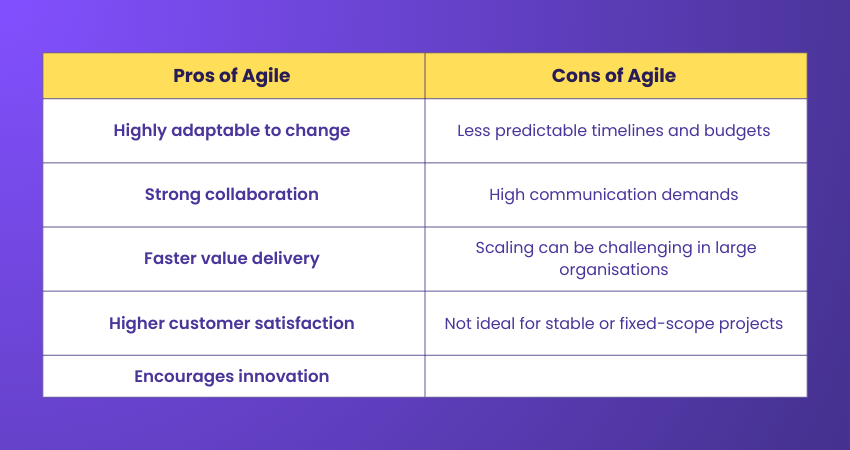
1) Pros of Agile
1) Highly Adaptable: Agile allows teams to respond quickly to changing requirements or evolving market conditions.
2) Strong Collaboration: Frequent communication keeps teams, stakeholders, and customers aligned.
3) Faster Value Delivery: Work is delivered in small increments, allowing early use and feedback collection.
4) Greater Customer Satisfaction: Continuous involvement ensures the product evolves based on real user needs.
5) Encourages Innovation: Flexible structures in Agile enable teams to experiment and improve solutions.
2) Cons of Agile
1) Less Predictable Outcomes: Changing requirements can make timelines and budgets harder to estimate and justify.
2) Communication Demands: Agile requires constant interaction, which can be challenging to maintain.
3) Scaling Challenges: Large organisations may require an additional framework to implement Agile effectively.
4) Unsuitable for Stable Projects: Agile may be unnecessary when requirements are fixed and unlikely to change.
Conclusion
Understanding the difference between Lean vs Agile help organisations choose the right approach to improve efficiency, deliver value, and respond to change. The key is not about choosing one over the other but understanding how each works and when to apply them. Carefully evaluating their goals, work environment, and project demands will help businesses make smarter decisions and achieve better results.
Eliminate waste, deliver value faster, and boost efficiency with Lean Training now!
Frequently Asked Questions
Is Scrum Lean or Agile?

Scrum is an Agile framework, not Lean. It focuses on iterative development, teamwork, and continuous feedback. While it shares some Lean principles, it is primarily part of the Agile family.
What is the Difference Between Lean and Scaled Agile?
Lean is a methodology focused on getting rid of waste and improving efficiency across processes. Scaled Agile, such as SAFe, builds on Agile principles to coordinate multiple Agile teams across large, complex organisations for enterprise-wide agility.
What are the Other Resources and Offers Provided by The Knowledge Academy?
The Knowledge Academy takes global learning to new heights, offering over 3,000+ online courses across 490+ locations in 190+ countries. This expansive reach ensures accessibility and convenience for learners worldwide.
Alongside our diverse Online Course Catalogue, encompassing 17 major categories, we go the extra mile by providing a plethora of free educational Online Resources like Blogs, eBooks, Interview Questions and Videos. Tailoring learning experiences further, professionals can unlock greater value through a wide range of special discounts, seasonal deals, and Exclusive Offers.
What is The Knowledge Pass, and How Does it Work?
The Knowledge Academy’s Knowledge Pass, a prepaid voucher, adds another layer of flexibility, allowing course bookings over a 12-month period. Join us on a journey where education knows no bounds.
What are the Related Courses and Blogs Provided by The Knowledge Academy?
The Knowledge Academy offers various Lean Training, including the Certified Lean Foundation & Practitioner Course, Certified Lean Practitioner Course, and Agile for Teams Training.These courses cater to different skill levels, providing comprehensive insights into Business Continuity Strategy.
Our Business Improvement Blogs cover a range of topics related to Lean vs Agile, offering valuable resources, best practices, and industry insights. Whether you are a beginner or looking to advance your Business Improvement skills, The Knowledge Academy's diverse courses and informative blogs have got you covered.

James Smith


Digital Marketing Manager and Trainer
James Smith is a digital marketing professional with over a decade of experience in SEO, content strategy, paid media and analytics. He has supported both SMEs and global brands in transforming their digital presence. James’s writing and training are rooted in results-driven tactics and the latest marketing trends.
View Detail
Upcoming Business Improvement Resources Batches & Dates
Date
 Certified Lean Foundation & Practitioner
Certified Lean Foundation & Practitioner
Thu 19th Mar 2026
Certified Lean Foundation & Practitioner
Thu 25th Jun 2026
Certified Lean Foundation & Practitioner
Thu 24th Sep 2026

 If you wish to make any changes to your course, please


