


 Top Rated Course


We may not have the course you’re looking for. If you enquire or give us a call on +39 800580270 and speak to our training experts, we may still be able to help with your training requirements.
Managerial Accounting: Definition, Concepts & Importance
Olivia Taylor 11 March 2026Managerial Accounting provides internal financial and non-financial data to managers for planning, decision-making, and controlling future business performance. It helps organisations improve efficiency and use resources wisely. This information enables managers to set targets, monitor costs, and track overall business performance.

Training Outcomes Within Your Budget!
We ensure quality, budget-alignment, and timely delivery by our expert instructors.
Table of Contents
Have you ever wondered how successful businesses make smart decisions before problems even appear? Behind every effective budget, profitable product, and well-planned strategy lies a system that helps managers understand costs, predict outcomes, and control resources. That system is Managerial Accounting, and it quietly shapes the decisions that drive business success every day.
If you are curious about What is Managerial Accounting, it is the key to smarter planning, cost control, and better decision-making. In this blog, you will explore the techniques, principles, and tools that support stronger strategies and sustainable business growth.
Table of Contents
1) What is Managerial Accounting?
2) Managerial vs Financial Accounting
3) Key Concepts in Managerial Accounting
4) Importance of Managerial Accounting
5) Managerial Accounting Techniques
6) What are the Five Principles of Managerial Accounting?
7) What Software is Used in Managerial Accounting?
8) Conclusion
What is Managerial Accounting?
Managerial Accounting also known as Management Accounting is an internal financial tool that businesses use for planning, controlling, and decision-making. It facilitates the collection, analysis, interpretation, and communication of financial data for internal purposes.
Unlike Financial Accounting, which is primarily concerned with presenting financial information to external stakeholders, Managerial Accounting's primary audience is the internal management team of the company. This internal focus allows the management to have a better understanding of the company's performance, operations, and overall financial health.

Managerial vs Financial Accounting
Both Managerial and Financial Accounting use financial data but serve different purposes. Managerial Accounting supports internal decisions and future insights, using budgets, forecasts, and cost analysis to improve planning, cost control, and performance.
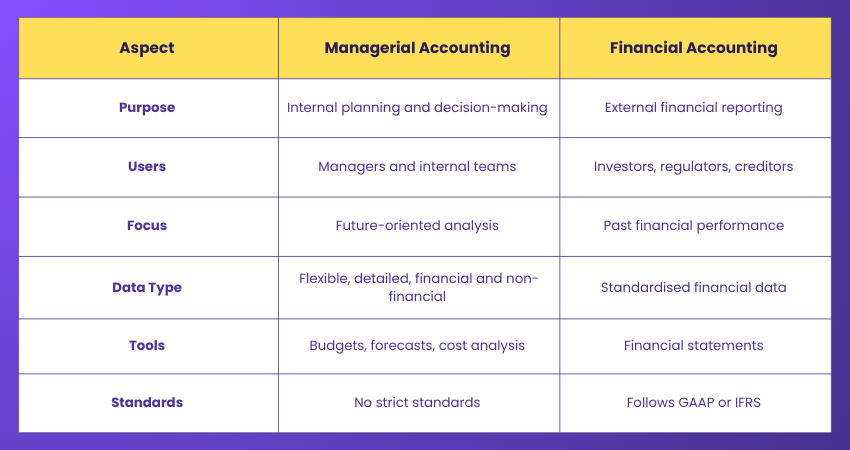
In contrast, Financial Accounting focuses on external reporting for investors, regulators, and creditors. It follows standards such as GAAP or IFRS and records past financial performance in summarised reports, ensuring accuracy, transparency, and consistency.
Key Concepts in Managerial Accounting
There are various key concepts in Managerial Accounting that help in the following parameters:
Cost Classification
Cost classification is a fundamental aspect of Managerial Accounting. It involves categorising costs to provide a clear understanding of their nature and impact on the organisation.“Direct costs” are production-related expenses like raw materials and labour. “Indirect costs” are expenses like overhead that are not directly tied to specific products. "Fixed costs" remain constant regardless of production volume, while "variable costs" fluctuate with production. "Semi-variable costs" combine elements of fixed and variable costs.
Cost Behaviour
Cost behaviour examines how costs change as production levels vary. Understanding this is crucial for effective Cost Management.
"Fixed costs" stay constant regardless of production changes, providing stability. "Variable costs" rise or fall with production volume, impacting overall expenses. This concept aids businesses in predicting cost fluctuations and adjusting strategies accordingly, which is essential for maintaining financial stability and optimal resource allocation.
Cost-Volume-Profit Analysis (CVP)
CVP Analysis is a vital tool for Managerial Accounting, allowing businesses to understand the relationship between costs, sales volume, and profits. It identifies the "break-even point," where total revenue equals total costs.
This analysis informs decision-making on pricing, production levels, and sales strategies, helping organisations maximise profits while managing costs effectively. By utilising CVP Analysis, businesses can make informed choices that align with financial goals, leading to improved performance and sustainability.
Budgeting
Budgets are integral to Managerial Accounting, serving as a roadmap for financial planning and control. Managers use budgets to set specific financial targets, allocate resources efficiently, and monitor performance against these objectives.
The various aspects of the budget include revenue, expenses, and capital expenditures. They enable organisations to track progress, identify potential issues, and make timely adjustments to ensure financial success. Effective budgeting enhances organisational efficiency, promotes accountability, and supports long-term strategic planning.
Performance Measurement
Performance measurement involves developing metrics to assess how well the organisation is achieving its objectives. These metrics span diverse areas, such as cost efficiency, revenue growth, and return on investment (ROI).
By quantifying performance, managers can identify strengths, weaknesses, and areas for improvement. Evaluating actual performance against targets helps businesses make informed decisions to enhance operational efficiency.
Understand risk management strategies to safeguard financial integrity with our Accounting and Finance Policies Course – Join today!
Importance of Managerial Accounting
In this section, we will discuss the importance of knowing Managerial Accounting.
Informed Decision-making
Managers can assess the potential impact of their choices on costs, profits, and the overall financial health of the company. This informed decision-making ensures that the business takes calculated risks and seizes opportunities.
Cost Control
This is essential for maintaining profitability, especially in competitive markets. Cost control strategies can include finding cost-saving opportunities, optimising resource allocation, and eliminating unnecessary expenditures.
Strategic Planning
Managerial Accounting plays a pivotal role in strategic planning, with a Management Accountant being instrumental in the process. It helps businesses align their financial objectives with their broader strategic goals. By providing insights into revenue projections, cost forecasts, and resource requirements, a Management Accountant assists in developing effective strategies. Organisations can assess the financial feasibility of their plans, allocate resources strategically, and work towards achieving long-term success. resources strategically, and work towards achieving long-term success.
Performance Evaluation
Managerial Accountants develop performance metrics and Key Performance Indicators (KPIs) that help assess various aspects of the business. These metrics can relate to cost efficiency, revenue growth, return on investment, and other relevant parameters. By monitoring performance against these metrics, businesses can identify strengths and weaknesses.
Resource Allocation
Effective resource allocation is a key aspect of Business Management. Managerial Accounting aids in determining where resources should be allocated for the best possible outcomes. Having a clear understanding of resource allocation based on financial data ensures that resources are optimally utilised to achieve the company's goals.
Long-term Sustainability
Managerial Accounting contributes to the long-term sustainability of a business. By providing insights into financial health, growth prospects, and risk factors, it helps in making strategic decisions that ensure the company's viability in the long run. This includes evaluating the impact of external factors, such as economic trends or regulatory changes, and adjusting the business strategies accordingly, which often connects closely with concepts from Managerial Economics.
Managerial Accounting Techniques
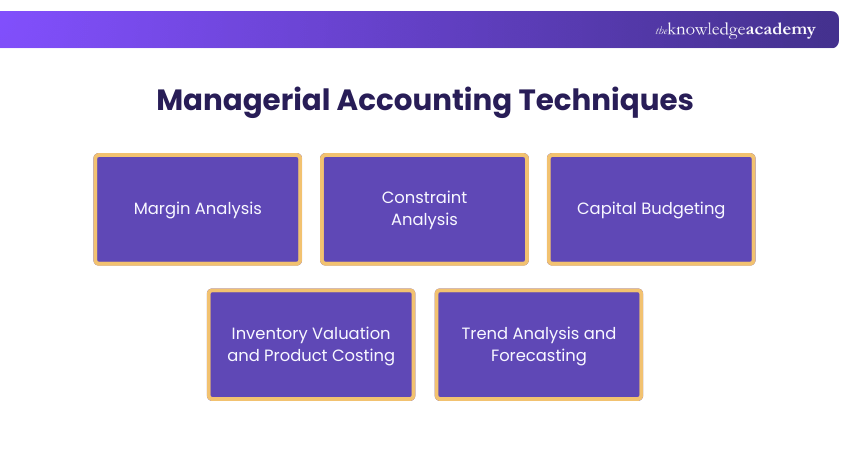
Managerial Accounting Techniques help organisations analyse costs and make better decisions. They support planning, control, and profitability. Key techniques are explained below:
1) Margin Analysis
Margin Analysis helps managers measure profit after covering costs. It compares sales revenue with variable and fixed costs to evaluate overall profitability. This technique supports pricing decisions, improves cost control, and enhances profit planning.
2) Constraint Analysis
Constraint Analysis identifies factors that limit production or performance. These may include resources, time, budget, or capacity. By addressing constraints, managers reduce bottlenecks and improve efficiency and output.
3) Capital Budgeting
Capital Budgeting evaluates long-term investments like equipment or expansion. It helps managers assess costs, returns, and risks using methods like Net Present Value (NPV), Internal Rate of Return (IRR), and payback period.
4) Inventory Valuation and Product Costing
Inventory Valuation measures the value of unsold goods, while Product Costing calculates production costs. Methods like First In, First Out (FIFO), Last In, First Out (LIFO), and Weighted Average help manage inventory, pricing, and profitability.
5) Trend Analysis and Forecasting
Trend Analysis examines past data to identify patterns, while Forecasting predicts future sales, costs, and profits. This technique supports better planning, budgeting, and strategic decision-making.
Gain expertise in project Financial Analysis and techniques with our Project Accounting Course – Register today!
What are the Five Principles of Managerial Accounting?
Managerial Accounting supports internal decisions through accurate information for planning and control. The five principles are Cost, Matching, Full Disclosure, Objectivity, and Consistency. They help managers understand costs, align expenses with revenue, ensure transparency, and apply consistent methods for better budgeting and decision-making.
What Software is Used in Managerial Accounting?
Managerial Accounting software helps organisations analyse costs, plan budgets, and support decision-making. ERP systems like SAP, Oracle NetSuite, and Microsoft Dynamics, along with tools such as QuickBooks, Xero, and Tally, help manage financial and operational data efficiently.
Budgeting platforms like Anaplan and Planful, analytics tools like Power BI and Tableau, and Cost Management solutions such as SAS and IBM Planning Analytics improve accuracy, integrate data, and support effective planning and performance monitoring.
Conclusion
Understanding What is Managerial Accounting helps organisations make smarter decisions, control costs, and plan confidently for the future. By applying its techniques, principles, and tools, businesses can strengthen strategies, improve performance, and achieve sustainable growth in competitive markets.
Understand regulatory compliance and financial reporting standards with our Accounting Courses – Join now!
Frequently Asked Questions
What are the Three Main Roles of Managerial Accounting?

The three main roles of Managerial Accounting are planning, controlling, and decision-making. It helps managers set goals, monitor performance, control costs, and analyse financial data to make informed business decisions and improve organisational efficiency and profitability.
What is a Real-life Example of Management Accounting?
A real-life example of Management Accounting is a manufacturing company using Cost-Volume-Profit (CVP) Analysis to decide whether to launch a new product line. By analysing production costs, fixed overheads, and expected sales volume, managers assess profitability and set the right price and production levels.
What are the Other Resources and Offers Provided by The Knowledge Academy?
The Knowledge Academy takes global learning to new heights, offering over 3,000+ online courses across 490+ locations in 190+ countries. This expansive reach ensures accessibility and convenience for learners worldwide.
Alongside our diverse Online Course Catalogue, encompassing 17 major categories, we go the extra mile by providing a plethora of free educational Online Resources like Blogs, eBooks, Interview Questions and Videos. Tailoring learning experiences further, professionals can unlock greater value through a wide range of special discounts, seasonal deals, and Exclusive Offers.
What is The Knowledge Pass, and How Does it Work?
The Knowledge Academy’s Knowledge Pass, a prepaid voucher, adds another layer of flexibility, allowing course bookings over a 12-month period. Join us on a journey where education knows no bounds.
What are the Related Courses and Blogs Provided by The Knowledge Academy?
The Knowledge Academy offers various Accounting Courses, including the Accounting Course, Project Accounting Course, and Accounting and Financial Statement Analysis Training. These courses cater to different skill levels, providing comprehensive insights into Accounting Software.
Our Accounting and Finance Blogs cover a range of topics related to Managerial Accounting, offering valuable resources, best practices, and industry insights. Whether you are a beginner or looking to advance your Accounting and Finance skills, The Knowledge Academy's diverse courses and informative blogs have got you covered.

Olivia Taylor


Chartered Accountant and Financial Training Specialist
Olivia Taylor is a qualified chartered accountant with over a decade of experience in financial management, auditing and corporate reporting. Having worked with leading firms in both the public and private sectors, Olivia brings clarity to complex financial topics. Her writing focuses on helping professionals build confidence in key areas of accounting, compliance and financial planning.
View Detail

 If you wish to make any changes to your course, please


