


 Top Rated Course

We may not have the course you’re looking for. If you enquire or give us a call on +39 800580270 and speak to our training experts, we may still be able to help with your training requirements.
What is Forex Trading? Understanding Basics, Strategies and Guide
The Knowledge Academy 03 March 2026Forex Trading is the world's largest, most liquid market, open 24/5. Traders buy and sell currencies on the global FX market to profit from exchange rate moves. This decentralised marketplace determines the exchange rates for currencies. Factors like economic indicators, geopolitical events and market sentiment control these fluctuations.

Training Outcomes Within Your Budget!
We ensure quality, budget-alignment, and timely delivery by our expert instructors.
Table of Contents
A fast-paced, global financial arena where markets never sleep and fortunes shift with every tick of the chart; this is the ideal playground for every Investor and Trader, and Forex Trading is what makes it happen. From predicting currency shifts to building strategies that balance risk and reward, Forex opens a gateway to the world’s most liquid market.
If you are envisioning diving into this dynamic trading world, then this blog's got you covered. It explores What is Forex Trading and spotlights its pros and cons, so that you can make the right decisions. So read on, decode the dynamics of the Foreign Exchange market and take your first step toward financial fluency!
Table of Contents
1) Understanding What is Forex Trading
2) How Does Forex Trading Work?
3) The Mechanics of Forex Trading
4) Ways to Trade Forex
5) Factors Influencing Exchange Rates
6) Getting Started in Forex Trading
7) Analysing the Forex Market
8) Risks of Forex Trading
9) Pros and Cons of Forex Trading
10) Conclusion
Understanding What is Forex Trading
Forex Trading, or Foreign Exchange Trading, is the global marketplace for buying and selling or exchanging one currency of one country for another. This global marketplace (also known as the Foreign Exchange Market or Forex Market) allows people and businesses to invest in currencies trading with the goal of attaining profit.
For example, if an individual or a business wants to buy Euros, they would need to buy Euros with their local currency, such as British Pounds. Forex Day Trading is a popular strategy within this market for short-term gains. This transaction would be priced based on the exchange rates of the currencies.
What is Forex?
Forex is a global decentralised market where currencies are bought and sold. It is the world’s largest and most liquid financial market. It runs 24 hours a day, five days a week. Banks, corporations, institutions, and individual Traders participate in it by speculating on shifting currency values. These values are influenced by economic conditions and geopolitical events affecting supply and demand.

How Does Forex Trading Work?
Now that you’ve got a glimpse of What is Forex trading, let’s learn how it works. Forex Trading functions much like any other exchange, where you purchase one asset using another. In this case, currencies are traded in pairs. The market price indicates how much of one currency is needed to buy another. Each currency has a unique code, making it easy for Traders to identify pairs quickly. Consider these points:
1) Buying or Selling a Currency Pair: Buying a currency pair means you expect the base currency to strengthen against the quote currency. Selling indicates you anticipate it will weaken. For instance, if you believe the pound will rise against the dollar, you would ‘buy’ GBP/USD, requiring more dollars to purchase a pound. Conversely, if you expect the pound to fall, you would ‘sell’ GBP/USD.
2) Spread in Forex Trading: The spread is the difference between the buy and sell prices of a currency pair. For example, if the buy price is 1.2150 and the sell price is 1.2146, the spread is 0.0004. To make a profit, the market must move past this gap in your favour; Either above the buy price if you’ve gone long or below the sell price if you’ve gone short.
3) Margin and Leverage in Forex Trading: Margin is the upfront deposit needed to open and maintain a leveraged position. Leverage lets Traders control larger trades with less capital. For instance, a USD/JPY trade requires only a 5% margin. Instead of needing £50,000 to open a position, you’d deposit just £2,500 while gaining exposure to the trade's full value.
Key Participants in the Forex Market
The Forex Market is made up of various participants, each with their own motivations and roles:
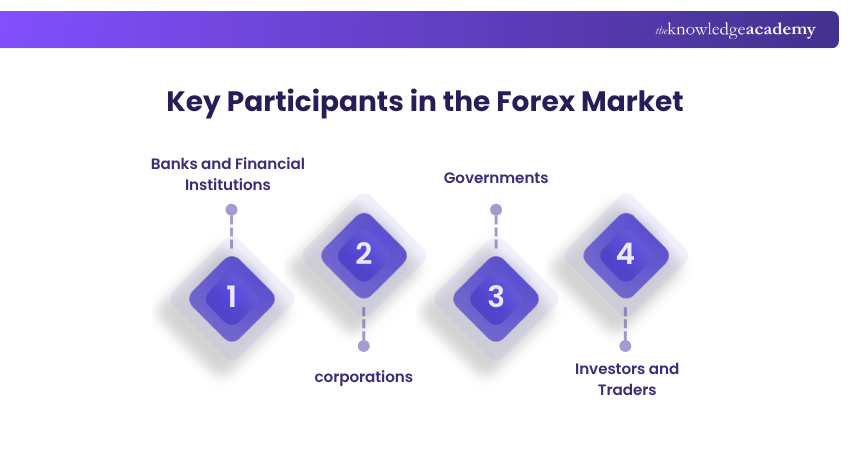
1) Banks and Financial Institutions: They trade for their client’s currencies and portfolio management.
2) Corporations: Banks and Financial Institutions: They trade for their client’s currencies and portfolio management.
3) Governments: National governments intervene in the Forex Market to stabilise their own currency or influence in terms of the economy.
4) Investors and Traders: Individuals and institutions trade currencies to profit from price movements, often leveraging strategies like Arbitrage, which involves exploiting price differences between markets for risk-free profits.
Major Currency Pairs
The term 'major' implies that these are the most heavily traded currency pairs. They represent roughly 85% of all Forex transactions and involve some of the world’s largest economies. In fact, around one in four Forex Trades involves the EUR/USD pair. Here are the major ones:
1) EUR/USD: Euro vs US Dollar
2) USD/JPY: US Dollar vs Japanese Yen
3) GBP/USD: British Pound vs US Dollar
4) AUD/USD: Australian Dollar vs US Dollar
5) USD/CHF: US Dollar vs Swiss Franc
6) USD/CAD: US Dollar vs Canadian Dollar
Since these pairs dominate global trading, they generally offer the tightest spreads. This makes them more cost-efficient to trade compared to less liquid pairs.
Learn the art of smart Trading and wise investment with our comprehensive Investment and Trading Training - Sign up now!
Why Do People Trade Forex?
People trade Forex for three main reasons: to speculate on currency movements, to hedge and reduce risk, and to take advantage of 24-hour trading. Let's explore these reasons in detail:
1) Speculating on Currency Movements
1) One of the key reasons people trade Forex is to speculate on whether a currency will strengthen or weaken against another.
2) When the price of a currency pair rises, the base currency is gaining value compared to the quote currency.
3) If it falls, the base is weakening. Traders go long when expecting strength, or short when expecting weakness.
4) Popular trading styles include scalping, Day Trading, Swing Trading, and Position Trading.
5) Each trading style is suited to different time horizons.
2) Hedging With Forex
1) Forex is also widely used for hedging to reduce risk.
2) By taking positions that may profit if another position loses value, Traders can balance their exposure.
3) For example, GBP/USD and EUR/USD are positively correlated
4) A Trader holding a long EUR/USD position might go short on GBP/USD to offset potential downside risk.
3) Taking Advantage of 24-hour Trading
1) Another key appeal is that the Forex market operates 24 hours a day.
2) It’s powered by a global network of banks and institutions across the US, Europe, and Asia. This continuous cycle creates round-the-clock opportunities.
3) Some brokers even provide weekend trading on selected pairs such as GBP/USD, EUR/USD, and USD/JPY.
4) It allows Traders to act when other markets are closed.
Factors Influencing Exchange Rates
Exchange Rates act like the Forex Trading pulse. It helps in deciding how much one currency is worth in comparison to another. To guess these rates and make clever Trading decisions, it is essential to know why they change. Let us check out the main things that push and pull exchange rates.
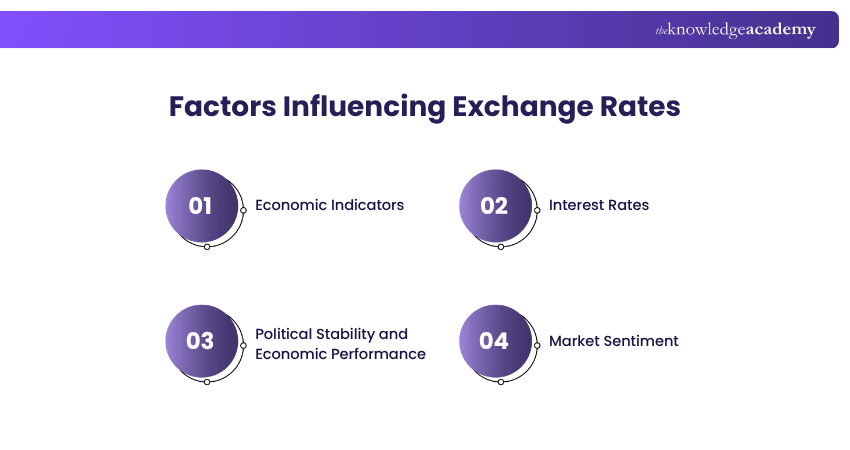
1) Economic Indicators
GDP, unemployment rates, inflation, other economic indicators along with the consumers' confidence, hold immense exchange rates. A strong economy often relates to a stronger currency, as it entices foreign investments and spikes the currency’s demand.
2) Interest Rates
A specific country’s central bank sets interest rates to influence the value of the currency. Higher interest rates can attract foreign Investors who are looking for better investment returns. Consequently, the demand for increased currency can lead to the depreciation of value. Meanwhile, lower interest rates can lead to depreciation.
3) Political Stability and Economic Performance
Political stability and the economic performance of the country are closely intertwined. Countries that have stable governments and strong economies tend to attract foreign investment. These further boosts currency demands. On the other hand, political uncertainty or economic instability can lead to a currency value decrease due to reduced Investor confidence.
4) Market Sentiment
The psychology of Traders and Investors can significantly impact exchange rates. Positive news and the general sense of optimism can lead to high demand for a currency, causing its value to rise. Conversely, negative news or uncertainty can trigger a decrease in demand and a currency's depreciation.
Master currency trading and unlock global opportunity with our Foreign Exchange Training - Register now!
Learn How Currency Markets Work
The Forex market involves currencies from across the globe, making exchange rate predictions complex due to the wide range of factors influencing price movements. Key drivers include:
1) Supply and Demand: Exchange rates are shaped by the balance of supply and demand between currencies. If demand for one currency is higher than another, its value will rise relative to the other.
2) Central Banks: These regulate a currency’s supply and can influence its price by adjusting interest rates or applying policies such as quantitative easing. Higher interest rates can attract foreign investment, boosting currency value, while easing can reduce value by increasing supply.
3) Interest Rates and Carry Trades: Institutional Investors often use carry trades, selling currencies with low interest rates and buying those with higher rates. This strategy is about profiting from the difference between the rates.
4) Fiscal Policy: Government tax and spending policies also impact currency values. Economies burdened by high debt and low growth often see weaker currencies, while those with healthier finances and stronger growth attract Forex Traders.
5) International Trade: Trade balances affect demand for currencies. Countries with trade deficits often see weaker currencies, as they need to buy more of their partners’ currencies to fund imports, while those with surpluses may see their currencies strengthen.
6) News and Market Sentiment: Currencies are influenced by how Investors perceive a region’s economic outlook. Positive news can boost confidence and demand, while negative developments may reduce it. Market sentiment amplifies these moves, as Traders act on expectations and often drive further price shifts.
Pros and Cons of Forex Trading
Here are the pros of Forex Trading:
1) Forex Trading offers very high liquidity, especially in major currency pairs. This makes it very easy to enter and exit trades quickly.
2) The market is open 24 hours a day during weekdays. It gives Traders the flexibility to trade at times that suit their schedule.
3) Forex has low barriers to entry. So, it allows individuals to start trading with relatively small amounts of capital.
4) Traders can have access to a broad range of currency pairs and trading styles. This makes it possible to find opportunities that match their strategies.
5) Forex Trading provides opportunities to hedge against other investments and diversify a portfolio.
Now let’s look at the Cons of Forex Trading:
1) The Forex market is highly volatile, and prices can move rapidly. This can lead to significant losses if risks are not properly managed.
2) The use of leverage, while increasing potential profits, also amplifies losses and raises overall risk exposure.
3) Forex Trading is less transparent than some regulated markets. Trading conditions such as spreads and execution quality may vary depending on the broker.
4) Traders must be able to manage emotional and psychological stress. Trading decisions made under pressure can often lead to mistakes.
5) Since the Forex market operates almost continuously on weekdays, it often requires ongoing monitoring, which can be tedious and time-consuming.
Embrace the fast-paced world of day trading and turn market moves into money. Sign up for our Day Trading Course now!
Is $100 Enough to Start Forex?
Yes, starting Forex Trading with $100 is possible, but it must be seen as a way to learn rather than a quick scheme towards wealth. A more realistic starting capital as far as Forex Trading is concerned is between $1,000 to $5,000. Here are some important points to remember:
1) Choose a Broker: Select one that accepts low deposits and offers micro or nano accounts, ideal for smaller capital.
2) Risk Management: Leverage, such as 1:100, allows control of larger positions. But never risk more than 1% to 2% per trade.
3) Practice First: Use a demo account to gain experience without risking real money and to build confidence.
4) Trading Strategy: Follow a structured plan with clear risk rules and stop-loss orders to protect your capital.
How do Forex Traders Make Money?
Forex Traders earn money by buying and selling currencies and trying to profit from changes in their prices. For instance, if a Trader feels like the Euro will go up compared to the US Dollar, they buy Euros and sell them later at a higher price.
Traders use tools like charts, news and economic data to make decisions. Many also use leverage, which lets them trade larger amounts with a small investment, but this also increases risk. To succeed, Traders need a good plan, careful Risk Management and lots of practice.
Conclusion
Forex Trading is a dynamic marketplace where knowledge, strategy and discipline can shape any Trader and Investor's success. By understanding What is Forex Trading including the fundamentals and the proven strategies, you can approach the Forex market with greater confidence. Treat it as a journey of learning and growth, where each trade refines your skills and opens new opportunities.
Learn the strategies behind smart investing with our Investment Management Course - Sign up now!
Frequently Asked Questions
How Can Mastering Forex Trading Enhance My Career Prospects?

Mastering Forex Trading can enhance your career prospects by opening up opportunities in numerous sectors, such as finance, banking, consulting, or Trading firms. You can also work as a self-employed Trader and earn income from your own strategies.
What are the Key Skills Employers Look for in Forex Trading Professionals?
Employers actively seek Trading professionals possessing strong analytical skills to assess market trends and effective risk management to protect investments. They also value discipline to stick to strategies, patience to wait for the right opportunities, and financial management skills to optimise and control trading portfolios.
What Are the Other Resources and Offers Provided by the Knowledge Academy?
The Knowledge Academy takes global learning to new heights, offering over 3,000+ online courses across 490+ locations in 190+ countries. This expansive reach ensures accessibility and convenience for learners worldwide.
Alongside our diverse Online Course Catalogue, encompassing 17 major categories, we go the extra mile by providing a plethora of free educational Online Resources like Blogs, eBooks, Interview Questions and Videos. Tailoring learning experiences further, professionals can unlock greater value through a wide range of special discounts, seasonal deals, and Exclusive Offers.
What Is Knowledge Pass and How Does It Work?
The Knowledge Academy’s Knowledge Pass, a prepaid voucher, adds another layer of flexibility, allowing course bookings over a 12-month period. Join us on a journey where education knows no bounds.
What are the Related Courses and Blogs Provided by the Knowledge Academy?
The Knowledge Academy offers various Investment and Trading Courses, including Day Trading Course, Forex Trading Training, Stock Trading Course and Revenue Management Training. These courses cater to different skill levels, providing comprehensive insights into Forex Day Trading.
Our Business Skills Blogs cover a range of topics related to Forex Trading, offering valuable resources, best practices, and industry insights. Whether you are a beginner or looking to advance your Investment and Trading skills, The Knowledge Academy's diverse courses and informative blogs have you covered.

The Knowledge Academy


Global Training Provider
The Knowledge Academy is a world-leading provider of professional training courses, offering globally recognised qualifications across a wide range of subjects. With expert trainers, up-to-date course material, and flexible learning options, we aim to empower professionals and organisations to achieve their goals through continuous learning.

Upcoming Business Skills Resources Batches & Dates
Date
 Cryptocurrency Trading Training
Cryptocurrency Trading Training
Fri 27th Mar 2026
Cryptocurrency Trading Training
Fri 8th May 2026
Cryptocurrency Trading Training
Fri 7th Aug 2026
Cryptocurrency Trading Training
Fri 30th Oct 2026

 If you wish to make any changes to your course, please


