


 Top Rated Course

We may not have the course you’re looking for. If you enquire or give us a call on +39 800580270 and speak to our training experts, we may still be able to help with your training requirements.
What is Credit Risk: Definition, Types, and How it is Assessed
Olivia Taylor 24 February 2026Credit Risk occurs when borrowers fail to repay a loan or meet agreed financial obligations, potentially resulting in financial loss to the lender or investor. Its level is dependent on the credit history and economic conditions of the borrower. Effective credit evaluation helps reduce default risk and protect financial stability.
Home
 Resources
Accounting and Finance
What is Credit Risk: Definition, Types, and How it is Assessed
Resources
Accounting and Finance
What is Credit Risk: Definition, Types, and How it is Assessed
Resources
Accounting and Finance
What is Credit Risk: Definition, Types, and How it is Assessed

Training Outcomes Within Your Budget!
We ensure quality, budget-alignment, and timely delivery by our expert instructors.
Table of Contents
Imagine lending money to a friend expecting it back with interest, only for them not to repay. That situation reflects Credit Risk, the possibility of losing your money when a borrower fails to meet repayment obligations. This risk is a major concern in finance and shapes lending decisions across banks, lenders, and investors worldwide, making effective Credit Risk Management essential.
Understanding this concept helps build a strong foundation for making smarter financial and investment decisions. In this blog, we’ll explain What is Credit Risk, its types, how it’s assessed, and why it plays a crucial role in financial decision-making. Let's get started!
Table of Contents
1) What is Credit Risk?
2) Why Credit Risk Matters for Your Business?
3) Credit Risk vs Interest Rates
4) The 5 Main Types of Credit Risk
5) How Credit Risk is Assessed and Rated?
6) What are the 5 C’s of Credit?
7) How Can You Reduce Credit Risk?
8) What is an Example of Credit Risk?
9) How Credit Risk Influences Interest Rates?
10) Conclusion
What is Credit Risk?
Credit Risk refers to the chances that a borrower may fail to return a loan or meet agreed repayment terms. If this happens, the bank or lender could lose money. Before giving a loan, lenders check if the person has a job, earns enough money, and has paid loans before. This helps them know if the person can pay the money back.
Lenders can’t always tell who will not pay. But they try to be careful. They charge extra money (called interest), ask for something valuable (like a car or house), and give loans to many people, not just one. They also use tools like credit scores to help decide. This keeps banks safe and helps the money system work better.

Why Credit Risk Matters for Your Business?
Credit Risk matters because it directly affects your cash flow and financial stability. When customers fail to pay on time or default completely, it can disrupt daily operations, delay growth plans, and increase financial pressure. Even a few unpaid invoices can strain working capital, especially for small and medium-sized businesses.
Managing Credit Risk helps protect your profits and maintain steady revenue. By assessing customer creditworthiness, setting clear payment terms, and monitoring outstanding balances, businesses can reduce the chances of bad debts. Even more, Strong Credit Risk Management not only safeguards financial health but also builds more reliable and sustainable business relationships.
Credit Risk vs Interest Rates
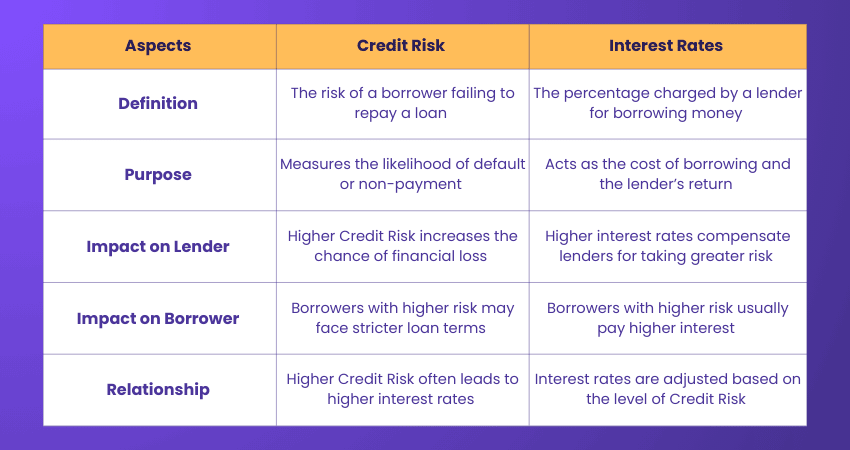
Credit Risk and interest rates are closely related but not the same. Credit Risk is the likelihood that a borrower will fail to repay a loan, while an interest rate is the cost a borrower pays for using the lender’s money.
Lenders assess a borrower’s Credit Risk by reviewing factors like income, debt history, and credit score. If the Credit Risk is high, lenders raise the interest rate to protect themselves from potential losses. This means people with poor credit often pay more to borrow money.
So, while Credit Risk is about the borrower’s reliability, the interest rate is the financial response to that risk. Below is a table that explains the differences between Credit Risk and interest rates:
The 5 Main Types of Credit Risk
Credit Risk does not arise from just one situation. It can take different forms depending on who is borrowing, the type of transaction involved, and the broader economic environment. Understanding the different types of Credit Risk helps identify potential threats and apply the right strategies to manage them effectively. These types include the following:
1) Default Risk
Default risk is the most common type of Credit Risk. It occurs when a borrower fails to repay a loan completely or on time. This can result in partial or total financial loss for the lender. You can reduce default risk by checking the borrower’s credit history, income, and repayment behaviour.
Example: A customer buys goods on credit but does not pay by the due date. If the money is not recovered, the supplier suffers a loss.
2) Concentration Risk
Concentration risk arises when a lender gives too many loans to a single borrower, industry, or region. If that borrower or sector faces financial trouble, the lender may suffer large losses. To manage this risk, financial institutions can diversify their loan portfolios across different customers and industries.
Example: A bank gives a large number of loans to companies in the real estate sector. If the property market crashes, many borrowers may default at the same time, causing heavy losses.
3) Counterparty Risk
Counterparty risk happens when one party in a financial transaction fails to fulfil their payment. This is common in trading activities, derivatives, and contracts between financial institutions. If the counterparty defaults, the other party may face unexpected financial loss. To reduce this risk, institutions use security like assets or trusted third parties to ensure safe transactions.
Example: Two financial institutions enter into a derivatives contract. If one institution becomes bankrupt and cannot meet the agreement, the other institution faces a financial loss.
4) Sovereign Risk
Sovereign risk happens when a foreign government is facing a financial crisis, political instability, or major policy changes. This influences the repayment capacity of borrowers within that country. Due to this, international lenders and investors may face higher uncertainty and potential losses.
Example: An investor buys government bonds from a foreign country. If that country faces a severe economic crisis and fails to repay its debt, the investor loses money.
5) Settlement Risk
Settlement risk occurs when one party makes a payment or delivers assets, but the other party does not complete their part of the transaction as agreed. This often happens during cross-border or time-zone-based transactions. Proper clearing systems and regulatory controls help reduce settlement risk.
Example: In a foreign exchange deal, one party sends the money first, but the other party goes bankrupt before sending their part. The first party then loses the money already paid.
Learn to manage cash efficiently and drive business growth with our Cash Management Training – Register today!
How Credit Risk is Assessed and Rated?
Lenders and financial institutions use structured methods and models to measure how risky a borrower may be. They try to estimate two main things: the possibility of the borrower missing payments and how much money could be lost if that happens. Now that you are aware of what is Credit Risk, below are the ways you can assess and rate the seriousness of your Credit Risk:
1) Probability of Default (PD)
Probability of Default (PD) means the chance that a borrower may not repay the loan within a specific period, usually one year. It is generally shown as a percentage, and a higher percentage signal indicates greater risks. For example, if the PD is 5%, there is a small chance the borrower might fail to pay. Lenders look at income, job stability, past repayments, and overall financial conditions to calculate this.
2) Loss Given Default (LGD)
Loss Given Default (LGD) estimates how much money a lender might lose if a borrower defaults and does not repay. If the lender recovers part of the loan through collateral such as some kind of assets, the LGD will be lower. Higher collateral generally reduces potential loss. This helps lenders understand the actual financial impact of unpaid loans.
3) Exposure at Default (EAD)
Exposure at Default (EAD) refers to the total amount of money the lender is exposed to and could lose when the borrower defaults. This includes the remaining loan amount, that is the outstanding loan balance and any extra credit used. If this goes higher, then you might face higher financial losses, too.
4) Credit Scores and Agency Ratings
Credit scores and rating agencies help measure Credit Risk. For individuals, credit scores are calculated based on repayment history and debt levels, while agencies give ratings to companies and governments based on their creditworthiness. Higher ratings mean lower risk, and lower ratings mean higher risk.
What are the 5 C’s of Credit?
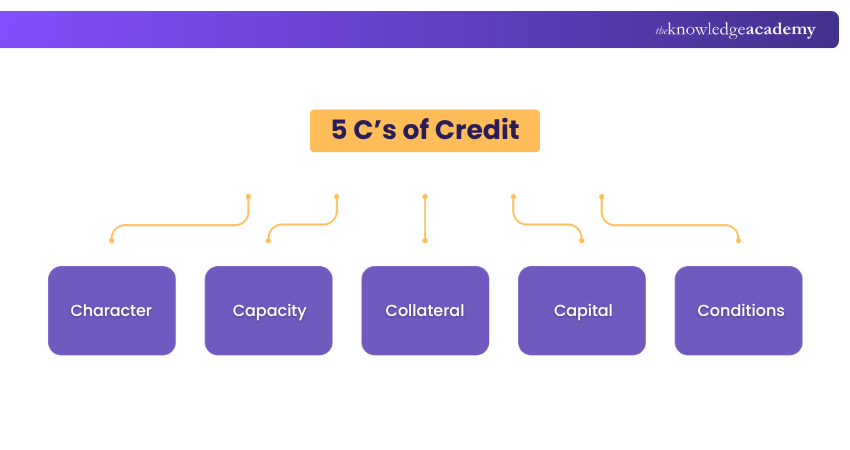
The 5 C's of Credit are a fundamental framework used by lenders to assess a borrower's creditworthiness and improve a credit score. Character examines credit history, Capacity evaluates repayment ability, Collateral provides security, Capital assesses financial stake, and Conditions consider external factors. Here are the 5 C’s of Credit explained in further detail:
1) Character
Character refers to the borrower's credit history and reputation for repaying debts. It assesses the individual's or business's trustworthiness and reliability in meeting financial obligations. Character comprises three key components, which are as follows:
a) Credit History: Lenders review the borrower's past credit performance, examining factors such as timely payments, defaults, bankruptcies, and any outstanding judgments.
b) Credit Score: A numerical representation of creditworthiness derived from credit reports. Higher scores indicate better creditworthiness.
c) Reputation: The borrower's general financial reputation, including their integrity in financial dealings, can impact the lender's assessment.
2) Capacity
Capacity evaluates the borrower's ability to repay the loan by assessing their financial stability and income relative to existing and potential debt obligations. Capacity is comprised of three key components that are:
a) Income: Lenders analyse the borrower's income sources, stability, and consistency to determine if it is sufficient to cover debt repayments.
b) Debt-to-Income Ratio (DTI): Calculated by dividing the borrower's total monthly credit payments by their gross monthly income. A lower DTI indicates a healthier financial situation.
c) Cash Flow: Evaluating the borrower's cash flow helps lenders understand their ability to generate liquid funds for repayment.
Learn how to control liquidity, working, and business cash cycles with our Cash Flow Management Course – Join now!
3) Collateral
Collateral serves as security for the loan, providing a secondary source of repayment in case the borrower defaults. It adds a layer of protection for the lender. Collateral is comprised of three key components which are:
a) Types of Collateral: Assets such as real estate, vehicles, or business inventory can be pledged as collateral. The type of collateral accepted varies based on the loan type.
b) Valuation: Lenders assess the value of the collateral to ensure it is adequate to cover the loan amount. Professional appraisals may be required.
c) Market Conditions: Fluctuations in the market can impact the value of collateral, influencing the lender's risk assessment.
Find top FinOps Interview Questions and Answers to ensure you're ready for your next interview!
4) Capital
Capital refers to the borrower's equity or the financial stake they have in the business or investment. It demonstrates the level of commitment and risk the borrower is willing to undertake. The three key components of capital are as follows:
a) Owner's Equity: In a business context, this represents the owner's investment in the business. A higher equity stake indicates a greater commitment to the venture.
b) Retained Earnings: For established businesses, retained earnings contribute to capital. It reflects the company's profitability and reinvestment in its own growth.
c) Liquidity: The borrower's access to liquid assets, such as cash, that can be used to meet financial obligations in the short term.
5) Conditions
Conditions encompass the external factors that may impact the borrower's ability to repay the loan. Lenders consider economic conditions, industry trends, and the purpose of the loan. The conditions aspect of credit comprises of the following key parts:
a) Economic Conditions: Lenders assess the overall economic environment to gauge its potential impact on the borrower's financial stability and ability to repay.
b) Industry Trends: Specific conditions within the borrower's industry can influence the risk associated with the loan. Lenders consider the outlook and challenges of the relevant sector.
c) Loan Purpose: The intended use of funds plays a role. For example, a loan for business expansion may be viewed differently from one for debt consolidation.
How Can You Reduce Credit Risk?
To reduce Credit Risk, you need to plan and be careful. Here are some easy ways to do it:
1) Know Your Risk Limit: Every business should know how much risk it can take. Stay within that limit. Check how your choices are working and make changes if needed.
2) Check the Customer’s Background: Before giving credit, look at the customer’s past payments, income, job, and where they live. Use credit reports and other records to see if they can pay you back.
3) Use a Credit Policy: Make rules to decide who can get credit. Look at how trustworthy the customer is and how it might affect your money if they don’t pay.
4) Don’t put all Risk in One Place: Give credit to different people or businesses. Don’t depend on just one customer or one industry. This spreads the risk.
5) Set Clear Payment Rules: Write down when and how customers should pay. Include credit limits, interest charges, late fees, and, if you need any extra protection, like a deposit.
6) Keep Checking old Customers: Even after giving credit, keep watching your customers. Make sure they still pay on time. If you see problems, reduce their credit or ask them to pay sooner.
7) Use Credit Insurance: This is like a safety net. If a customer doesn’t pay, the insurance can help cover the money you lost.
Gain expertise in project Financial Analysis and techniques with our Project Accounting Course – Join today!
What is an Example of Credit Risk?
Let’s say a bank gives a loan to a small shop owner to grow their business. The shop owner must pay back the loan every month for 10 years.
Now, two things can happen:
1) The Business Fails: The shop doesn’t earn enough money, and the owner cannot pay back the loan. This is Credit Risk. The bank may lose the money it gave.
2) The Business Does Well: The shop earns more money, and the owner pays back the loan on time. This means there is no loss, and the Credit Risk is low.
How Credit Risk Influences Interest Rates?
Credit Risk strongly influences lending decisions and interest rates, as lenders evaluate the likelihood of borrower default. Those with strong credit profiles secure favourable terms, while high-risk borrowers face higher costs or may be denied credit.
Key Points:
1) Borrowers seen as too risky may have their applications rejected to protect lenders from losses
2) Strong credit scores and stable income typically result in lower interest rates
3) Poor credit often leads borrowers to subprime lenders who charge higher rates due to greater risk
4) Improving credit history and reducing debt can help high-risk borrowers qualify for better terms
5) Bond issuers with weaker credit ratings must offer higher returns to attract investors willing to accept increased risk
Conclusion
In essence, understanding What is Credit Risk is key to smart lending and financial safety. It helps lenders choose the right borrowers, set fair terms, and avoid big losses. By checking credit carefully, setting clear rules, and watching payments, lenders can protect their money. With the right steps, Credit Risks becomes manageable and supports long-term business success.
Boost your credibility and attractiveness with specialised accounting expertise with our Accounting Courses – Register today!
Frequently Asked Questions
Why Does Credit Risk Matter?

Credit Risk is key to keeping a business stable. It supports good credit and debt systems. If not managed well, it can cause big losses. Poor data, fraud, and market changes make it hard. A bad credit profile can also limit loans and slow down business growth.
How do Banks Manage Credit Risk?
Banks manage Credit Risk by being careful when they give out loans. They ask for a good credit score before lending money. After giving the loan, they keep checking if the person can still pay it back. If things change, the bank can change the loan rules to stay safe.
What are the Other Resources and Offers Provided by The Knowledge Academy?
The Knowledge Academy takes global learning to new heights, offering over 3,000 online courses across 490+ locations in 190+ countries. This expansive reach ensures accessibility and convenience for learners worldwide.
Alongside our diverse Online Course Catalogue, encompassing 17 major categories, we go the extra mile by providing a plethora of free educational Online Resources like Blogs, eBooks, Interview Questions and Videos. Tailoring learning experiences further, professionals can unlock greater value through a wide range of special discounts, seasonal deals, and Exclusive Offers.
What is The Knowledge Pass, and How Does it Work?
The Knowledge Academy’s Knowledge Pass, a prepaid voucher, adds another layer of flexibility, allowing course bookings over a 12-month period. Join us on a journey where education knows no bounds.
What are the Related Courses and Blogs Provided by The Knowledge Academy?
The Knowledge Academy offers various Accounting Courses, including the Introduction to Credit Control Training, Accounting Course, and the Fixed Assets Accounting and Management Course. These courses cater to different skill levels, providing comprehensive insights into What is Remittance.
Our Accounting and Finance Blogs cover a range of topics related to Credit Risk, offering valuable resources, best practices, and industry insights. Whether you are a beginner or looking to advance your accounting skills, The Knowledge Academy's diverse courses and informative blogs have got you covered.

Olivia Taylor


Chartered Accountant and Financial Training Specialist
Olivia Taylor is a qualified chartered accountant with over a decade of experience in financial management, auditing and corporate reporting. Having worked with leading firms in both the public and private sectors, Olivia brings clarity to complex financial topics. Her writing focuses on helping professionals build confidence in key areas of accounting, compliance and financial planning.
View Detail
Upcoming Accounting and Finance Resources Batches & Dates
Date
 Credit Control Course
Credit Control Course
Fri 25th Sep 2026
Credit Control Course
Fri 18th Dec 2026

 If you wish to make any changes to your course, please


