


 Top Rated Course

We may not have the course you’re looking for. If you enquire or give us a call on +39 800580270 and speak to our training experts, we may still be able to help with your training requirements.
What is a Compliance Manager: A Career Overview
Hailey Davis 15 July 2026A Compliance Manager ensures organisations follow laws, ethics, and policies, prevents risks, updates regulations, implements policies, and upholds integrity. They play a key role in protecting an organisation from legal trouble, financial penalties, and reputational damage and building trust with customers, regulators, and employees.

Training Outcomes Within Your Budget!
We ensure quality, budget-alignment, and timely delivery by our expert instructors.
Table of Contents
Ever wondered who’s behind the scenes, ensuring that businesses navigate the complex maze of regulations and standards with finesse? This is where a Compliance Manager steps in. Think of a Compliance Manager as the organisation’s moral compass; guiding decisions, avoiding legal traps, and keeping everything above board. This blog explores What is a Compliance Manager , including the skills required, how to get this role, and why this career is more important than ever. So read on, decode the compliance rulebook and become the backbone of modern business!
Table of Contents
1) Who is a Compliance Manager?
2) What Does a Compliance Manager Do?
3) Compliance Manager Requirements
4) How to Become a Compliance Manager
5) Skills Required for a Compliance Manager
6) Where Does a Compliance Manager Work?
7) What is the Main Role of Compliance?
8) Conclusion
Who is a Compliance Manager?
A Compliance Manager is the person responsible for an organisation’s laws, rules, and internal policies. They guide teams on what is allowed, set clear standards, and track how work follows those standards. They report risks and issues to leaders and help the business operate in a lawful, honest way.
1) Key Responsibilities:
a) Regulatory Knowledge: Stay updated on legal requirements and their impact
b) Policy Implementation: Develop and enforce compliance policies and procedures
c) Advisory Role: Guide departments on compliance issues and support initiatives
d) Risk Management: Identify and mitigate compliance risks
e) Training: Educate employees on compliance and ethical standards
f) Monitoring: Track compliance activities and report to management
2) Importance:
a) Ethical Standards: Ensure responsible operations
b) Risk Reduction: Minimise legal and financial risks
c) Reputation Management: Protect and enhance the organisation’s reputation
d) Operational Efficiency: Align processes with regulatory requirements

What Does a Compliance Manager Do?
A Compliance Manager plays a vital role in shaping the culture and performance of an organisation. They accomplish this by ensuring compliance with legal, regulatory and ethical standards. They have a plethora of responsibilities that improve the integrity and efficiency of the organisation. Here are some of the key roles of a Compliance Manager:
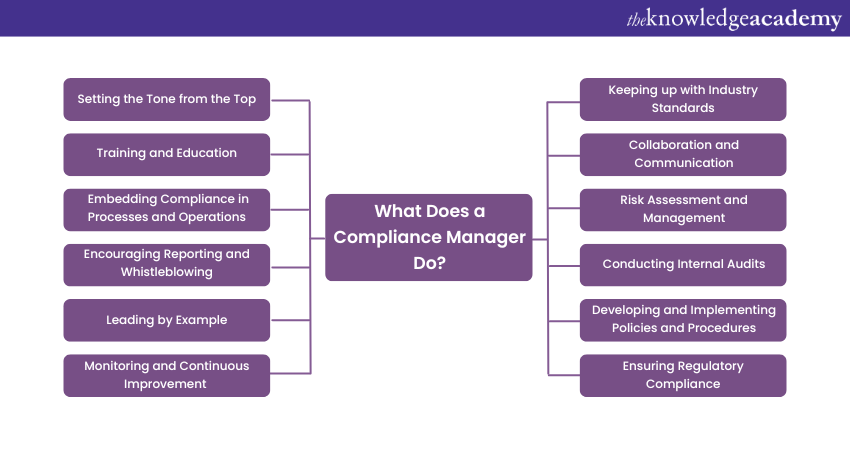
1) Setting the Tone from the Top
Compliance Managers work with senior leaders to create a culture of compliance that aligns with the organisation’s values:
a) Working with Leadership: Compliance Managers collaborate with senior leaders to set goals, policies and expectations related to ethical conduct.
b) Aligning with Organisational Values: They make sure that the compliance efforts are consistent with the organisation’s vision and values. This creates a solid base for a compliance culture.
2) Training and Education
Compliance Managers design and conduct training programmes to educate employees on compliance requirements and ethical issues:
a) Creating Training Programmes: Compliance Managers design training programs to teach employees about regulatory requirements and ethical issues.
b) Conducting Regular Training Sessions: They hold regular sessions to help employees learn their compliance duties and the outcomes of non-compliance.
3) Embedding Compliance in Processes and Operations
Compliance Managers cooperate with various departments to incorporate compliance aspects into daily operations and provide guidance and review:
a) Working Across Departments: Compliance Managers cooperate with various departments to incorporate compliance aspects into daily operations.
b) Providing Guidance and Review: They offer advice on compliance matters, check policies and procedures, and ensure alignment with business practices.
Sign up for our Environmental, Social, and Governance (ESG) Training and align your values for the bottom line and a better world – Join today!
4) Encouraging Reporting and Whistleblowing
Compliance Managers establish reporting mechanisms for any potential violations :
a) Developing Reporting Mechanisms: They set secure reporting channels for possible violations. This also ensures safety for whistle-blowers.
b) Creating a Reporting Culture: Compliance Managers promote an atmosphere where reporting is appreciated and encouraged.
5) Leading by Example
Compliance Managers demonstrate integrity, transparency, and ethical decision-making as role models and embody the organisation’s values:
a) Role Modelling: Compliance Managers show integrity, transparency, and ethical decision-making as role models.
b) Embodying Organisational Values: Their dedication to ethical behaviour sets a standard for employees.
6) Monitoring and Continuous Improvement
Compliance Managers monitor and evaluate the efficiency of compliance programmes and perform audits and Risk Assessments to improve and update compliance frameworks:
a) Assessing Compliance Training: Compliance Managers frequently monitor and evaluate the efficiency of compliance Training.
b) Finding and Addressing Gaps: They perform audits and Risk Assessments to improve and update compliance frameworks.
7) Ensuring Regulatory Compliance
Compliance Managers ensure the organisation follows the changing regulations and industry standards and stay informed of legislative and regulatory changes:
a) Guardians of Compliance: Compliance Managers make sure the organisation follows the changing regulations and industry standards.
b) Staying Informed: They keep track of legislative and regulatory changes to stay compliant.
8) Developing and Implementing Policies and Procedures
Compliance Managers develop and customise policies that match legal and ethical standards and work with legal teams and experts:
a) Creating Policy Frameworks: They develop policies that match legal and ethical standards.
b) Working with Stakeholders: Compliance Managers work with legal teams and experts to customise policies to the organisation’s needs.
9) Conducting Internal Audits
Compliance Managers perform regular internal audits to measure adherence to policies, identify non-compliance areas, and take corrective actions:
a) Performing Audits: Regular internal audits are performed to measure adherence to policies and identify non-compliance areas.
b) Taking Corrective Actions: They give recommendations and actions to improve compliance efforts.
10) Risk Assessment and Management
Compliance Managers identify and manage Compliance Risks and work with departments for integrated Risk Management:
a) Identifying Risks: Compliance Managers identify potential risks within the organisation.
b) Managing Risks: They devise strategies to reduce Compliance Risks and work with departments for integrated Risk Management.
11) Collaboration and Communication
Compliance Managers collaborate and communicate effectively with various stakeholders and foster a culture of compliance and support across the organisation:
a) Collaborating Across Departments: Effective collaboration and communication with various stakeholders are essential.
b) Fostering Compliance Culture: They cultivate a culture of compliance and provide support across the organisation.
12) Keeping up with Industry Standards
Compliance Managers stay updated on industry standards and trends, pursue continuous development, and implement innovative compliance strategies:
a) Staying Updated: Compliance Managers stay updated on industry standards and trends.
b) Professional Development: They pursue continuous development and implement innovative compliance strategies.
Become the guardian of law in the Cyberspace with our Security Governance and Compliance Training - Register now!
Compliance Manager Requirements
Most Compliance Managers undergo targeted learning and practical experience to prepare for the role. Key requirements to pursue this career path may include:
a) Foundation in business principles, regulatory knowledge and organisational practices.
b) Expanded expertise through further studies or specialised learning.
c) Understanding of Compliance Frameworks and governance.
d) Entry-level exposure to regulations and compliance processes.
e) Practical insights through shadowing senior compliance professionals.
f) Experience with participation in audits.
g) Experience in related fields like corporate operations or legal environments before moving into compliance roles.
How to Become a Compliance Manager
There are different ways to become a Compliance Manager, and we’ll look at them below. Some paths need specific qualifications, but many employers focus more on enthusiasm, a willingness to learn and simply the ability to follow instructions.
1) Earn a Degree
You could complete an undergraduate degree in a related subject, such as Business Administration, Finance, or health and safety. Once you have a first degree, you can go for a postgraduate degree to gain more expertise. You can undertake further professional qualifications offered by any university that specialises in compliance, governance, law, and risk.
2) Complete an Internship
Engage in internships or work placements in compliance, auditing, or regulatory departments. These experiences will give you practical insights and help you build a network within the industry.
3) Apply for Entry-level Positions
Practice the highest standards of medical practice and become the pillar of trust in every pulse! Sign up for our Medical Compliance Training now!
4) Complete a Related Certification
Enhance your qualifications by obtaining certifications relevant to compliance. Notable certifications include:
Certified in Risk and Information Systems Control (CRISC)
The CRISC certification is offered by Information Systems Audit and Control Association (ISACA). It is designed for IT Compliance Managers. It showcases their expertise in Risk Assessment within the technology sector. Candidates with relevant IT experience can sit for the exam. This exam covers risk identification, response, monitoring, and IT Systems Control Design.
Certified in Governance of Enterprise IT (CGEIT)
Another prominent certification issued by ISACA, the CGEIT certification is aimed at enterprise IT Compliance Managers. It highlights their proficiency in strategic management and risk optimisation. To obtain this credential, professionals must meet specific experience requirements and pass the certification exam.
These certifications spotlight your commitment to the field, making you a more competitive candidate.
5) Apply for Compliance Manager Positions
With a combination of education, experience, and certifications, you're well-positioned to apply for Compliance Manager roles. In this position, you'll develop and oversee Compliance Training, conduct Risk Assessments, and make sure that the organisation adheres to all applicable laws and regulations.
Skills Required for a Compliance Manager
Compliance Managers need various skills to perform well in their role and comply with the complex and changing regulations in their industry. These skills include technical, interpersonal, and analytical aspects. Here are the main skills that Compliance Managers should have:
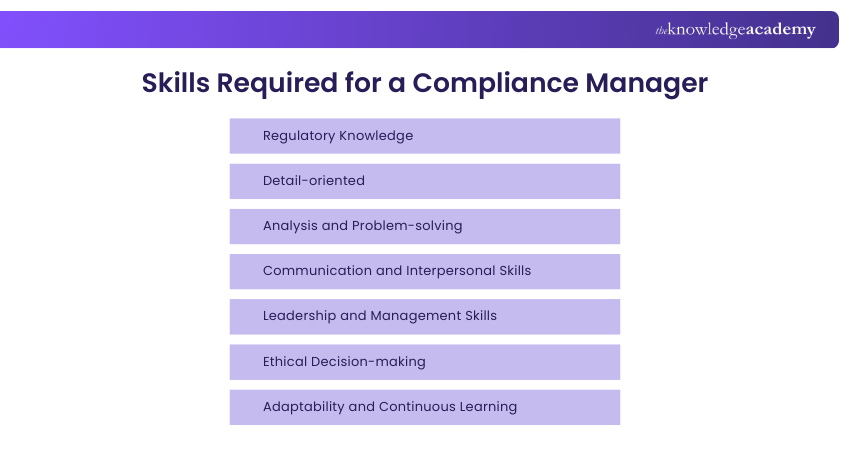
1) Regulatory Knowledge
Compliance Managers must know the laws, regulations and standards that apply to their organisation. They must keep up with the changes in the regulatory environment and ensure compliance. They’ll have to do research, attend conferences and network with professionals to learn more.
2) Detail Orientation
Compliance Managers should pay attention to compliance details. They should review documents carefully and spot any issues or areas for improvement. They should understand the nuances of regulations and interpret and implement them correctly.
3) Analysis and Problem-solving
Compliance Managers must have strong analysis and problem-solving skills to deal with challenges. They’ll be tasked with analysing information, understanding regulatory requirements, and finding practical solutions. They should identify compliance risks and plan strategies to reduce them. They should think critically and creatively.
Compliance is one of the keys to unlock sustainable business success! Learn about it in our Effective Compliance Training – Sign up now!
4) Communication and Interpersonal Skills
Compliance Managers should communicate effectively with different audiences. They should explain complex regulatory information clearly and concisely. They should interact with stakeholders, such as leaders, employees, regulators, and auditors. They should build good relationships, listen actively, and communicate clearly.
5) Leadership and Management Skills
Compliance Managers often lead or work with other teams in the organisation. They should have Leadership and Management Skills to ensure the success of compliance initiatives. They should motivate and guide their team members, assign tasks efficiently, and provide support. They should also organise and manage their time well to handle multiple projects and deadlines.
6) Ethical Decision-making
Compliance Managers should make ethical decisions in their role. They should have a strong sense of morality and make decisions that benefit the organisation. They should face ethical dilemmas and balance compliance requirements and business goals. They should show integrity and ethical judgment.
7) Adaptability and Continuous Learning
Compliance Managers work in a dynamic and evolving regulatory environment. They should be adaptable and willing to learn new things. They should stay informed on the latest regulatory developments, industry trends, and best practices. They should seek professional development opportunities, attend workshops, and learn continuously.
Where Does a Compliance Manager Work?
Compliance Managers can find opportunities across a wide range of industries. Although they often report to the HR department, they may also work within legal or finance teams, depending on organisational needs. Common sectors include manufacturing, Finance and technology, but any heavily regulated industry requires skilled Compliance Managers.
What is the Main Role of Compliance?
The main job of compliance is to ensure a company follows all the laws, rules, and policies. This helps avoid legal trouble, protects the company’s reputation, and supports honest and fair behaviour.
Conclusion
A Compliance Manager is central to keeping an organisation lawful, fair, and trusted. With clear policies, sound judgment, and steady follow-up, they reduce risk, prevent fines, and protect reputation. The role turns complex rules into simple steps that teams can follow and supports better decisions across the business. If you are detail-oriented and like practical problem-solving, this can be a strong, long-term career path.
Master the art of shielding digital trust, one transaction at a time! Sign up for our PCI DSS Implementer Course now!
Frequently Asked Questions
What are the Career Prospects for a Compliance Manager?

Compliance Managers are in high demand and have lucrative careers in industries like finance, healthcare, manufacturing, and technology. They can advance to senior positions, such as chief compliance officer, director of compliance, or vice president of compliance.
How can one Become a Compliance Manager?
To become a Compliance Manager, one typically needs a bachelor’s degree in a related field, such as business, law, accounting, or finance. Some employers may prefer a master’s degree or a professional certification. One also needs several years of experience in compliance, Risk Management, or auditing.

Hailey Davis


Compliance Officer
Hailey Davis is an ISO compliance expert with over 10 years of experience in audit, quality management systems (QMS), and regulatory compliance. She has worked with various industries, including manufacturing, healthcare, and technology, ensuring organisations achieve and maintain ISO certifications. Hailey’s content provides practical, actionable insights on navigating compliance challenges and improving business processes.
View Detail

 If you wish to make any changes to your course, please


