


 Top Rated Course

We may not have the course you’re looking for. If you enquire or give us a call on +39 800580270 and speak to our training experts, we may still be able to help with your training requirements.
Types of Photography: Explore 20+ Styles and Genres
The Knowledge Academy 03 March 2026Types of Photography include portrait, landscape, nature, event, wedding, sports, commercial, architectural, macro, wildlife, and aerial styles. Each style captures unique moments, subjects, and perspectives. Understanding these types helps you choose the right approach and develop your creative skills.

Training Outcomes Within Your Budget!
We ensure quality, budget-alignment, and timely delivery by our expert instructors.
Table of Contents
Photography goes far beyond simply capturing moments; it is about telling meaningful stories through visuals. Exploring different categories of photography highlights unique styles, creative techniques, and expressive possibilities that shape how stories are told.
Each photography style serves a distinct purpose, from capturing emotion to showcasing detail and atmosphere. Let us dive into these types and discover what each one has to offer, while understanding how they support creativity and effective visual storytelling.
Table of Contents
1) What is Photography?
2) What are the Types of Photography?
3) Other Types of Photography
4) What is a Type 3 Photo?
5) What is B and W Photography?
6) Conclusion
What is Photography?
Photography is the art and science of capturing light to create images. It's a window into frozen moments, reflecting the world's beauty, chaos, and everyday life. Originating from the Greek words 'photos' (light) and 'graphein' (to draw); Photography essentially translates to "drawing with light."
Furthermore, from its rudimentary beginnings with the Camera Obscura to the high-definition Digital Cameras of today, the essence of Photography remains consistent: storytelling through visual means. While technicalities like composition, exposure, and focus are pivotal, the heart of a photograph lies in its ability to evoke emotion, tell a tale, or convey an idea. Whether it’s the vastness of a landscape, the intimate gaze of a portrait, or the dynamic intensity of a street scene, Photography is a universal language.

What are the Types of Photography?
Photography spans diverse genres, which capture individuals' essence or showcase nature's vastness, its minute details, wildlife animals in their habitat, social occasions, urban life's candid moments, and so much more. Each genre offers unique perspectives, reflecting the many facets of the world. The following Types of Photography are most common:
Nature Photography
As the name suggests, Nature Photography is about capturing the beauty and diversity of life on Earth. It features everything from tiny, dew-covered spider webs to the migration of wildebeests. It’s a way to celebrate life’s smallest and grandest moments, ones we often overlook in our busy lives.
Through their lenses, Nature Photographers reveal the delicate balance of ecosystems and the natural artistry in the world around us. Their images inspire appreciation and encourage conservation. Since nature can be unpredictable, planning ahead and bringing the right gear is key. These are the main subcategories:
Landscape Photography
a) Landscape Photography captures the beauty and grandeur of nature
b) It showcases diverse landscapes, from rolling plains to mountain peaks
c) It offers a glimpse into the changing moods of the natural world
d) It requires attention to composition, lighting, and perspective
e) It inspires appreciation for the planet’s wonders and can inspire acts of conservation

Astro Photography
a) Astrophotography captures the wonders of the cosmos beyond our planet
b) It focuses on celestial bodies such as stars, planets, nebulae, and galaxies
c) It often combines night skies with Earth's landscapes
d) It utilises long exposures and advanced equipment to reveal hidden details
e) It blends art and science to highlight the vastness of the universe and our place in it
Storm Photography
a) Storm Photography is about capturing the raw power and intensity of storms
b) It focuses on tornadoes, lightning, massive cloud formations, etc
c) It combines dramatic weather with serene landscapes to create exciting contrast
d) It requires knowledge of meteorology and readiness for unpredictable conditions
It showcases nature’s dual role as both creator and destroyer
Flower Photography
a) This style of Photography captures the delicate beauty and intricate details of flowers
b) It employs Macro Photography to highlight a flower’s texture, coloura, and patterns
c) It beautifully showcases the play of light and shadow on petals
d) It’s purpose is to highlight the diversity of floral life
e) It tells stories of growth, change, and nature’s renewal
Looking to improve the quality and appeal of your visual content? Sign up for the Photo Retouching Training now!
Macro Photography
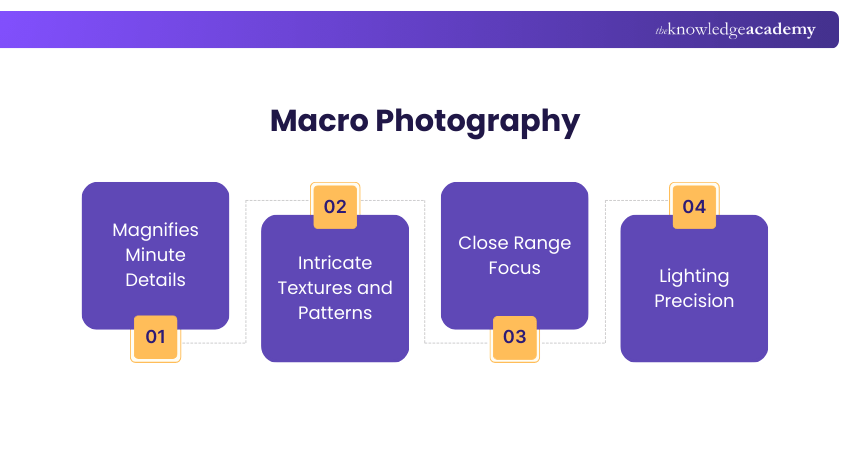
a) Macro Photography reveals details unseen by the naked eye through extreme close-ups.
b) It focuses on tiny subjects like insects, water droplets, and textures.
c) It highlights intricate patterns, textures and natural designs.
d) It essentially captures the hidden beauty of the microscopic world.
e) Macro Photography reveals details unseen by the naked eye through extreme close-ups.
f) It focuses on tiny subjects like insects, water droplets, and textures.
g) It highlights intricate patterns, textures and natural designs.
h) It essentially captures the hidden beauty of the microscopic world.
Manmade Objects
Photographing man-made structures can be either artistic or commercial, and the way you capture buildings in their most striking form depends on your creative vision and purpose. Here are some popular examples:
Architecture Photography
a) This style of Photography captures the beauty, design, and essence of structures.
b) It showcases buildings, bridges, and urban landscapes.
c) It highlights the interplay of light, shadow, lines, and curves and interprets the Architect’s vision beyond simple documentation.
d) It requires a keen eye for composition and spatial relationships.
e) It often requires patience to capture the perfect lighting conditions.
Real Estate Photography
a) This style showcases the appeal and functionality of properties for sale or rent.
b) It plays a key role in property marketing by highlighting design and space.
c) It focuses on unique features of homes and commercial spaces.
d) It uses Photography Lighting, composition, and perspective to create inviting visuals.
e) It uses wide-angle lenses to capture spaciousness and layout effectively.
f) The post-processing improves colour accuracy and vibrancy.
g) It communicates property value and attracts buyers or tenants with a vision of comfort.
Gain in-depth knowledge on the art and science of Cinematography in our Cinematography Course for Crafting Visual Stories Training - Register now!
Aerial Photography
a) Aerial Photography involves capturing landscapes from a high, bird’s-eye perspective,
traditionally done using aircraft, balloons, or tall structures.
b) Modern drone technology has made it more accessible.
c) It showcases cityscapes, natural landscapes, and agricultural patterns.
d) It basically highlights patterns, symmetries, and contrasts unseen from the ground.
e) It finds usage in urban planning, real estate, and environmental studies.
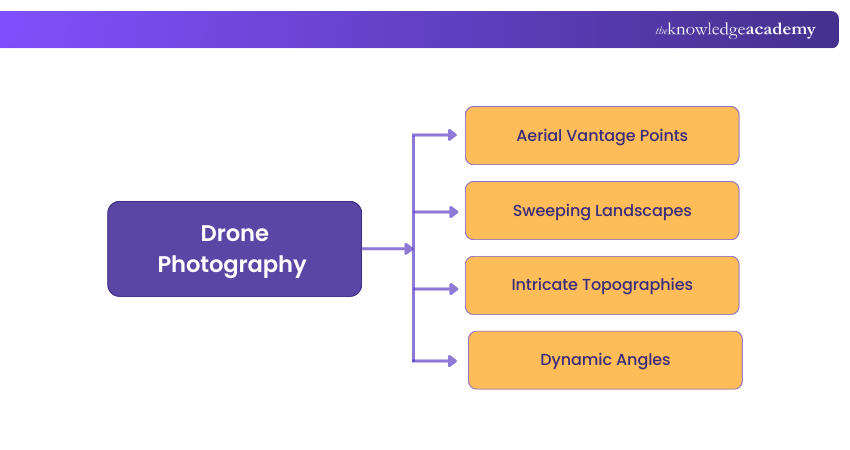
Drone Photography
a) Drone Photography provides stunning aerial views as it captures landscapes, topographies, and dynamic events from new angles
b) It showcases natural formations and urban structures in striking detail.
c) It enhances industries such as real estate, agriculture, and filmmaking.
d) It offers accessibility to aerial Photography without traditional aircraft.
e) This style continues to evolve with advancements in drone technology.
People Photography
People Photography covers a broad range including portraits, Wedding Photography, glamour shots, and documentary. Let's explore them in detail
Wedding Photography
a) Wedding Photography captures the magic and emotions of a couple’s special day.
b) It tells the couple’s unique love story through Photography.
c) It preserves raw emotions like laughter, tears, and loving glances.
d) It requires attention to detail to capture fleeting yet meaningful moments.

Family Photography
a) This type of Photography captures special moments, milestones, and family celebrations.
b) It’s widely popular for holiday cards and cherished keepsakes.
c) It requires thoughtful planning and composition to highlight the various relationships.
d) It bridges the past, present, and future through Photography.
Headshot Photography
a) Headshot Photography focuses on close-up portraits, typically from the shoulders up.
b) It highlights facial features and expressions.
c) The photographer requires strong Communication Skills to make subjects feel comfortable.
d) This style is commonly used by Actors, business professionals, and corporate executives as it helps them present themselves professionally.
e) It’s an essential tool for personal branding and career profiles.
Explore your personal interests and transform them into purposeful activities through our comprehensive Hobbies & Interests Training - Sign up now!
Glamour Photography
a) Unlike Fashion Photography, which is more about clothing and accessories, Glamour Photography highlights the beauty and charm of the person being photographed.
b) This style uses lighting, poses, and styling to create a sense of elegance and appeal.
c) Glamour Photography is popular among aspiring models building their portfolios.
d) It blends creativity and technique to enhance the subject’s presence.
Documentary
a) Documentary Photography captures images that tell a story or share important news.
b) It covers a wide range of subjects, from local events to war zones.
c) It sheds light on important but often overlooked issues and can highlight inspiring moments of humanity and resilience.
d) It aims to inform, educate, and create awareness through visuals.
e) It basically blends storytelling with Photography to document real-life events.
Portrait Photography
a) This type of Photography captures emotions, personalities, and stories in a single frame.
b) It goes beyond physical appearance to reveal the subject’s essence.
c) It uses composition, lighting, and connection to create powerful images.
d) It highlights unique features like expressions, wrinkles, and eyes.
e) It showcases the depth and diversity of human experiences through Photography.
Other Types of Photography
Not every photo fits neatly into one genre. Some images blend multiple styles, like a sequence of telescopes under the Milky Way. The lines between genres are flexible; they simply help describe images. If you’re unsure which category your photo falls into, that’s okay—it doesn’t affect its quality. The goal of these categories is to inspire you with different Photography styles, not limit your creativity.
1) Digital Photography
Digital Photography has transformed how people capture, process, and share images. Using electronic sensors to record light offers instant feedback, allowing Photographers to adjust and perfect their shots quickly.
This immediacy, combined with the capacity to store thousands of images on portable devices and the flexibility of post-processing software, has democratised the art form. No longer constrained by film rolls or darkroom chemicals, Digital Photographers can experiment endlessly.
Moreover, the ease of sharing digitally captured moments online has reshaped social interactions and storytelling. Digital Photography encapsulates the dynamic fusion of technology and artistry in the 21st century.
2) Film Photography
Film Photography embodies the classic essence of capturing light on emulsified surfaces. With a slower, more deliberate process than digital, it demands a deep understanding of exposure and composition.
Additionally, each frame is a calculated endeavour, cultivating patience and intentionality. The tactile nature of handling film, from loading to developing, instils a connection to the craft that digital may lack.
Moreover, the grain, colours, and tonal range of the film evoke nostalgia and authenticity, reminiscent of a bygone era. Film Photography remains a testament to the enduring allure of analogue aesthetics in a fast-paced digital world.
Accentuate your Film Photography skills with lighting techniques, by signing up for the Filmmaking Course now!
3) Pinhole Photography
Pinhole Photography harks back to this art form's origins, using simplicity to craft ethereal imagery. It involves a light-tight box with a tiny hole, allowing light to seep in and create exposures over extended periods.
This method returns to the essence of Photography: the play of light and time. The resulting dreamlike images possess a soft focus and subtle distortions, rendering scenes in a surreal, poetic light.
More importantly, Pinhole Photography is a deliberate step back in an instant gratification age, inviting patience and curiosity and offering a tangible connection to the medium's foundational principles.
4) Boudoir Photography
Boudoir Photography celebrates intimacy, confidence, and the art of sensuality. Rooted in private spaces, typically bedrooms or luxurious settings, it captures the subjects in delicate poses. Beyond suggestive imagery, Boudoir Photography empowers individuals to embrace their bodies, exuding self-assurance and vulnerability.
Furthermore, the Photographer's skill lies in creating a comfortable environment, allowing genuine emotions to shine through while emphasising beauty and grace. Mastery of Photography Lighting is essential in achieving this, as it highlights the subject's features while adding depth and warmth to the image. Done with taste and respect, these sessions become transformative experiences, producing images that are both deeply personal and timelessly elegant.
5) Music Photography
Music Photography harmonises two dynamic arts: music and visual storytelling. It freezes the kinetic energy of performances, translating melodies into visual rhythms. The challenge is capturing the musicians' technical prowess and the emotions they conjure.
Photographers anticipate crescendos, interpret harmonies and seize fleeting expressions. Each frame is a symphony of colours, lights, and gestures that resonate with the audience's visceral connection to the music.
Whether in the intimate space of a studio or amidst a roaring concert crowd, Music Photography unites sound and vision, preserving the soulful essence of melodies long after the final note fades.
What is a Type 3 Photo?
A Type 3 photograph is a second-generation print made out of a copy of a negative, as opposed to the original camera negative. It is generally printed approximately two years later than the original photograph, and it is worth less than a Type 1 or Type 2 photograph.
What is B And W Photography?
Black and white photography is the photography that lacks colour, whereby grey shades of black to white are used. It has laid stress on composition, tonality, contrast, and texture, enabling photographers to concentrate on light and shape and not colour.
Conclusion
Photography gives an unlimited method to communicate ideas, feelings, and narratives using photographs. Every style offers a different dimension, making you look at the world with creativity and new ideas. Keep searching, trying, and following your curiosity about the kind of photography style that will suit you.
Increase your brand value with improved tonality and lens qualities, by signing up for the Photography Course now!
Frequently Asked Questions
What are the Four Elements of a Good Photograph?

The four primary elements of a good photograph are:
a) Lighting
b) composition
c) Timing
d) Gesture/expression
What are the Three Basic Styles of Photography?
The three basic styles of Photography are:
a) Landscape
b) Portrait
c) Documentary
What are the Other Resources and Offers Provided by The Knowledge Academy?
The Knowledge Academy takes global learning to new heights, offering over 3,000+ online courses across 490+ locations in 190+ countries. This expansive reach ensures accessibility and convenience for learners worldwide.
Alongside our diverse Online Course Catalogue, encompassing 17 major categories, we go the extra mile by providing a plethora of free educational Online Resources like Blogs, eBooks, Interview Questions and Videos. Tailoring learning experiences further, professionals can unlock greater value through a wide range of special discounts, seasonal deals, and Exclusive Offers.
What is The Knowledge Pass, and How Does it Work?
The Knowledge Academy’s Knowledge Pass, a prepaid voucher, adds another layer of flexibility, allowing course bookings over a 12-month period. Join us on a journey where education knows no bounds.
What are the Related Courses and Blogs Provided by The Knowledge Academy?
The Knowledge Academy offers various Hobbies & Interests Courses, including the Cake Decorating Getting Started Workshop, Cake Decorating Course, and Mixing And Mastering Course. These courses cater to different skill levels, providing comprehensive insights into Mobile Photography.
Our Business Skills Blogs cover a range of topics related to Types of Photography, offering valuable resources, best practices, and industry insights. Whether you are a beginner or looking to advance your Business skills, The Knowledge Academy's diverse courses and informative blogs have got you covered.

The Knowledge Academy


Global Training Provider
The Knowledge Academy is a world-leading provider of professional training courses, offering globally recognised qualifications across a wide range of subjects. With expert trainers, up-to-date course material, and flexible learning options, we aim to empower professionals and organisations to achieve their goals through continuous learning.

Upcoming Business Skills Resources Batches & Dates
Date
 Photography Course
Photography Course
Fri 19th Jun 2026
Photography Course
Fri 4th Sep 2026
Photography Course
Fri 27th Nov 2026

 If you wish to make any changes to your course, please


