


 Top Rated Course

We may not have the course you’re looking for. If you enquire or give us a call on +39 800580270 and speak to our training experts, we may still be able to help with your training requirements.
What is Cognitive Automation? Technologies, Benefits & Use Cases
Lily Turner 06 June 2026Cognitive Automation uses AI and RPA to automate complex tasks, improve decision-making, and streamline processes for greater efficiency and better outcomes. It analyses both structured and unstructured data to deliver meaningful insights. Over time, it enhances operations, customer experience and innovation across various industries.
Home
 Resources
Data, Analytics & AI
What is Cognitive Automation? Technologies, Benefits & Use Cases
Resources
Data, Analytics & AI
What is Cognitive Automation? Technologies, Benefits & Use Cases
Resources
Data, Analytics & AI
What is Cognitive Automation? Technologies, Benefits & Use Cases

Training Outcomes Within Your Budget!
We ensure quality, budget-alignment, and timely delivery by our expert instructors.
Table of Contents
The real question is no longer “Can we automate this?” but “Can it think for us?” As businesses handle more data, make quicker decisions, and want to meet higher customer expectations, simple automation is no longer enough. You need systems that can understand information, learn from it, and respond intelligently. This is where Cognitive Automation steps in.
It enables machines to analyse data, recognise patterns, and make informed decisions with minimal human input. In this blog, we will explore what is Cognitive Automation, how it works, its key technologies, and the role it plays in modern business transformation. Let's dive in!
Table of Contents
1) What is Cognitive Automation?
2 How Cognitive Automation Works?
3) Key Technologies Behind Cognitive Automation
4) Benefits of Cognitive Automation
5) Use Cases of Cognitive Automation
6) Challenges of Cognitive Automation
7) Latest Trends in Cognitive Automation
8) Differences Between RPA and Cognitive Automation
9) Conclusion
What is Cognitive Automation?
Cognitive Automation is an advanced form of automation that uses Artificial Intelligence (AI) to perform tasks that require human-like thinking. It combines the “thinking” capabilities of AI with the “doing” functions of Robotic Process Automation (RPA), allowing systems to not only execute tasks but also understand, learn, and make decisions.
It combines technologies like Machine Learning (ML) and Natural Language Processing (NLP) to handle both simple and complex tasks. In simple terms, Cognitive Automation is designed to mimic human behaviour and intelligence, making it suitable for processes that involve judgement, reasoning, and data interpretation.

How Cognitive Automation Works?
Cognitive Automation works by combining data, advanced technologies, and intelligent decision-making to perform tasks with minimal human involvement. It enables systems to not only automate processes but also understand, learn, and make informed decisions similar to human thinking. Here is the step-by-step procedure of how it actually works:
1) Data Collection
Cognitive Automation starts by gathering data from different sources such as emails, documents, databases, and customer interactions. This includes both structured and unstructured data. Collecting diverse data sources ensures the system has a comprehensive foundation to analyse and generate meaningful insights.
2) Data Processing and Understanding
The system processes the collected data using technologies like NLP and computer vision. It understands text, images, and patterns within the data. This step transforms raw data into usable information, enabling the system to interpret context and meaning effectively.
3) Pattern Recognition
Then, Machine Learning models analyse the data to identify patterns, trends, and relationships. This helps the system understand how tasks are performed and what outcomes are expected. By recognising patterns, the system can replicate processes and predict outcomes with increasing accuracy over time.
4) Decision-making
Based on the identified patterns, the system makes decisions or predictions. It can choose the best possible action without needing constant human input. This capability allows organisations to automate complex decision-making processes while maintaining consistency and speed.
5) Task Execution
Once a decision is made, Cognitive Automation uses tools like Robotic Process Automation (RPA) to carry out the task automatically. This ensures that actions are executed quickly, accurately, and without manual intervention, improving overall efficiency.
6) Continuous Learning
The system learns from new data and feedback over time. This improves its accuracy and performance, making it smarter and more efficient with each use. Continuous learning enables the system to adapt to changing conditions and deliver better results in the long term.
Key Technologies Behind Cognitive Automation
Several advanced technologies work together to make Cognitive Automation possible. Each technology plays a specific role in enabling intelligent, automated decision-making and process execution. Let's check what those are:
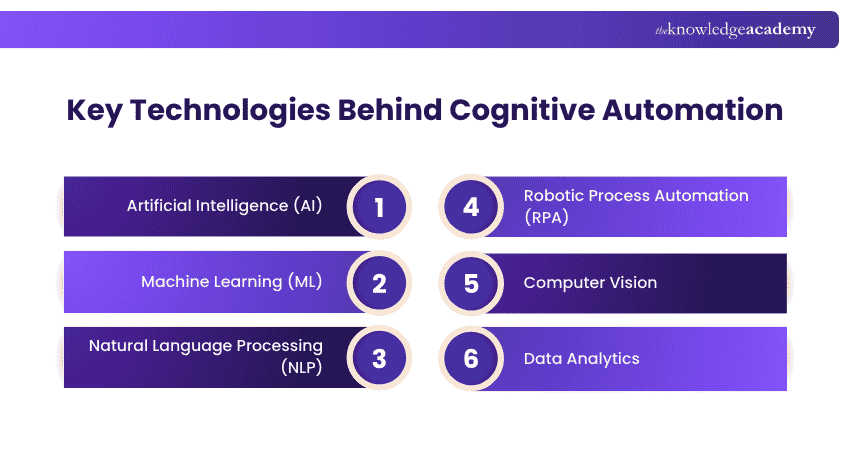
1) Artificial Intelligence (AI)
AI is the foundation of Cognitive Automation. It enables systems to simulate human thinking, make decisions, and solve problems based on data.
2) Machine Learning (ML)
Machine Learning allows systems to learn from past data and improve over time. It helps in identifying patterns, making predictions, and increasing accuracy without manual programming.
3) Natural Language Processing (NLP)
NLP helps machines understand and interpret human language. It is used in chatbots, virtual assistants, and systems that process text-based data.
4) Robotic Process Automation (RPA)
RPA handles repetitive, rule-based tasks by automating processes such as data entry and transaction processing. When combined with AI, it enables more Intelligent Automation (IA).
5) Computer Vision
Computer vision allows systems to interpret visual data such as images and scanned documents. It is useful for tasks like document processing and image recognition.
6) Data Analytics
Data Analytics helps process and analyse large volumes of data to extract meaningful insights. It supports better decision-making and improves overall system performance.
Enhance your support operations and reduce response times with AI Automation Training for Customer Services – Register today!
Benefits of Cognitive Automation
Cognitive Automation offers many benefits for businesses to work efficiently, make better decisions and stay competitive. Here are some of those benefits:
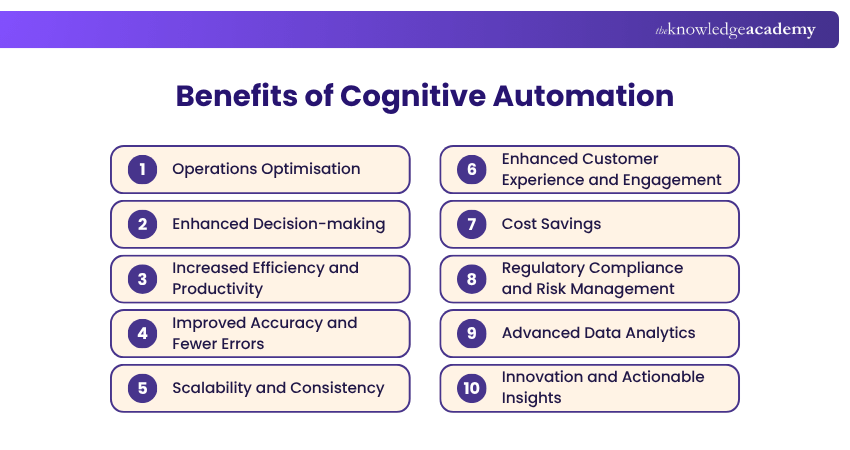
1) Operations Optimisation
Cognitive Automation helps improve business processes by identifying delays and inefficiencies. It removes unnecessary steps and ensures smoother workflows across departments. This leads to better use of time and resources, making operations more organised and effective.
2) Enhanced Decision-making
By analysing large volumes of data, Cognitive Automation gives useful insights for decision-making. It helps businesses understand patterns and trends that may not be obvious with manual research. This allows leaders to make faster, accurate, and data-driven decisions.
3) Increased Efficiency and Productivity
Cognitive Automation takes over repetitive and time-consuming tasks, allowing employees to focus on more important work. This reduces workload pressure and improves productivity. Teams can complete tasks faster while maintaining better quality.
4) Improved Accuracy and Fewer Errors
Manual processes often lead to mistakes, especially when tasks are repetitive. Cognitive Automation ensures consistent execution, reducing the chances of errors. It also detects unusual patterns and alerts users, improving overall accuracy.
5) Scalability and Consistency
As businesses grow, managing large volumes of work becomes challenging. Cognitive Automation addresses this issue and allows organisations to scale their operations without losing quality. It ensures tasks are completed in a consistent and reliable manner.
6) Enhanced Customer Experience and Engagement
Cognitive Automation improves customer service by providing quick and accurate responses. It enables personalised interactions based on customer behaviour and preferences. This leads to better engagement and higher customer satisfaction.
7) Cost Savings
By reducing manual work and improving efficiency, it helps lower operational costs. Furthermore, this minimises errors, reduces processing time, and optimises resource usage. This results in better financial performance for organisations.
8) Regulatory Compliance and Risk Management
Cognitive Automation helps organisations follow industry regulations by monitoring processes and identifying risks. It ensures that tasks are handled correctly and consistently. This reduces the chances of getting into compliance issues and penalties.
9) Advanced Data Analytics
Cognitive Automation can process and analyse large volumes of data quickly. It helps businesses gain useful insights into customer behaviour and business performance. These insights support better planning and strategic decisions.
10) Innovation and Actionable Insights
By providing meaningful insights, Cognitive Automation encourages innovation within organisations. It helps businesses identify new opportunities and improve existing processes. This supports continuous growth and helps companies stay competitive.
Simplify complex financial tasks with the AI Automation Course for Finance and Accounting – Sign up soon!
Use Cases of Cognitive Automation
Cognitive Automation is used in many industries because it can manage a wide range of tasks. Let's check some of the sectors where it is highly used:
1) IT Operations
Cognitive Automation monitors systems, detects issues, and resolves problems automatically. It reduces downtime, improves performance, and allows IT teams to focus on strategic development instead of routine tasks.
2) Customer Service
Cognitive Automation uses chatbots and virtual assistants to handle customer queries. It provides quick responses, personalises interactions, ensures 24/7 support, and improves overall customer satisfaction and engagement.
3) Finance and Accounts Payable
Cognitive Automation processes invoices, matches purchase orders, and manages payments automatically. It reduces manual work, improves accuracy, speeds up financial operations, and ensures better control over accounts payable processes.
4) Human Resources
Cognitive Automation supports resume screening, candidate selection, and employee onboarding. It reduces manual effort, speeds up hiring processes, and helps organisations manage workforce data more effectively.
5) Insurance Claims Management
Cognitive Automation reads and verifies claim documents, detects fraud, and speeds up approvals. It improves accuracy, reduces processing time, enhances customer satisfaction, and helps insurance companies manage risks effectively.
Challenges of Cognitive Automation
Despite its benefits, implementing Cognitive Automation comes with its own set of challenges. Those include:
1) Integrating Cognitive Automation with existing systems can be complex and may require upgrading legacy infrastructure.
2) Poor-quality or inconsistent data can cause inaccurate results and affect decision-making.
3) Lack of skilled professionals and the need for employee training can slow down adoption.
4) Decisions made by cognitive systems can sometimes lack transparency, making them difficult to interpret.
5) Continuous monitoring and updates are needed to maintain system performance and accuracy.
Latest Trends in Cognitive Automation
Cognitive Automation is evolving quickly as businesses adopt smarter and more advanced technologies. Here are the latest trends of it:
1) Real-time Data Processing
Modern cognitive systems are highly capable of processing data in real time. This helps organisations to respond quickly to changing conditions and make decisions based on up-to-date information.
2) Enhancing Customer Experiences
Businesses are focusing on using Cognitive Automation to deliver personalised and engaging customer experiences. By analysing customer preferences, organisations can tailor their offerings and interactions, improving satisfaction and loyalty.
3) Integration of AI
The integration of advanced AI-driven technologies enhances the capabilities of Cognitive Automation. Systems are becoming more intelligent, capable of handling complex tasks and making more accurate predictions. This integration is driving innovation across industries.
4) Focus on Security and Compliance
As data usage increases, organisations are placing greater emphasis on security and compliance. Cognitive Automation systems are being designed with strong security options to protect data and ensure regulatory compliance.
5) Automation-as-a-Service (AaaS)
Automation-as-a-Service (AaaS) is emerging as a popular trend, allowing organisations to access Cognitive Automation solutions through cloud-based platforms. This reduces the need for upfront investment and makes advanced automation more accessible to businesses of all sizes.
Start leveraging AI to optimise IT challenges with the AI Automation Course for IT – Join now!
Differences Between RPA and Cognitive Automation
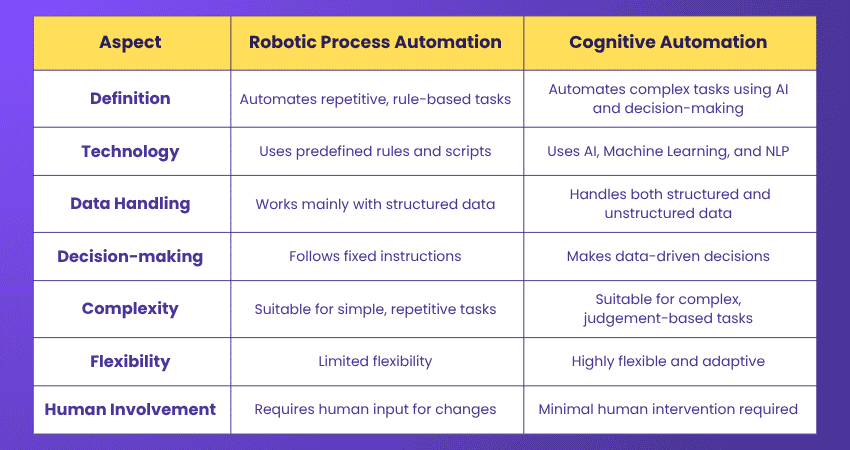
Robotic Process Automation (RPA) and Cognitive Automation are often used together, but they are different. RPA focuses on automating repetitive, rule-based tasks like data entry or transaction processing. It follows fixed instructions and does not learn from experience.
Cognitive Automation goes further by adding intelligence to automation. It can understand data, learn from it, and make decisions. While RPA is useful for structured tasks, Cognitive Automation is better for complex tasks that require thinking. Together, they can improve business processes significantly. Let’s look at their differences in detail with the table below:
Conclusion
Cognitive Automation represents a significant step forward in the evolution of business automation. It goes beyond basic automation by enabling systems to learn, analyse data, and make informed decisions. Businesses that embrace this technology today are better prepared to adapt, innovate, and grow in an increasingly digital world.
Stay ahead in the evolving digital landscape with AI Automation Training – Begin today!
Frequently Asked Questions
What are the Top 5 Cognitive Skills?

The top five cognitive skills include problem-solving, critical thinking, memory, attention, and language processing. These skills enable individuals to analyse information, make decisions, and communicate effectively.
How Can Businesses Successfully Implement Cognitive Automation?
To successfully implement Cognitive Automation, businesses can begin with finding the processes that need automation. They need to ensure high-quality data, invest in the right technologies and provide training for employees. They also have to continuously monitor outcomes to scale Cognitive Automation across the enterprise.
What are the Other Resources and Offers Provided by The Knowledge Academy?
The Knowledge Academy takes global learning to new heights, offering over 3,000+ online courses across 490+ locations in 190+ countries. This expansive reach ensures accessibility and convenience for learners worldwide.
Alongside our diverse Online Course Catalogue, encompassing 17 major categories, we go the extra mile by providing a plethora of free educational Online Resources like Blogs, eBooks, Interview Questions and Videos. Tailoring learning experiences further, professionals can unlock greater value through a wide range of special discounts, seasonal deals, and Exclusive Offers.
What is The Knowledge Pass, and How Does it Work?
The Knowledge Academy’s Knowledge Pass, a prepaid voucher, adds another layer of flexibility, allowing course bookings over a 12-month period. Join us on a journey where education knows no bounds.
What are the Related Courses and Blogs Provided by The Knowledge Academy?
The Knowledge Academy offers various AI Automation Training, including AI Automation Course for Marketing, AI Automation Course for Product Management and AI Automation Training for Customer Services. These courses cater to different skill levels, providing comprehensive insights into the Differences Between AI and RPA.
Our Data Analytics & AI Blogs cover a range of topics related to Cognitive Automation, offering valuable resources, best practices, and industry insights. Whether you are a beginner or looking to advance your Data Analytics & AI skills, The Knowledge Academy's diverse courses and informative blogs have got you covered.

Lily Turner


Senior AI/ML Engineer and Data Science Author
Lily Turner is a data science professional with over 10 years of experience in artificial intelligence, machine learning, and big data analytics. Her work bridges academic research and industry innovation, with a focus on solving real-world problems using data-driven approaches. Lily’s content empowers aspiring data scientists to build practical, scalable models using the latest tools and techniques.
View Detail
Upcoming Data, Analytics & AI Resources Batches & Dates
Date
 AI Automation Course for Marketing
AI Automation Course for Marketing
Fri 17th Jul 2026
AI Automation Course for Marketing
Fri 16th Oct 2026

 If you wish to make any changes to your course, please


