


 Top Rated Course

We may not have the course you’re looking for. If you enquire or give us a call on +44 1344 203999 and speak to our training experts, we may still be able to help with your training requirements.
Why is Feedback Important? The Key to Team Success
The Knowledge Academy 21 April 2026Feedback boosts performance, engagement, and growth by providing insights, strengthening relationships, and supporting long-term success. It encourages continuous improvement and learning. When shared effectively, feedback builds trust, clarity, and accountability across teams and organisations, supporting collaboration and performance.

Training Outcomes Within Your Budget!
We ensure quality, budget-alignment, and timely delivery by our expert instructors.
Table of Contents

Feedback is among the strongest instruments to enhance performance and strengthen employee relations within an organisation. Understanding Why is Feedback Important? helps organisations gain clearer insights, encourage continuous improvement, and support sustainable growth. It is time to explore how feedback drives success across every level of an organisation.
Table of Contents
1) What is the Importance of Feedback?
2) The Different Types of Feedback
3) Key Reasons Why Feedback is Important
4) 7 Feedback Techniques to Help You Stay Constructive
5) Asking for Feedback
6) How to Act on Feedback?
7) Tips on Providing Feedback
8) Tips on Receiving Feedback
9) Conclusion
What is the Importance of Feedback?
Feedback is a vital communication tool that highlights both strengths and areas for improvement. It can take place through formal reviews or casual conversations, guiding individuals toward personal and professional growth.
Regular feedback enhances performance development, strengthens engagement, and promotes cost efficiency by identifying potential issues early. It also helps maintain working standards and fosters a positive workplace culture built on collaboration, trust, and shared accountability.

The Different Types of Feedback
Feedback in the workplace comes in different forms, each playing a vital role in personal and professional development. Understanding these types helps individuals give and receive input effectively to drive growth, motivation, and continuous improvement.
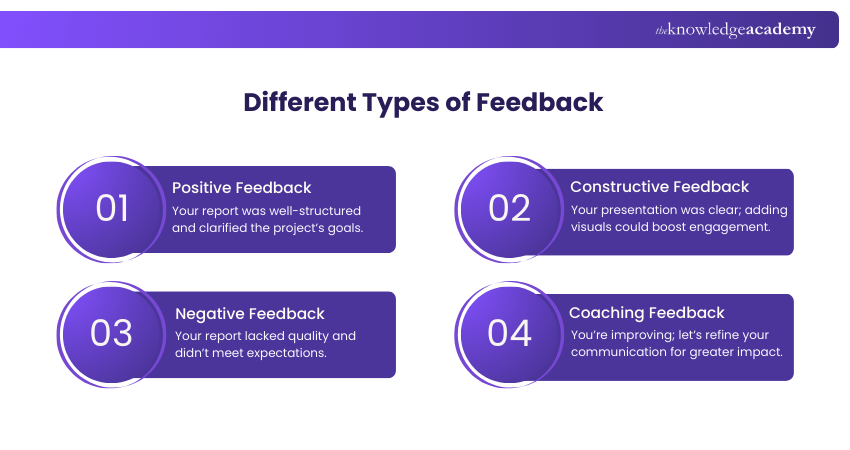
Positive Feedback
Positive feedback recognises and reinforces desirable behaviour or performance. It motivates individuals to maintain or exceed their current standards.
Example: “Your report was thorough and well-structured; it helped clarify the project’s direction.”
Constructive Feedback
Constructive feedback focuses on improvement through actionable advice. It highlights what can be enhanced while maintaining a supportive tone.
Example: “Your presentation was clear, but adding visuals could make it more engaging for the audience.”
Negative or Destructive Feedback
Negative feedback focuses solely on faults without offering guidance for improvement. It can lower confidence and morale when delivered harshly.
Example: “Your report was poorly done and didn’t meet expectations.”
Coaching Feedback
Coaching feedback is collaborative and supportive. It helps individuals identify challenges and develop strategies to improve performance and growth.
Example: “You’re improving quickly; let’s focus on refining your communication skills to strengthen your impact.”
Learn about Workforce Planning tools with our Workforce Resource Planning Course – Register today!
Key Reasons Why Feedback is Important
Feedback plays a crucial role in fostering personal and professional development. It allows individuals and organisations to reflect, refine, and improve their performance while strengthening collaboration and trust. Below are some of the key reasons why feedback is essential:
1) Identifying Areas for Improvement Through Feedback Insights
Feedback helps uncover blind spots and highlight areas that need attention. Structured feedback methods, such as surveys and one-on-one reviews, provide actionable insights that guide employees and organisations in refining strategies and enhancing overall performance.
2) Understand Your Successes
Feedback is not just about identifying weaknesses but also celebrating achievements. Recognising what works well helps reinforce positive behaviour and sustain high performance. Understanding your successes allows you to replicate effective practices across teams and projects.
3) Building Relationships with Customers and Stakeholders
Requesting and acting on feedback shows customers and employees that their opinions matter. This openness fosters trust, loyalty, and long-term partnerships. When people see their feedback leads to real improvements, engagement and satisfaction naturally increase.
4) Create a Culture of Continuous Learning
Feedback encourages a forward-thinking culture focused on growth and innovation. By regularly gathering and implementing insights, organisations remain adaptable and relevant in changing environments. This continuous learning mindset drives sustained success and employee development.
5) Motivate and Inspire Your Team Members
Constructive feedback motivates employees to reach their full potential. When feedback highlights strengths and provides guidance for improvement, it boosts morale, promotes accountability, and inspires individuals to deliver better results for both themselves and the organisation.
Learn motivation strategies with Successful People Management And Team Leadership Course – Join now!
7 Feedback Techniques to Help You Stay Constructive
These proven feedback techniques provide practical frameworks to deliver constructive, clear, and growth-focused feedback in the workplace.
1) Sandwich Method
This technique frames constructive criticism between positive comments, helping soften the impact of feedback while maintaining a respectful tone and encouraging improvement. It works well for relationship-focused conversations, but should be used sparingly to avoid seeming insincere.
2) DESC Model
The DESC model is an abbreviation for Descriptions, Expressions, Specifications, and Consequences. It can help you to make behaviour clear, express your feelings, define what you want to change, and describe the consequences, keeping feedback focused and clear.
3) EDGE Model
EDGE is an acronym that means Explain, Describe, and Give an Example. It organises feedback by posing situations so as to clarify, describe the problem, and give concrete examples, which simplifies understanding of feedback and taking corresponding actions.
4) 360-Degree Feedback
The method provides a balanced approach to the performance behaviour by calling on various sources of inputs, which include peers, supervisors, subordinates, and customers, enabling the identification of blind spots.
5) CAS Model
CAS model is an abbreviation of Context, Action, and Result. It makes feedback result-oriented and focused by structuring it by describing the situation, actions taken, and results attained.
6) SBI Model
SBI will be abbreviated as Situation, Behaviour, and Impact. It focuses on how to describe the situation, observed behaviour, and its effect, with feedback being focused and fact-based.
7) GROW Model
GROW is involved with Goal, Reality, Options, and Will. It puts feedback in the form of a coaching dialogue, which reinforces goal setting, problem solving, and action.<
Asking for Feedback
Requesting feedback demonstrates openness to growth and improvement. It helps you understand how others perceive your performance and provides valuable perspectives for development.
1) Ask specific questions about performance or behaviour.
2) Choose the right person who can offer constructive input.
3) Request feedback regularly, not just during reviews.
4) Be open-minded and avoid becoming defensive.
5) Thank the person for their honesty and time.
How to Act on Feedback
Acting on feedback is essential for meaningful progress. It involves reflecting insights, creating an action plan, and implementing necessary changes to improve.
1) Evaluate feedback objectively and identify key takeaways.
2) Prioritise areas that need the most attention.
3) Create a realistic plan with measurable goals.
4) Seek clarification if any feedback seems unclear.
5) Monitor progress and reassess regularly to ensure improvement.
Tips on Providing Feedback
While giving feedback, you should strive to be specific, honest, and objective so that other people can get to know what behaviour or outcome you are talking about. Give good examples and always remain constructive to ensure that your message is appealing to improve and grow.
Tips on Receiving Feedback
In responding to feedback, maintain concentration by listening without interruptions and asking questions to achieve the best of the conversation. See valuable comments as an opportunity to improve and think over them in a wise manner.
Conclusion
Effective feedback transforms everyday communication into meaningful opportunities for learning and development. Understanding Why is Feedback Important? enables organisations to build trust, improve performance, and foster a culture of continuous improvement. It encourages open dialogue, aligns expectations, and supports informed decision making across teams.
Learn to support employee growth and career development with our Talent Management Training – Join now!
Frequently Asked Questions
What is the Ultimate Goal of Feedback?

The ultimate goal of feedback is to promote growth and improvement. By providing insights, feedback helps individuals understand their strengths and areas for development.
What are the characteristics of effective feedback?
Effective feedback has several key characteristics:
a) Specific
b) Timely
c) Constructive
d) Balanced
e) Actionable
f)Objective
g) Respectful
What are the Other Resources and Offers Provided by The Knowledge Academy?
The Knowledge Academy takes global learning to new heights, offering over 3,000+ online courses across 490+ locations in 190+ countries. This expansive reach ensures accessibility and convenience for learners worldwide.
Alongside our diverse Online Course Catalogue, encompassing 17 major categories, we go the extra mile by providing a plethora of free educational Online Resources like Blogs, eBooks, Interview Questions and Videos. Tailoring learning experiences further, professionals can unlock greater value through a wide range of special discounts, seasonal deals, and Exclusive Offers.
What is The Knowledge Pass, and How Does it Work?
The Knowledge Academy’s Knowledge Pass, a prepaid voucher, adds another layer of flexibility, allowing course bookings over a 12-month period. Join us on a journey where education knows no bounds.
What are the Related Courses and Blogs Provided by The Knowledge Academy?
The Knowledge Academy offers various People Management Courses, including the Workforce Resource Planning Training, Talent Acquisition Training, and Performance Appraisal Training. These courses cater to different skill levels, providing comprehensive insights into Human Capital Management.
Our HR Blogs cover a range of topics related to Feedback, offering valuable resources, best practices, and industry insights. Whether you are a beginner or looking to advance your HR skills, The Knowledge Academy's diverse courses and informative blogs have got you covered.

The Knowledge Academy


Global Training Provider
The Knowledge Academy is a world-leading provider of professional training courses, offering globally recognised qualifications across a wide range of subjects. With expert trainers, up-to-date course material, and flexible learning options, we aim to empower professionals and organisations to achieve their goals through continuous learning.

Upcoming HR Resources – Learn about Human Resources Batches & Dates
Date
 Successful People Management and Team Leadership
Successful People Management and Team Leadership
Fri 3rd Jul 2026
Successful People Management and Team Leadership
Fri 2nd Oct 2026

 If you wish to make any changes to your course, please


