


 Top Rated Course

We may not have the course you’re looking for. If you enquire or give us a call on +44 1344 203999 and speak to our training experts, we may still be able to help with your training requirements.
What is Leverage in Forex Trading: A Complete Beginner’s Guide
The Knowledge Academy 27 February 2026Leverage in Forex lets you control larger trades with a small margin. It amplifies both profits and losses, allowing £1,000 deposit to control £20,000 position. This essentially means Traders can borrow funds from their broker to increase their trading power. The level of leverage available varies by Broker and regulatory environment.

Training Outcomes Within Your Budget!
We ensure quality, budget-alignment, and timely delivery by our expert instructors.
Table of Contents
Imagine controlling a £100,000 trade with just £1,000 in your account. Sounds incredible, doesn’t it? That is the power of Leverage in Forex Trading. With this, you can enhance your trading strategy, protect your capital, and make informed decisions that support long-term success. But What is Leverage in Forex Trading?
It is a financial tool that allows Traders to amplify their market exposure far beyond their actual capital. You can borrow the capital from your broker to open larger trades than your account balance would normally allow. In This blog, we’ll uncover What is Leverage in Forex Trading, how it works, its benefits and key tips to use it safely. Let's dive in!
Table of Contents
1) What is Leverage in Forex Trading?
2) Types of Leverage Ratios
3) How to Calculate Leverage in Forex?
4) Benefits of Using Leverage in Forex
5) Risks Associated With Forex Trading and Leverage
6) Choosing the Right Leverage
7) Trading Examples
8) Do Professional Traders use Leverage?
9) Is 10x Leverage too Much?
10) Conclusion
What is Leverage in Forex Trading?
In Forex, leverage is a financial tool that allows traders to control positions that are much larger than their capital. It works like an amplifier, increasing both possible profits and potential losses. Brokers provide leverage to help traders with smaller account balances participate in the market more effectively.
Leverage makes Forex Trading easier to access for people who don’t want to invest large sums of money. Comprehending how leverage works and using it responsibly is significant for long-term trading success.
How Leverage Works?
Leverage works by letting Traders open larger positions using a small deposit called the margin, while the broker lends the rest. This increases your market exposure without needing the full trade amount. The ratio between your total trade size and margin is called the leverage ratio.
For example, with a 10% margin (10:1 leverage), you can control a £100,000 position using just £10,000. If GBP/USD rises by 20 percentage in points (pips), you make a £200 profit; if it falls by 20 pips, you lose £200. The profit or loss is the same, but its impact on your smaller margin is much greater.
The Mechanics of Leverage
a) Initial Margin: This is the amount of money you need to deposit to open a leveraged position. It acts as the security deposit to cover potential losses.
b) Borrowed Funds: The broker provides the additional money required to control a larger position than your deposit alone would allow.
c) Position Size: This is the total value of your trade, which includes both your initial margin and the borrowed funds from the broker.

Types of Leverage Ratios
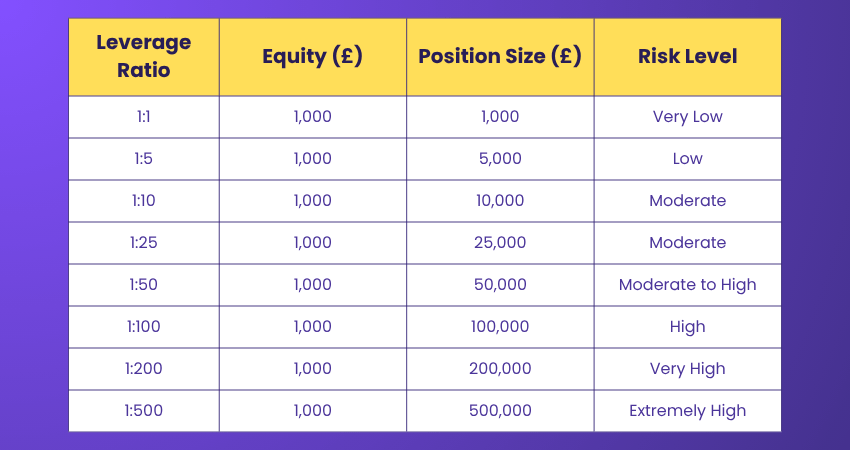
Broker-specified initial margins fluctuate based on trade size. For example, a 100,000 GBP/USD trade might require a £1,000 margin, equating to a 1% requirement (£1,000 / £100,000). The resulting Leverage ratio, illustrating trade amplification due to the held margin, is calculated as 100:1 (£100,000 / £1,000). The subsequent outlines margin requirements and corresponding Leverage ratios:
a) A 2% margin necessitates a 50:1 Leverage ratio
b) A 1% margin yields a 100:1 Leverage ratio
c) A 0.5% margin corresponds to a 200:1 Leverage ratio
Lower margin requirements in Forex Trading determine the level of exposure a Trader can achieve with their capital. Different Leverage ratios offer varying levels of risk and potential reward, making it crucial for Traders to understand these ratios for effective trading. Common Leverage ratios include:
Now lets’ explore the prominent types of leverage ratios:
1) Debt-to-Equity (D/E) Ratio
The debt-to-equity ratio is one of the most recognised financial leverage measures. It is calculated as:
Debt-to-Equity Ratio = Total Liabilities ÷ Total Shareholders’ Equity
A D/E ratio above 2.0 generally signals higher risk, though acceptable levels vary by industry. Companies with heavy capital expenditure like utilities and manufacturers naturally take on more debt. A high D/E ratio shows a business is financing growth using borrowed funds, which can make earnings more volatile.
2) Equity Multiplier
The equity multiplier is similar, but it substitutes total assets for debt:
Equity Multiplier = Total Assets ÷ Total Equity
For example, if Company A holds £19.85 billion in assets and £4.32 billion in equity, its equity multiplier is:
£19.85 billion ÷ £4.32 billion = 4.59
Although debt isn’t directly included in the formula, it still influences the ratio because assets contain debt-financed items. Company A's high multiplier of 4.59 indicates that most of its assets are funded by liabilities, £15.53 billion in this case.
3) Debt-to-Capitalisation Ratio
This ratio spotlights how much of a company’s capital structure is funded by debt:

Operating leases are included as capitalised items, and equity includes both common and preferred shares. Analysts may use total debt instead of only long-term debt depending on the company’s structure.
4) Degree of Financial Leverage (DFL)
DFL shows how sensitive a company’s Earnings per Share (EPS) is to the changes in operating income. It measures how a shift in EBIT affects EPS:
DFL = % Change in EPS ÷ % Change in EBIT
It can also be expressed as:

A higher DFL indicates that earnings will fluctuate more dramatically. Because interest is a fixed cost, leverage amplifies both gains and losses; favourable in good times but risky when revenue drops.
5) Consumer Leverage Ratio
This ratio measures how much debt the average consumer holds relative to their disposable income:
Consumer Leverage Ratio = Total Household Debt ÷ Disposable Personal Income
Rising consumer debt has been linked to economic growth but has also been cited as a factor in major downturns such as the Great Recession.
6) Debt-to-Capital Ratio
This ratio evaluates the proportion of total capital funded by debt:
Debt-to-Capital = Total Debt ÷ (Total Debt + Shareholders’ Equity)
Higher ratios suggest greater financial risk and reliance on borrowed funds. Acceptable ranges vary by sector—some industries naturally operate with higher leverage.
7) Debt-to-EBITDA Leverage Ratio
This ratio compares total debt to EBITDA to assess a company’s ability to repay obligations:
Debt-to-EBITDA = Total Debt ÷ EBITDA
It estimates how many years of EBITDA would be needed to clear all debt. Ratios above 3.0 can be concerning, depending on the industry.
8) Debt-to-EBITDAX Ratio
This is similar to the previous ratio but excludes exploration expenses, primarily for oil and gas firms. EBITDAX stands for 'Earnings Before Interest, Taxes, Depreciation, Amortisation and Exploration'. It is used to normalise financial performance across companies that use different exploration accounting methods.
9) Interest Coverage Ratio
This ratio measures how easily a company may cover interest payments:
Interest Coverage = Operating Income ÷ Interest Expense
A ratio of 3.0 or higher is typically considered healthy, though standards vary by sector.
10) Fixed-Charge Coverage Ratio (Times Interest Earned)
Also known as TIE, this ratio refines interest coverage by focusing on long-term liabilities:
TIE = EBIT ÷ Interest Expense
Using pretax earnings is important because interest expenses are tax-deductible. Higher ratios indicate stronger ability to meet debt obligations.
Start building your path to lasting financial success with our Investment Management Course – Register today!
How to Calculate Leverage in Forex?
The basic formula to calculate Leverage is straightforward:
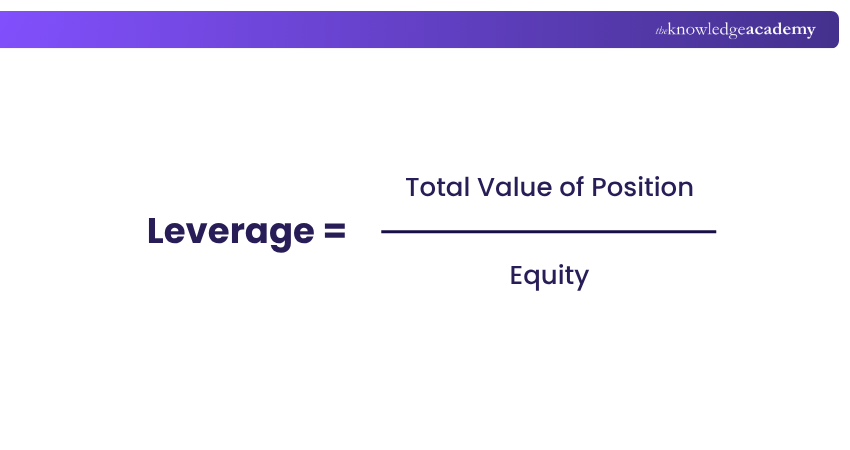
a) Total Value of Position: This is the size of the position you are controlling in the market. It is the total amount of money you are trading, including the borrowed funds.
b) Equity: This is the amount of your own money that you have put into the trade.
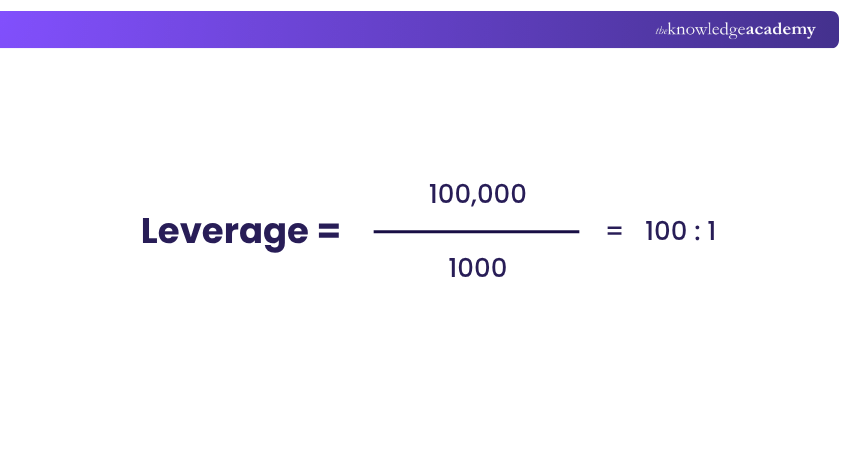
For example, if a Trader uses £1,000 of their own money to control a £100,000 position, the Leverage ratio would be:
Practical Steps to Calculate Leverage
a) Determine Your Equity: Start by identifying the amount of capital you have available to trade. This is the money you have in your trading account that you are willing to use for trading.
b) Decide on the Position Size: This is the total amount of money you want to control in the market. Forex Brokers often allow Traders to control large positions with relatively small amounts of equity.
c) Apply the Leverage Formula: Use the Leverage formula mentioned above to calculate your Leverage ratio.
Example of Leverage Calculation
Let’s say you have £5,000 in your trading account, and you want to open a position worth £250,000. To find out the Leverage ratio, you would use the formula:

This means you are using a Leverage of 50:1, allowing you to control a £250,000 position with just £5,000 of your own money.
Using a Forex Leverage Calculator
To simplify the process, many brokers offer online Forex Leverage calculators. These Forex Trading Tools automatically calculate the Leverage based on the input values of equity and position size. Here’s how to use a Forex Leverage calculator:
a) Enter Your Equity: Input the amount of money you have available to trade.
b) Enter the Position Size: Input the total value of the position you wish to control.
c) Calculate: The calculator will compute the Leverage ratio for you automatically.
Benefits of Using Leverage in Forex
Leverage is an integral part of the Forex market, offering both risks and advantages. When used judiciously, Leverage can be a significant asset to Traders. Let’s explore its numerous benefits.
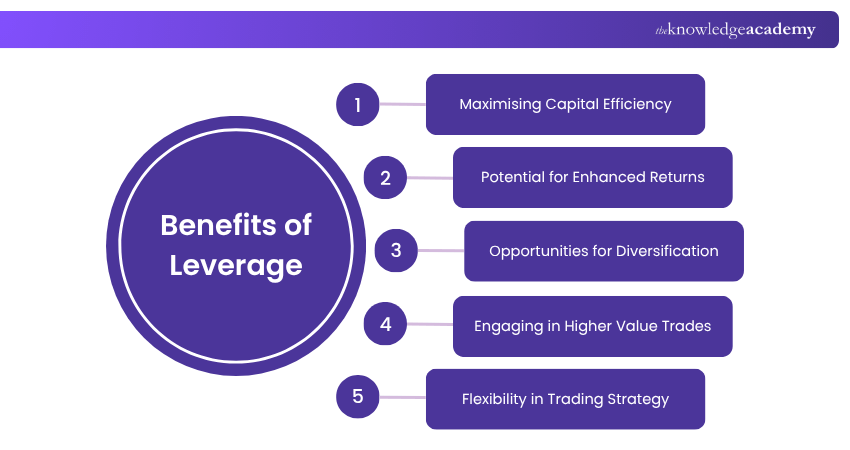
1) Maximising Capital Efficiency
Leverage enables Traders to control quite large trading exposures for relatively small amounts of capital. For example, a 100:1 Leverage ratio means that with £1000, a Trader is able to manage a £100,000 trade. This capability can lead to potentially higher profits without having to commit all their capital. This allows the Trader to make optimal use of the capital at his or her disposal.
2) Potential for Enhanced Returns
The amplifying effect of Leverage means that even minor price shifts can lead to substantial profits. For instance, a 1% shift in a currency’s value can result in a 100% return on investment with the right Leverage. This magnification can turn small market movements into significant profit opportunities, making Leverage a powerful tool for increasing trading returns.
3) Opportunities for Diversification
By accessing larger positions, Traders can spread their capital across various trades, reducing the impact of a poor-performing trade on the overall portfolio. Diversification serves as a Risk Management strategy, providing a safety net that ensures not all capital is at risk in a single position. This ability to diversify can enhance the overall stability and performance of a Trader's portfolio.
4) Engaging in Higher Value Trades
Leverage also allows one to participate in trades of higher value than they would be able to without Leverage, which is generally a domain of larger institutions or banks. Thus, if applied correctly, it levels up the playground. An individual Trader would then be allowed to compete with other big boys, taking part in markets far beyond their financial capability.
5) Flexibility in Trading Strategy
Finally, Leverage enables the Trader to engage in many Forex Trading Strategies that would not be possible without it. Whether he is involved in short-term scalping or long-term position trading, Leverage can be adapted to fit many trading styles. This makes it possible to optimise the outcomes of trading by giving Traders the tools they need to reach their particular financial goals.
Understand effective Risk Management strategies to protect your capital with our Day Trading Course – Sign up right now!
Risks Associated With Forex Trading and Leverage
Forex trading provides the potential for lucrative returns but it comes with its fair share of risks. The use of Leverage amplifies these risks, making it imperative for Traders to approach with caution. Here are the primary risks associated with Forex trading and Leverage.
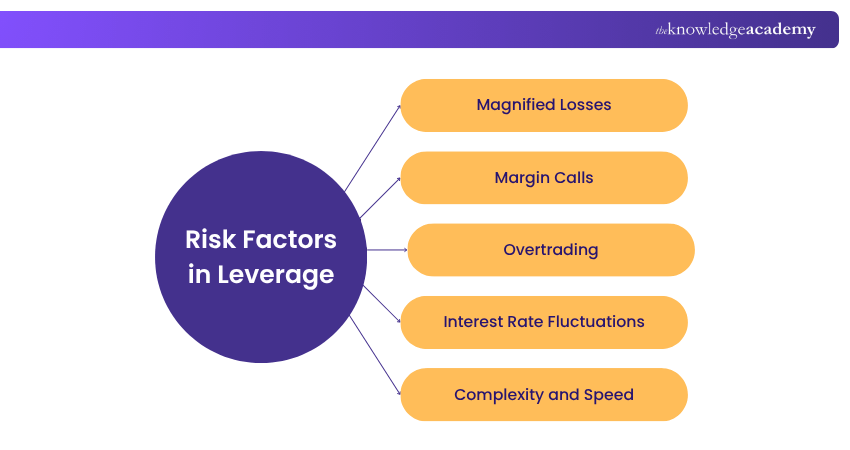
1) Magnified Losses
Leverage can magnify losses just as it can amplify profits. A slight adverse movement in currency values can result in significant losses when trading with high Leverage. This means that one could potentially lose more than their initial investment, highlighting the importance of careful Risk Management.
2) Margin Calls
Margin calls are another significant risk. Brokers require the Traders to maintain a minimum balance, known as the "margin requirement." If a Leveraged position moves against the Trader, their balance might fall below this requirement. In such cases, brokers can initiate a margin call, liquidating positions to cover the shortfall. This can lead to unexpected and substantial losses.
3) Overtrading
Overtrading is a common pitfall for Traders attracted by the prospect of high returns. The allure of significant gains can tempt Traders to take on excessive positions. Overtrading, especially when fueled by high Leverage, can lead to substantial losses. It's crucial to maintain discipline and not let greed dictate trading decisions, ensuring a more balanced and thoughtful approach.
4) Interest Rate Fluctuations
Interest rate fluctuations also pose a risk in Forex Trading. Trading often involves borrowing one currency to purchase another, and fluctuations in interest rates can affect the cost of borrowing, impacting profitability. An unfavourable shift in interest rates can erode potential profits or exacerbate losses, making it essential to stay informed about economic indicators.
5) Complexity and Speed
Lastly, the complexity and speed of the Forex market add to the risk. Operating 24 hours a day, the market experiences rapid price changes. Leveraged positions are particularly sensitive to these swift fluctuations, requiring Traders to stay alert and make quick decisions, informed by Forex Market Analysis, to protect their investments. This high-speed environment can be challenging to navigate without a robust understanding of the market.
Choosing the Right Leverage
Selecting the right leverage is one of the most important decisions a Trader can make. It depends on your trading experience, risk tolerance, and market understanding. Beginner Traders can prefer low leverage ratios like 1:5 or 1:10, as they limit risk and allow more control during market swings. Experienced Traders may use higher leverage, such as 1:50 or 1:100, but they consider strict Risk Management and local regulatory limits.
The key is to balance potential rewards with acceptable risk. Always select a leverage level that matches your trading experience, strategy, and risk tolerance.
Learn proven strategies for more profitable investment with our Stock Trading Course – Join soon!
Trading Examples
To understand how leverage works in practice, let’s look at a few real-world trading examples. They show how different leverage levels can impact your profits and losses across various markets.
1) Forex Trading Example
Let’s imagine that you have £5,000 in your forex account:
a) Without leverage (1:1), you can trade a position worth £5,000.
b) With 50:1 leverage, you control a position size of £250,000 (50 times your capital).
If the currency pair rises by 1%, you gain £250. That is a 5% return on your original £5,000 capital. But if the market moves against you by the same amount, you’d lose £250.
2) Stock Trading Example
Assume you want to buy shares in a tech company priced at £100 per share.
a) With £5,000 and no leverage, you can buy 50 shares. If the price rises to £110, your profit is £500.
b) Using 2:1 leverage, you control £10,000 worth of stock with your £5,000. If the price rises by the same £10, your profit doubles to £1,000.
However, if the share price falls instead, your losses also double, showing why leverage must be used wisely.
3) Cryptocurrency Trading Example
Let’s consider that you have £1,000 to trade Bitcoin (BTC) at £40,000 per BTC.
a) Without leverage (1:1), you can buy 0.025 BTC.
b) With 10:1 leverage, you control £10,000 worth of Bitcoin by borrowing £9,000 from your broker.
If BTC rises by 1%, you earn £100 (1% of £10,000), giving you a 10% return on your £1,000. But if it falls by 1%, you lose £100, highlighting how volatile leveraged Crypto Trading can be.
4) Commodity Trading Example
Let’s think that you have £2,000 to trade crude oil, which is priced at £60 per barrel.
1) Without leverage (1:1), you can control a position worth £2,000, which equals about 33 barrels.
2) With 1:25 leverage, you control a position worth £50,000, borrowing £48,000 from your broker.
If oil prices rise by 2%, you make a £1,000 profit, earning a 50% return on your £2,000. But if prices fall by 2%, you lose £1,000, showing how quickly leverage can impact both profits and losses.
Do Professional Traders Use Leverage?
Yes, professional Traders use leverage, but they use it strategically with strict risk controls. They apply lower leverage ratios to maintain stability and preserve capital. Professionals rely on a mix of technical analysis, stop-loss placements, and risk-to-reward ratios to ensure that leverage enhances performance without exposing them to unnecessary risk.
Is 10x Leverage too Much?
The proper leverage depends on your risk tolerance, experience, and the market conditions you’re trading in. For most retail Traders, 10x leverage can be considered quite high and risky. However, beginners can ideally start with low leverage, such as 1x to 5x, to maintain control and limit risk exposure. Experienced Traders may use 5x to 20x leverage, but only with well-defined stop-losses and position sizing strategies.
Conclusion
Leverage in Forex Trading can be an indispensable ally when used wisely to access larger positions, increase potential profits, and make the most of market opportunities. However, it also carries significant risk, as the same force that offers gains can just as easily lead to losses. The key lies in having a proper knowledge of What is Leverage in Forex Trading and in its discipline. Use it with caution because, in trading, protecting your capital is just as vital as growing it.
Explore our Investment and Trading Training today and become an expert in Forex Trading!
Frequently Asked Questions
How Does Leveraging Pave the way for Better Risk Assessment and Management in the Forex Market?

Leveraging in the Forex market enhances risk assessment and management by allowing Traders to control larger positions with relatively little capital. While it amplifies potential profits, it also magnifies potential losses. Traders can assess and calibrate risk exposure by understanding and effectively utilising Leverage ratios.
Can Traders With Varying Levels of Experience Effectively Utilise Leverage in Their Forex Transactions?
Traders with varying experience levels can use Leverage in Forex transactions, but effectiveness depends on risk awareness. Novice Traders may benefit from conservative Leverage to minimise potential losses, while experienced Traders may Leverage more aggressively based on a thorough understanding of market dynamics.
What are the Other Resources and Offers Provided by The Knowledge Academy?
The Knowledge Academy takes global learning to new heights, offering over 3,000 online courses across 490+ locations in 190+ countries. This expansive reach ensures accessibility and convenience for learners worldwide.;
Alongside our diverse Online Course Catalogue, encompassing 17 major categories, we go the extra mile by providing a plethora of free educational Online Resources like Blogs, eBooks, Interview Questions and Videos. Tailoring learning experiences further, professionals can unlock greater value through a wide range of special discounts, seasonal deals, and;Exclusive Offers.
What is The Knowledge Pass, and How Does it Work?
The Knowledge Academy’s Knowledge Pass, a prepaid voucher, adds another layer of flexibility, allowing course bookings over a 12-month period. Join us on a journey where education knows no bounds.
What are the Related Courses and Blogs Provided by The Knowledge Academy?
The Knowledge Academy offers various Investment and Trading Training, including Forex Trading Course, Day Trading course and Stock Trading Course. These courses cater to different skill levels, providing comprehensive insights into the best Forex Trading Strategies.
Our Business Skills Blogs cover a range of topics related to Leverage in Forex Trading, offering valuable resources, best practices, and industry insights. Whether you are a beginner or looking to advance your Forex Trading skills, The Knowledge Academy's diverse courses and informative blogs have got you covered.

The Knowledge Academy


Global Training Provider
The Knowledge Academy is a world-leading provider of professional training courses, offering globally recognised qualifications across a wide range of subjects. With expert trainers, up-to-date course material, and flexible learning options, we aim to empower professionals and organisations to achieve their goals through continuous learning.

Upcoming ISO & Compliance Resources Batches & Dates
Date
 Cryptocurrency Trading Training
Cryptocurrency Trading Training
Fri 7th Aug 2026
Cryptocurrency Trading Training
Fri 30th Oct 2026

 If you wish to make any changes to your course, please


