


 Top Rated Course

We may not have the course you’re looking for. If you enquire or give us a call on +44 1344 203999 and speak to our training experts, we may still be able to help with your training requirements.
Self-employed vs Employed: Salary, Tax, and Job Security Comparison
The Knowledge Academy 27 February 2026Self-employed individuals run their own business, clients, handle taxes, and set hours but lack benefits. Employees earn a salary with paid leave and PAYE tax. They are two ways of working with different financial structures and responsibilities. Understanding Self-employed vs Employed clarifies its effects on income, tax, and finances.

Training Outcomes Within Your Budget!
We ensure quality, budget-alignment, and timely delivery by our expert instructors.
Table of Contents
Have you ever thought whether running your own business would suit you or working for an employer? The choice between Self-employed vs Employed shapes your daily routine, income stability, and level of independence. From flexible schedules to steady pay cheques, each path offers a different work experience that influences both your lifestyle and financial security.
Understanding Self-employed vs Employed means recognising the responsibility, freedom, and risk both bring. Some people value control and flexibility, while others prefer structure and a stable income. In this blog, you will learn about the difference between Self-employed and employed along with their benefits to help you decide which path fits you better.
Table of Contents
1) What is Self-employed?
2) What is Employed?
3) Self-employed vs Employed: Key Differences
4) Benefits of Being Self-employed
5) Benefits of Employment
6) Conclusion
What is Self-employed?
A Self-employed person is an individual who works independently from a company or is the owner or key member of a business. Self-employed individuals receive direct payment from clients and rarely work under a salary-based framework. Being Self-employed unveils many opportunities and enables individual freedoms such as flexible hours, work environment customisation, and increased pay.
What is Employed?
Being Employed refers to having paid work. It involves a relationship between an employer, who provides the job, and an Employee, who performs tasks in exchange for compensation. Additionally, employment can refer to the process of hiring people to perform services. So, employment is the condition where an individual gets paid to do a job, whether full-time, part-time, or even a temporary gig.
Self-employed vs Employed: Key Differences
The choice between Self-employed vs Employed work affects how you earn, plan your finances, and manage your career growth. While both provide opportunities to succeed, learning their differences helps you decide with clarity. Let’s look at their differences below:
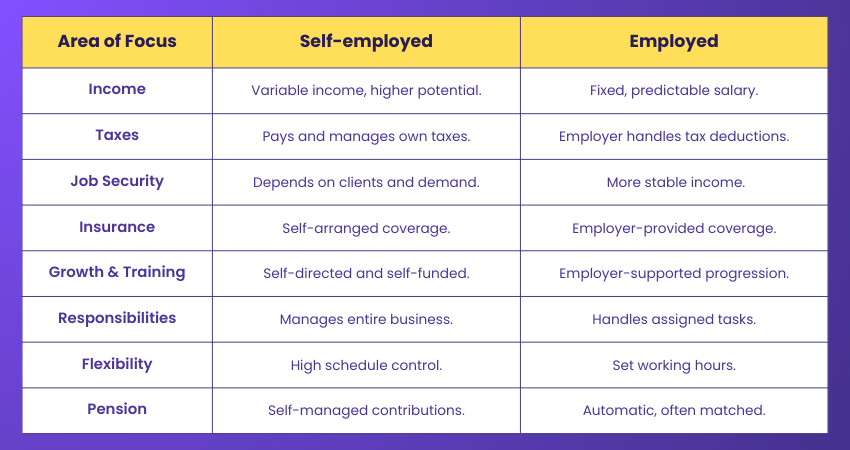
1) Income
Self-employed individuals have the potential to earn more, especially in industries where income is based on demand, pricing, and client work. You can set your own rates and take on multiple projects, resulting in increased earning potential over time.
Although it is important to note that income can be inconsistent, monthly earnings can vary when building a client base or searching for new projects. In contrast, Employed individuals receive a monthly fixed salary, providing financial stability and a predictable income source.
2) Taxes
Self-employed professionals are responsible for managing their own taxes, including paying applicable income and payroll taxes. They must plan to set aside money and make scheduled payments throughout the year.
In contrast, traditional Employed individuals rarely handle their taxes directly. Their employer’s Human Resources (HR) or payroll department calculates deductions and withholds taxes automatically from their fixed salary.
3) Job Security
Standard employment and Self-employment both involve different types of job security risks. Employees usually benefit from a steady workflow and receive regular pay on a fixed schedule. However, external factors such as changing business needs, client losses, or contract changes can still affect their job stability.
Self-employed individuals may face uncertainty when work is limited or when contracts and clients are not consistent. Also, they have greater flexibility to adapt their skills or offer new services in different markets. This control can help create more opportunities and support long-term income potential.
4) Insurance
Employed professionals are protected by insurance provided by their employer. This may cover workplace illness or injury, and many organisations offer benefits such as life insurance for added financial protection.
In contrast, Self-employed individuals must arrange and pay for their own insurance. This includes personal accident cover, health insurance, or income protection, making financial planning essential to manage unexpected risks.
5) Promotions and Training
Employed individuals have structured career paths, with opportunities to move up through promotions and performance-based growth. Additionally, many employers invest in staff development by providing training, certifications, or learning opportunities.
In contrast, Self-employed professionals are responsible for their own growth and career progression. While they can still pursue training or skill development, they must find, fund, and manage these opportunities independently.
Take control of your finances confidently with the Introduction to Managing Budgets Course today!
6) Responsibilities
A Self-employed individual carries more responsibility than an Employed person. This is because the former must manage, execute, and oversee daily operations and handle every aspect of the business. Also, they are accountable for any mistakes that may occur.
Meanwhile, for Employed professionals, the company manages and oversees daily operations and is only required to carry out the assigned tasks. This means they are only held accountable for the mistakes they make on the assigned projects.
7) Flexibility
Self-employment is flexible, allowing individuals to work on projects they enjoy and with whomever they want. This means you can pick and choose your projects and clients, offering flexibility in workspace selections, whether at home or in a leased space.
Meanwhile, Employed individuals offer little flexibility. The assigned tasks must be completed within certain work hours based on your contract. Failure to do so can result in penalties or job termination.
8) Work-life Balance
Self-employment provides greater flexibility. With control over their schedules, Self-employed individuals can organise their time more freely and prioritise personal commitments, helping them maintain stronger social connections and personal well-being.
In contrast, Employed individuals follow fixed working hours and structured routines. While this provides stability, it can also increase the risk of stress or burnout over time, especially when workloads are high or flexibility is limited.
9) Earning Potential
Self-employed individuals earn income after covering business expenses. They pay for taxes, utilities, and software, while also covering insurance, rent, and wages. The remaining income can then be saved, invested, or reinvested.
Conversely, Employed individuals are provided with consistent pay checks, which are received on the same day each month, enabling far easier budgeting and future planning. Additionally, earnings are typically unaffected by business performance, ensuring stable income even during tough times for the company.
10) Pension Schemes
Employed professionals usually contribute automatically to pension schemes through salary deductions. In many cases, employers also add contributions, helping employees build retirement savings more steadily over time.
Self-employed individuals must create and manage their own pension arrangements. They are responsible for making regular contributions and planning independently to secure their retirement income.
Looking to enhance your relationship-building skills as a business owner? Sign up for our Building Business Relationships Course now!
Benefits of Being Self-employed
Self-employed offers greater independence and control over how you work. Let’s look at the key benefits it brings below:
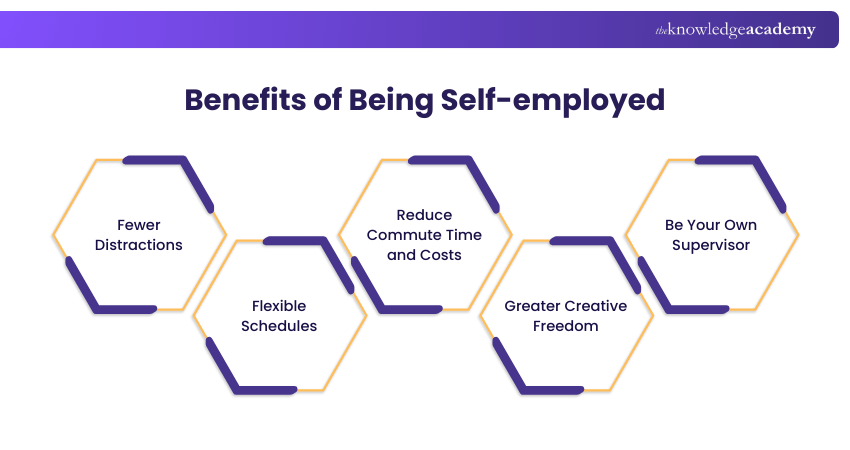
1) Fewer Distractions
Self-employed professionals work in environments they control, such as their home or client locations. This reduces common workplace distractions, such as constant meetings, office noise, or interruptions, leading to improved focus and productivity.
2) Flexible Schedules
One of the best advantages of Self-employment is the ability to set your own working hours. You can adjust your schedule daily or weekly to suit personal commitments without being dependent on company-approved leave or fixed office timings.
3) Reduce Commute Time and Costs
Many Self-employed individuals work remotely or travel less frequently. This reduces time spent commuting and lowers commute-related expenses, such as fuel, parking, and daily purchases like coffee or lunch.
4) Greater Creative Freedom
Self-employed professionals can choose how they approach tasks and projects. Without any strict organisational rules or assigned methods, they can experiment with ideas, try new strategies, and work in ways that suit their strengths.
5) Be Your Own Supervisor
Self-employment means managing your own workload and progress. There is no need to report to a manager or wait for any instructions. This enables you to make decisions independently and take full ownership of your work.
Turn your ideas into successful businesses and build your dream venture with the Entrepreneurship Course – Sign up now!
Benefits of Employment
When comparing Self-employed vs Employed, working as an employee offers structure, financial stability, and access to workplace benefits that support security. Let’s look at the various key benefits it brings below:
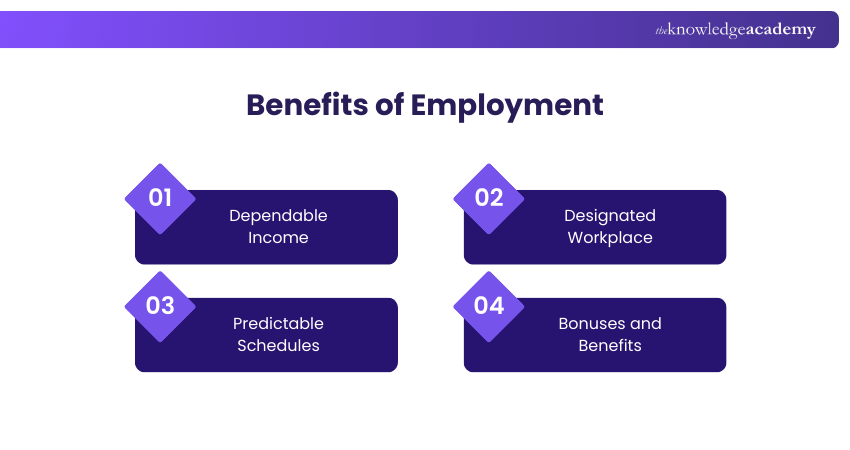
1) Dependable Income
One of the key benefits of being Employed is receiving a regular and predictable salary. Employees are paid on a fixed schedule, making it easier to plan budgets, manage expenses, and maintain financial stability.
2) Designated Workplace
Employees work in a specific office or work location, which helps separate their professional and personal lives. A structured workplace can also provide opportunities for social interaction, teamwork, and collaboration with workplace colleagues.
3) Predictable Schedules
Employment comes with set working hours, allowing employees to plan their time more easily. Knowing your schedule in advance helps with managing personal commitments and reduces uncertainty during working hours
4) Bonuses and Benefits
Many organisations offer additional financial incentives, such as bonuses or commissions. Employees may also receive valuable benefits, such as private healthcare, retirement contributions, or childcare support, enhancing overall job security and well-being.
Conclusion
The choice between Self-employed vs Employed depends on your priorities, lifestyle, and comfort. If you value flexibility, independence, and control, Self-employment may suit you. If you prefer stability, structured growth, and reliable benefits, employment may be the better choice. Understanding what each path offers helps you make a confident decision that aligns with your long-term goals.
Take the first step towards personal growth and unlock your potential with Personal Development Courses now!
Frequently Asked Questions
Can You Be Both Self-employed and Employed at the Same Time?

Yes, you can be Self-employed and Employed at the same time. Many individuals work a regular job while running a business or side hustle. However, income from Self-employment must be declared separately and requires registering and submitting a tax return.
Is Freelancing the Same as Being Self-employed?
Yes, freelancing is a type of self-employment, but the two are similar. A freelancer works on short-term projects for different clients. However, Self-employment is a broader term that can include running a business, hiring staff, or offering ongoing service.
What are the Other Resources and Offers Provided by The Knowledge Academy?
The Knowledge Academy takes global learning to new heights, offering over 3,000+ online courses across 490+ locations in 190+ countries. This expansive reach ensures accessibility and convenience for learners worldwide.
Alongside our diverse Online Course Catalogue, encompassing 17 major categories, we go the extra mile by providing a plethora of free educational Online Resources like Blogs, eBooks, Interview Questions and Videos. Tailoring learning experiences further, professionals can unlock greater value through a wide range of special discounts, seasonal deals, and Exclusive Offers.
What is The Knowledge Pass, and How Does it Work?
The Knowledge Academy’s Knowledge Pass, a prepaid voucher, adds another layer of flexibility, allowing course bookings over a 12-month period. Join us on a journey where education knows no bounds.
What are the Related Courses and Blogs Provided by The Knowledge Academy?
The Knowledge Academy offers various Personal Development Courses, including the Self-Employment Training, Introduction to Managing Budgets Course and the Building Business Relationships Course. These courses cater to different skill levels, providing comprehensive insights into What is Flexible Budget.
Our Business Skills Blogs cover a range of topics related to employment, offering valuable resources, best practices, and industry insights. Whether you are a beginner or looking to advance your employment prospects, The Knowledge Academy's diverse courses and informative blogs have got you covered.

The Knowledge Academy


Global Training Provider
The Knowledge Academy is a world-leading provider of professional training courses, offering globally recognised qualifications across a wide range of subjects. With expert trainers, up-to-date course material, and flexible learning options, we aim to empower professionals and organisations to achieve their goals through continuous learning.

Upcoming Business Skills Resources Batches & Dates
Date
 Self-Employment Training
Self-Employment Training
Fri 24th Jul 2026
Self-Employment Training
Fri 16th Oct 2026

 If you wish to make any changes to your course, please


