


 Top Rated Course

We may not have the course you’re looking for. If you enquire or give us a call on +44 1344 203999 and speak to our training experts, we may still be able to help with your training requirements.
Go Programming Language: Features, Applications & Limitations
The Knowledge Academy 25 December 2025Go is an open-source, statically typed, compiled language by Google, built to create fast, scalable, and concurrent applications with clean, efficient code. It features simple syntax and built-in concurrency support through goroutines and channels. This makes Go ideal for cloud services, APIs, and high-performance backends.

Training Outcomes Within Your Budget!
We ensure quality, budget-alignment, and timely delivery by our expert instructors.
Table of Contents

Go has gained fame for its straightforwardness, speed, and trustworthiness. It allows programmers to create effective software with little or no complications. Go Programming is now present in the areas of cloud infrastructures, microservices, and modern applications. Join us as we examine its main characteristics, applications, and constraints below.
Table of Contents
1) What is the Go Programming Language?
2) Features of Golang
3) Applications of Go Programming
4) Go vs Other Programming Languages
5) Benefits of the Go Programming Language
6) Limitations of the Go Programming Language
7) Is Go a compiled or Interpreted Language?
8) Conclusion
What is the Go Programming Language?
Go (also known as Golang or Go language) is an open-source Programming Language developed by Google. Software developers use Go in various operating systems (OS) and frameworks to develop Cloud and networking services, web applications and other types of software.
Go is statically typed and modelled after the C Programming Language. Due to its low runtime overhead, fast startup time, and ability to run without a virtual machine (VM), it has become popular for writing microservices and other uses. Additionally, Go is used for concurrent programming, a strategy for executing multiple tasks simultaneously, out of order or in partial order.

Features of Golang
Golang is an advanced programming language that helps software development by providing a clean and efficient design that supports fast, scalable, and reliable development. Speed, simplicity, and safe concurrent programming are the main aspects of its core features.
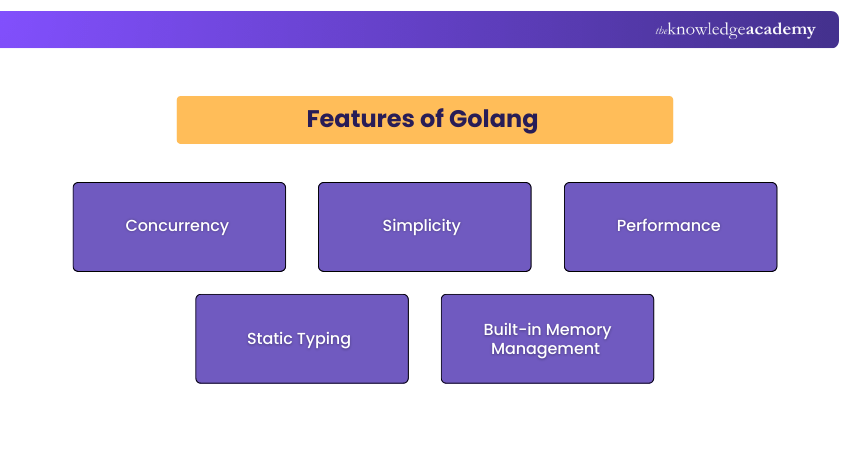
1) Concurrency
Golang employs goroutines and channels to execute multiple tasks at the same time with very little overhead. Thus, it proves to be the best suited for scalable network services and distributed systems.
2) Simplicity
The language adheres to a minimal and clear syntax, which is a great help to the developers in writing code that is readable and maintainable. This simplicity in writing code leads to bugs being reduced and development being accelerated.
3) Performance
Golang translates the source code into machine code, and thus it gets the performance nearly equal to C and C++. The lightweight concurrency model of Golang also contributes to the speed of real-world applications.
4) Static Typing
Golang relies on static typing as a mechanism to identify and avoid errors early in the development process and to improve the reliability of the code. Static typing also makes tooling support better, as the types are available at compile time.
5) Built-in Memory Management
Garbage collection is done automatically, which means developers would not have to intervene manually and would still manage memory safely. This causes stability to be enhanced and memory-related issues in applications to be reduced.
Acquire the practical skills needed to create apps, websites, and software with our Programming Courses– Start your journey today!
Applications of Go Programming
If you’re seeking a new language to add to your tech stack, Go is an excellent option. There are plenty of reasons to develop Go programming skills. Its versatile can be applied in a variety of settings, including the following:
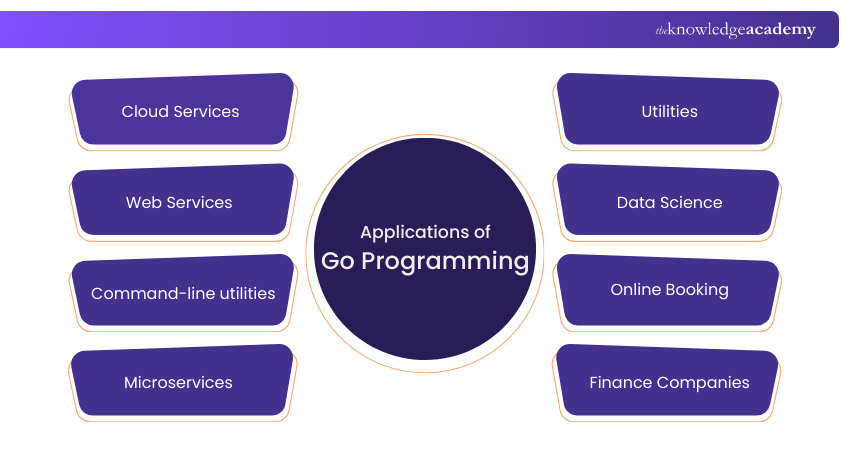
1) Cloud Services
The cloud and network services are the main applications for Go due to the combination of efficient concurrency and small binary files.
2) Web Services
A server and API are the main backend elements of scaling and rapidly developing web applications, and Go is one of the most common languages for that.
3) Command-line utilities
Another reason for Go to be a leader in the development of CLI tools and utilities is the creation of small, fast executables that can run on all operating systems.
4) Microservices
Go is the right choice for microservices-based applications as its concurrent programming model, simplified deployment (one binary per service), and low overhead all contribute to this.
5) Utilities
Go is used by developers to provide their tools and utilities for automation, system tasks, and infrastructure management, to take advantage of its performance and portability.
6) Data Science
Coming from an area of web/cloud, Go is still less popular for data processing or data-intensive backend services, but similar reasons of speed and concurrency support can be mentioned.
7) Online Booking
In the case of Go, its backend efficiency, concurrency management, and scalability allow it to be the main player in the development of online booking systems, as well as in web services, microservices, and concurrency handling.
8) Finance Companies
Performance, concurrency, and reliability of compiled Go binaries encourage it as a strong candidate for backend systems in the finance industry, high-volume transaction processing, and scalable services.
Advance your career with expert-led Python Course training.
Go vs Other Programming Languages
Go delivers remarkable advantages in speed, simplicity, and built-in concurrency, which are very important for modern applications that need to scale. Evaluating it against other languages gives the developers a chance to determine the best option based on either performance or flexibility.
Go vs Python
Go provides benefits such as faster performance, static typing, and powerful concurrent features which are perfect for building large-scale backend systems. On the other hand, Python is all about flexibility and ease of use and is therefore the best choice for areas like data science, scripting, and rapid development. Go is the preferred option for high throughput workloads, whereas Python's strength lies in its versatility.
Go vs C++
Go ensures the utmost simplicity in development through the means of automatic memory management and an easy-to-read syntax. On the other hand, C++ provides more control for tasks where high performance is a requirement. Go is a perfect match for large and complex cloud infrastructures, while C++ is the undisputed champion for performance-sensitive applications.
Benefits of the Go Programming Language
Go Programming Language offers numerous benefits, including the following:
1) It's a concurrent language that supports CSP communication channels.
2) It is an innovative language that takes the best of modern languages to forge an efficient, clear, and simple one.
3) Its garbage collector allows you to maximise efficiency and performance and minimises latency.
4) It has an active network of developers contributing tools, libraries, and resources.
5) It is ideal for building scalable systems that can handle large volumes of concurrent requests.
6) It strongly emphasises security and error prevention. Its compiler conducts extensive static checks at compile time, helping catch common errors before the app is executed.
7) It comes with a comprehensive standard library providing a wide range of functionality, enabling you to build applications without relying heavily on external libraries.
Limitations of the Go Programming Language
Despite its many advantages, Go Programming carries a baggage of drawbacks as well as detailed below:
1) Go is still a young language compared to other, more established languages. This means that the community may still be developing best practices and standard solutions in certain areas.
2) In some specific domains, there may be fewer mature and widely adopted libraries than in other, more established languages. Implementing specific functionality may require more effort and time.
3) In specific scenarios, manual memory management may be required to optimise performance. This necessitates increased attention and knowledge on the part of the developer.
4) Go uses composition instead of class inheritance. Despite its flexibility, it can be a challenge for those used to a more traditional inheritance paradigm.
5) Debugging is a common way to handle exceptional situations. However, it can be less intuitive for those used to traditional exception-handling mechanisms.
6) It may not be the best option for all use cases. For example, other specialised languages might be more appropriate if manipulation of complex scientific data or high mathematical computational ability is required.
Is Go a Compiled or Interpreted Language?
Go is a compiled language that transforms the source code into machine code, which is a binary format, and then execution takes place. This method eliminates the requirements of an interpreter during runtime.
The compiled code produces fast and effective performance, thus giving the developers the maximum performance. It also makes the distribution process easy since the final executable can be run on the target system without any intermediate steps.
Conclusion
Go Programming is still very noticeable for its fast, simple, and trustworthy integration in the current development scene. The language's quality in concurrency and scalability makes it a solid alternative for cloud, backend, as well as distributed systems. With the progress of technology, Go still holds its value as a practical and future-ready choice for developers.
Looking to build your next big Web Application? Our Python Django Training will guide you - Sign up now!
Frequently Asked Questions
Is Golang Used for the Backend?

Go is a good choice for backend development, specifically for large projects. It's primarily a backend language used to build components in Kubernetes, Terraform, Docker, InfluxDB, and more.
What are the two Main Functions of Golang?
In Go (Golang), there are two main functions:
a) main() Function: This is the entry point of any executable Go program. It must be defined in a package named main.
b) init() Function: This function is used for initialisation tasks that must be performed before the main() function runs.
What are the Other Resources and Offers Provided by The Knowledge Academy?
The Knowledge Academy takes global learning to new heights, offering over 3,000 online courses across 490+ locations in 190+ countries. This expansive reach ensures accessibility and convenience for learners worldwide.
Alongside our diverse Online Course Catalogue, encompassing 19 major categories, we go the extra mile by providing a plethora of free educational Online Resources like Blogs, eBooks, Interview Questions and Videos. Tailoring learning experiences further, professionals can unlock greater value through a wide range of special discounts, seasonal deals, and Exclusive Offers.
What is The Knowledge Pass, and How Does it Work?
The Knowledge Academy’s Knowledge Pass, a prepaid voucher, adds another layer of flexibility, allowing course bookings over a 12-month period. Join us on a journey where education knows no bounds.
What are the Related Courses and Blogs Provided by The Knowledge Academy?
The Knowledge Academy offers various Programming Courses, including the Python Course, ReactJS Course, and Haskell Programming Course. These courses cater to different skill levels, providing comprehensive insights into Data Discrepancy.
Our Programming & DevOps Blogs cover a range of topics related to Earned Value Management, offering valuable resources, best practices, and industry insights. Whether you are a beginner or looking to advance your Programming & DevOps skills, The Knowledge Academy's diverse courses and informative blogs have got you covered.

The Knowledge Academy


Global Training Provider
The Knowledge Academy is a world-leading provider of professional training courses, offering globally recognised qualifications across a wide range of subjects. With expert trainers, up-to-date course material, and flexible learning options, we aim to empower professionals and organisations to achieve their goals through continuous learning.

Upcoming Programming & DevOps Resources Batches & Dates
Date
 Go Programming Training
Go Programming Training
Thu 16th Jul 2026
Go Programming Training
Thu 5th Nov 2026

 If you wish to make any changes to your course, please


