


 Top Rated Course

We may not have the course you’re looking for. If you enquire or give us a call on +353 12338944 and speak to our training experts, we may still be able to help with your training requirements.
What is Referential Integrity and Why It Matters
Richard Harris 06 March 2026Referential integrity is a rule in relational databases that ensures data in related tables stays consistent, accurate, reliable, and properly connected. It means that a foreign key in one table must match a primary key in another table. This prevents broken links, for example, you can’t assign an order to a customer that doesn’t exist.

Training Outcomes Within Your Budget!
We ensure quality, budget-alignment, and timely delivery by our expert instructors.
Table of Contents

You know that feeling when one sock vanishes in the laundry? Databases feel that too, when one record points to another that’s mysteriously missing. That’s where Referential Integrity comes in. It’s the simple but powerful rule that keeps your data relationships tight, clean, and reliable.
If you’ve ever wondered how databases keep things so structured, this is the secret sauce. In this blog, we’ll walk you through Referential Integrity in a way that’s easy, visual, and yes, even a little fun. Whether you’re studying for exams or just curious, get ready to make sense of one of the most important but invisible rules in data.
Table of Contents
1) What is Referential Integrity?
2) The Importance of Referential Integrity
3) Factors for Inconsistencies in Database Data
4) Best Practices for Creating Databases with Referential Integrity
5) What is Database Normalisation?
6) Referential Integrity in Synthetic Data
7) What are the conditions required to enforce referential integrity?
8) What is referential integrity in a level computer science?
9) What is the difference between referential integrity and data integrity?
10) Conclusion
What is Referential Integrity?
Referential Integrity is a fundamental concept in relational databases that ensures the consistency and validity of relationships between tables. It guarantees that foreign keys in one table correctly correspond to primary keys in another table, maintaining accurate and meaningful connections between related data. Ensures every order point to an existing customer, or every enrollment points to an actual student and course.

If one table (child) references another table (parent), Referential Integrity makes sure the link is valid. For example, ensuring every order points to an existing customer, or every enrolment points to an actual student and course.
Key Takeaways:
1) Maintains data accuracy and consistency
2) Prevents broken relationships between tables
3) Enforces data integrity across the database
4) Reduces the risk of logical errors and data corruption
The Importance of Referential Integrity
Ever tried finding an old friend’s number, only to realise it’s saved under “Emily – New” in your phone, but you never updated her contact details? Frustrating, right? The same mess can happen in databases when Referential Integrity is ignored.
1) Prevents Data Anomalies
Without RI, data becomes unreliable. Suppose a company deletes a customer record, but their associated orders remain—now, we have ghost orders with no owner! This leads to errors in reporting, customer service mishaps, and financial discrepancies.
2) Improves Data Accuracy
By enforcing Referential Integrity, databases ensure that relationships remain intact. This accuracy is especially vital in industries like healthcare, finance, and E-Commerce, where incomplete data can lead to incorrect medical records, misplaced transactions, or misallocated shipments.
3) Enhances System Efficiency
When a database maintains strong Referential Integrity, searches and queries return accurate results without redundant or meaningless data. This boosts overall system performance, making applications and reporting tools more efficient.
4) Supports Business Logic and Decision-Making
Bad data leads to bad decisions. Imagine an inventory system with missing supplier links. The procurement team might order stock from a supplier that no longer exists! Referential Integrity ensures that business processes align with actual, verifiable data.
Learn how to install and configure InfluxDB OSS with our InfluxDB Training – Join now!
Factors for Inconsistencies in Database Data
If Referential Integrity is so vital, why do databases still suffer from inconsistencies? Often, it boils down to human errors, design flaws, or technical limitations. Here are the usual suspects:
1) Manual Data Entry Errors
Picture an intern hastily entering sales data into a system but misspelling customer IDs or leaving them blank. Such errors lead to mismatched records, breaking Referential Integrity.
2) Poorly Designed Database Schema
A haphazard database design with missing foreign key constraints is an open invitation for inconsistencies. Developers often skip integrity constraints in favour of “flexibility,” but in the long run, this creates a data jungle.
3) Lack of Proper Deletion Rules
If a user deletes a primary record without cascading the changes, orphaned records remain. Imagine removing a registered student from a school database but leaving behind their unlinked grades—it doesn’t make sense, right?
4) Batch Processing Failures
Many systems update databases in batches rather than in real-time. If a batch process fails midway, it may leave incomplete relationships, leading to inconsistencies.
Learn to build a high-performance application with Redis Cluster Database Training – Join Now!
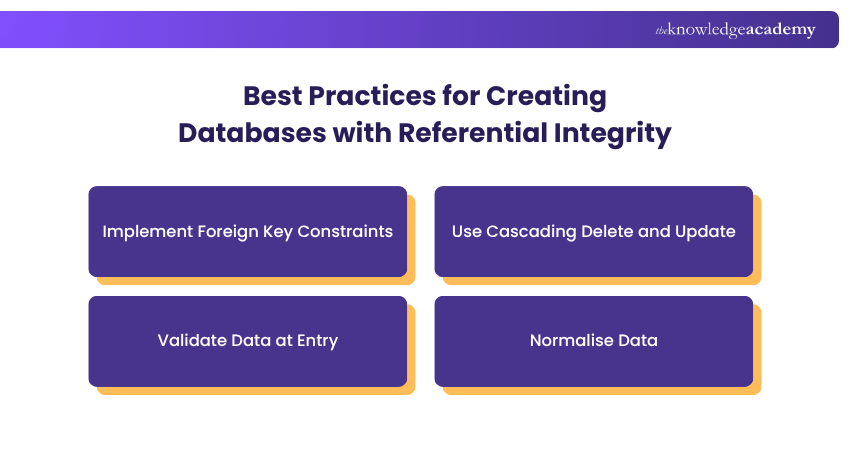
Best Practices for Creating Databases with Referential Integrity
Ensuring Referential Integrity isn’t just about enforcing foreign key constraints; it’s about designing databases with foresight. Here are some golden rules:
1) Implement Foreign Key Constraints
Foreign keys ensure that references between tables remain valid. For example, in an e-commerce system, an order record must have a valid customer ID. By enforcing foreign key constraints, databases reject operations that violate RI.
2) Use Cascading Delete and Update
Consider enabling ON DELETE CASCADE or ON UPDATE CASCADE to adjust dependent records automatically. If a customer is deleted, their associated orders should either be removed or reassigned.
3) Validate Data at Entry
Use validation rules at the application level to prevent incorrect data from entering the system. For instance, an airline booking system should ensure that every reservation has a valid passenger ID before allowing the transaction.
4) Normalise Data
Apply Normalisation principles to eliminate redundancy while maintaining necessary relationships between tables.
Learn to seamlessly connect with mainframe and network applications with our Teradata Training – Sign up Now!
What is Database Normalisation?
Think of normalisation as Marie Kondo tidying up your database—eliminating redundancy, ensuring clarity, and keeping only what “sparks joy” (or, in this case, what makes logical sense).
Database normalisation is the process of structuring a database to minimise redundancy and ensure data integrity. It involves breaking down large tables into smaller, related ones while maintaining Referential Integrity.
For instance, instead of storing a customer’s address in every transaction, you store it once in a separate table and reference it when needed. This avoids inconsistencies where “John Doe” has three different addresses in different records.
The key normalisation levels (or normal forms) include:
a) 1NF (First Normal Form): No duplicate rows and each column holds atomic data.
b) 2NF (Second Normal Form): No partial dependencies—data is split into related tables.
c) 3NF (Third Normal Form): No transitive dependencies—each field depends only on the primary key.
Normalisation helps maintain Referential Integrity by ensuring a clear structure where relationships are meaningful and logical.
Referential Integrity in Synthetic Data
Now, let’s step into the future—synthetic data. This refers to artificially generated data used for testing and Machine Learning (ML), mimicking real-world data without exposing actual user information.
Why does Referential Integrity matter here? Because broken relationships can lead to inaccurate AI models! Imagine training an AI fraud detection system on inconsistent bank transaction records—it would make all the wrong predictions.
When generating synthetic data, ensuring Referential Integrity means:
a) Assigning valid foreign key values
b) Avoiding orphaned records
c) Keeping relationships logically consistent across datasets
AI models thrive on well-structured data. If your synthetic dataset mirrors real-world integrity constraints, your AI predictions will be far more reliable.
Improve your API development skills with the GraphQL PDF. Download it now to learn how to implement and leverage GraphQL for faster, more flexible data queries.
What Are the Conditions Required to Enforce Referential Integrity?
Referential integrity ensures that relationships between tables remain consistent, when foreign keys are used to link related data. It prevents orphaned records and maintains data accuracy. To enforce referential integrity, the following conditions must be met:
1) Foreign Key Must Match a Primary Key
The value of a foreign key in one table must either match a primary key value in the related table or Be NULL. This ensures that every reference is valid and points to an existing, unique record.
2) Data Types Must Be Compatible
The data type of the foreign key column must be the same or compatible with that of the referenced primary key. For example, if the primary key is INT, the foreign key should also be INT.
3) Referenced Table Must Have a Primary or Unique Key
The foreign key must refer to a column (or combination of columns) in the parent table that has a PRIMARY KEY or UNIQUE constraint. This guarantees that the reference is made to a unique, valid entry.
4) Referential Integrity Constraints Must Be Declared
You must explicitly define the foreign key constraint during table creation or modification using FOREIGN KEY syntax in SQL.
Understand, Organise, and Optimise with our Teradata Training. Start Learning Now!
5) No Orphaned Records Allowed
When enforcing referential integrity, you cannot insert a foreign key value that doesn’t exist in the parent table. Similarly, you can’t delete a record in the parent table if it's being referenced in a child table. Cascade delete/update is enabled, or the child records are deleted/updated first.
6) Both Tables Must Be in the Same Database
Referential integrity can only be enforced when both the parent and child tables exist within the same database schema (most RDBMSs don’t support cross-database foreign keys).
What Is Referential Integrity in a Level Computer Science?
Referential Integrity is a fundamental concept in relational databases that ensures the relationships between tables remain consistent and valid.
In simple terms, referential integrity makes sure that if one table refers to another using a foreign key, that reference must be accurate, meaning the foreign key must match an existing primary key in the related table. Key areas:
1) Prevents orphaned records data that references missing or deleted entries
2) Ensures data accuracy and consistency across related tables
3) Is enforced using foreign key constraints in SQL
What Is the Difference Between Referential Integrity and Data Integrity?
Referential integrity is a specific rule that ensures valid links between tables using foreign keys, as explained in the Relational Database Guide. In contrast, data integrity is a broader concept that covers the overall quality, accuracy, and trustworthiness of data within a database.
Conclusion
Referential integrity is a key concept in relational databases that ensures data across related tables stays accurate and connected. It prevents errors like orphan records by making sure foreign keys always refer to valid primary keys. By enforcing these rules, databases remain consistent, reliable, and easier to manage. It’s a foundation for data quality. Mastering for anyone working with relational data and building systems that depend on accurate relationships.
Learn advanced search and data visualisation techniques for Big Data with our Elasticsearch Training– Join Now!
Frequently Asked Questions
Can Referential Integrity be Enforced Automatically?

Yes, databases enforce Referential Integrity automatically using foreign key constraints, ensuring data consistency and preventing orphaned records or invalid relationships between tables.
What Violates Referential Integrity?
Violations occur when a foreign key references a non-existent primary key, a referenced record is deleted without handling dependencies, or incorrect data modifications disrupt relationships between tables.
What are the Other Resources and Offers Provided by The Knowledge Academy?
The Knowledge Academy takes global learning to new heights, offering over 3,000 online courses across 490+ locations in 190+ countries. This expansive reach ensures accessibility and convenience for learners worldwide.
Alongside our diverse Online Course Catalogue, encompassing 17 major categories, we go the extra mile by providing a plethora of free educational Online Resources like Blogs, eBooks, Interview Questions and Videos. Tailoring learning experiences further, professionals can unlock greater value through a wide range of special discounts, seasonal deals, and Exclusive Offers.
What is The Knowledge Pass, and How Does it Work?
The Knowledge Academy’s Knowledge Pass, a prepaid voucher, adds another layer of flexibility, allowing course bookings over a 12-month period. Join us on a journey where education knows no bounds.
What are the Related Courses and Blogs Provided by The Knowledge Academy?
The Knowledge Academy offers various Database Training Course, including the InfluxDB Training, Redis Cluster Database Training, and Introduction to Database Training. These courses cater to different skill levels, providing comprehensive insights into What is DBMS.
Our Programming & DevOps Blogs cover a range of topics, offering valuable resources, best practices, and industry insights. Whether you are a beginner or looking to advance your Programming skills, The Knowledge Academy's diverse courses and informative blogs have got you covered.

Richard Harris


Senior Full Stack Developer and Technology Educator
Richard Harris is a highly experienced full-stack developer with deep expertise in both frontend and backend technologies. Over his 12-year career, he has built scalable web applications for startups, enterprises and government organisations. Richard’s writing combines technical depth with clear explanations, ideal for developers looking to grow in modern frameworks and tools.

Upcoming Programming & DevOps Resources Batches & Dates
Date
 Redis Cluster Database Training
Redis Cluster Database Training
Fri 24th Jul 2026
Redis Cluster Database Training
Fri 23rd Oct 2026

 If you wish to make any changes to your course, please


