


 Top Rated Course

We may not have the course you’re looking for. If you enquire or give us a call on +353 12338944 and speak to our training experts, we may still be able to help with your training requirements.
Five Lean Principles Explained: Simple and Clear Guide
The Knowledge Academy 16 July 2026Lean Principles focus on maximising customer value while minimising waste across processes by identifying inefficiencies and streamlining operations. They strongly emphasise continuous improvement, efficient workflows, and customer-centric thinking. They help improve productivity, reduce costs, and deliver higher-quality outcomes.

Training Outcomes Within Your Budget!
We ensure quality, budget-alignment, and timely delivery by our expert instructors.
Table of Contents

Do you know that a large portion of everyday business activities adds little to no value for the customer? Yet, many organisations continue to invest their time and resources into processes that do not directly contribute to meaningful outcomes. This is where Lean Principles become highly relevant.
It focuses on identifying what truly matters to the customer and removing anything that does not contribute to value. In this blog, we’ll explore the five Lean Principles and how you can use them to drive long-term efficiency and business success. Let’s dive in!
Table of Contents
1) What are Lean Principles?
2) The Five Lean Principles
3) Key Benefits of Lean Principles
4) How Do the Lean Principles Improve Organisational Performance?
5) How to Implement the Lean Principles
6) Conclusion
What are Lean Principles?
Lean Principles refers to a set of practices that aim to improve efficiency through waste reduction and focus only on what adds value to the customer. They were originally developed in the Toyota Production System’s manufacturing process and help businesses streamline operations, improve quality, and save time and resources.
Real-life Example: In a retail setting, a company might use Lean Principles to reorganise its stockroom. By removing unused items and arranging products based on demand, staff can find items faster, reduce errors, and serve customers more efficiently, leading to improved satisfaction and lower costs.

The Five Lean Principles
The following principles prove to be an effective method for team management across various industries. Many of these principles are highly valued in Lean Manager Job Descriptions emphasising the importance of effective team management and leadership. Let’s delve into each of these principles in more detail:
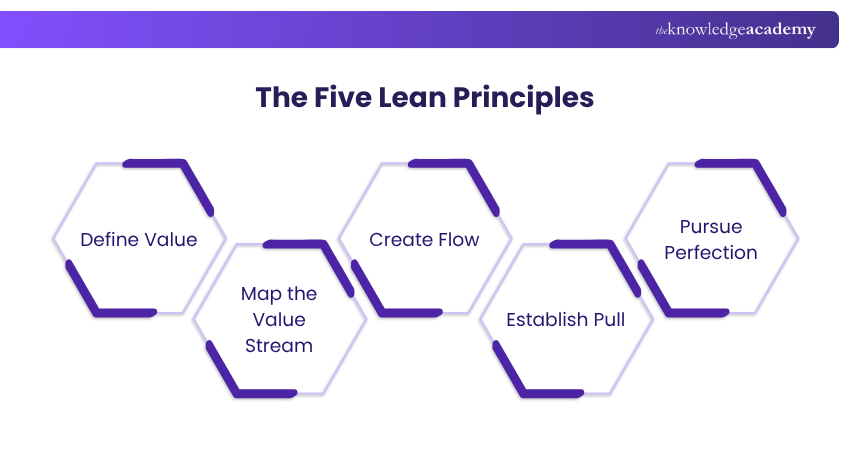
1) Define Value
The first step in Lean is understanding what truly matters to the customer. Value is defined from the customer’s perspective as what they are willing to pay for. This means businesses need to clearly identify customer needs and focus only on activities that directly contribute to delivering that value. Anything else is considered waste and should be minimised or removed.
2) Map the Value Stream
Once the value is defined, the next step is to map out the entire process required to deliver it. This is known as the value stream. It includes every step, from raw materials to the final product or service. By analysing the value stream, organisations can identify inefficiencies, delays, and unnecessary steps, making it easier to eliminate waste and improve overall efficiency.
3) Create Flow
After removing waste from the value stream, the goal is to ensure that work flows smoothly without interruptions or delays. Creating flow means designing processes so that tasks move continuously from one stage to the next. This reduces bottlenecks, improves speed, and ensures that work is completed efficiently without unnecessary waiting or rework.
4) Establish Pull
Instead of producing goods or services based on forecasts, Lean encourages a pull-based system. This means work is only done when there is actual demand from the customer. By responding to real needs rather than predictions, businesses can avoid overproduction, reduce inventory, and use resources more effectively.
5) Pursue Perfection
Lean is not a one-time improvement; instead, it is an ongoing journey. The final Lean Principle focuses on continuous improvement, where organisations constantly look for ways to refine processes and eliminate waste. By encouraging feedback, innovation, and employee involvement, businesses can move closer to perfection over time.
Future-proof your career with Lean expertise - Join our Certified Lean Foundation & Practitioner Training today!
Key Benefits of Lean Principles
1) Reduced Waste: Lean minimises all forms of waste, helping organisations use resources efficiently and reduce costs.
2) Improved Quality: Practices like standardisation and continuous improvement enhance product and service quality, boosting customer satisfaction and strengthening the company’s reputation.
3) Increased Productivity: Streamlined processes and fewer bottlenecks enable teams to achieve more in less time.
4) Faster Delivery: Shorter lead times improve speed from order to delivery and enhance responsiveness to change.
5) Stronger Engagement: Encourages employee involvement, creating a more motivated and proactive workforce.
How Do the Lean Principles Improve Organisational Performance?
The Principles of Lean enhance the performance of an organisation by concentrating on customer value and eliminating non-value-adding activities throughout the system. Here are the ways it can improve organisational performance:
1) Improved Productivity: Lean Principles remove unnecessary steps and streamline workflows, which leads to faster task completion, fewer delays, and better overall output.
2) Cost Reduction: By eliminating waste such as overproduction, excess inventory, and inefficient processes, organisations can reduce operational costs while maintaining quality standards.
3) Enhanced Quality: Lean encourages standardisation and continuous monitoring, which helps reduce errors and rework. As a result, businesses can deliver consistent and reliable products or services.
4) Better Customer Satisfaction: Since Lean focuses on delivering value from the customer’s perspective, organisations are better able to meet expectations, resulting in improved customer experience and stronger loyalty.
5) Increased Efficiency: Streamlined processes and smooth workflows ensure that resources are used effectively. This minimises bottlenecks and improves the overall efficiency of operations.
6) Stronger Employee Engagement: Lean promotes a culture where employees are encouraged to identify problems and suggest improvements. This increases involvement, accountability, and motivation within the workforce.
7) Continuous Improvement Culture: One of the core strengths of Lean is its focus on ongoing improvement. Organisations continuously refine processes and strive for better performance over time.
8) Greater Agility and Flexibility: With reduced waste and optimised processes, organisations can respond quickly to market changes and customer demands, making them adaptable in competitive environments.
How to Implement the Lean Principles
Implementing Lean Principles requires a structured and consistent approach that focuses on both processes and people. Here's how you can do it:
1) Set Your Goals: Begin by setting clear goals, such as improving quality, reducing costs, or speeding up delivery. Communicate these goals to gain support from employees at all levels.
2) Identify and Remove Waste: A core step in Lean implementation is identifying waste within processes. Focus on removing unnecessary activities, delays, errors, excess inventory, duplicated work, and non-value-adding steps to improve efficiency and reduce costs.
3) Involve and Empower Employees: Employees often have the best understanding of daily operations and process inefficiencies. Involve them in identifying problems and suggesting improvements. This not only leads to better solutions but also increases ownership and engagement.
4) Use Lean Tools and Techniques: Lean tools help organisations systematically improve processes and maintain efficiency. Some commonly used tools include Value Stream Mapping (VSM), Kanban boards, and more.
5) Standardise Processes: Once improvements are made, you need to standardise the processes. This makes it easier to maintain quality and identify future improvement opportunities.
6) Monitor and Measure Performance: Track progress using Key Performance Indicators (KPIs) such as cycle time, defect rates, and productivity levels. Regular monitoring helps evaluate success and identify areas that need further improvement.
Streamline your organisation with Lean tools - Sign up for our Lean Processes and Tools Training today!
Conclusion
The five Lean Principles offer a practical framework for boosting efficiency, reducing waste, and delivering greater customer value. By applying Lean thinking and the right tools consistently, organisations can streamline workflows, improve performance, and build a culture of continuous improvement for long-term operational excellence.
Discover how to foster a neat, safe, and efficient work environment - Sign up for our 5S Training today!
Frequently Asked Questions
What are the Best Lean Tools for Waste Elimination?

The best Lean tools for waste elimination include 5S (workplace organisation), Value Stream Mapping (VSM) (identifying process waste), Kaizen (continuous improvement), Kanban (workflow control), Root Cause Analysis (problem solving), and Poka-Yoke (error prevention). These tools help improve efficiency, quality, and productivity while reducing non-value-added activities.
What are the Four Pillars of Lean?
The four pillars of Lean are Value, Value Stream, Flow, and Pull, supported by the goal of Perfection through continuous improvement. Together, they help organisations deliver customer value, eliminate waste, improve process efficiency, and create a culture of ongoing operational excellence.

The Knowledge Academy


Global Training Provider
The Knowledge Academy is a world-leading provider of professional training courses, offering globally recognised qualifications across a wide range of subjects. With expert trainers, up-to-date course material, and flexible learning options, we aim to empower professionals and organisations to achieve their goals through continuous learning.


 If you wish to make any changes to your course, please


