


 Top Rated Course

We may not have the course you’re looking for. If you enquire or give us a call on +353 12338944 and speak to our training experts, we may still be able to help with your training requirements.
Compliance Officer Roles and Responsibilities Explained
Hailey Davis 14 July 2026Compliance roles involve managing risks, ensuring legal adherence, developing policies, training staff, and monitoring processes. They help organisations maintain strong accountability and avoid costly regulatory penalties. Strong compliance also supports consistent ethical practices and builds long-term trust with key stakeholders.
Home
 Resources
IT Security & Data Protection
Compliance Officer Roles and Responsibilities Explained
Resources
IT Security & Data Protection
Compliance Officer Roles and Responsibilities Explained
Resources
IT Security & Data Protection
Compliance Officer Roles and Responsibilities Explained

Training Outcomes Within Your Budget!
We ensure quality, budget-alignment, and timely delivery by our expert instructors.
Table of Contents
In today’s highly regulated business environment, organisations must ensure they operate within legal and ethical boundaries while managing growing risks. Understanding compliance officer roles and responsibilities is essential for maintaining accountability, avoiding penalties, and building trust with stakeholders. With that in mind, let’s explore the key duties and expectations that define this critical role.
Table of Contents
1) Who is a Compliance Officer?
2) How to Become a Compliance Officer?
3) Roles of Compliance Officer
4) Compliance Officer Responsibilities
5) Skills and Qualities of an Effective Compliance Officer
6) How Much Does a Compliance Officer Earn?
7) What are the Three Requirements for the Position of Compliance Officer?
8) What Does the Future of Compliance Look Like?
9) Conclusion
Who is a Compliance Officer?
A Compliance Officer is a professional who makes sure that a company follows legal requirements as well as its own internal policies. Their job is to actively monitor and manage compliance. Without them, businesses risk breaking laws or rules, which can lead to fines and serious damage to their reputation.
As Compliance rules become stricter, more companies, both medium and large, depend on Compliance Officers. They act as in-house experts, staying updated on regulations, monitoring changes, and making sure compliance processes are followed. Because of this important role, there is strong demand for skilled Compliance Officers.

How to Become a Compliance Officer?
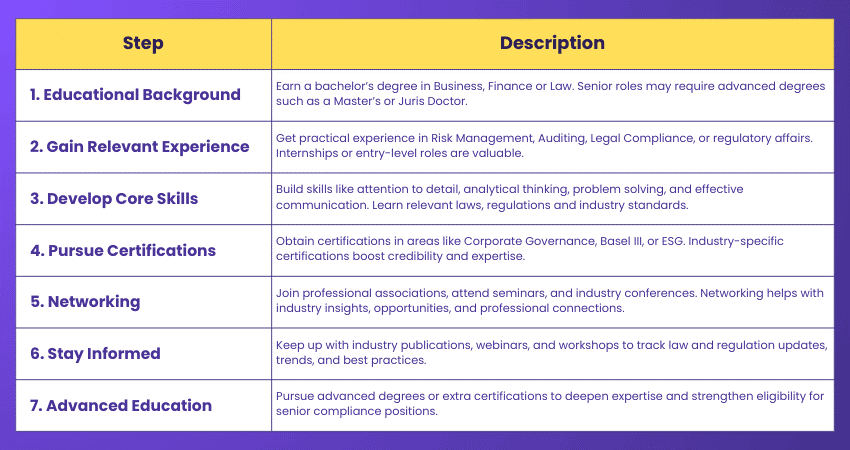
Becoming a Compliance Officer involves a combination of education, relevant experience, and obtaining specific skills. The following provides a step-by-step outline on how to become a Compliance Officer:
Roles of Compliance Officer
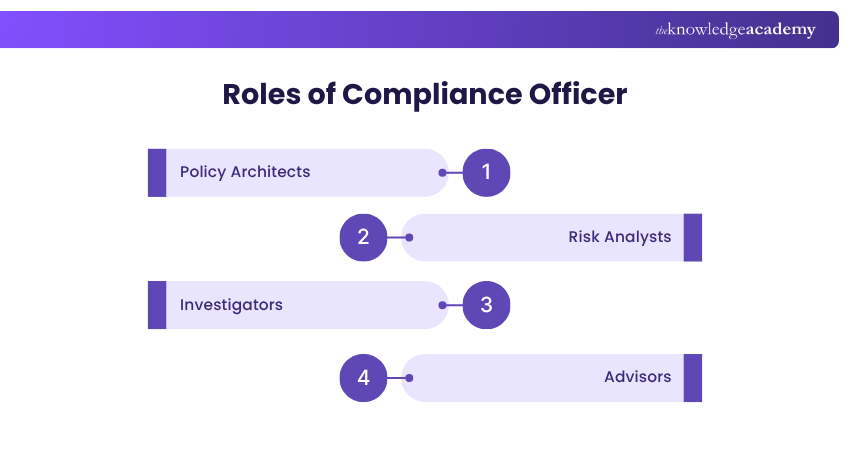
Compliance Officer duties and responsibilities are the ethical compass guiding an organisation through the complexities of regulations and ethical standards. As the name implies, their fundamental duty is to ensure that the company's actions remain within the boundaries set by the law and ethical principles. Some of the most crucial roles of a Compliance Officer are as follows:
Policy Architects
1) Compliance Officers act as Policy Architects as they design detailed compliance policies
2) Through clear documentation, they address the complexities of regulatory frameworks
3) These policies guide the employees by outlining expected behaviour and responsibilities
4) This helps make sure that the organisation’s activities remain legal and ethical
5) They simplify complex regulations into actionable steps for staff
6) Their work promotes a culture of integrity and transparency
Risk Analysts
1) Risk assessment is a key responsibility of a Compliance Officer
2) They carefully evaluate the risks and vulnerabilities in business operations
3) The strategies are developed to reduce compliance-related threats
4) Their strong Analytical Skills help them predict potential issues
5) They enable the organisation to address risks proactively
6) This helps avoid the risks of legal problems and reputational damage

Investigators
1) Compliance Officers serve as Investigators when any instance of non-compliance crops up
2) They examine the issues closely to identify their root causes
3) They conduct thorough analyses to understand the problem fully
4) They introduce corrective measures to stop the recurrence of such issues
5) Their proactive approach ensures swift resolution of every compliance breach
Advisors
1) Compliance Officers offer management guidance on compliance-related strategies
2) Their expertise can shape policies and procedures to meet regulatory requirements
3) They provide deep insights into the possible compliance implications of business choices
4) This ensures that the leaders make responsible strategic decisions
5) Compliance stays integrated into the organisation’s overall direction
Compliance Officer Responsibilities
Compliance Officer Roles and Responsibilities help companies be open, responsible, and honest. Some of the key responsibilities of a Compliance Officer are as follows:
1) Developing and Implementing Policies
Compliance Officer duties and responsibilities are charged with the critical task of creating and putting into action comprehensive Compliance policies. These policies act as guidelines that dictate ethical behaviour and ensure the organisation's alignment with legal regulations. By crafting and implementing these policies, Compliance Officers lay the groundwork for a culture of lawful conduct and integrity within the company.
2) Monitoring and Assessment
Monitoring forms a core responsibility of Compliance Officers. They consistently track the organisation's activities to confirm adherence to regulations and ethical standards. This involves regular assessments, internal audits, and vigilant scrutiny to identify potential non-compliance areas. The meticulous monitoring process provides insights into operational practices and enables early detection of any deviations from established norms.
Gain insight into the different levels of assessing organisational Cyber Security governance in our Security Governance and Compliance Training - Sign up now!
3) Training and Education
Compliance Officers play an instrumental role in educating employees about Compliance expectations. They organise training sessions to familiarise staff with the organisation's Compliance policies, codes of conduct, and industry-specific regulations. By imparting this knowledge, Compliance Officers empower employees to make informed decisions and take actions that align with the organisation's ethical framework.
4) Risk Assessment and Mitigation
Identifying and mitigating risks is crucial to a Compliance Officer’s responsibilities. They assess the organisation's processes, operations, and external factors to determine potential vulnerabilities. Based on this assessment, they strategies and implement measures to minimise the impact of risks, safeguarding the organisation's reputation and financial stability.
5) Reporting and Communication
Compliance Officers are the bridge between internal stakeholders and external authorities. They regularly communicate the organisation's Compliance status to Senior Management and relevant Stakeholders. Effective reporting ensures transparency, keeps all parties informed about Compliance efforts, and helps make well-informed decisions.
6) Responding to Non-compliance
In instances of non-compliance, Compliance Officers initiate prompt action. They investigate the root causes of the breach, analyse the extent of the violation, and recommend corrective measures. Their proactive approach ensures that non-compliance is swiftly addressed, preventing reccurrence and minimising potential negative consequences.
Learn how to turn complex policies into everyday practices with our Effective Compliance Training – Sign up now!
Skills and Qualities of an Effective Compliance Officer
The role of Compliance Officer necessitates a unique blend of skills and inherent qualities that contribute to their effectiveness in upholding ethical standards and ensuring legal adherence within an organisation. Here are some of the most essential skills of a Compliance Officer:
1) Analytical and Critical Thinking
The ability to analyse intricate regulatory frameworks and assess potential Compliance gaps is paramount. Effective Compliance Officers exhibit sharp analytical skills, enabling them to identify areas of vulnerability and proactively devise strategies to address them. Critical Thinking empowers them to craft comprehensive solutions that anticipate potential challenges.
2) Strong Communication Skills
Communication is key for Compliance Officers, who must translate complex regulations into clear directives for employees at all levels. Effective communication fosters understanding, ensuring Compliance policies are disseminated effectively and embraced by the workforce.
3) Attention to Detail
The role demands a meticulous eye for detail. Effective Compliance Officers scrutinise policies, procedures, and operations to identify even the most minute deviations from Compliance standards. This attention to detail is instrumental in preventing oversights that could lead to non-compliance.
4) Ethical Integrity
Exemplifying ethical behaviour is non-negotiable for a Compliance Officer. Effective Officers uphold moral principles and act as role models for ethical conduct. Their integrity resonates throughout the organisation, reinforcing the importance of Compliance at all levels.
Empower your organisation’s success with our Corporate Governance Training – Sign up now!
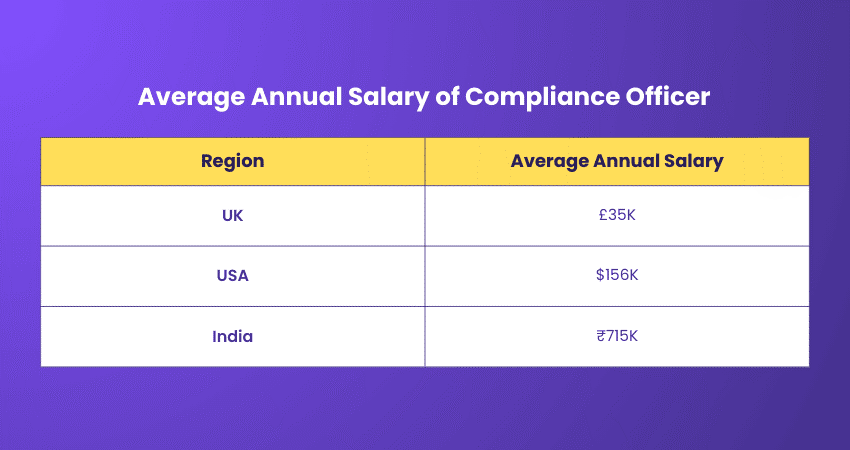
How Much Does a Compliance Officer Earn?
The greater their professional experience, the higher their salary. The role demands elevated standards of integrity, exceptional communication skills, and managerial expertise. Consequently, it is uncommon for companies to appoint Compliance Officers to junior positions.
Here’s a breakdown of the average annual salary earned by a Compliance Officer across three major regions:
What are the Three Requirements for the Position of Compliance Officer?
The three requirements for the position of a Compliance Officer are:
1) Reliability: A Compliance Officer must be dependable and committed to following company regulations.
2) Unity: They should align with organisational standards and lead by example for colleagues.
3) Attention to Detail: They must have a strong focus to spot and manage compliance issues effectively.
What Does the Future of Compliance Look Like?
As regulations grow more complex, compliance officers will need to engage more deeply with evolving legal frameworks and increasing transparency demands. Their role will become more strategic as organisations adjust to continual regulatory change while maintaining ethical standards.
Future compliance work will require stronger analytical skills and proactive risk management as data protection and financial crime regulations become more intricate. This shift positions compliance professionals as essential guardians of organisational integrity.
Conclusion
As automation, AI‑driven insights, and global regulatory shifts reshape the landscape, the future of compliance will hinge on anticipating risks before they emerge. In this rapidly advancing environment, elevating Compliance Officer Roles and Responsibilities becomes essential to building resilient organisations capable of thriving amid continuous transformation.
Learn to navigate rules, reduce risks, and build a culture of integrity. Sign up for our comprehensive Compliance Training now!
Frequently Asked Questions
What Unique Challenges do Compliance Officers Face in Different Sectors?

Compliance officers face sector‑specific challenges, such as strict financial regulations in banking that demand vigilance against risks like money laundering, and rapidly evolving issues in tech, including AI ethics and data privacy concerns.
Why is a Compliance Strategy Important for a Business?
A strong compliance strategy is essential because it ensures that a company’s processes align with legal and internal standards, helping prevent violations that could lead to fines or reputational damage.

Hailey Davis


Compliance Officer
Hailey Davis is an ISO compliance expert with over 10 years of experience in audit, quality management systems (QMS), and regulatory compliance. She has worked with various industries, including manufacturing, healthcare, and technology, ensuring organisations achieve and maintain ISO certifications. Hailey’s content provides practical, actionable insights on navigating compliance challenges and improving business processes.
View Detail

 If you wish to make any changes to your course, please


