


 Top Rated Course

We may not have the course you’re looking for. If you enquire or give us a call on +44 1344 203999 and speak to our training experts, we may still be able to help with your training requirements.
What is a Budget Deficit? Types, Causes and Implications
The Knowledge Academy 03 March 2026A budget deficit occurs when government spending exceeds revenue, creating a shortfall financed through borrowing, which increases national debt over time. To fill this gap, the government must take help from the international market or increase taxes. Read further to understand What is Budget Deficit and the significant components of it in detail.

Training Outcomes Within Your Budget!
We ensure quality, budget-alignment, and timely delivery by our expert instructors.
Table of Contents
Have you ever wondered why and how inflation takes place? This negative force usually arises because of the Budget Deficit. Now, What is Budget Deficit? It’s a situation where the government overshoots expenses over the revenue generated from various sources. Budget Deficit is a crucial Gross Domestic Product (GDP) factor as it reflects the management of any country's finances. If you're keen on understanding economic indicators, learning how to calculate GDP can offer deeper insight into how such deficits influence the economy. Financial issues like inflation occur when the government runs in such a situation.
Budget Deficit can also be applied to businesses and individuals but primarily used in a context related to government. Let’s learn more about What is Budget Deficit and how the government handles this shortfall to safeguard its economy.
Table of Contents
1) What is a Budget Deficit?
2) Components of Budget Deficits
3) Types of Budget Deficits
4) Key Factors Contributing to Budget Deficits
5) Implications of Budget Deficit
6) Methods for Calculating Budget Deficits
7) Conclusion
What is a Budget Deficit?
Budget Deficit is a situation where the total expenditure is more than the total revenue of a given financial time. The term is mostly applied in the context of government finances, the government expenditure exceeds tax and other income receipts. But it may also be applied to both businesses and individuals in cases where costs exceed incomes.
The persistent deficit over time is a factor that leads to the build-up of the national debt. Governments normally borrow the amount to finance the deficit and borrowing has the effect of creating interest payments. The higher the debt level, the higher interest payments and this could limit financial flexibility in the future as well as it could have an impact on the stability of a fiscal situation. The repayment ability of lenders can also be evaluated more carefully when debt rises tremendously.
Conversely, a Budget Surplus is a situation where the revenue is more than the expenditure. The excess enables governments to cut off debt, create reserves, or invest in economic development programs.
Common Causes of a Budget Deficit:
A budget deficit could be caused by several economic and fiscal factors:
1) Tax Revenue Shortfalls: Government revenue may be lowered by the slowdown of the economy or reduction of tax collections, or lower income levels.
2) Greater Government Expenditure: The fiscal gap can be increased by high spending on defence, healthcare, infrastructure, and social welfare programmes.
3) Economic Downturns and Low GDP Growth: Tax revenues normally decrease and the sums paid as support to the population rise as the Gross Domestic Product (GDP) decreases or grows at a slow rate.
4) Government Subsidies and Public Assistance: Government spending can increase because of the financial assistance given to industries or vulnerable populations.
5) Unexpected Events: Unanticipated rises in public expenditure may occur as a result of natural disasters, pandemics, or security crises.
A budget deficit is not always negative. In some cases, governments deliberately run deficits to stimulate economic growth during recessions. But long-term deficits that are uncontrolled can result in long-term fiscal problems.

Components of Budget Deficits
Budget Deficits have two major components, namely:
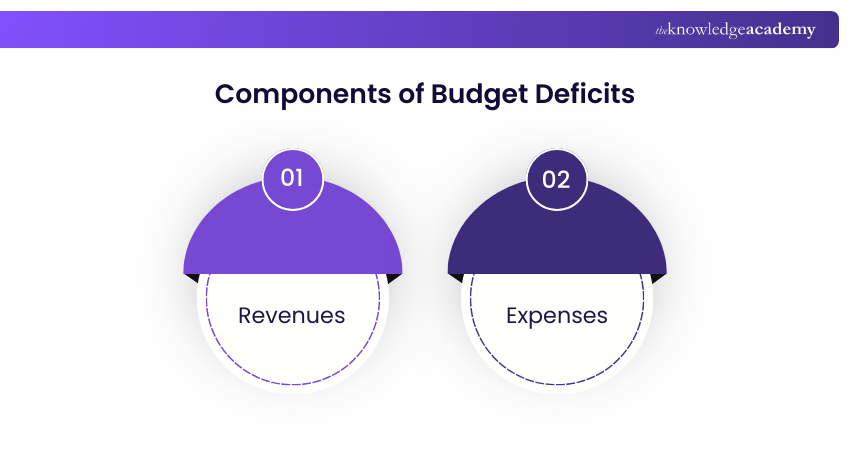
1) Revenues
Most of the revenue gets generated either through corporate taxes, social insurance taxes, income taxes, or consumption taxes. In the case of companies and enterprises, services and goods sales make up the revenues.
2) Expenses
Government expenses arise when spending is done on infrastructure, pensions, subsidies, defense, and healthcare. Another type of spending also exists to support the overall economy. In the case of businesses, the expense arises because of daily operations happening inside the company. Also, the production factors, wages, and rent happen to increase spending.
Additionally, Structured Budget Deficits and Cyclical Budget Deficits also exist. When long-lasting factors such as excessive public spending and failure in the tax system are prevalent, it is called a Structured Deficit. On the other hand, the Cyclical Deficit occurs when economic factors such as Inflation vs Recession influence the budget, impacting the overall financial health of a country.
Types of Budget Deficits
The Budget Deficit has five key types that affect the economy. All of them are explained below in detail here:
1) Fiscal Deficit
The shortfall arose in total revenue of government in comparison to the total expenditure results in Fiscal Deficit. It encompasses both capital and revenue transactions. The difference between income and spending from taxes makes up the Fiscal Deficit.
2) Revenue Deficit
Revenue Deficit is a specific type of Budget Deficit that refers to the difference between a government's revenue receipts and its revenue expenditures. It excludes borrowing and capital receipts.
3) Primar Deficit
The Primary Deficit emphasis on the difference between government spending and revenues. However, it doesn’t include interest payments. To assess the situation, the total Deficit is taken into consideration.
4) Trade Deficit
When the export of goods/services becomes higher than the import, a Trade Deficit occurs. It also results in the outflow of exchange. Variables of both imports and exports are taken into consideration.
5) Current Account Deficit
When the receipts from abroad are lower than the payments it generates, the Current Account Deficit is seen. Trade Deficit makes up the largest factor of a current account Deficit.
Introduction To Managing Budgets Course- sign up today!
Key Factors Contributing to Budget Deficits
The budget deficits occur when the government spending is high in comparison with the government revenue. This imbalance is caused by a number of shared factors that either increase the level of spending or decrease the level of income:
1) Tax Structures That Limit Revenue: Low or inefficient taxation can cause the decrease of the revenues that should be received by governments, which causes the increase of the balance between income and expenditures.
2) High Spending on Government Programmes: High expenditures on social security, healthcare, defence, and other state services enhance the overall government expenditure, a factor that increases the deficit.
3) Subsidies to Industries and Individuals: When large or inefficient, government subsidies to support some sector or population can impose additional budget demands.
4) Revenue Loss Due to Tax Cuts: Cuts in taxes may stimulate economic activity but can temporarily lower government revenues, contributing to budget shortfalls.
5) Low Economic Growth (GDP): In the case of poor gross domestic product (GDP), taxation revenue is likely to decrease, cutting government revenues and possibly leading to deficits.
6) Unanticipated Events and Policy Shifts: Governments may have to add to budgets because of unexpected crises (such as wars or natural disasters) or sudden changes in fiscal policies, which cause budgets to go into deficit.
Implications of Budget Deficit
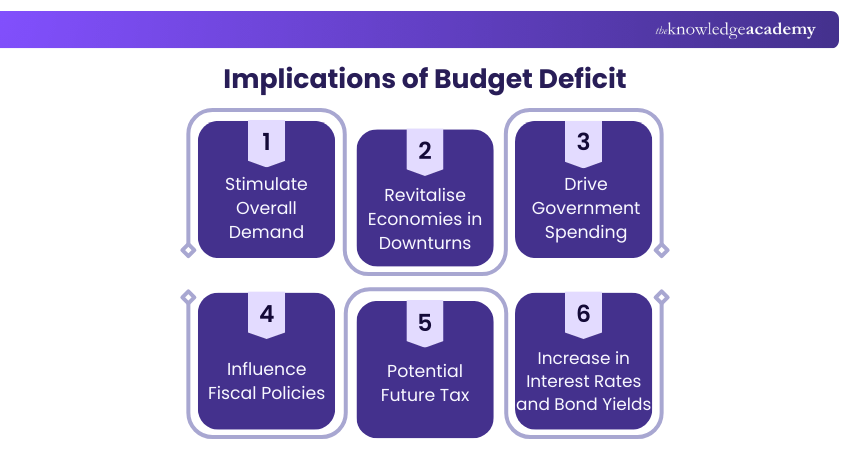
A Budget Deficit sounds like a negative factor; however, this is not the case always. Given below are the top six implications of Budget Deficit:
1) Stimulate Overall Demand
Budget Deficit stimulates overall demand as taxes get reduced. This subsequently contributes to the increase in aggregate demand of the country.
2) Revitalise Economies in Downturns
In a recession, the Private Sector decreases investment, which lowers demand and consumption in an economy. To fight back, the government can either borrow from the international market or take other measures.
3) Drive Government Spending
Spending by the government is done for various purposes like healthcare, pension programs, human capital, etc. A Deficit consists of the government spending more than its overall revenue.
4) Influence Fiscal Policies
Expansionary fiscal policies can be financed during a Deficit. The result is a reduction in corporate and income taxes. To boost the growth of the economy, the government increases spending on investment and infrastructure.
5) Potential Future Tax
A persistent Deficit increases the chances of tax increment in future. Generally, it’s done to pay off the accumulated debt.
6) Increase in Interest Rates and Bond Yields
The government charge higher interest rates to banks and investors to borrow in large quantities. This strategy can compensate for the risk associated with the Deficit.
Methods for Calculating Budget Deficits
Budget Deficits can be calculated using the following methods. Have a look at calculations for different Deficit types:
Budget Deficit = Total government expense – Total government income
Fiscal Deficit = Total expenditure – Total receipts (no borrowing included)
Revenue Deficit = Total revenue spending – Total revenue receipts
Primary Deficit = Fiscal Deficit – Interest payments
Trade Deficit = Import value – Export value
Current Account Deficit = Trade gap + Net current transfers + Net income abroad
Conclusion
In conclusion, when government or business outlay overshoots earnings, a Budget Deficit occurs. Fiscal Deficit and Revenue Deficit are two Deficit types under the Budget Deficits. The government takes effective measures to overcome Deficits so that the economy remains stable. Increment in revenue inflow and reduction in revenue outflow also suppress the Deficit. That is all about What is Budget Deficit and how it can raise issues like inflation.
Learn about Management with our Personal Development Courses- join now!
Frequently Asked Questions
What is the relationship between budget deficit and taxes?

A budget deficit and taxes are closely connected because tax revenue is a government’s primary source of income. When tax collections fall due to rate cuts or economic slowdown, deficits can widen. To reduce a budget deficit, governments may increase taxes or broaden the tax base to boost revenue.
What is the Difference Between Budget Deficit and Fiscal Deficit?
The Budget Deficit shows the shortage in government outlays and earnings generated. Fiscal Deficit shows how much dependency the government has on borrowings. To counter the Deficit, reductions in bonuses, subsidies, and leave encashments must be made.
What are the Other Resources and Offers Provided by The Knowledge Academy?
The Knowledge Academy takes global learning to new heights, offering over 3,000+ online courses across 490+ locations in 190+ countries. This expansive reach ensures accessibility and convenience for learners worldwide.
Alongside our diverse Online Course Catalogue, encompassing 17 major categories, we go the extra mile by providing a plethora of free educational Online Resources like Blogs, eBooks, Interview Questions and Videos. Tailoring learning experiences further, professionals can unlock greater value through a wide range of special discounts, seasonal deals, and Exclusive Offers.
What is The Knowledge Pass, and How Does it Work?
The Knowledge Academy’s Knowledge Pass, a prepaid voucher, adds another layer of flexibility, allowing course bookings over a 12-month period. Join us on a journey where education knows no bounds.
What are the Related Courses and Blogs Provided by The Knowledge Academy?
The Knowledge Academy offers various Personal Development Courses, including the Introduction to Managing Budgets and Strategic Planning and Thinking Course. These courses cater to different skill levels and provide comprehensive insights into What is Budget.
Our Business Skills Blogs cover a range of topics related to Personal Development, offering valuable resources, best practices, and industry insights. Whether you are a beginner or looking to advance your Business Skills, The Knowledge Academy's diverse courses and informative blogs have got you covered.

The Knowledge Academy


Global Training Provider
The Knowledge Academy is a world-leading provider of professional training courses, offering globally recognised qualifications across a wide range of subjects. With expert trainers, up-to-date course material, and flexible learning options, we aim to empower professionals and organisations to achieve their goals through continuous learning.

Upcoming Business Skills Resources Batches & Dates
Date
 Introduction to Managing Budgets
Introduction to Managing Budgets
Fri 14th Aug 2026
Introduction to Managing Budgets
Fri 9th Oct 2026

 If you wish to make any changes to your course, please


