


 Top Rated Course

We may not have the course you’re looking for. If you enquire or give us a call on +44 1344 203999 and speak to our training experts, we may still be able to help with your training requirements.
What is Real Estate Investment: Everything You Should Know
The Knowledge Academy 30 March 2026Real Estate Investment involves buying, owning, renting, or selling property to earn rental income, profit, and long-term appreciation while diversifying. It focuses on steady cash flow and gradual wealth building over time, with investors typically holding properties for years to benefit from appreciation and tax advantages.

Training Outcomes Within Your Budget!
We ensure quality, budget-alignment, and timely delivery by our expert instructors.
Table of Contents

Real Estate Investment is a smart strategy to grow your wealth by using property to generate income and long-term value. Understanding What is Real Estate Investment enables Investors to benefit from rising property prices. This brings steady rental income and improves financial security. From purchasing small rental homes to investing in Real Estate Investment Trusts (REITs), this approach opens strong financial opportunities.
This blog will take you through What is Real Estate Investment and simplify the journey by breaking down the essential concepts, benefits and risks. So read on and discover how Real Estate can become your smartest financial move yet!
Table of Contents
1) What is Real Estate Investment?
2) Types of Real Estate Investment
3) Benefits of Real Estate Investment
4) Real Estate Investment Strategies
5) Which Type of Real Estate Investment is Best?
6) What is the Difference Between Real Estate Investment and Real Estate Trading?
7) Conclusion
What is Real Estate Investment?
Real Estate Investment refers to the act of buying, owning, managing, renting, or selling property to generate income. It can involve residential properties like homes and apartments, commercial spaces such as offices and shops, or even land. Typically, the returns are earned through rental income, property appreciation, or both.
Real Estate is considered a tangible and relatively steady asset, and a popular way to diversify an investment portfolio. Investing in Real Estate can be done directly, by purchasing physical property, or indirectly, through Real Estate Investment Trusts (REITs), mutual funds, or crowdfunding platforms. It requires a good understanding of local market trends.

Types of Real Estate Investment
Here are the prominent types of Real Estate Investment to consider. These options help you understand What is Real Estate Investment from a practical point of view.
1) Residential
Properties where people live are the most common investment type for beginners. It offers stable demand and a predictable rental income.
Examples: Single-family homes, duplexes, townhouses, apartments
Key Benefits:
a) Regular rental income potential
b) Lower entry barrier
c) Simpler management
d) More beginner-friendly
2) Commercial
Business-focused properties that often yield higher returns but require more expertise. They can provide longer lease agreements and stronger profit potential.
Examples: Office buildings, retail spaces, shopping centres
Key Benefits:
a) Higher initial investment
b) Potentially greater returns
c) Longer-term business leases
d) Higher rental rates
3) Industrial
Large-scale properties for manufacturing, storage, and distribution. This type often provides reliable, long-term tenants due to the business-critical facilities they offer.
Examples: Factories, manufacturing plants, distribution centres
Key Benefits:
a) Long-term corporate leases
b) Stable income streams
c) Lower maintenance needs
4) Land
Purchasing undeveloped property for future use or appreciation. This investment provides potential for high returns as land value grows over time and development chances increase.
Examples: Raw land, Agricultural land, Development plots, Infill lots
Key Benefits:
a) Offers higher returns investment on investment
b) Can be developed into agricultural, commercial or residential properties
c) Requires minimal maintenance
d) May offer various tax benefits depending on the locality
Looking for some guidance towards smarter property decisions? Our Real Estate Risk Management Training will help you out – Sign up now!
Benefits of Real Estate Investment
Here are some of the key advantages. Understanding What is Real Estate Investment helps investors to view trusted long-term financial assets.
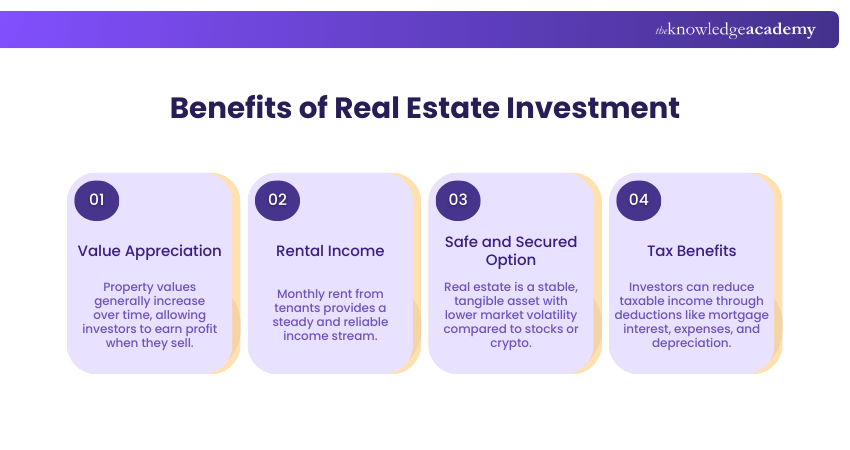
1) Value Appreciation
a) Investment properties can generate capital gains when their value increases over time.
b) A capital gain is the profit made from the difference between the purchase price and the selling price.
c) Investors can only realise capital gains once the property is sold.
d) Rising property prices over recent decades are largely due to increased housing demand.
Supply and demand can strongly influence capital gains. Limited supply in a region usually leads to higher property appreciation.
2) Rental Income
a) Many Investors purchase Real Estate for its steady income potential.
b) Residential or commercial tenants pay rent monthly until the lease expires.
c) This consistent rental income can provide retirees and others with financial stability.
d) Real Estate income serves as an alternative to securities like stocks or bonds.
e) It can also act as a hedge against stock market downturns and inflation.

3) Safe and Secured Option
a) Real Estate is considered more stable and safer than stocks or Cryptocurrencies.
b) Property values show less volatility, making it a predictable long-term investment.
c) The Real Estate Regulatory Authority oversees regulations to maintain market stability.
d) Real Estate is a tangible asset possessing intrinsic value and practical usability.
e) Properties can be leveraged or utilised even during changing market conditions.
4) Tax Benefits
a) Investors are often able to claim mortgage interest as a deductible expense, which can significantly lower their overall taxable income.
b) Property taxes paid on investment properties can also be deducted, allowing Investors to reduce their annual tax burden.
c) Operating expenses, such as maintenance, repairs, and management costs, are generally deductible.
d) Depreciation offers Investors an additional tax advantage by allowing them to gradually write off the cost of the property over several years.
e) Together, these tax incentives substantially reduce the overall cost of owning and managing Real Estate.
Learn to craft and convey compelling equity stories in line with investor expectations. Join our Investor Relations Course now!
Real Estate Investment Strategies
Here are some common Real Estate Investment techniques:
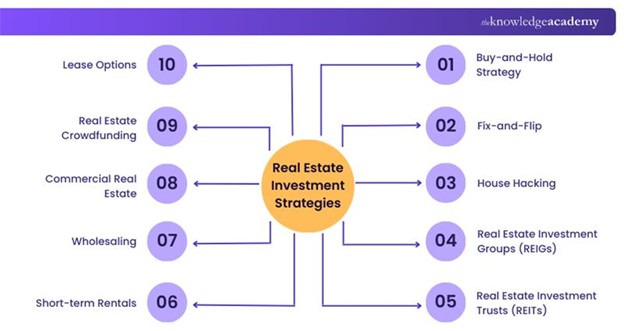
1) Buy-and-hold Strategy
a) Long-term property ownership strategy
b) Focus on building equity and wealth over time
c) Popular among traditional Real Estate Investors
How it Works:
a) Purchase property and maintain ownership long-term
b) Rent to tenants for monthly income
c) Hold through market cycles for appreciation
d) Pay down mortgage with rental income
Advantages:
a) Steady monthly rental income
b) Property value appreciation
c) Tax benefits and deductions
d) Equity building through mortgage paydown
e) Hedge against inflation
Build your brand in the brokerage business. Sign up for our Real Estate Brokerage Training now!
2) Fix-and-flip
a) Short-term investment strategy
b) Focus on rapid property transformation
c) Profit through forced appreciation
How it Works:
a) Purchase undervalued or distressed properties
b) Complete strategic renovations
c) Sell quickly at market value
d) Move on to the next project
Advantages:
a) Quick return on investment
b) Higher profit potential
c) Development of market expertise
d) No long-term management required
e) Building renovation experience
3) House Hacking
a) Owner-occupant investment strategy
b) Combines personal residence with investment
c) Popular among first-time Investors
How it Works:
a) Buy a multi-unit property
b) Live in one unit
c) Rent out other units
d) Use rental income for mortgage payments
Advantages:
a) Reduced or eliminated housing costs
b) FHA loan eligibility (lower down payment)
c) Hands-on management experience
d) Tax benefits while building equity
e) Lower risk entry to Real Estate Investment
4) Real Estate Investment Groups (REIGs)
a) Collaborative investment approach
b) Pooled resources and expertise
c) Professional management structure
How it Works:
a) Multiple Investors pool money
b) Group purchases and manages properties
c) Profits shared based on investment share
d) Professional management handles operations
Advantages:
a) Shared risk and resources
b) Professional management
c) Lower individual capital required
d) Access to larger deals
e) Network and knowledge sharing
5) Real Estate Investment Trusts (REITs)
a) Securities-based Real Estate Investment
b) Publicly traded companies
c) Highly regulated investment vehicle
How it Works:
a) Purchase shares in REIT companies
b) The company manages a property portfolio
c) Regular dividends from rental income
d) Trade shares like stocks
Advantages:
a) High liquidity
b) Professional management
c) Regular dividend income
d) Low minimum investment
e) No direct Property Management

6) Short-term Rentals
a) Vacation/temporary rental strategy
b) Higher turnover, higher potential returns
c) Popular in tourist destinations
How it Works:
a) Purchase properties in high-demand areas
b) Furnish and maintain for short stays
c) List on vacation rental platforms
d) Manage guest experiences
Advantages:
a) Higher potential rental income
b) Flexibility in use
c) Property available for personal use
d) Market rate adjustability
e) Portfolio diversification
7) Wholesaling
a) Contract assignment strategy
b) No property ownership required
c) Focus on finding deals
How it Works:
a) Find undervalued properties
b) Contract with sellers
c) Assign contracts to buyers
d) Profit from the assignment fee
Advantages:
a) Low capital requirement
b) No renovation needed
c) Quick turnaround
d) Market knowledge building
e) No long-term commitments
Close deals with ease. Sign up with the Real Estate Agent Course and dominate the property market!
8) Commercial Real Estate
a) Business property investment
b) Larger scale operations
c) Professional tenant focus
How it Works:
a) Purchase business-use properties
b) Lease to commercial tenants
c) Manage property and tenant relations
d) Focus on long-term appreciation
Advantages:
a) Higher potential returns
b) Longer lease terms
c) Triple net lease options
d) Professional tenant relationships
e) Scale potential
9) Real Estate Crowdfunding
a) Online investment platform
b) Fractional property ownership
c) Technology-enabled investing
How it Works:
a) Join an online investment platform
b) Select specific projects
c) Invest alongside others
d) Receive proportional returns
Advantages:
a) Low minimum investment
b) Project diversity
c) Geographic flexibility
d) Professional management
e) Regular reporting
10) Lease Options
a) Rent-to-own strategy
b) Option to purchase
c) Flexibility in commitment
How it Works:
a) Secure option to purchase
b) Pay the option fee upfront
c) Rent property during the option period
d) Decide on purchase within the timeframe
Advantages:
a) Test the property before buying
b) Lock in the purchase price
c) Income during the option period
d) Lower initial investment
e) Time to arrange financing
Which Type of Real Estate Investment is Best?
Real Estate choices depend on your goals, experience, and risk level. Below is a list of some important types of Real Estate Investments that have a high earning potential.
a) Residential Rental Properties: Reliable demand and regular income, great for beginners.
b) Commercial Real Estate: Higher returns with longer leases, but requires more investment knowledge.
c) Fix-and-flip Properties: Quick profit through renovations, but needs accurate cost planning and market insight.
d) Short-term Vacation Rentals: High income in tourist hotspots, though earnings can change with seasons and rules.
e) Real Estate Investment Trusts (REITs): Easy and hands-off investing with higher dividends and diversification.
What is the Difference Between Real Estate Investment and Real Estate Trading?
A Real Estate Investment is a long-term approach where properties are held for years to earn rental income and benefit from gradual appreciation. It focuses on steady cash flow, wealth building, and stability, though it involves risks like maintenance, vacancies, and low liquidity.
Real Estate trading, or flipping, is a short-term approach where properties are bought and sold quickly for profit. It focuses on fast returns and market timing but carries a higher risk due to price changes and renovation costs.
Conclusion
Real Estate Investment is about planting seeds for future wealth and stability. With the right understanding of What is Real Estate Investment, even beginners can transform opportunities into rewarding ventures. Whether you seek a steady income or long-term growth, the key lies in starting smart and staying consistent. Make sure your journey to financial freedom begins with Real Estate.
Gain real-world market knowledge and invest with confidence with Investment and Trading Training now!
Frequently Asked Questions
What are the Five Golden Rules of Property Investment?

The golden rules are as follows:
a) Prioritise location, as it strongly influences property value.
b) Develop a clear understanding of the Real Estate market before investing.
c) Prioritise long-term growth rather over short-term gains.
d) Manage your budget to avoid financial strain.
e) Diversify property types to reduce investment risks.
What is the Basic Rule of Real Estate?
The basic rule of Real Estate is to buy low and sell high. It forms the foundation of profitable property investment. This principle means acquiring property at a favourable or undervalued price and later selling it when demand and property values rise, generating a profit.
What are the Other Resources and Offers Provided by The Knowledge Academy?
The Knowledge Academy takes global learning to new heights, offering over 3,000+ online courses across 490+ locations in 190+ countries. This expansive reach ensures accessibility and convenience for learners worldwide.
Alongside our diverse Online Course Catalogue, encompassing 17 major categories, we go the extra mile by providing a plethora of free educational Online Resources like Blogs, eBooks, Interview Questions and Videos. Tailoring learning experiences further, professionals can unlock greater value through a wide range of special discounts, seasonal deals, and Exclusive Offers.
What is The Knowledge Pass, and How Does it Work?
The Knowledge Academy’s Knowledge Pass, a prepaid voucher, adds another layer of flexibility, allowing course bookings over a 12-month period. Join us on a journey where education knows no bounds.
What are the Related Courses and Blogs Provided by The Knowledge Academy?
The Knowledge Academy offers various Investment and Trading Training, including RERA Training, Real Estate Financial Modelling Training, and Investment Banking Training. These courses cater to different skill levels, providing comprehensive insights into Real Estate Regulatory Authority.
Our Business Skills Blogs cover a range of topics related to Real Estate Investment, offering valuable resources, best practices, and industry insights. Whether you are a beginner or looking to advance your Real Estate Investment skills, The Knowledge Academy's diverse courses and informative blogs have got you covered.

The Knowledge Academy


Global Training Provider
The Knowledge Academy is a world-leading provider of professional training courses, offering globally recognised qualifications across a wide range of subjects. With expert trainers, up-to-date course material, and flexible learning options, we aim to empower professionals and organisations to achieve their goals through continuous learning.

Upcoming Business Skills Resources Batches & Dates
Date
 RERA Training Course
RERA Training Course
Thu 27th Aug 2026
RERA Training Course
Thu 19th Nov 2026

 If you wish to make any changes to your course, please


