


 Top Rated Course

We may not have the course you’re looking for. If you enquire or give us a call on +44 1344 203999 and speak to our training experts, we may still be able to help with your training requirements.
AI in Accounting: Benefits, Applications, and Future Trends 2026
Lily Turner 30 April 2026AI in Accounting uses advanced tools to automate tasks, improve accuracy, enhance decision-making, and streamline financial processes across organisations. It is transforming the field through faster data processing, smarter insights, and proactive financial management, driving innovation, compliance, and better financial performance.
Home
 Resources
Data, Analytics & AI
AI in Accounting: Benefits, Applications, and Future Trends 2026
Resources
Data, Analytics & AI
AI in Accounting: Benefits, Applications, and Future Trends 2026
Resources
Data, Analytics & AI
AI in Accounting: Benefits, Applications, and Future Trends 2026

Training Outcomes Within Your Budget!
We ensure quality, budget-alignment, and timely delivery by our expert instructors.
Table of Contents
Handling finances today is becoming more complex, with growing data, tighter regulations, and the increasing pressure for accuracy. Many professionals spend valuable time on repetitive tasks, leaving less room for strategic thinking. This is where AI in Accounting is reshaping the landscape, helping organisations work faster, reduce errors, and manage financial processes efficiently.
As businesses move towards digital transformation, the role of Accountants is also evolving from routine work to more strategic responsibilities. In the UK, around 75% of financial services firms are using AI, highlighting its growing importance in finance. It supports this shift through real-time insights, automation, and improved compliance. In this blog, you will learn what AI in Accounting is, its impact, key technologies, benefits, and more. Let’s get started!
Table of Contents
1) What is AI in Accounting?
2) How AI is Transforming Accounting?
3) The Impact of AI on Accounting
4) Key Technologies Behind AI in Accounting
5) Advantages of AI in Accounting
6) Current Use Cases of AI in Accounting
7) Best Practices for Implementing AI in Accounting
8) How Can Accountants Stay Relevant With AI?
9) The Future of AI in Accounting
10) Conclusion
What is AI in Accounting?
Artificial intelligence (AI) is a group of technologies that simulate human intelligence to perform tasks like analysing data, making predictions, and understanding language. AI in Accounting applies these capabilities to process large volumes of financial data quickly and accurately, helping professionals gain meaningful insights and improve decision-making.
In practice, AI in Accounting is used to automate everyday tasks through cloud-based software, apps, and system integrations. It can generate financial reports, forecast cash flow, and identify unusual patterns. By managing repetitive work efficiently, it allows Accountants to focus more on strategic planning and value-driven activities.

How AI is Transforming Accounting?
AI is transforming accounting by moving beyond basic automation to more intelligent systems. This evolution is transforming how financial tasks are managed, analysed, and delivered across modern organisations. Let's look at it below:
1) From Early Automation to Generative and Agentic AI
AI in Accounting began with rules-based automation for tasks like data entry, transaction matching, and structured data processing. The rise of generative AI in 2023 expanded these capabilities to report drafting, deeper analysis, and decision support. Looking ahead, agentic AI is expected to automate end-to-end accounting workflows with minimal human input, using systems that can plan and act across multistep processes.
2) The Current Role of AI in Finance
AI is increasingly used in finance and accounting for areas like financial reporting, accounts payable and receivable, tax processes, and auditing. Its strength lies in processing large volumes of data quickly and accurately. This helps organisations improve fraud detection, support cash flow forecasting, and enable informed decision-making with greater efficiency and reliability.
3) Enterprise Platforms Using AI, With Certain Limitations
Major platforms like SAP, Oracle, and Microsoft have embedded AI into their finance. However, the depth of integration can vary across existing enterprise systems. By contrast, AI-native accounting platforms are built with AI at their core. This allows more seamless automation and supports adaptive, insight-driven workflows for modern finance teams.
The Impact of AI on Accounting
AI is transforming accounting by reducing the burden of repetitive tasks such as data entry, transaction processing, and parts of financial reporting. This shift improves accuracy and efficiency while allowing Accountants to move beyond routine work and focus on strategic decision-making.
The impact of AI goes further by enhancing, not replacing, human expertise. With real-time insights and predictive capabilities, AI supports better financial planning and faster decisions. As a result, Accountants can deliver more valuable, insight-driven services, helping organisations and clients achieve stronger financial outcomes.
Transform data into actionable intelligence and analyse data faster with Generative AI For Data Analyst Training – Join now!
Key Technologies Behind AI in Accounting
AI in Accounting is driven by a set of advanced technologies that help automate processes, generate insights, and improve decision-making. From intelligent assistants to predictive models, they are helping finance teams improve efficiency, accuracy, and decision-making across everyday operations. Let's look at some of the key technologies below:
1) AI Chatbots, Copilots, and Virtual Assistants
These tools help accounting teams access financial data, retrieve reports, explain variances, and support routine tasks through simple natural-language prompts. They make finance work faster, more accessible, and easier to manage across everyday systems.
2) AI Agents and Agentic Workflows
AI agents extend automation by supporting multi-step accounting workflows with greater independence. In finance, they can help manage processes such as approvals, invoice handling, and exception routing using context-aware actions instead of following fixed rules alone.
3) Generative AI and Large Language Models (LLMs)
Generative AI helps finance teams draft, summarise, and interpret content more efficiently. In accounting, it supports tasks such as financial commentary, documentation, and regulatory interpretation. However, strong oversight and controls remain essential for accuracy and compliance.
4) Predictive Analytics and Forecasting
Predictive Analytics uses financial data to identify patterns and forecast likely outcomes. In accounting and finance, it supports cash flow planning, variance analysis, and more dynamic forecasting. This helps organisations make better-informed financial decisions.
Advantages of AI in Accounting
AI in Accounting offers practical benefits that improve how financial tasks are handled and decisions are made. From increasing efficiency to enhancing accuracy and insights, these advantages help organisations deliver greater value through modern accounting practices. Let’s look at some core advantages below:
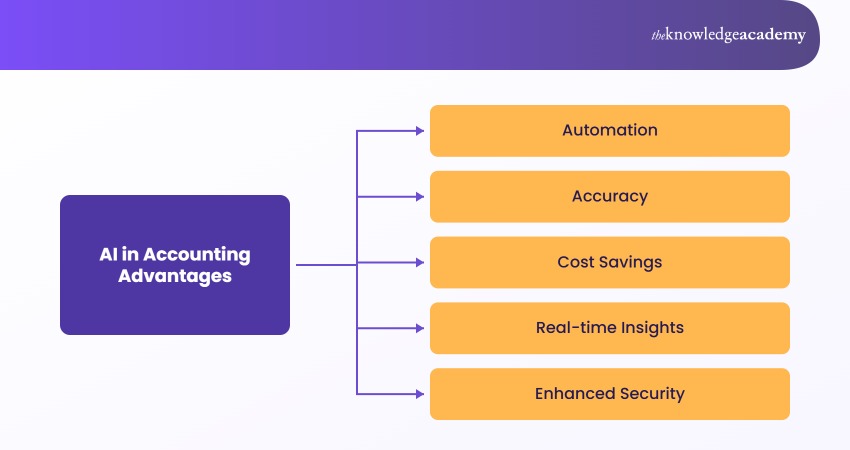
1) Automation
AI automates repetitive tasks such as data entry, invoice processing, and bank reconciliations. This reduces manual effort and saves time. This is especially useful for Accountants, as it allows them to focus on higher-value activities such as analysis, client support, and strategic decision-making.
2) Accuracy
AI can process large volumes of data with high consistency, reducing the risk of human error. It also helps identify patterns and anomalies, supporting better error detection and strengthening fraud monitoring. This leads to more reliable financial records and reporting.
3) Cost Savings
By reducing time spent on routine tasks, AI helps lower operational costs and improve overall efficiency. This enables organisations to optimise resources and potentially handle more work without increasing workload pressure. It also supports better allocation of time towards value-driven activities.
4) Real-time Insights
AI provides access to timely financial data and insights, supporting faster and more informed decision-making. This enables accountants to deliver more relevant, data-driven advice to businesses and clients. It also allows quicker responses to financial changes and emerging trends.
5) Enhanced Security
AI supports fraud detection by identifying unusual patterns and transactions in financial data. It can also assist in continuous monitoring, helping organisations respond quickly to potential risks and protect financial operations. This strengthens overall financial security and improves risk management practices.
Build smarter products with AI automation and accelerate product success with the AI Automation Course For Product Management – Sign up now!
Current Use Cases of AI in Accounting
AI is already being used across several accounting functions to improve efficiency, strengthen analysis, and support faster decision-making. Let’s look at some of the real-life AI in Accounting use cases below:
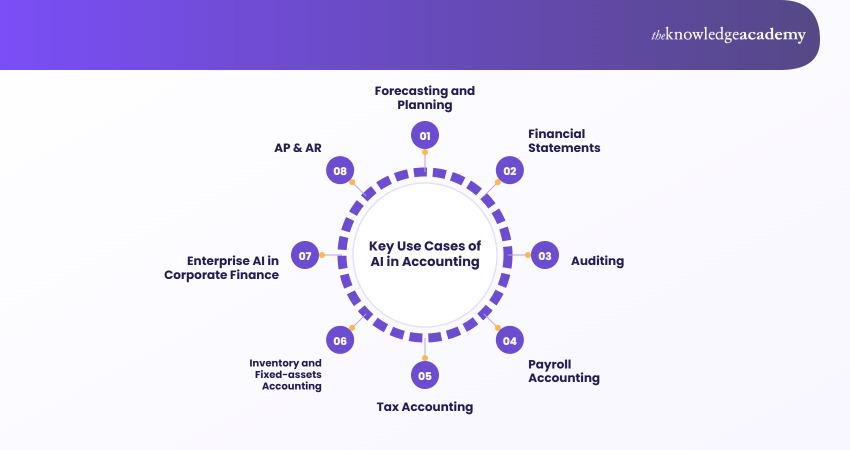
1) Forecasting and Planning
AI supports forecasting and planning by analysing historical and current financial data to identify patterns, model scenarios, and improve predictions. It also helps finance teams with variance analysis, rolling forecasts, and cash flow planning, making planning cycles faster and more responsive to change.
2) Financial Statements
AI is increasingly used to support the preparation of financial statements by pulling data from finance systems, assisting with classification, and helping generate reporting narratives. This reduces manual effort, improves consistency, and shortens reporting cycles when combined with proper review and internal controls.
3) Auditing
In auditing, AI helps teams review large volumes of transactions, identify anomalies, and focus attention on unusual patterns that require investigation. Rather than replacing professional judgement, it enhances audit quality by improving speed and depth of analysis.
4) Payroll Accounting
AI is being applied in payroll to automate data handling, support calculations, and improve compliance monitoring across payroll processes. It is especially useful where payroll is complex, helping organisations manage data more efficiently and identify potential compliance risks earlier.
5) Tax Accounting
Tax accounting is another strong use case, as AI can process documents, support compliance workflows, and improve access to regulatory insights. It also helps automate parts of tax operations and strengthens data-driven decision-making in increasingly complex tax environments.
6) Inventory and Fixed-assets Accounting
AI can support inventory and fixed-assets accounting by improving tracking, forecasting, and the analysis of asset-related data. Within enterprise finance platforms, these capabilities are connected to broader financial management processes. This is helping teams to manage reporting, asset visibility, and operational planning more effectively.
7) Enterprise AI in Corporate Finance
In corporate finance, AI improves cash management, forecasting, risk monitoring, and connected planning. This enables finance teams to move closer to real-time financial intelligence, supporting faster and more Agile decision-making.
8) AP & AR
Accounts Payable (AP) and Accounts Receivable (AR) are key areas where AI improves document processing, workflow automation, and faster access to financial insights. Organisations are increasingly using AI in AP and AR to streamline processes, support better decision-making, and increase efficiency across daily finance operations.
Streamline IT systems using AI power and upgrade IT efficiency with the AI Automation Course For IT – Join today!
Best Practices for Implementing AI in Accounting
Adopting AI in Accounting requires a clear strategy, strong governance, and a well-prepared team. By following proven best practices, organisations can successfully implement AI in Accounting and achieve long-term value from their financial operations. Let's look at them below:
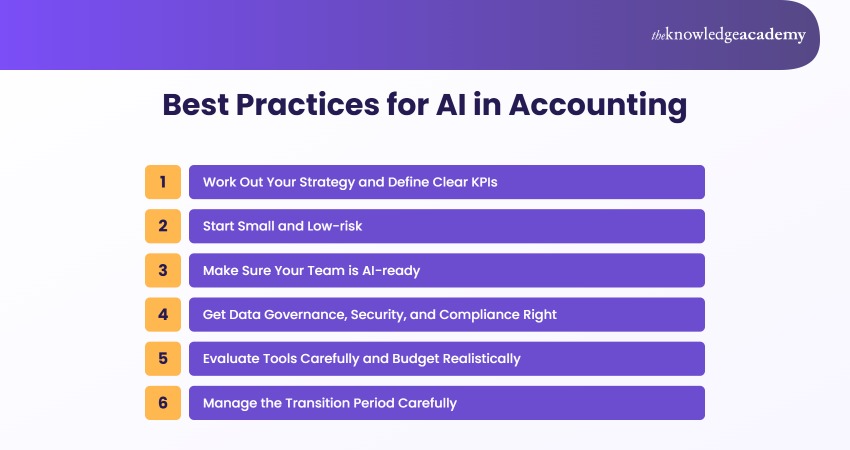
1) Work Out Your Strategy and Define Clear KPIs
A successful rollout should begin with clearly identifying the accounting pain points you want to solve, such as slow close cycles, manual reconciliations, or invoice bottlenecks. From there, define measurable Key Performance Indicators (KPIs) like time to close, processing speed, reconciliation rates, or error reduction so progress can be tracked against business goals.
2) Start Small and Low-risk
It is best to begin with structured, repeatable processes such as invoice capture, expense categorisation, or reconciliations. A pilot approach reduces risk, demonstrates value early, and builds confidence before scaling AI across broader workflows.
3) Make Sure Your Team is AI-ready
AI adoption is more effective when teams understand that the technology supports their work rather than replaces professional judgement. Training, clear communication, internal champions, and continuous feedback are essential for successful adoption.
4) Get Data Governance, Security, and Compliance Right
Strong governance is essential because accounting data must remain accurate, secure, and auditable. Organisations should focus on controls, such as access management, audit trails, oversight, testing, and compliance monitoring. It keeps AI outputs trustworthy and aligned with financial and regulatory requirements.
5) Evaluate Tools Carefully and Budget Realistically
When selecting AI tools, organisations should assess integration, scalability, security, and long-term compatibility with existing systems. Budgets should also include implementation, training, governance, and ongoing optimisation, as AI adoption evolves over time.
6) Manage the Transition Period Carefully
AI implementation requires an adjustment phase as teams learn new processes and workflows. During this period, change management, realistic expectations, and continued support are important. Mostly for finance roles as they increasingly shift towards more analytical and advisory work alongside AI tools.
Deliver faster support with AI automation and enhance customer experience with the AI Automation Training For Customer Services – Sign up now!
How Can Accountants Stay Relevant With AI?
As AI continues to reshape accounting, many professionals may worry about being replaced. However, AI is more likely to transform the role rather than eliminate it. Accountants who adapt by combining technology with human expertise can remain highly valuable, especially as businesses increasingly rely on data-driven insights. Let’s explore some practical and effective ways below:
1) Enhance Skills and Develop Strong Soft Skills
While AI can handle data processing and analysis, it cannot fully replace human skills such as critical thinking, communication, and problem-solving. By strengthening these abilities, accountants can better interpret insights and provide meaningful advice to clients and stakeholders.
2) Deliver Value-added Services
With routine tasks automated, Accountants can focus more on services like financial planning, risk management, and strategic advisory. These services are reliant on human judgment and experience. This makes them essential in delivering greater value beyond basic accounting functions.
3) Collaborate With AI for Efficiency
Rather than viewing AI as a replacement, Accountants should use it as a tool to enhance their work. AI can provide accurate data and forecasts, while professionals apply their expertise to interpret results and guide business decisions effectively.
4) Adopt AI-powered Accounting Software
Adopting AI-enabled accounting tools can improve accuracy, streamline processes, and provide real-time insights. These tools support better decision-making, but the role of Accountants remains crucial in applying context, ensuring compliance, and delivering strategic advice.
The Future of AI in Accounting
The future of AI in Accounting is expected to bring more advanced capabilities that go beyond automation into deeper analysis and decision support. As technology continues to evolve, AI is likely to play a larger role in areas such as tax planning. It can help analyse complex regulations, identify opportunities, and support more informed strategies when combined with professional judgement.
Also, AI is set to further enhance auditing by enabling more comprehensive data analysis and improving the detection of anomalies and risks. As adoption grows, the demand for Accountants with AI-related skills will increase. This can create new roles focused on data analysis, technology integration, and advisory services, while reinforcing the importance of human expertise in financial decision-making.
Conclusion
AI in Accounting is reshaping how financial tasks are managed, analysed, and delivered across modern organisations. By automating routine processes, improving accuracy, and enabling data-driven insights, it allows Accountants to focus on strategic and value-driven work. As technology keeps evolving, embracing AI will be essential for delivering smarter financial decisions in 2026 and the years ahead.
Simplify workflows with intelligent automation and boost efficiency with AI-driven automation with AI Automation Training – Join today!
Frequently Asked Questions
Which AI Model is Best at Accounting?

The right AI model choice depends on specific business requirements. Advanced models such as GPT support data analysis and automation in accounting. While tools like QuickBooks, Xero, Vic.ai, and Trullion excel in areas such as bookkeeping, accounts payable, and financial reporting.
Will AI Replace ACCA?
AI is unlikely to replace ACCA professionals, but it is reshaping the role. Routine tasks are increasingly automated, while Accountants focus more on strategy, judgment, and client relationships. Those who adopt AI tools can enhance their value and stay competitive in an evolving profession.
What are the Other Resources and Offers Provided by The Knowledge Academy?
The Knowledge Academy takes global learning to new heights, offering over 3,000+ online courses across 490+ locations in 190+ countries. This expansive reach ensures accessibility and convenience for learners worldwide.
Alongside our diverse Online Course Catalogue, encompassing 17 major categories, we go the extra mile by providing a plethora of free educational Online Resources like Blogs, eBooks, Interview Questions and Videos. Tailoring learning experiences further, professionals can unlock greater value through a wide range of special discounts, seasonal deals, and Exclusive Offers.
What is The Knowledge Pass, and How Does it Work?
The Knowledge Academy’s Knowledge Pass, a prepaid voucher, adds another layer of flexibility, allowing course bookings over a 12-month period. Join us on a journey where education knows no bounds.
What are the Related Courses and Blogs Provided by The Knowledge Academy?
The Knowledge Academy offers various AI Automation Training, including the AI Automation Course For Finance And Accounting, AI Automation Course For Product Management, and AI Automation Course For IT. These courses cater to different skill levels, providing comprehensive insights into How to Become MLOps Engineer.
Our Data, Analytics & AI Blogs cover a range of topics related to AI in Accounting, offering valuable resources, best practices, and industry insights. Whether you are a beginner or looking to advance your Accounting skills, The Knowledge Academy's diverse courses and informative blogs have got you covered.

Lily Turner


Senior AI/ML Engineer and Data Science Author
Lily Turner is a data science professional with over 10 years of experience in artificial intelligence, machine learning, and big data analytics. Her work bridges academic research and industry innovation, with a focus on solving real-world problems using data-driven approaches. Lily’s content empowers aspiring data scientists to build practical, scalable models using the latest tools and techniques.
View Detail
Upcoming Data, Analytics & AI Resources Batches & Dates
Date
 AI Automation Course for Finance and Accounting
AI Automation Course for Finance and Accounting
Fri 7th Aug 2026
AI Automation Course for Finance and Accounting
Fri 6th Nov 2026

 If you wish to make any changes to your course, please


