


 Top Rated Course

We may not have the course you’re looking for. If you enquire or give us a call on +36 18508731 and speak to our training experts, we may still be able to help with your training requirements.
5 Psychological Theories: Definition, Importance, and Examples
Michael Jones 27 February 2026Psychological Theories explain human thoughts, behaviours, and emotions through research, including behavioural, cognitive, humanistic, and psychodynamic. These help psychologists interpret mental processes, develop treatments, and improve education. Each offers a different lens for understanding how and why people think and their actions.

Training Outcomes Within Your Budget!
We ensure quality, budget-alignment, and timely delivery by our expert instructors.
Table of Contents
Psychological Theories help explain how people think, feel, and behave. They offer structured ways to understand mental processes and social interactions. These theories are developed through research and observation across different branches of psychology. Let’s explore the key types and their practical relevance.
Table of Contents
1) What are Psychological Theories?
2) 5 Major Psychological Theories
3) Different Types of Psychological Theories
4) Examples of Psychological Theories
5) Key Terms Related to Psychological Theory
6) Why are Psychological Theories Important?
7) Conclusion
What are Psychological Theories?
Psychological theories are evidence-based explanations that describe human behaviour and predict future actions. They begin with a hypothesis and are supported by research findings. To be considered valid, a theory must explain a behaviour and offer testable predictions.
In everyday language, the word "theory" is often used loosely, but in science, it refers to a concept that can be tested and refined. Researchers gather evidence to support or challenge a theory, and as new data emerges, theories may be updated or replaced. The strength of a theory lies in its ability to explain a wide range of behaviours.
5 Major Psychological Theories
Different branches of psychology offer distinct ways of understanding human thoughts and behaviour. Each theory contributes to valuable insights, but none is considered the absolute truth.

1) Behavioral Theories
These theories focus on how behaviour is learned and influenced by the environment. Key features are:
1) Focus on observable behaviour, not internal thoughts or emotions
2) Emphasise learning through conditioning like classical and operant
3) Key figures: B.F. Skinner, John Watson
4) Behaviour is shaped by the environment and reinforcement
5) Applied in habit formation, education, and behavioural therapy
2) Cognitive Theories
Cognitive theories explain how our thoughts and mental processes shape behaviour. Key features are as follows:
1) Study internal mental processes like memory, thinking, and problem-solving
2) Behaviour is influenced by how we perceive and interpret information
3) Key figures are Jean Piaget, Aaron Beck
4) Forms the basis for Cognitive Behavioural Therapy (CBT)
5) Commonly used in education and mental health treatment
3) Humanistic Theories
Humanistic theories emphasise personal growth, self-awareness, and human potential. Key areas are:
1) Emphasise personal growth, free will, and self-actualisation
2) Believe people are inherently good and capable of change
3) Key figures are Carl Rogers, Abraham Maslow
4) Focus on empathy, self-awareness, and achieving potential
5) Influences therapy, coaching, and motivational approaches
4) Psychodynamic Theories
These theories delve into how unconscious forces and early experiences shape behaviour. Key features are:
1) Highlight the role of the unconscious mind and early experiences
2) Behaviour is driven by inner conflicts, desires, and repressed memories
3) The key figure is Sigmund Freud
4) Introduced concepts like defense mechanisms and dream analysis
5) Used in talk therapy and exploring emotional roots of behaviour
Make a move towards Mind Empowerment – Register for our Social Psychology Training today!
5) Biological Theories
Biological theories link behaviour to genetics, brain chemistry, and physical structure. Key functions are as follows:
1) Explore how brain structure, genes, and neurotransmitters affect behaviour
2) Behaviour and mental health have physical or genetic causes
3) Supported by research in neuroscience and pharmacology
4) Explains disorders like depression, schizophrenia, and anxiety biologically
5) Forms the basis for medical treatments and brain-based research
Different Types of Psychological Theories
Psychological theories vary in scope and focus, offering different ways to understand human behaviour. These categories help organise theories based on their depth, purpose, and how they evolve over time.

1) Developmental Theories
Developmental theories focus on how people grow and change throughout life. They explore physical, emotional, and cognitive development from infancy to adulthood. These theories help explain how early experiences shape later behaviour.
Gain knowledge to recognise the early signs and risks of mental illness with our Child Psychology Course today!
2) Grand Theories
Grand theories aim to explain broad aspects of human behaviour and personality. They offer comprehensive frameworks, often rooted in foundational psychological concepts. Examples include Freud’s psychoanalytic theory and Erikson’s psychosocial theory.
3) Mini Theories
Mini theories concentrate on specific behaviours or mental processes. They are more focused than grand theories and often address particular psychological functions. These theories are useful for studying targeted areas like memory or motivation.
4) Emergent Theories
Emergent theories combine elements from existing models and adapt to new research findings. They reflect evolving perspectives in psychology and often integrate insights from multiple disciplines. These theories are shaped by ongoing scientific developments.
Build resilience, prevent harm, and support mental health effectively with our Prevention Psychology Training - Join today!
Examples of Psychological Theories
Below are some important and widely recognised Psychological Theories:
1) Cognitive Dissonance Theory – Leon Festinger
This theory explains the discomfort people feel when their beliefs and actions don’t align.

1) Key Idea: People are motivated to reduce this mental tension by changing their beliefs or actions.
2) Example: A smoker who knows smoking is harmful might quit or justify the habit to reduce dissonance.
3) Application: Used in marketing, health campaigns, and behavior change strategies.
Learn various exercises and techniques for increasing mental strength with our Handle Stress and Develop Your Resilience course – Join today!
2) Maslow’s Hierarchy of Needs – Abraham Maslow
A humanistic theory that outlines a five-level pyramid of human needs.
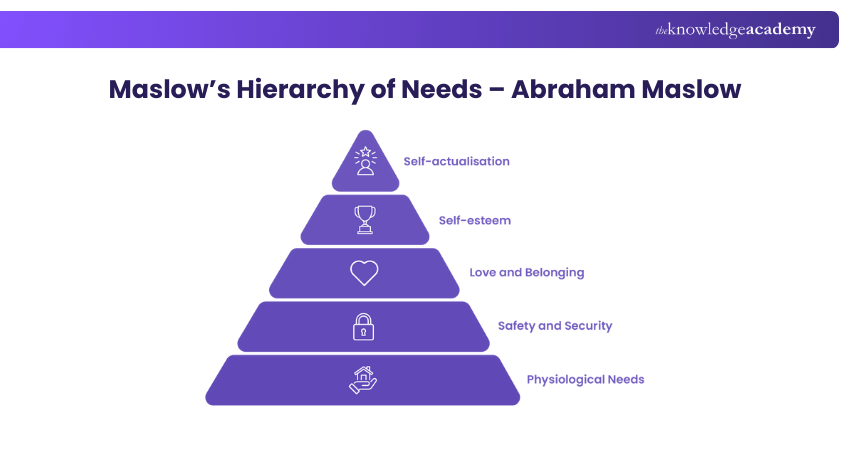
1) Levels: Physiological → Safety → Love/Belonging → Esteem → Self-actualisation
2) Key Idea: People must satisfy lower-level needs before pursuing higher ones.
3) Application: Used in education, workplace motivation, therapy, and marketing.
3) Classical Conditioning – Ivan Pavlov
A foundational behavioral theory explaining how learning occurs through associations.

1) Key Idea: A neutral stimulus becomes associated with a response after being paired repeatedly with a stimulus that naturally produces that response.
2) Example: Pavlov’s dogs learned to salivate at the sound of a bell associated with food.
3) Application: Used in behavior therapy, advertising, and habit formation.
4) Attachment Theory – John Bowlby & Mary Ainsworth
This theory explains how early relationships with caregivers influence emotional development.

1) Key Idea: Secure attachment in early life leads to healthier relationships and emotional well-being in adulthood.
2) Example: Children with consistent, responsive caregivers develop trust and emotional security.
3) Application: Used in child development, counseling, and parenting programs.
5) Ecological Systems Theory – Urie Bronfenbrenner
An emergency theory that explains how multiple environmental layers influence development.

1) Layers: Microsystem (family), mesosystem (school), exosystem (community), macrosystem (culture)
2) Key Idea: Development is shaped by the interactions between individuals and their environments.
3) Application: Used in education, public policy, and developmental psychology.
Key Terms Related to Psychological Theory
Understanding Psychological Theories becomes easier when you're familiar with the core terms. Here are some essential concepts:
1) Behaviour: Observable actions or responses by individuals or groups
2) Cognition: Mental processes like thinking, memory, and problem-solving
3) Motivation: Internal drive that directs behaviour
4) Emotion: A mix of thoughts, feelings, and physical responses
5) Personality: Unique patterns of thoughts, feelings, and behaviours
6) Unconscious Mind: Hidden thoughts influencing behaviour, Psychoanalytic theory
7) Reinforcement: A consequence that increases behaviour repetition
8) Development: Growth across emotional, mental, and physical stages
9) Self-Actualisation: Reaching one’s full potential, Humanistic theory
10) Learning: Behaviour or knowledge change from experience
11) Stimulus: An event that triggers a response
12) Response: Reaction to a stimulus
13) Schema: Mental structure for organising information, Cognitive theory
14) Attachment: Emotional bond, especially between child and caregiver
15) Theory: A framework explaining behaviour, backed by research
Why are Psychological Theories Important?
Here are some points to explain why these Psychological Theories matter:
1) Explain Human Behaviour: Theories offer insights into why people act in certain ways, from daily habits to complex emotional responses.
2) Predict Future Behaviour: By understanding patterns, psychologists can predict how people might behave in similar situations.
3) Guide Research and Practice: Theories form the basis for psychological studies and influence how therapists, educators, and researchers approach their work.
4) Improve Mental Health Treatment: They shape therapeutic approaches like cognitive-behavioural therapy, helping people overcome anxiety, depression, trauma, and more.
5) Support Learning and Development: Theories inform how we teach, parent, and guide individuals through different life stages.
6) Build Better Relationships and Workplaces: They help in conflict resolution, team dynamics, leadership, and communication.
Conclusion
Psychological Theories offer valuable insights into how people think, feel, and behave. They help researchers and practitioners understand complex mental processes and social interactions. By exploring different theories, we gain a deeper appreciation of human nature. Let’s now look at how these theories apply in real-world settings.
Understand the strategies for cultivating happiness and resilience with our Positive Psychology Course – Register now!
Frequently Asked Questions
How do I Explain a Theory?

To explain a theory, introduce its key concepts, purpose, and significance. Discuss its origins, foundational principles, and real-world applications. Use examples to illustrate how it operates and highlight its impact on understanding specific phenomena or solving problems.
How do you Analyse a Psychology Theory?
To analyse a Psychology Theory, first understand its core concepts and assumptions. Evaluate its evidence and methodology, considering empirical support and limitations. Compare it with other theories, and assess its applicability in real-world contexts, considering its contributions and shortcomings.
What are the Other Resources and Offers Provided by The Knowledge Academy?
The Knowledge Academy takes global learning to new heights, offering over 3,000 online courses across 490+ locations in 190+ countries. This expansive reach ensures accessibility and convenience for learners worldwide.
Alongside our diverse Online Course Catalogue, encompassing 17 major categories, we go the extra mile by providing a plethora of free educational Online Resources like Blogs, eBooks, Interview Questions and Videos. Tailoring learning experiences further, professionals can unlock greater value through a wide range of special discounts, seasonal deals, and Exclusive Offers.
What is The Knowledge Pass, and How Does it Work?
The Knowledge Academy’s Knowledge Pass, a prepaid voucher, adds another layer of flexibility, allowing course bookings over a 12-month period. Join us on a journey where education knows no bounds.
What are the Related Courses and Blogs Provided by The Knowledge Academy?
The Knowledge Academy offers various Mental Health Courses, including Psychology Course, Mental Capacity Training, and Positive Psychology Course. These courses cater to different skill levels, providing comprehensive insights into Emotional Wellbeing.
Our Health & Safety Blogs cover a range of topics related to Mental Health, offering valuable resources, best practices, and industry insights. Whether you are a beginner or looking to advance your Mental Health knowledge, The Knowledge Academy's diverse courses and informative blogs have you covered.

Michael Jones


Health and Safety Consultant and Compliance Trainer
Michael Jones is a seasoned health and safety expert with more than 15 years of experience in workplace safety, risk management, and compliance training. He has worked across construction, manufacturing, and corporate sectors, helping organisations meet legal requirements and create safer working environments. Michael’s training and writing are known for being practical, clear, and aligned with UK regulations.

Upcoming Health & Safety Resources Batches & Dates
Date
 Psychology Course
Psychology Course
Fri 10th Jul 2026
Psychology Course
Fri 18th Sep 2026
Psychology Course
Fri 4th Dec 2026

 If you wish to make any changes to your course, please


