


 Top Rated Course

We may not have the course you’re looking for. If you enquire or give us a call on +36 18508731 and speak to our training experts, we may still be able to help with your training requirements.
What is Minimum Spanning Tree? All You Need To Know
The Knowledge Academy 10 February 2026A Minimum Spanning Tree connects all vertices in a weighted graph with no cycles, ensuring full connectivity at the lowest possible total edge cost. It is widely used in network design to minimise infrastructure costs. Algorithms like Kruskal’s and Prim’s help identify the optimal spanning tree quickly and accurately.

Training Outcomes Within Your Budget!
We ensure quality, budget-alignment, and timely delivery by our expert instructors.
Table of Contents

A Minimum Spanning Tree is a way to connect all the vertices in a weighted graph using the least total edge cost. It avoids cycles and ensures full connectivity. This concept is widely used in network design and optimisation. Let’s explore how it works and why it matters.
Table of Contents
1) Understanding Spanning Tree
2) What is a Minimum Spanning Tree?
3) Example of a Spanning Tree
4) Algorithms to Find Minimum Spanning Tree
5) Applications of Minimum Spanning Tree
6) Can MST Algorithms Work on Directed Graphs?
7) What are Some Common Mistakes When Learning Minimum Spanning Tree?
8) Conclusion
Understanding Spanning Tree
A Spanning Tree is a portion of a graph that includes all the vertices with the minimum number of edges. Multiple Spanning Trees can exist for a given graph, but there will always be at least one. In a Spanning Tree, the edges included are known as “branch edges,” while those excluded are “cycle edges.”
This type of graph helps determine the least number of edges needed to connect all vertices. It is also useful for creating minimally secured networks with redundant paths.

What is a Minimum Spanning Tree?
A Minimum Spanning Tree (MST) is a selection of edges from a connected, edge-weighted graph that connects all vertices without creating cycles and with the lowest possible total edge weight. It signifies the most cost-effective method to link a set of vertices.
In an MST, all edge weights must be unique. If the graph’s edge weights are identical, any Spanning Tree of the graph qualifies as an MST. The edges of the MST can be determined using the greedy algorithm or more advanced methods like Kruskal’s or Prim’s algorithms.
Example of a Spanning Tree
A Spanning Tree is a subgraph of an undirected, connected graph that includes all the vertices of the original graph with the minimum possible number of edges. Here’s a detailed example to illustrate this concept:
Consider a graph ( G ) with the following vertices and edges:
a) Vertices: ( A, B, C, D )
b) Edges: ( (A-B), (A-C), (B-C), (B-D), (C-D) )
The graph can be visualised as follows:

To create a Spanning Tree from this graph, we need to ensure that all vertices are connected with the minimum number of edges and without forming any cycles. One possible Spanning Tree for this graph could be:
a) Edges: ( (A-B), (B-C), (B-D) )
This can be visualised as:

In this Spanning Tree, all vertices ( A, B, C, D ) are connected, and there are no cycles. The total number of edges is ( 3 ), which is ( N-1 ), where ( N ) is the number of vertices.
Equip yourself with the latest coding techniques and tools - Join our Programming Training now!
Algorithms to Find Minimum Spanning Tree
There are multiple algorithms available to determine the Minimum Spanning Tree from a given graph. Some of these include:

1) Kruskal's Algorithm for Finding Minimum Spanning Trees
It is one of the popular algorithms for figuring out the Minimum Spanning Tree in a connected, undirected graph. It is a greedy algorithm. The workflow of the algorithm is as follows:
a) First, it sorts every edge of the graph by its weights
b) Then, it begins the iterations to find the Spanning Tree
c) During each iteration, the algorithm sequentially adds the next lowest-weight edge, making sure that the chosen edges do not create a cycle.
This algorithm can be efficiently implemented using a Disjoint-Set (DSU) data structure to keep track of the connected components of the graph. It is used in various practical applications such as network design, clustering, and Data Analysis.
2) Prim's Algorithm for Minimum Spanning Trees
This is also a greedy algorithm with the following workflow:
a) It begins by choosing a random vertex and adding it to the MST
b) It then continuously looks for the smallest edge weight that links a vertex in the MST to one not yet included.
c) This procedure repeats until all vertices are part of the MST
To efficiently select the minimum weight edge at each iteration, this algorithm uses a priority queue to store the vertices sorted by their current minimum edge weight. It also keeps track of the MST using an array or another suitable data structure, depending on the data type being stored. It can be applied in scenarios like image segmentation and routing for finding the shortest path.
3) Boruvka's Algorithm for Minimum Spanning Trees
This is also a graph traversal algorithm applied to find the Minimum Spanning Tree of a connected, undirected graph. It is one of the oldest algorithms. The algorithm works by iteratively constructing the MST, with each vertex in the graph as its own tree.
In every iteration, the algorithm identifies the cheapest edge that connects one tree to another and sums up that edge to the Minimum Spanning Tree. This is quite similar to Prim’s algorithm for finding the MST. The algorithm follows this workflow:
a) Initialise a forest of trees, with every vertex in the graph as its own tree
b) For every tree in the forest:
1) Find the cheapest edge that links it to another tree
2) Add these edges to the Minimum Spanning Tree
c) Update the forest by combining the trees linked by the added edges
d) Repeat the above steps until the forest includes only one tree, which is the Minimum Spanning Tree.
Boruvka’s algorithm is a straightforward and easy-to-implement method for finding Minimum Spanning Trees, though it may not be as effective as other algorithms for large graphs with multiple edges.
Join our comprehensive Delphi Course and gain hands-on training in Software Development!
Applications of Minimum Spanning Tree
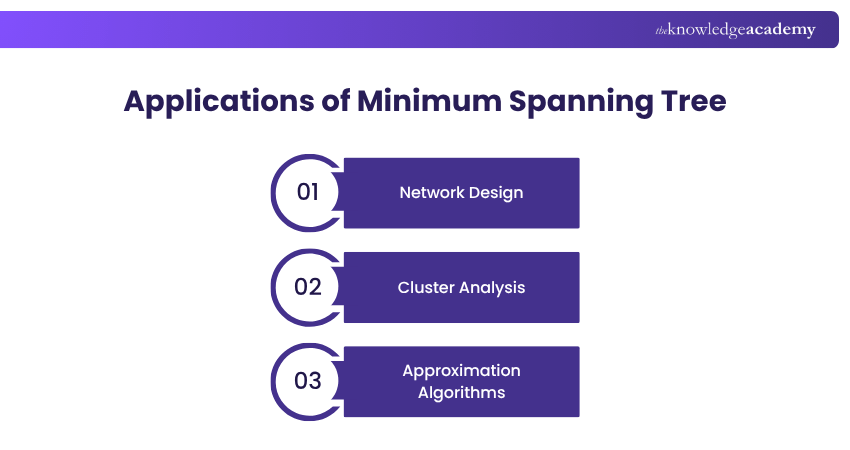
A Minimum Spanning Tree (MST) is a fundamental concept in graph theory with numerous practical applications across various fields. Here are some key applications:
Network Design
Minimum Spanning Trees are widely used in designing efficient networks such as telephone lines, electrical grids, and computer networks. They help minimise infrastructure costs by connecting all nodes with the least total edge weight.
Cluster Analysis
In clustering problems, MSTs help group data by removing the most expensive edges. This technique is useful in image segmentation, bioinformatics, and facility location planning, where distinct clusters or regions need to be identified.
Approximation Algorithms
MSTs are used to approximate solutions for NP-hard problems like the Travelling Salesperson Problem. By tracing paths around the MST, one can find near-optimal tours that are within a factor of two of the best possible solution.
Can MST Algorithms Work on Directed Graphs?
Standard MST algorithms like Prim’s and Kruskal’s are not suitable for directed graphs. Prim’s algorithm assumes all vertices are reachable, which is not guaranteed in a directed graph.
Kruskal’s algorithm struggles to detect cycles correctly due to edge direction, often misclassifying valid connections. For directed graphs, the equivalent concept is called a Minimum Spanning Arborescence, which can be solved using Edmonds’ algorithm, a specialised method designed for this purpose.
What are Some Common Mistakes When Learning Minimum Spanning Tree?
While learning about Minimum Spanning Tree, learners often make avoidable errors that can affect their understanding and problem-solving accuracy.
1) Ignoring Edge Weights: Some learners overlook the importance of edge weights, which are crucial for determining the minimum cost connections.
2) Creating Cycles: Adding edges without checking for cycles, especially in Kruskal’s algorithm, can lead to invalid spanning trees.
3) Not Validating the Result: Failing to confirm that all vertices are included and the tree is truly minimal can result in incorrect solutions.
4) Misapplying Algorithms: Choosing the wrong algorithm for the graph type, such as using Prim’s on a sparse graph, can reduce efficiency.
5) Overlooking Graph Structure: Not recognising whether the graph is directed, undirected, or disconnected can lead to flawed approaches.
Conclusion
Minimum Spanning Tree is a key concept in graph theory and network optimisation. It helps connect all points in a graph with minimal cost and no cycles. Understanding its algorithms and applications is essential for solving real-world problems efficiently. With practice, learners can avoid common mistakes and apply MST confidently.
Build data skills with our practical R Programming Course today!
Frequently Asked Questions
What is Prim's Algorithm Used for?

Prim's algorithm is utilised to search for the Minimum Spanning Tree (MST) of a weighted, undirected graph. It starts with a single vertex and grows the MST by adding the cheapest possible edges from the tree to new vertices.
Can Minimum Spanning Tree be Used for Cycle Detection in Graphs?
Minimum Spanning Tree cannot directly detect cycles, as its purpose is to connect all vertices with the minimum total edge weight while avoiding cycles. However, during MST construction using algorithms like Kruskal’s, cycle detection is essential to ensure only valid edges are added to the tree.
What are the Other Resources and Offers Provided by The Knowledge Academy?
The Knowledge Academy takes global learning to new heights, offering over 3,000+ online courses across 490+ locations in 190+ countries. This expansive reach ensures accessibility and convenience for learners worldwide.
Alongside our diverse Online Course Catalogue, encompassing 19 major categories, we go the extra mile by providing a plethora of free educational Online Resources like Blogs, eBooks, Interview Questions and Videos. Tailoring learning experiences further, professionals can unlock greater value through a wide range of special discounts, seasonal deals, and Exclusive Offers.
What is The Knowledge Pass, and How Does it Work?
The Knowledge Academy’s Knowledge Pass, a prepaid voucher, adds another layer of flexibility, allowing course bookings over a 12-month period. Join us on a journey where education knows no bounds.
What are the Related Courses and Blogs Provided by The Knowledge Academy?
The Knowledge Academy offers various Programming Training, including the PHP Course, Python Django Training, and Bootstrap Training. These courses cater to different skill levels, providing comprehensive insights into Floor Division in Python.
Our Programming & DevOps Blogs cover a range of topics related to Minimum Spanning Tree, offering valuable resources, best practices, and industry insights. Whether you are a beginner or looking to advance your Programming & DevOps skills, The Knowledge Academy's diverse courses and informative blogs have got you covered.

The Knowledge Academy


Global Training Provider
The Knowledge Academy is a world-leading provider of professional training courses, offering globally recognised qualifications across a wide range of subjects. With expert trainers, up-to-date course material, and flexible learning options, we aim to empower professionals and organisations to achieve their goals through continuous learning.

Upcoming Programming & DevOps Resources Batches & Dates
Date
 Data Structure and Algorithm Training
Data Structure and Algorithm Training
Fri 28th Aug 2026
Data Structure and Algorithm Training
Fri 27th Nov 2026

 If you wish to make any changes to your course, please


