


 Top Rated Course

We may not have the course you’re looking for. If you enquire or give us a call on +36 18508731 and speak to our training experts, we may still be able to help with your training requirements.
Importance of Marketing for Businesses: An Overview
James Smith 10 January 2026Marketing is vital for any business to stay relevant and adapt in a competitive market. It provides insights for smart decisions and helps build strong, lasting relationships. Learn the Importance of Marketing and how effective marketing strategies can boost sales by showcasing your business’s value and differentiating it from competitors.

Training Outcomes Within Your Budget!
We ensure quality, budget-alignment, and timely delivery by our expert instructors.
Table of Contents

Have you ever thought about how businesses create a buzz and get people excited about their brands and products? Well, that's why it is crucial to understand the Importance of Marketing for Business. It's like the special ingredient that enables businesses to share their message, connect with people, and increase sales. Regardless of the industry, incorporating Marketing is like opening opportunities to connect with more people and achieve significant growth.
However, if you haven’t adopted the latest marketing strategies yet, it’s time you did. You ask why? Well, don’t worry more, we have the answer to your question. Read this blog to explore the profound impact and Importance of Marketing for Business. Also, understand the crucial role it plays in enhancing brand awareness and engagement.
Table of Contents
1) Why is Marketing Important for Business?
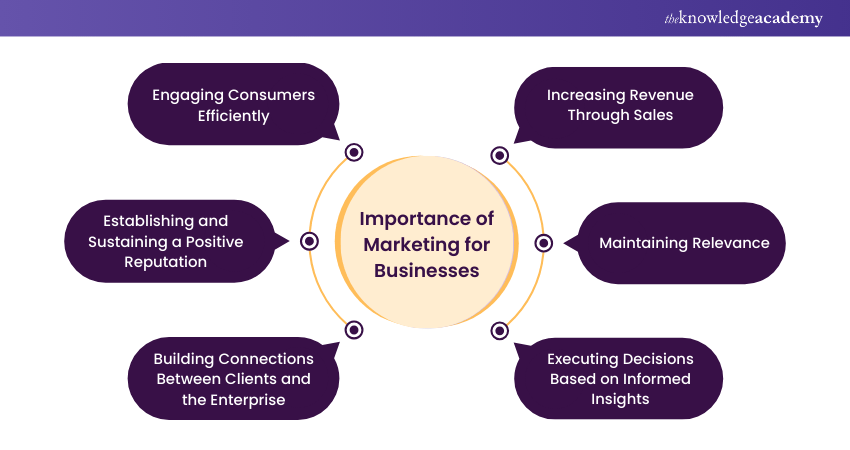
a) Engaging Consumers Efficiently
b) Establishing and Sustaining a Positive Reputation
c) Building Connections Between Clients and the Enterprise
d) Increasing Revenue Through Sales
e) Maintaining Relevance
f) Executing Decisions Based on Informed Insights
2) Types of Marketing
3) How do Marketing Strategies Lead to Success?
4) Conclusion
Why is Marketing Important for Business?
The primary aim of Marketing is to assist businesses in achieving efficient growth and maximising their Return On Investment (ROI) through the promotion of brands, products, and services. Marketing promotions typically concentrate on enhancing content engagement. As a result, they elevate the sales of products and services and expand brand awareness.
Marketing strategies can be categorised as either traditional, involving print media, or digital, involving digital media. These approaches encompass a range of channels, including both conventional and digital avenues. Some traditional and digital Marketing avenues include the following:
a) Billboards and posters
b) Digital ads
c) Articles in print magazines or newspapers
d) Email
e) Postal mail
f) Social media
g) Blogs and posts online
In the competitive landscape of businesses, marketing stands out as a cornerstone for success. It plays a pivotal role in various facets that contribute to overall growth and prosperity. Thus, without understanding the Importance of Marketing for Businesses, it is unimaginable to reach your target audience and improve brand awareness. But you don’t have to worry about your brand image anymore. The following are reasons to answer the question: Why is Marketing Important for Businesses:
1) Engaging Consumers Efficiently
Effective consumer engagement is a hallmark of successful Marketing strategies. By informing and captivating consumers with compelling narratives about products and services, businesses can forge meaningful connections.
This engagement goes beyond mere transactions, fostering brand loyalty and advocacy. It involves not just meeting but surpassing customer expectations. Thus, Marketing helps create a symbiotic relationship that resonates with the target audience.
2) Establishing and Sustaining a Positive Reputation
The reputation of a business is its intangible asset, and Marketing acts as the guardian of this invaluable treasure. Through strategic communication and brand positioning, Marketing shapes the perception of the enterprise in the eyes of its audience.
Moreover, by consistently delivering on promises and aligning with core values, Marketing contributes to establishing and maintaining a positive reputation. Thus, it becomes a key determinant of long-term success.
3) Building Connections Between Clients and the Enterprise
Businesses thrive on relationships, and the Importance of Marketing for Businesses is reflected by clients who connect with the enterprise. By delving into demographics, psychographics, and consumer behaviour, Marketing provides insights that facilitate the creation of tailored approaches. This personalised interaction builds trust and understanding. As a result, it lays a foundation for enduring connections that extend beyond mere transactions.
4) Increasing Revenue Through Sales
A fundamental goal of Marketing is to drive revenue growth through increased sales. By employing diverse promotional techniques, businesses can enhance product visibility, attract new customers, and retain existing ones.
Satisfied customers, cultivated through effective Marketing, become advocates. Moreover, they also contribute to a positive feedback loop of increased sales and sustained financial success. The revenue generated becomes a tangible metric of the effectiveness of a well-executed Marketing strategy, underlining its indispensable role in the business ecosystem.
Transform your Marketing prowess with our comprehensive Marketing Courses - join now!
5) Maintaining Relevance
Marketing serves as the linchpin in any long-term campaign by continuously aligning a business with the changing needs and preferences of its target audience. By staying attuned to market trends, consumer behaviour, and emerging technologies, Marketing enables businesses to adapt their strategies, products, and services.
Through targeted campaigns and communication, Marketing fosters a dynamic connection between the business and its audience. This ensures that the brand remains not only visible but also resonant in the minds of consumers. Moreover, this ongoing relevance enhances customer loyalty, attracts new audiences, and positions the business as an Agile and forward-thinking player in its industry.
6) Executing Decisions Based on Informed Insights
Informed decision-making is a cornerstone of successful business operations, and Marketing plays a pivotal role in providing the necessary insights. Through market research, data analysis, and consumer feedback, Marketing arms businesses with valuable information about market dynamics, customer preferences, and competitive landscapes.
This wealth of data empowers decision-makers to make strategic choices that are rooted in a deep understanding of their target audience. Marketing insights guide product development, pricing strategies, and promotional efforts, ensuring that resources are optimally allocated for maximum impact. By utilising informed insights, businesses can navigate uncertainties with confidence, anticipating and responding to market shifts effectively.
Gain knowledge of how to implement an Integrated Marketing strategy with our Integrated Marketing Training – sign up now!
Types of Marketing
There are different types of marketing based on who is selling and who is buying. Here’s a simple breakdown of the main types:
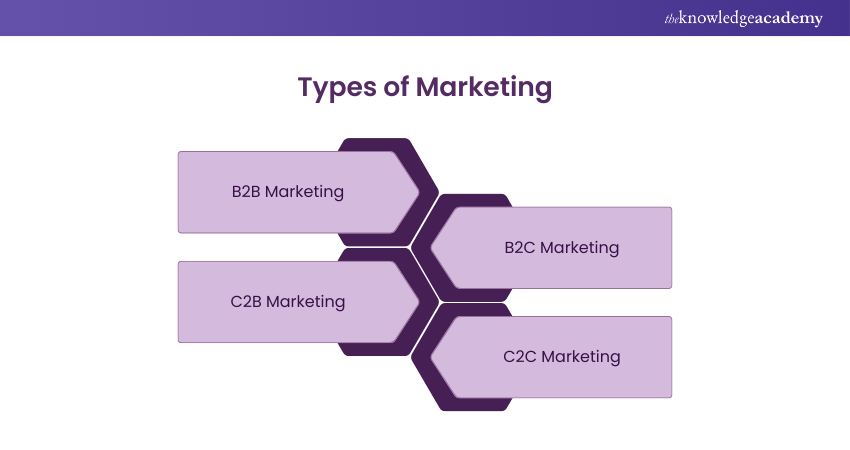
B2B Marketing
Business-to-Business (B2B) Marketing focuses on businesses selling products or services to other businesses. These transactions are usually more complex and involve a longer decision-making process, as multiple stakeholders are often involved.
The goal is to address the needs of business buyers, such as improving efficiency or solving specific problems. For example, a software company might provide project management tools to a construction firm.
B2C Marketing
Business-to-Consumer (B2C) Marketing is when businesses sell directly to individual consumers. The focus here is on appealing to emotions, convenience, and personal needs to encourage quick buying decisions.
Marketing campaigns are often broader, targeting large audiences with relatable messages. For instance, a clothing brand might promote its latest collection to shoppers looking for trendy outfits.
C2B Marketing
Consumer-to-Business (C2B) Marketing is when individuals offer products or services to businesses. This type of marketing is common in freelance work or influencer partnerships.
For example, a freelance designer might create branding materials for a company, or a popular influencer could promote a brand to their followers. The focus is on showcasing personal skills or reach that add value to the business.
C2C Marketing
Consumer-to-Consumer (C2C) Marketing happens when individuals sell directly to other individuals, often through online platforms. This type of marketing relies on peer-to-peer interactions and platforms that connect buyers and sellers.
Examples include eBay, where people sell second-hand items, and Facebook Marketplace, where users can trade goods locally. The focus is on simplicity, convenience, and community-based transactions.
How do Marketing Strategies Lead to Success?
Marketing strategies play a big role in a business’s success. They help a company grow, attract more customers, and build trust. Even if a business offers great products or services, people need to know about them. Strategies like advertising, promotions, and media relations spread the word and make customers aware.
A good marketing strategy also boosts a company’s reputation, making it more reliable in the eyes of consumers. In short, marketing not only drives growth but also helps a business stand out and connect with its audience.
Elevate your Marketing capabilities with our Content Marketing Course – to boost your brand's impact today!
Conclusion
The significance of marketing for businesses cannot be overstated. It serves as the foundation for growth, customer engagement, and strategic decision-making. In the midst of this, Marketing Interview Questions help professionals understand key industry concepts and best practices. Beyond maintaining relevance in a competitive market, marketing enables businesses to make informed choices and adapt to evolving consumer needs. As a driving force behind brand reputation, customer relationships, and sales, marketing plays a vital role in shaping long-term success and business resilience.
Transform your business with effective Marketing strategies – sign up for our Business Marketing Strategies Training now!
Frequently Asked Questions
What is Marketing?

Marketing is the process of promoting products or services to connect with customers and meet their needs. It involves strategies like advertising, branding, and building relationships to increase awareness, drive sales, and grow a business. Marketing helps businesses stand out in a competitive market.
What Factors Affect Consumer Behaviour?
Consumer behaviour is influenced by factors like personal preferences, social trends, culture, and economic conditions. Marketing strategies, product quality, price, and brand reputation also play a big role. Emotional and psychological triggers, such as trust or urgency, often impact purchasing decisions.
What are the Other Resources and Offers Provided by The Knowledge Academy?
The Knowledge Academy takes global learning to new heights, offering over 3,000 online courses across 490+ locations in 190+ countries. This expansive reach ensures accessibility and convenience for learners worldwide.
Alongside our diverse Online Course Catalogue, encompassing 19 major categories, we go the extra mile by providing a plethora of free educational Online Resources like Blogs, eBooks, Interview Questions and Videos. Tailoring learning experiences further, professionals can unlock greater value through a wide range of special discounts, seasonal deals, and Exclusive Offers.
What is The Knowledge Pass, and How Does it Work?
The Knowledge Academy’s Knowledge Pass, a prepaid voucher, adds another layer of flexibility, allowing course bookings over a 12-month period. Join us on a journey where education knows no bounds.
What are the Related Courses and Blogs Provided by The Knowledge Academy?
The Knowledge Academy offers various Marketing Courses, including Introduction to Marketing Training, Marketing Budget Course and Business Marketing Strategies Training. These courses cater to different skill levels, providing comprehensive insights into Brand Management.
Our Digital Marketing Blogs cover a range of topics related to Marketing, offering valuable resources, best practices, and industry insights. Whether you are a beginner or looking to advance your Marketing skills, The Knowledge Academy's diverse courses and informative blogs have you covered.

James Smith


Digital Marketing Manager and Trainer
James Smith is a digital marketing professional with over a decade of experience in SEO, content strategy, paid media and analytics. He has supported both SMEs and global brands in transforming their digital presence. James’s writing and training are rooted in results-driven tactics and the latest marketing trends.
View Detail
Upcoming Office Applications Resources Batches & Dates
Date
 Business Marketing Strategies Training
Business Marketing Strategies Training
Thu 30th Apr 2026
Business Marketing Strategies Training
Thu 6th Aug 2026
Business Marketing Strategies Training
Thu 5th Nov 2026

 If you wish to make any changes to your course, please


