


 Top Rated Course

We may not have the course you’re looking for. If you enquire or give us a call on +36 18508731 and speak to our training experts, we may still be able to help with your training requirements.
What is Human Resource Management: Skills and Importance
The Knowledge Academy 21 April 2026Human Resource Management is the strategic management of employees to improve performance, support growth, and help organisations achieve business goals. Understanding What is Human Resource Management gives a clear picture of how organisations build strong teams and maintain running daily operations smoothly.

Training Outcomes Within Your Budget!
We ensure quality, budget-alignment, and timely delivery by our expert instructors.
Table of Contents
The workforce of any organisation needs to feel supported and valued before they can achieve growth and innovation and maintain their ability to adapt. Human Resource Management establishes the basic system that manages employee hiring processes and employee motivation strategies to achieve maximum work performance.
In this blog, we’ll unpack What is Human Resource Management, explore why it’s essential in today’s dynamic workplaces, and highlight the skills and career paths that define this field. Read on to discover how strategic people management becomes a catalyst for organisational success!
Table of Contents
1) What is Human Resource Management (HRM)?
2) Why is Human Resource Management Important?
3) How Does Human Resource Management Work?
4) Responsibilities of Human Resource Management?
5) Essential Skills for Human Resource Management
6) HRM Systems and Software
7) Careers in Human Resource Management
8) How to Get Started in Human Resources Management?
9) What are the Trends in Human Resources Management?
10) Conclusion
What is Human Resource Management (HRM)?
Human Resource Management (HRM) means managing people within an organisation to achieve its goals. It includes creating policies, procedures, and workplace practices to support business objectives and align with the long-term vision of the company.
At its core, HRM focuses on building a positive work environment. It seeks to align the culture with organisational values, motivate employees and empower them. It makes sure the right people are hired, provided training, and supported so they can contribute meaningfully to the organisation.

Why is Human Resource Management Important?
Human Resource Management (HRM) functions as an essential component because it helps organisations to recruit and develop their most essential resource, which consists of their personnel who will assist them in achieving their business objectives.
a) Right Talent Acquisition: HR attracts and hires skilled employees aligned with organisational needs.
b) Employee Engagement: HR promotes communication, resolves conflicts, and improves workplace morale.
c) Training and Development: HR supports continuous learning and builds employee capabilities.
d) Compensation and Benefits: HR designs fair pay structures to motivate and retain talent.
e) Workplace Safety and Compliance: HR ensures legal compliance and maintains safe work environments.
f) Culture and Efficiency: HR strengthens organisational culture and boosts overall productivity.
How Does Human Resource Management Work?
The Human Resource management operates by integrating people practices and business objectives by planning, recruiting, training, and managing performance. It makes employees competent, nurtured, and placed to work on it.
The HR also handles payroll, benefits, attendance, and legal compliance to ensure that operations proceed without a hitch. It creates an engaged workforce that leads to organisational success through participation and feedback.
Understand current legal developments in People Management strategies. Join our CIPD Level 7 Advanced Diploma in Strategic People Management now!
Responsibilities of Human Resource Management?
HR professionals are responsible for creating and handling programmes to make the workplace better and improve the relationships between employers and employees. Here are some of their key tasks:
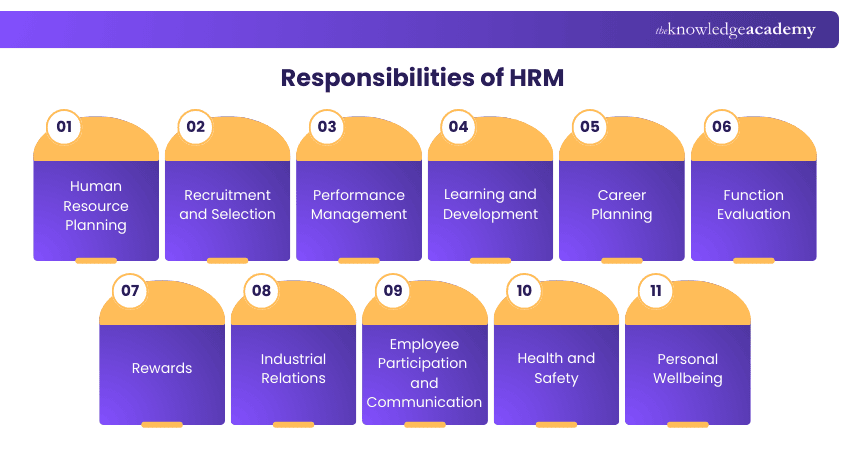
a) Human Resource Planning: The HR department creates personnel forecasts for upcoming workforce requirements. The HR department uses this planning process to establish procedures for recruiting personnel and developing their skills.
b) Recruitment and Selection: The HR department uses recruitment methods to identify suitable candidates who possess the necessary skills needed by the organisation and match its cultural values. This process creates an efficient team that can achieve high-performance results.
c) Performance Management: HR establishes performance criteria that it uses to control assessment processes and feedback distribution. This process keeps workers dedicated to their tasks while supporting the organisation through its objectives.
d) Learning and Development: HR provides training programs that help employees develop their abilities and prepare for future challenges. The system supports performance improvement while enabling employees to advance their careers.
e) Career Planning: HR provides assistance to employees who want to create their career development plans, which include potential advancement paths inside the company. This process increases employee engagement while helping businesses retain their most valuable staff.
f) Function Evaluation: HR department assesses job positions to determine their proper organizational ranking and compensation value. This process ensures that all employees receive fair pay while they understand their job responsibilities.
g) Rewards: The HR department creates salary structures and employee benefits programs that provide incentives for workers to stay with the company. The various incentives workers receive include base salary, bonuses, recognition awards, and benefits that promote work-life balance.
h) Industrial Relations: HR department establishes positive connections with labor unions and employee organizations. Strong connections between organizations and their labor unions help to maintain workplace peace, which leads to stability.
i) Employee Participation and Communication: The HR department promotes employee participation in decision-making processes through its open dialogue systems. The organization establishes trust through transparent communication, which also improves its work environment.
j) Health and Safety: HR department establishes health and safety regulations while creating a secure workplace environment. The system safeguards workers while decreasing both organizational and operational risks.
k) Personal Wellbeing: HR department helps employees develop personal wellness through its mental health programs and physical health initiatives.
Learn essential strategies to establish in your organisation. Join our CIPD Level 5 Associate Diploma in Organisational Learning and Development now!
Essential Skills for Human Resource Management
If you are a seasoned HR professional or looking to begin your career in this field, there are important skills you need, no matter where you work. These skills include:
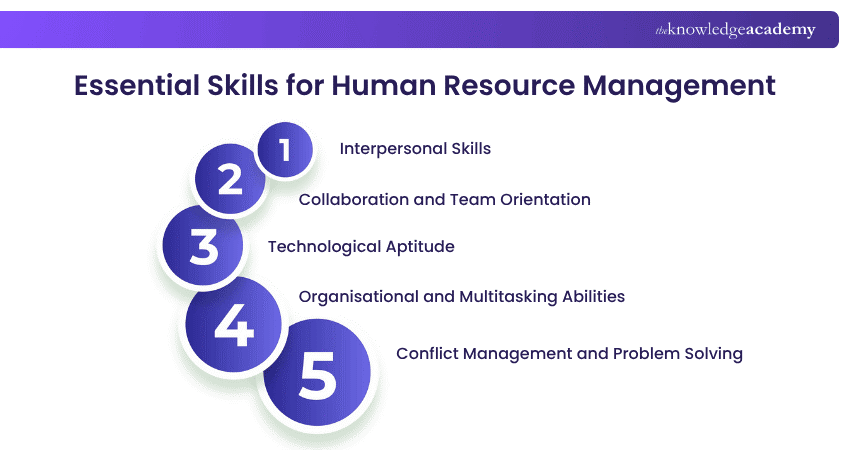
1) Interpersonal Skills
As a Human Resources professional, you will work with all employees to help the business run well. This includes interviewing new employees, helping them get started and solving any problems. Since the job is about people, you need to have strong communication skills and the ability to work collaboratively.
2) Collaboration and Team Orientation
It is important to be a good team member and help others work together. You will work closely not just with the HR team, but also with other employees to ensure each person in the company is working towards the same goals.
3) Technological Aptitude
There are different programmes used in HR for tasks like hiring, pay, benefits, and more. It’s important for HR professionals to know how to use these programmes and be ready to learn new ones as technology changes.
4) Organisational and Multitasking Abilities
The size of the company and the number of HR staff can mean there’s a lot of information to manage. It’s important to stay organised and be able to handle several tasks at once when needed.
5) Conflict Management and Problem Solving
The HR department is usually the first to help when there is a problem at work. They find creative ways to solve the issues that employees are facing and ensure a positive work environment for everyone.
Gain practical skills to lead people-focused and drive business success. Join our CIPD Level 5 Associate Diploma in People Management now!
HRM Systems and Software
Human Resource Management Systems function as digital platforms that consolidate essential human resources processes together with employee data management. The system replaces manual tasks to achieve better operational performance and precise results.
The HRMS system enables organizations to control multiple functions through a single platform, which handles payroll, attendance tracking, recruitment processes, performance evaluation, and employee benefits management.
Examples of HRM Software
Popular HRM software solutions help organisations manage people, processes, and workforce performance at scale. Some widely used platforms include:
a) SAP SuccessFactors HCM: Cloud-based HR platform for core HR, payroll, talent, analytics, and workforce planning.
b) Workday HCM: Enterprise-grade software supporting global HR, payroll, talent, and workforce management.
c) Oracle Cloud HCM: Comprehensive HR suite covering recruitment, performance, payroll, and workforce planning.
d) BambooHR: User-friendly HRIS for small and mid-sized businesses with onboarding and self-service.
e) Personio: Cloud-based HR and payroll solution designed for mid-sized organisations.
f) Darwinbox: AI-powered HCM platform automating HR operations for growing enterprises.
g) HiBob: Cloud HR platform offering core HR, payroll, and employee engagement tools.
h) factoHR: HRMS solution managing payroll, attendance, performance, and self-service features.
Careers in Human Resource Management
There are various career paths offered by Human Resource Management. HR roles vary from specialist positions to leadership roles. Here are some common jobs and career paths to choose the one that resonates with you.
1) Careers in Human Resource Management
Human Resource Management has several career paths for professionals who enjoy working with people, supporting business goals, and shaping workplace culture. Some of the popular jobs include:
1) HR Specialist: Handles HR functions, such as recruitment, training, or providing benefits. They focus on daily tasks that support employee needs and organisational goals.
2) HR Manager: Responsible for overseeing the HR operations, guiding HR teams and ensuring policies are followed. They play a major role in employee development and performance.
3) HR Director: Leads the entire HR department and sets long-term HR strategies. They work closely with senior leadership to align HR with broader organisational goals.
4) HR Business Partner: Works together with business leaders to solve workforce challenges and develop organisational strategy. They focus on strategic planning instead of daily HR tasks.
5)Talent Acquisition Specialist: Manages the hiring process, from sourcing candidates to conducting interviews. They ensure the organisation attracts and hires the right talent.
2) Human Resource Specialisations
Human Resource specialisations allow professionals to focus on specific areas of HR that align with their strengths and interests. These special roles help organisations build stronger people strategies and improve overall workforce performance.
1) Recruitment and Talent Acquisition: Finding, screening, and hiring the right candidates.
2) Learning and Development: Designing training programmes to upskill employees.
3) Compensation and Benefits: Managing salaries, incentives, and reward structures.
4) Employee Relations: Handling workplace issues, conflict resolution, and engagement.
5) HR Analytics: Using data to improve hiring, performance, and workforce planning.
6) Performance Management: Creating systems to track, review, and enhance employee performance.
How to Get Started in Human Resources Management?
There are several pathways into a career in HRM. These often combine education, experience, certification, and networking. Here are the key steps:
1) Consider Qualifications: A degree isn’t mandatory in the UK, but having one in HR or business-related degrees can support faster progression. Alternatives include apprenticeships or completing recognised HR certifications, which are also highly valued by employers.
2) Gain HR Experience: Build experience through internships, apprenticeships, or entry-level roles like an HR assistant. Networking at conferences and joining professional associations also enhances knowledge and opportunities.
3) Earn CIPD Qualifications: In the UK, the Chartered Institute of Personnel and Development (CIPD) sets HR standards. Completing CIPD-accredited courses at foundation, associate, or advanced levels can boost your career prospects and may lead to Chartered status.
4) Apply for HRM Roles: Update your CV with qualifications, internships, experience, professional memberships, and achievements. Spotlighting your continuous learning and involvement in HR-related activities will improve your chances of securing a role.
What are the Trends in Human Resources Management?
Human Resources Management is evolving rapidly as workplaces become more digital, diverse, and employee focused. Modern HR teams are shifting from traditional administrative tasks to strategic, data driven roles that directly support business growth and employee wellbeing.
1) Rising Importance of the Human Resources Information Technology (HRIT) Role: HR teams are becoming more tech-driven, leading to growing demand for HRIT specialists. These professionals manage HR systems, safeguard data and ensure smooth integration of HR and technology.
2) Artificial Intelligence and Machine Learning: These streamlines hiring by scanning (Curriculum Vitae) CVs and automating tasks. This helps to save time and enable HR professionals to dedicate time towards complex decisions and strategic work.
3) Technology to Measure Employee Engagement: Organisations utilise pulse surveys and real-time feedback instead of conducting annual surveys. These methods offer insights faster into the satisfaction levels of employees.
4) Stronger Emphasis on People Management: Effective leadership is integral than ever. HR teams must manage diverse groups and support employees through constant organisational changes.
Conclusion
Understanding What is Human Resource Management equips organisations to create stronger, more adaptable workforces in an ever‑changing business landscape. By applying effective HR strategies, companies can enhance performance and support long‑term growth. We hope this blog has provided the clarity and insight you were looking for.
Unlock your HR career and boost your skills with our CIPD Qualification Courses -Register today!
Frequently Asked Questions
What’s the Difference Between HR and HRM?

Human Resources (HR) is generally viewed as a support function. It focuses on administrative and operational tasks concerning employees. On the other hand, Human Resource Management goes for a strategic approach by aligning the HR practices and policies with wider organisational goals.
What is an Example of HR?
An example of HR is when a company hires new employees. HR handles the whole process from posting job openings, interviewing candidates, to selecting the right person and making sure they are properly onboarded into the company.
What are the Other Resources and Offers Provided by The Knowledge Academy?
The Knowledge Academy takes global learning to new heights, offering over 3,000+ online courses across 490+ locations in 190+ countries. This expansive reach ensures accessibility and convenience for learners worldwide.
Alongside our diverse Online Course Catalogue, encompassing 17 major categories, we go the extra mile by providing a plethora of free educational Online Resources like Blogs, eBooks, Interview Questions and Videos. Tailoring learning experiences further, professionals can unlock greater value through a wide range of special discounts, seasonal deals, and Exclusive Offers.
What is The Knowledge Pass, and How Does it Work?
The Knowledge Academy’s Knowledge Pass, a prepaid voucher, adds another layer of flexibility, allowing course bookings over a 12-month period. Join us on a journey where education knows no bounds.
What are the Related Courses and Blogs Provided by The Knowledge Academy?
The Knowledge Academy offers various CIPD Courses, including the CIPD Level 3 Foundation Certificate In People Practice Course, CIPD Level 5 Associate Diploma In People Management Course, and CIPD Level 5 Associate Diploma In Organisational Learning And Development Course. These courses cater to different skill levels, providing comprehensive insights into Employee Lifecycle.
Our HR Blogs cover a range of topics related to Human Resource Management, offering valuable resources, best practices, and industry insights. Whether you are a beginner or looking to advance your HR skills, The Knowledge Academy's diverse courses and informative blogs have got you covered.

The Knowledge Academy


Global Training Provider
The Knowledge Academy is a world-leading provider of professional training courses, offering globally recognised qualifications across a wide range of subjects. With expert trainers, up-to-date course material, and flexible learning options, we aim to empower professionals and organisations to achieve their goals through continuous learning.

Upcoming HR Resources – Learn about Human Resources Batches & Dates
Date
 CIPD Level 3 Foundation Certificate in People Practice Course

 If you wish to make any changes to your course, please


