


 Top Rated Course

We may not have the course you’re looking for. If you enquire or give us a call on +44 1344 203 999 and speak to our training experts, we may still be able to help with your training requirements.
What is Lean Startup? Everything You Need to Know
William Brown 16 July 2026Lean Startup is a new and practical approach to developing and growing businesses that focuses on rapid iteration, continuous learning, and quick adaptation. It helps entrepreneurs test ideas quickly, get real customer feedback, and improve before spending too much time or money. This makes startups faster, smarter, and more efficient.

Training Outcomes Within Your Budget!
We ensure quality, budget-alignment, and timely delivery by our expert instructors.
Table of Contents
Starting a business venture today requires navigating uncertainty, limited resources, and rapid change. To address these challenges, the Lean Startup offers a more innovative way by focusing on testing ideas quickly, learning from customers, and adapting fast. In this blog, we will explore What is Lean Startup, its key principles, how it differs from traditional methods, and how entrepreneurs can profit from this approach to build better businesses with less risk.
Table of Contents
1) What is Lean Startup?
2) Characteristics and Philosophies of a Lean Startup
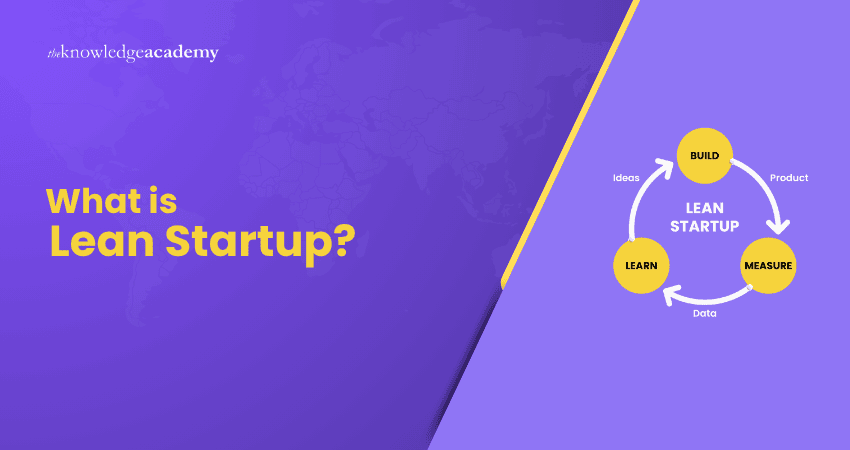
3) Build-Measure-Learn (BML) Methodology
4) Requirements for Lean Startup
5) Lean Startup vs Traditional Businesses
6) Real-world Example of Lean Startup
7) Conclusion
What is Lean Startup?
Lean Startup is a method developed by Eric Ries that helps entrepreneurs build businesses with less risk. Instead of spending large amounts of time and money upfront, it focuses on creating a Minimum Viable Product (MVP), testing it quickly with customers, and learning from feedback.
Using the Build–Measure–Learn cycle, businesses can adapt faster, reduce waste, and deliver products people actually need. This approach makes innovation more efficient and increases the chances of success.
Characteristics and Philosophies of a Lean Startup
A Lean Startup works on a few key principles that set it apart from old-style business models. Let’s look at what makes it unique.
1) Validated Learning
Instead of guessing what customers want, Lean Startups do experiments to confirm it. Every action, whether creating a new feature or launching a campaign. It should lead to learning something useful about the customer.
2) Customer Focus
Customers are at the heart of everything. The startup keeps talking to users, collecting feedback, giving support and improving products based on what they need, not what the founders assume.
3) Minimum Viable Product (MVP)
An MVP is the basic version of your product that still delivers value. It helps test your idea with real customers quickly. For example, before building a full app, you might start with a landing page or a basic prototype.
4) Continuous Innovation
Lean Startups never stop learning or improving. They adapt as the market changes and as they receive feedback. This makes them flexible and open-minded compared to rigid, traditional companies.
5) Data-driven Decisions
Every decision is based on real data, not guessing. Lean entrepreneurs rely on analytics, customer interviews, and measurable outcomes to decide their next steps.
6) Fail Fast, Learn Fast
Failure isn’t seen as a bad thing here. If something doesn’t work, you learn from it and move on quickly. This mindset saves both time and money.
7) Pivot or Persevere
If your idea doesn’t seem to fit the market, you “pivot”, change direction while keeping what you’ve learned. If it’s working, you “persevere” and keep growing. This flexibility keeps the business alive and relevant.
Acquire skills to identify and eliminate waste in processes with our Lean Processes and Tools Training – Join now!
Build-Measure-Learn (BML) Methodology
The Build-Measure-Learn cycle is the main process behind every Lean Startup methodology. It’s a simple loop that helps you act fast and make better decisions.

1) Build
Make a simple version of your product called a Minimum Viable Product (MVP). This helps you test your main ideas about what customers need and how your product can help them.
2) Measure
Gather real feedback and data from people using your MVP. This shows whether your idea works and helps you understand how customers behave.
3) Learn
Study the feedback to see what worked and what didn’t work. If your idea is doing well, keep improving it (persevere). If not, change your plan or idea (pivot) and try again.
Requirements for Lean Startup
To start a Lean Startup, you need the right attitude and way of working. It is not only about having an idea but also about testing it and learning from it.
1) Entrepreneurial Mindset
Think like a problem solver. Be open to new ideas and ready to try again if something fails. Every mistake helps you learn. This attitude keeps your business strong and growing.
2) Clear Vision
Know what problem you want to solve and what goal you want to reach. A clear vision helps you stay focused. It also guides your team in the right direction.
3) Minimum Viable Product (MVP)
Start with a simple version of your product. It helps you check your ideas quickly and saves time and money. This way, you can improve before spending more time.
4) Customer Feedback
Ask customers what they think about your product. Their opinions help you make it better and more useful. Listening to them builds trust and loyalty.
5) Use of Data
Look at real results like sales or user activity. Use facts to decide what works best. Data helps you make smarter choices for your business.
6) Small and Flexible Team
Work with a small team that can act fast and make changes easily. Everyone should help wherever they are needed. A flexible team can solve problems quickly.
7) Willingness to Learn
Keep learning from every result. Do not fear failure. Use what you learn to improve your product. Learning helps you grow and stay ahead of the competition.
Gain an understanding of lean process mapping with our Certified Lean Foundation & Practitioner Training – Join now!
Lean Startup vs Traditional Businesses
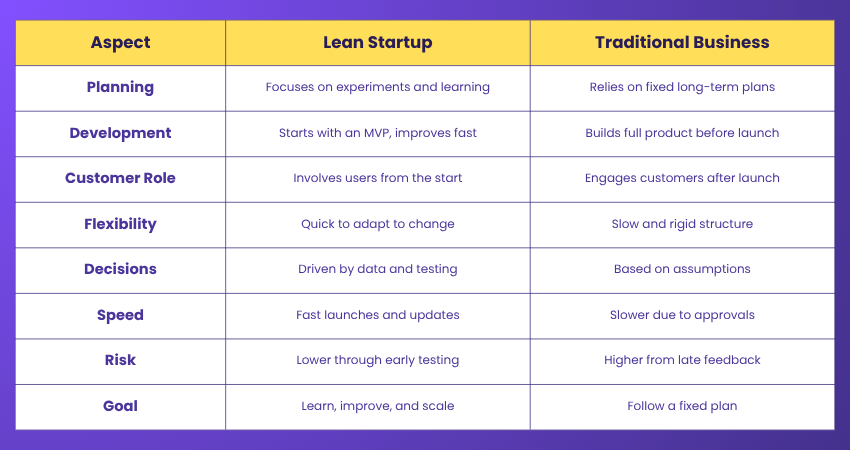
Lean Startups and traditional businesses take different paths to success. Here are the main differences in approach and execution.
Real-world Example of Lean Startup
A good example of a Lean Startup is Dropbox. Before making the full product, its founder, Drew Houston, made a short video to show how it would work. Many people liked the idea and signed up to try it. This showed that people were interested in the product.
After that, the team made a simple version and tested it with users. They listened to feedback and made it better each time. This helped them save time, reduce mistakes, and build something that people really needed.
Conclusion
The Lean Startup approach helps new businesses grow smarter by testing ideas, learning from feedback, and improving quickly. It reduces risk, saves time, and focuses on creating products people truly want. By staying flexible and data-driven, startups can build stronger foundations for long-term success and adapt easily to changing market needs.
Acquire knowledge in waste reduction and resource optimisation. Join our Lean Training today!
Frequently Asked Questions

William Brown


Senior Business Analyst and Strategic Advisor
William Brown is a senior business analyst with over 15 years of experience driving process improvement and strategic transformation in complex business environments. He specialises in analysing operations, gathering requirements and delivering insights that support effective decision making. William’s practical approach helps bridge the gap between business goals and technical solutions.
View Detail

 If you wish to make any changes to your course, please


