
Lean Training

Online Instructor-led (2 days)

Online Self-paced (16 hours)

Certified Lean Foundation and Practitioner Exam

Certified Lean Foundation and Practitioner Course Outline

Module 1: About Lean

  • Path to Value
  • Key Lean Terms and Concepts
  • Gemba Walk

Module 2: Five Steps of Lean Thinking

  • Process Stapling
  • Lean Temple

Module 3: Customers, Processes, and Waste

  • What are Customers?
  • What is a Process?
  • Tension Between VOB and VOC
  • What Do We Mean by Value?
  • Path to Value
  • Dealing with Values
  • Eight Wastes of Lean

Module 4: Key Lean Metrics

  • Introduction to Key Lean Metrics
  • Tools and Techniques
  • Spaghetti (Movement/Transportation) Diagrams
  • Measles Charts
  • Lean Triad
  • 5S
  • What is of 5S
  • Steps of 5S
  • What is Poka Yoke
  • Two Main Types of Poka Yoke
  • What is SMED?
  • Employing SMED Will Enable You to…
  • How SMED Looks Like?
  • Voice of Customer (VOC)
  • Customer Segmentation
  • Four Steps of VOC Methodology and Tools
    • Identify Customers
    • Gather Customer Information
    • Analyse Customer Information
    • Determine Customer Needs
  • Customer Segmentation
  • SIPOC
  • CSandF Web Fulfilment SIPOC
  • VOC Step Two: Gather Customer Information
  • VOC Step Three: Analyse Customer Information
  • Affinity Diagrams
  • Overview of the Kano Model
  • Kano Model
  • Kano Analysis: Budget TV 2012
  • VOC Step Four: Determine Customer Needs
  • Identifying the Requirements
  • What is a Critical to Quality (CTQ)?
  • Common Terminology
  • Identifying the Root Cause
  • Five Whys
  • Root Cause Analysis (Fishbone)
  • Reverse Fishbone
  • Control Frameworks
  • Three C’s
  • Eight Ds
  • Plan Do Check Act
  • Introduction to Kaizen
  • Kaizen
  • Kaizen Philosophy
  • Kaizen Events
  • Formal Kaizen Roles and Process

Module 5: Managing and Building Lean Teams

  • Managing Teams
  • Lean Teams
  • Features of Lean Teams
  • High Performing Teams (HPT)
  • High Performance Challenge
  • Contrasting Team Structures
  • Managing Progress and Demonstrating Control
  • Kanban Board
  • MoSCoW Prioritisation
  • Daily Stand-Ups
  • Managing Teams
  • Work Cells
  • Lean Management
  • Self-Managed Team Philosophy
  • Lean Manager and the Self-Managed Team
  • Personality Styles
  • High Performing Teams (HPT)
  • Autonomous HPTs
  • High Performance Challenge

Module 6: Problem-Solving

  • Problem Solving
  • Problem Solving Framework
  • A Seven-Step Problem Solving Methodology
  • Prioritisation Tools
    • Pay-off matrices
    • Weighting through voting
    • Weighting with evaluation criteria
    • Pugh Matrix

Module 7: Visual Management

  • Introduction to Visual Management
  • Guidelines for Visual Management

Module 8: Advanced VOC

  • Advanced Intelligence Methods
  • Ways of Gathering the VOC
  • Intelligence Gathering: Top Tips
  • Critical to Quality Trees
    • Steps to Creating a CTQ Tree

Module 9: Lean Metrics

  • Metrics
  • Measures and Targets
  • A Reminder: Fundamental Lean Metrics
  • Metrics Drive Behaviour
  • Traditional Vs Lean Metrics
  • Choosing the Right Metrics
  • Things to Consider When Selecting Metrics
  • Useful Metrics
  • First and Second Project Metrics
  • Metrics and Measures Roadmap

Module 10: Process Measurement

  • What are Lean Process Measurements?
  • Two Level Measures
  • Four Sub-Metrics
  • Availability
  • Quality
  • Performance
  • Loading
  • Calculating OEE and TEPP
  • OEE is Not a Magic Number
  • First Time Quality
  • Rolled Throughput Yield (RTY)
  • Work in Progress
  • Completed Orders Metrics
  • Delivery Metrics
  • Warranty Metrics
  • Customer Feedback Metrics
  • Reporting Metrics
  • Aims of Data Collection
  • Key Performance Indicators
  • Process Measurement Points
  • List of Criteria for a Good Measure
  • Gauge R and R
  • Measurement System Resolution
  • Brief Description of Data Collection Planning
  • Five Steps of Data Collection Process
  • Data Collection Sheet
  • Frequency and Sample Size
  • Evolving Your Data Collection Plan

Module 11: Total Productive Maintenance

  • TPM in a Nutshell
  • What is TPM?
  • TPM: Goals
  • Why is TPM Needed?
  • Benefits of TPM
  • TPM: What to Focus On?
  • TPM: Where Should it be Applied?
  • TPM Maturity Levels
  • TPM Health Check
  • Implementation Structure of TPM
  • Establish Infrastructure
  • Eliminate Top Issues
  • Training
  • Conduct Autonomous
  • Conduct Planned Maintenance
  • Design Maintenance Prevention

Module 12: Process Levelling (Heijunka)

  • Heijunka
  • Heijunka in a Nutshell
  • Process Levelling Overview
  • Production Levelling
  • Demand Levelling
  • Sequencing
  • Sequencing Concepts
  • Single Piece Flow
  • First in First Out
  • Pull
  • Kanban
  • Three-Bin System
  • Kanban Operation Rules
  • Andon
  • Process Levelling
  • Resource Scheduling
  • Theory of Constraints
  • TOC Process
  • Other Techniques to Enable Level Scheduling
  • Process Levelling in the Office
  • What is the Minimum Cycle Time for a Form?
  • Putting it All Together
  • Lean Office: How it Was?
  • Purchasing Department: After Laen
  • The Lean Office: Putting it All Together

Module 13: Value Stream Mapping

  • Value Stream Terminology
  • Process Maps
  • Swim Lanes
  • Typical Process Map Contests
  • Value Stream Maps
  • Headache Tablets: Value Stream Mapping
  • Process Maps
  • Process Map Levels
  • On the Ground Instructions (OTGIs)
  • What is a Value Stream?
  • Creating the “As Is” VSM
  • Investigating and Understanding the Process
  • Headache Tablets: Value Stream Mapping
  • Creating a VSM: Process Borders Definition
  • Process Boxes
  • Useful VSM Metrics
  • Square Wave
  • Creating an Improved Process
  • Steps for Building a Value Stream Map
  • Action Plans
  • Identifying Priorities: Effort/Impact Grid

Show moredown

Who Should Attend this Certified Lean Foundation & Practitioner Course?

This Certified Lean Foundation & Practitioner Training Course is designed to provide delegates with a comprehensive understanding of Lean principles and methodologies. The Certified Lean Foundation & Practitioner Course can be beneficial for the following professionals:

  • Project Managers
  • Lean Practitioners
  • Senior Managers
  • Frontline Employees
  • Operational Staff
  • Quality Control Professionals
  • Supply Chain and Logistics Personnel

Prerequisites of the Certified Lean Foundation and Practitioner Course

There are no formal prerequisites for this Certified Lean Foundation & Practitioner Training Course. However, a basic understanding of Lean principles can be beneficial.

Certified Lean Foundation and Practitioner Course Overview

Certified Lean Foundation and Practitioner Training introduces core and advanced Lean principles that improve efficiency and reduce waste. It explains how Lean methods streamline processes, boost productivity, and support organisational excellence across industries.

This training supports professionals seeking to master Lean and drive continuous improvement across organisations. It builds the ability to enhance operational efficiency, improve quality, and support sustainable business growth across project, quality, and operations-focused roles.

This 2-Day course offered by The Knowledge Academy enables delegates to apply Lean methods with confidence. Through focused learning and practical activities, delegates gain the skills to identify waste, implement improvements, and lead Lean initiatives effectively.

Certified Lean Foundation and Practitioner  Course Objectives

  • To comprehend the fundamental principles and concepts of Lean methodologies
  • To identify and analyse waste in processes and implement Lean strategies for waste reduction
  • To gain proficiency in Lean tools and techniques for process optimisation
  • To apply Lean thinking and problem-solving methodologies in real-world scenarios
  • To empower professionals to drive efficiency and enhance operational performance using Lean principles

Upon completing Certified Lean Foundation & Practitioner Course, delegates will acquire practical expertise in Lean methodologies, enabling them to lead process improvement initiatives effectively. This proficiency will elevate their professional capabilities and position them as valuable assets to their organisations.

Show moredown

What’s Included in this Certified Lean Foundation & Practitioner Course?

  • Certified Lean Foundation & Practitioner Examination
  • World-Class Training Sessions from Experienced Instructors
  • Certified Lean Foundation & Practitioner Certificate
  • Digital Delegate Pack

Show moredown

Certified Lean Foundation Exam Information

To achieve the Certified Lean Foundation, candidates will need to sit for an examination. The exam format is as follows: 

  • Question Type: Multiple Choice 
  • Total Questions: 50 
  • Total Marks: 50 Marks 
  • Pass Mark: 60%, or 30/50 Marks 
  • Duration: 60 Minutes 
  • Open Book/ Closed Book: Closed Book

Certified Lean Practitioner Exam Information

To achieve the Certified Lean Practitioner, candidates will need to sit for an examination. The exam format is as follows: 

  • Question Type: Multiple Choice 
  • Total Questions: 60 
  • Total Marks: 60 Marks 
  • Pass Mark: 65%, or 39/60 Marks 
  • Duration: 80 Minutes
  • Open Book/ Closed Book: Closed Book

Show moredown

Online Instructor-led (1 days)

Online Self-paced (8 hours)

Certified Lean Foundation Exam

Lean Foundation Course Outline

Module 1: About Lean

  • The Path to Value
  • Key Lean Terms and Concepts
  • Gemba (The Real Place)
  • Going to Gemba
  • Gemba Tools
  • Gemba Walk

Module 2: The Five Steps of Lean Thinking

  • Process Stapling
  • The Lean Temple

Module 3: Customers, Processes, and Waste

  • What are Customers?
  • What is a Process?
  • Tension Between VOB and VOC
  • What Do We Mean by Value?
  • The Path to Value
  • Dealing with Values
  • The Eight Wastes of Lean

Module 4: Key Lean Metrics

  • Key Lean Metrics
  • Tools and Techniques
  • Spaghetti (Movement/Transportation) Diagrams
  • Measles Charts
  • The Lean Triad
  • What is of 5S
  • The Steps of 5S
  • What is Poka Yoke
  • Two Main Types of Poka Yoke
  • Exercise on Mistake Proofing
  • SMED-Single Minute Exchange of Dies
  • What is SMED?
  • Employing SMED Will Enable You to…
  • In the Extreme, SMED Looks Like…
  • Voice of Customer (VOC)
  • The VOC Methodology has Four Steps and Tools
  • VOC Step One: Identify Customers
  • Customer Segmentation
  • SIPOC
  • CSandF Web Fulfilment SIPOC
  • VOC Step Two: Gather Customer Information
  • VOC Step Three: Analyse Customer Information
  • Affinity Diagrams
  • Overview of the Kano Model
  • Kano Model
  • Kano Analysis: Budget TV 2012
  • VOC Step Four: Determine Customer Needs
  • Identifying the Requirements
  • What is a Critical to Quality (CTQ)?
  • Common Terminology
  • Identifying Root Causes
  • Five Whys
  • Root Cause Analysis (Fishbone)
  • Reverse Fishbone
  • Control Frameworks
  • The Three C’s
  • The Eight Ds
  • Plan Do Check Act
  • Introduction to Kaizen
  • Kaizen 
  • Kaizen Philosophy
  • Kaizen Events
  • Kaizen vs Waterfall (Traditional) Approach
  • Typical Kaizen Events
  • Formal Kaizen Roles
  • Formal Kaizen Process
  • Variations on a Theme
  • Success Factors of a Kaizen Events
  • Employing Kaizen Will Enable You to…
  • Evening Assignment
     

Show moredown

Who Should Attend this Certified Lean Foundation Course?

This Certified Lean Foundation Training Course is designed to understand the fundamentals of Lean methodologies and basics of Lean for business improvement. Lean Course will be beneficial for the following professionals:

  • Production Managers
  • Operations Managers
  • Quality Managers
  • Lean Practitioners
  • Industrial Engineers
  • Supply Chain Managers
  • Customer Service Representatives

Prerequisites of the Certified Lean Foundation Course

There are no formal prerequisites to attend this Certified Lean Foundation Training Course. However, a basic understanding of Lean concepts would be beneficial.

Certified Lean Foundation Course Overview

Certified Lean Foundation Training introduces delegates to core Lean principles focused on waste reduction and process optimisation. It explains how Lean thinking improves efficiency and streamlines operations across diverse organisational environments.

This training supports professionals seeking to understand and apply Lean methods for operational improvement. It builds the ability to identify waste, enhance workflows, and promote a culture of continuous improvement across industries.

This 1-Day course offered by The Knowledge Academy enables delegates to apply Lean principles with confidence. Through focused learning and practical activities, delegates gain the skills to use value stream mapping, waste identification, and standardised work effectively.

Certified Lean Foundation Course Objectives

  • To introduce delegates to the foundational principles of Lean methodologies
  • To provide insights into waste reduction and process optimisation using Lean principles
  • To equip delegates with practical tools for implementing Lean practices
  • To demonstrate the application of Lean concepts through interactive sessions
  • To instil a mindset of continuous improvement within organisational processes
  • To empower professionals to initiate Lean practices within their respective industries

Upon completing this Certified Lean Foundation from our Lean Certification, delegates will possess a fundamental understanding of Lean principles, enabling them to identify inefficiencies, apply Lean methodologies and drive a culture of continuous enhancement within their organisations. They'll be equipped to streamline operations, minimise waste, and enhance overall organisational efficiency.

Show moredown

What’s Included in this Certified Lean Foundation Course?

  • Certified Lean Foundation Examination
  • World-Class Training Sessions from Experienced Instructors
  • Certified Lean Foundation Certificate
  • Digital Delegate Pack

Show moredown

Certified Lean Foundation Exam Information

To achieve the Certified Lean Foundation, candidates will need to sit for an examination. The exam format is as follows: 

  • Question Type: Multiple Choice 
  • Total Questions: 50 
  • Total Marks: 50 Marks 
  • Pass Mark: 60%, or 30/50 Marks 
  • Duration: 60 Minutes 
  • Open Book/ Closed Book: Closed Book

Show moredown

Online Instructor-led (1 days)

Online Self-paced (8 hours)

Certified Lean Practitioner Exam

Certified Lean Practitioner Course Outline

Module 1: Managing and Building Lean Teams

  • Managing Teams
  • Lean Teams
  • Features of Lean Teams
  • High Performing Teams (HPT)
  • High Performance Challenge
  • Contrasting Team Structures
  • Managing Progress and Demonstrating Control
  • Kanban Board
  • MoSCoW Prioritisation
  • Daily Stand-Ups
  • Work Cells
  • Self-Managed Team Philosophy
  • Lean Manager and the Self-Managed Team
  • Personality Styles
  • Autonomous HPTs

Module 2: Problem-Solving

  • Problem Solving
  • Problem Solving Framework
  • A Seven-Step Problem Solving Methodology
  • Prioritisation Tools

Module 3: Visual Management

  • Introduction to Visual Management
  • Guidelines for Visual Management
  • Advanced Intelligence Methods
  • Ways of Gathering the VOC
  • Intelligence Gathering: Top Tips
  • Critical to Quality Trees

Module 4: Advanced VOC

  • Advanced Intelligence Methods
  • Ways of Gathering the VOC
  • Intelligence Gathering: Top Tips
  • Critical to Quality Trees

Module 5: Lean Metrics

  • Metrics
  • Measures and Targets
  • Metrics Drive Behaviour
  • Traditional Vs Lean Metrics
  • Choosing the Right Metrics
  • Things to Consider When Selecting Metrics
  • Useful Metrics
  • First and Second Project Metrics
  • Metrics and Measures Roadmap

Module 6: Process Measurement

  • What are Lean Process Measurements?
  • Two Level Measures
  • Four Sub-Metrics
  • Calculating OEE and TEPP
  • OEE is Not a Magic Number
  • First Time Quality
  • Work in Progress
  • Completed Orders Metrics
  • Delivery Metrics
  • Warranty Metrics
  • Customer Feedback Metrics
  • Reporting Metrics
  • Aims of Data Collection
  • Key Performance Indicators
  • Process Measurement Points
  • List of Criteria for a Good Measure
  • Gauge R and R
  • Measurement System Resolution
  • Brief Description of Data Collection Planning
  • Five Steps of Data Collection Process
  • Data Collection Sheet
  • Frequency and Sample Size
  • Evolving Data Collection Plan

Module 7: Total Productive Maintenance

  • TPM in a Nutshell
  • What is TPM?
  • TPM: Goals
  • Why is TPM Needed?
  • Benefits of TPM
  • TPM: What to Focus On?
  • TPM: Where Should it be Applied?
  • TPM Maturity Levels
  • TPM Health Check
  • Implementation Structure of TPM
  • Establish Infrastructure
  • Eliminate Top Issues
  • Training
  • Conduct Autonomous
  • Conduct Planned Maintenance
  • Design Maintenance Prevention

Module 8: Process Levelling (Heijunka)

  • Heijunka
  • Heijunka in a Nutshell
  • Process Levelling Overview
  • Production Levelling
  • Demand Levelling
  • Sequencing
  • Sequencing Concepts
  • Single Piece Flow
  • First in First Out
  • Pull
  • Kanban
  • Three-Bin System
  • Kanban Operation Rules
  • Andon
  • Process Levelling
  • Resource Scheduling
  • Theory of Constraints and TOC Process
  • Other Techniques to Enable Level Scheduling
  • Process Levelling in the Office
  • What is the Minimum Cycle Time for a Form?
  • Putting it All Together
  • Lean Office: How it Was?

Module 9: Value Stream Mapping

  • Process Maps
  • Swim Lanes
  • Typical Process Map Contests
  • Value Stream Maps
  • Headache Tablets: Value Stream Mapping
  • On the Ground Instructions (OTGIs)
  • Creating the “As Is” VSM
  • Investigating and Understanding the Process
  • Process Boxes
  • Useful VSM Metrics and Square Wave
  • Creating an Improved Process
  • Steps for Building a Value Stream Map
  • Action Plans
  • Identifying Priorities: Effort/Impact Grid

Show moredown

Who Should Attend this Certified Lean Practitioner Course?

This Certified Lean Practitioner Training Course from our Lean Certification suite is designed for professionals who are looking to improve their business with Lean thinking. This course will be beneficial for the following professionals:

  • Manufacturing Engineers
  • Operations Managers
  • Quality Control Professionals
  • Customer Service Representatives
  • IT Professionals
  • Supply Chain and Logistics Personnel
  • Managers and Department Heads

Prerequisites of the Certified Lean Practitioner Course

This Certified Lean Practitioner Training Course demands a proper understanding of the basic Lean tools and Lean thinking. It is also recommended to complete the Introduction to Lean or Lean Six Sigma Yellow Belt Course before taking up this Certified Lean Practitioner Course.

Certified Lean Practitioner Course Overview

Certified Lean Practitioner Training introduces delegates to advanced Lean principles and their application in organisational environments. It explains how Lean methodologies drive operational excellence and continuous improvement across complex business processes.

This training supports professionals who lead process improvement and organisational change. It builds the ability to identify inefficiencies, manage complexity, and drive meaningful improvements using practitioner-level Lean expertise.

This 1-Day Lean Certification offered by The Knowledge Academy enables delegates to apply advanced Lean concepts with confidence. Through focused learning and practical activities, delegates develop the skills to implement Kaizen, DMAIC, and Lean Six Sigma techniques effectively.

Certified Lean Practitioner Course Objectives

  • To advance delegates' knowledge and application of Lean methodologies
  • To provide in-depth insights into advanced Lean principles and techniques
  • To equip delegates with skills to lead and drive Lean initiatives within organisations
  • To demonstrate the application of Kaizen, DMAIC, and Lean Six Sigma principles
  • To foster expertise in identifying and resolving complex organisational challenges
  • To empower professionals to lead successful Lean transformations within their respective domains

Upon completing this Certified Lean Practitioner Course, delegates will possess advanced Lean skills, enabling them to lead impactful Lean initiatives, drive substantial improvements, and spearhead Lean transformations within their organisations. They'll also have the expertise to identify and address complex organisational challenges.

Show moredown

What’s Included in this Certified Lean Practitioner Course?

  • Certified Lean Practitioner Examination
  • World-Class Training Sessions from Experienced Instructors
  • Certified Lean Practitioner Certificate
  • Digital Delegate Pack 

Show moredown

Certified Lean Practitioner Exam Information

To achieve the Certified Lean Practitioner, candidates will need to sit for an examination. The exam format is as follows: 

  • Question Type: Multiple Choice 
  • Total Questions: 60 
  • Total Marks: 60 Marks 
  • Pass Mark: 65%, or 39/60 Marks 
  • Duration: 80 Minutes
  • Open Book/ Closed Book: Closed Book

Show moredown

Online Instructor-led (1 days)

Online Self-paced (8 hours)

Lean Fundamentals Training Course Outline

Module 1: What is Lean?

  • What is Lean
  • Lean in a Nutshell
  • Lean Temple
  • Fables and Facts
  • What Lean Should Look Like?
  • Lean Thinking can Transform Business
  • Lean is Not Just for Manufacturing
  • What is Changing at Service Companies?
  • Origins of Lean
  • Customers, Processes, and Waste
  • What are Customers?
  • Anatomy of a Process
  • Who Wants the Outputs?
  • Tension Between the VOB and VOC
  • Meaning of Value
  • Path to Value
  • Dealing with Values
  • Seven Wastes (Muda) of Lean
  • Introducing Lean Methodologies
  • Lean Principles
  • 3Cs
  • Key Lean Metrics

Module 2: One Sentence Expert

  • Gemba (The Real Place)
  • Gemba Tools
  • Kaizen
  • Hoshin Kanri (Policy Deployment)
  • Jidoka (Autonomation)
  • Just in Time (JIT)
  • Six Big Losses
  • 5S
  • The Steps of 5S
  • What is Poka Yoke?
  • What is Single Minute Exchange of Dies (SMED)
  • Total Productive Maintenance (TPM)
  • Standardised Work
  • On the Ground Instructions (OTGIs)
  • Visual Factory
  • Value Stream Mapping
  • Headache Tablets: Value Stream Mapping (“As Is Example)
  • Life in our Office

Module 3: Case for Lean

  • Cost of Poor Quality
  • Iceberg Theory
  • Identifying Hidden Costs
  • Benefits of a Simple Lean Project
  • Categories Associated with the Cost of Poor Quality
  • In Practice it’s a Balancing Act
  • Setting up Lean Thinking in Business
  • Costs of Adoption
  • Prerequisites and Essential Requirements
  • Timeframes

Show moredown

Who Should Attend this Lean Fundamentals Training Course?

This Introduction to Lean Training Course is a beginner-level course which is designed to help professionals adopt Lean methodologies and Lean thinking. Lean Course will be beneficial for the following professionals:

  • Managers and Supervisors
  • Process Improvement Specialists
  • Operations Managers
  • Quality Control Personnel
  • Supply Chain Professionals
  • Project Managers
  • Continuous Improvement Enthusiasts

Prerequisites of the Introduction to Lean Fundamentals Training Course

There are no formal prerequisites to attend this Introduction to Lean Training Course.

Lean Fundamentals Training Course Overview

Introduction to Lean Training introduces delegates to core Lean principles focused on efficiency, waste reduction, and continuous improvement. It explains how Lean thinking optimises workflows and enhances operational effectiveness across diverse industries.

This training supports professionals seeking to improve efficiency and minimise waste within their organisations. It builds the ability to identify inefficiencies, streamline operations, and promote a culture of continuous improvement across sectors.

This 1-Day course offered by The Knowledge Academy enables delegates to apply Lean fundamentals with confidence. Through focused learning and practical activities, delegates gain the skills to use value stream mapping, waste identification, and process optimisation effectively.

Lean Fundamentals Course Objectives

  • To introduce delegates to the fundamental principles of Lean thinking
  • To provide insights into waste reduction and process optimisation through Lean methodologies
  • To equip delegates with practical tools for identifying and eliminating inefficiencies
  • To demonstrate the application of Lean concepts through real-world case studies
  • To foster a mindset of continuous improvement within organisational processes
  • To empower professionals to initiate Lean practices within their respective industries

Upon completing this Lean Fundamentals Training, delegates will possess a fundamental understanding of Lean principles, enabling them to identify inefficiencies and implement Lean methodologies within their organisations. They'll be equipped to drive operational efficiency, minimise waste, and encourage a culture of continuous improvement.

Show moredown

What’s Included in this Lean Fundamentals Training?

  • World-Class Training Sessions from Experienced Instructors
  • Introduction to Lean Certificate
  • Digital Delegate Pack

Show moredown

Online Instructor-led (1 days)

Online Self-paced (8 hours)

Value Stream Mapping Course Outline

Module 1: Overview of Value Stream Mapping

  • Overview: Value Stream Maps (VSMs)
  • What is a Value Stream?
  • Process Maps
  • Swim Lanes
  • Process Map Levels
  • Levels of Process Maps

Module 2: Customer Value

  • What is a SIPOC?
  • Benefits of SIPOC
  • SIPOC Layout
  • CS&F Web Fulfilment SIPOC

Module 3: What is Value Stream Mapping?

  • Value Stream Maps (VSMs)
  • Practical VSMs
  • Deploying VSMs
  • Types of VSM
  • Comparing Process Types
  • Manufacturing VSM
  • Creating the ‘AS-IS’ VSM
  • Investigating and Understanding the Process
  • Headache Tablets: Value Stream Mapping (‘As Is’)
  • Creating a VSM: Process Borders Definition
  • Using Swim Lane Diagrams to Identify Logical Process Blocks
  • Process Boxes
  • Capturing Data
  • Useful VSM Metrics
  • First-Time Yield (FTY)
  • Rolled Throughput Yield (RTY)
  • VSM Metrics
  • Square Wave
  • Kaizen Burst
  • Creating an Improved Process
  • Transactional VSM: Mortgage Application (As-Is)
  • Layout Diagrams
  • On the Ground Instructions (OTGIs)

Module 4: Interactive Value Stream Map

  • Interactive
  • Format of the Interactive VSM
  • Common Rows on the Interactive VSM
  • How to Create an Interactive Map?
  • Interactive Map and VSM
  • Interactive VSM Symbols and Measures
  • Service Transaction Box

Module 5: Overview of Data Collection

  • Data Collection Planning

Module 6: Data Collection Process

  • Building the Hierarchies
  • Breakdown Structure
  • Spider Diagram
  • Planning Ideas
  • Measures and Modelling Tools
  • Data Collection
  • Breakdown Structure
  • Spider Diagram
  • Process Measurement Points
  • Measurement System Analysis (MSA)
  • Analysing the Data
  • Frequency and Sample Size

Module 7: Data Collection Planning and Documentation

  • Data Collection
  • Evolving Data Collection Plan

Show moredown

Who Should Attend this Value Stream Mapping Training Course?

This Value Stream Mapping Course is designed for individuals across various roles and levels within an organisation who are involved in or responsible for process improvement, optimisation, and efficiency. Value Stream Mapping Training can be beneficial for a wide range of professionals, including:

  • Process Improvement Specialists
  • Manufacturing Engineers
  • Operations Managers
  • Continuous Improvement Professionals
  • Quality Assurance Experts
  • Project Managers
  • Customer Service Representatives

Prerequisites of the Value Stream Mapping Training Course

There are no formal prerequisites for this Value Stream Mapping Course. However, having a basic understanding of Lean tools and Lean techniques can be beneficial.

Value Stream Mapping Training Course Overview

Value Stream Mapping Training introduces delegates to a key Lean tool for visualising and analysing organisational processes. It explains how to map material and information flows to identify waste, improve efficiency, and deliver greater value to customers.

This training supports professionals seeking to streamline workflows and uncover inefficiencies. It builds the ability to view the entire value stream, enabling informed decision-making for process improvement across manufacturing, services, logistics, and supply chain environments.

This 1-Day course offered by The Knowledge Academy enables delegates to apply Value Stream Mapping with confidence. Through focused learning and hands-on practice, delegates gain the skills to create current and future state maps, remove bottlenecks, and drive continuous improvement.

Value Stream Mapping Training Course Objectives

  • To impart a thorough understanding of Value Stream Mapping principles
  • To equip delegates with the skills to create current-state and future-state value stream maps
  • To enable delegates to identify and eliminate waste in processes using VSM
  • To demonstrate the application of VSM through practical exercises
  • To empower professionals to make informed decisions for process optimisation

Upon completing this Value Stream Mapping Certification Course, delegates will possess the knowledge and practical skills to use Value Stream Mapping effectively. They will be equipped to analyse and optimise processes, identify areas for improvement, and drive efficiency within their organisations, ultimately contributing to streamlined workflows and enhanced operational performance.

Show moredown

What’s Included in this Value Stream Mapping Training Course?

  • World-Class Training Sessions from Experienced Instructors
  • Value Stream Mapping Certificate
  • Digital Delegate Pack

Show moredown

Online Instructor-led (1 days)

Online Self-paced (8 hours)

5S Training  Course Outline

Module 1: Introduction to 5S

  • What is 5S?
  • Lean Manufacturing
  • Eight Wastes
  • Tips for 5S
  • Poka Yoke Methods
  • What is SMED?
  • Benefits of 5S

Module 2: Getting Started with 1S Sort

  • 1S Sort
  • Red Tagging
  • Removing Unnecessary Items

Module 3: Introduction to 2S Set

  • Determining Equipment Requirements
  • Equipment Layout
  • Storage Methods
  • Visual Management

Module 4: 3S Shine

  • General Cleaning
  • Inspection and Preventive Maintenance

Module 5: 4S Standardisation

  • Activity Planning and Resourcing
  • Developing Procedures
  • Training

Module 6: 5S Sustain

  • Auditing
  • Maintaining and Improving Standards
  • Implementation Plan Development

Show moredown

Who Should Attend this 5S Training Course?

This 5S Training is designed for individuals and teams seeking to learn and implement the principles of the 5S methodology (Sort, Set in Order, Shine, Standardise, Sustain) for workplace organisation and efficiency. This training will be beneficial for the following professionals:

  • Frontline Employees
  • Lean Practitioners
  • Supervisors
  • Managers
  • Process Improvement Specialists
  • Quality Control Personnel
  • Operations Staff

Prerequisites of the 5S Training Course

There are no formal prerequisites to attend this 5S Course.

5S Training Course Overview

5S Training introduces delegates to the principles of Sort, Set in Order, Shine, Standardise, and Sustain for workplace organisation. The training focuses on creating clean, structured, and efficient environments that support operational excellence.

This training supports upskilling by strengthening waste reduction practices, safety awareness, and productivity improvement. Delegates enhance their ability to maintain consistent quality standards and embed continuous improvement within daily operations.

This 1-Day course offered by The Knowledge Academy helps delegates apply 5S principles confidently in real-world scenarios. Delegates gain practical experience through interactive exercises that support long-term implementation and sustained workplace improvement.

5S Training Course Objectives

  • To provide an understanding of the principles and benefits of the 5S methodology
  • To equip delegates with the skills to apply Sort, Set in order, Shine, Standardise, and Sustain practices
  • To enable delegates to identify and eliminate waste through effective workplace organisation
  • To demonstrate the practical implementation of 5S principles in various workplace settings
  • To empower professionals to maintain organised, efficient, and safe work environments using the 5S methodology

Upon completing this 5S Training, delegates will possess the knowledge and tools to implement and sustain the 5S methodology within their workplaces. They will be capable of fostering an organised, efficient, and safe work environment, enhancing productivity, reducing waste, and promoting a culture of continuous improvement and safety.

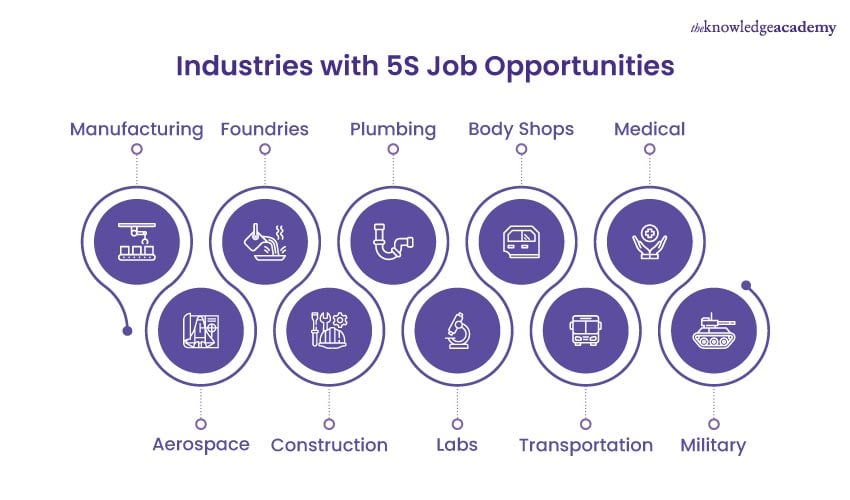
Different Industries With 5S Job Opportunities

Different Industries with 5S Job Opportunities

A wide range of industries actively implement 5S methodology. From manufacturing to medical environments, 5S Training opens doors to careers that value efficiency, safety, and workplace organisation.

  • Manufacturing: Improve workflow, reduce waste, and enhance production quality.
  • Foundries: Optimise space and maintain safer working environments.
  • Plumbing: Apply 5S to tool management and service efficiency.
  • Body Shops: Streamline processes for quicker, cleaner repairs.
  • Medical: Maintain sterile, organised environments to meet healthcare standards.
  • Aerospace: Ensure precision and compliance in high-stakes environments.
  • Construction: Create clean, efficient job sites and tool systems.
  • Labs: Support research through organised, hazard-free workspaces.
  • Transportation: Apply 5S in logistics, maintenance, and fleet management.
  • Military: Enhance discipline, readiness, and equipment handling.

Show moredown

What’s Included in this 5S Training Course?

  • World-Class Training Sessions from Experienced Instructors
  • 5S Training Certificate
  • Digital Delegate Pack

Show moredown

Online Instructor-led (1 days)

Online Self-paced (8 hours)

Lean Awareness Training Course Outline

Module 1: Introduction to Lean

  • About Lean
  • Focus of Lean
  • Origins of Lean
  • Lean in a Nutshell
  • Lean Temple

Module 2: Quality Improvement – PDCA and DMAIC

  • Plan Do Check Act
  • DMAIC Cycle
  • What is DMAIC?
    • Define
    • Measure
    • Analyse
    • Improve
    • Control
    • Summary of DMAIC

Module 3: Lean Principles

  • The Lean Principles

Module 4: Seven Wastes

  • Muda (Waste)
  • Seven Wastes (Muda) of Lean
  • Types of Demand
  • Failure Demand
  • 7 Wastes

Module 5: Value

  • What are Customers?
  • Who Wants the Outputs?
  • Tension Between the VOB and VOC
  • What is Mean by Value?
  • Path to Value
  • Dealing with Values

Module 6: Value Streams and Value Stream Mapping

  • Value Stream Terminology
  • Process Maps
  • Swim Lanes
  • Process Mapping
  • Typical Process Map Contents
  • Typical Process Map Symbols
  • Value Stream Maps
  • What is a "Value Stream"?
  • Value Stream Mapping
  • Process Boxes
  • Value Stream Symbols

Module 7: Key Lean Tools and Techniques

  • Tools and Techniques
  • What is Poka-Yoke?
  • Two Main Types of Poka Yoke
  • Advantages of Poka Yoke
  • Three Poka-Yoke Methods
  • What is SMED?
  • Why do We Need to Listen to the VOC?
  • Determine the Value and Define the Voice of the Customer (VOC)
  • VOC Methodology
  • Heijunka in a Nutshell
  • Description of Pull Systems
  • Pull
  • Brief Description of Pull Systems
  • Push vs. Pull Systems
  • Kanban
  • What are Kanbans?
  • Three-Bin System
  • 5 Whys
  • How to Complete the 5 Whys?
  • Problem Solving Framework
  • 7 Steps of Problem Solving
  • Prioritisation Tools
  • What is Kaizen?
  • Kaizen Philosophy
  • Kaizen Events
  • Formal Kaizen Roles
  • The Formal Kaizen Process
  • Features of Lean Teams
  • High Performing Teams (HPT)
  • Contrasting Team Structures
  • Managing Progress and Demonstrating Control

Module 8: Getting Started

  • Key Lean Terms
  • Key Lean Concepts

Module 9: 5S and the Numbers Game

  • What is 5S?
  • Steps of 5S
  • Numbers Game
  • The Workplace
  • The SORTED Workplace
  • The ORDERED Workplace

Module 10: Leadership and Culture

  • Managing Teams
  • Role of the Team Leader
  • Lean Management
  • Self-Managed Team Philosophy
  • Lean Manager and the Self-Managed Team
  • Leadership and Culture

Show moredown

Who Should Attend this Lean Awareness Training Course?

This Lean Awareness Course from our Lean Courses suite is designed for individuals across various roles and functions who want to gain a foundational understanding of Lean principles and concepts. This training will be beneficial for the following professionals: 

  • Quality Control Personnel
  • Operations and Production Staff
  • Frontline Employees
  • Supervisors and Managers
  • Administrative Staff
  • Continuous Improvement Enthusiasts
  • Supply Chain and Logistics Personnel

Prerequisites of the Lean Awareness Training Course

There are no formal prerequisites to attend this Lean Awareness Course.

Lean Awareness Training Course Overview

This Lean Awareness Training in Honduras provides a solid base in the principle of Lean to streamline the processes in order to minimise waste. It points out Lean thinking as a major contributor to efficiency and productivity. 

The most fundamental job advantage is the possibility to spot the areas of inefficiencies and spearhead fundamental improvement efforts. The skills are very desirable in jobs that are concerned with quality, productivity and constant improvement. 

This 1-Day Lean Awareness Training provided by The Knowledge Academy is interactive and provides examples. Representatives are taught how to implement Lean tools and to introduce changes in their offices.

Course Objectives

  • To introduce delegates to the fundamental principles of Lean methodologies
  • To provide insights into waste reduction and process optimisation using Lean principles
  • To equip delegates with foundational tools for implementing basic Lean practices
  • To demonstrate the practical application of Lean concepts through examples
  • To foster a mindset of continuous improvement within organisational processes
  • To empower professionals to contribute to efficiency improvements using Lean principles

Upon completing these Lean Awareness Training, delegates will possess a foundational understanding of Lean principles, enabling them to identify inefficiencies and contribute to foundational Lean initiatives within their organisations.

Show moredown

What’s Included in this Lean Awareness Training Course?

  • World-Class Training Sessions from Experienced Instructors
  • Lean Awareness Training Certificate
  • Digital Delegate Pack

Show moredown

Online Instructor-led (1 days)

Online Self-paced (8 hours)

Lean Processes and Tools Training Course Outline

Module 1: Lean Processes

  • What is Lean?
  • What is Value?
  • What is Waste?
  • Constraints of Performance Improvement
  • Principles of Lean
  • Four Goals of Lean
  • Seven Forms of Waste
  • Lean Tools
  • Poka-Yoke
  • 5s Visual Workplace
  • Time Management
  • Continuous Improvement
  • Work in Process
  • Material Management
  • Value Stream Mapping
  • Value Added Vs Non-Value Added
  • Creating Lean Systems

Module 2: Standardised Work

  • Why Standardised Work?
  • Elements of Standardised Work
  • Disconnects and Misconceptions

Module 3: Reducing Batch Size

  • Introduction to Reducing Batch Size

Module 4: Poka-Yoke

  • What is Poka-Yoke?
  • Development of Poka-Yoke
  • Quality Control Vs Poka-Yoke
  • Purpose of Poka-Yoke

Module 5: Total Productive Maintenance

  • Introduction to Total Productive Maintenance
  • 5S Foundation

Module 6: Time Management

  • Time Management
  • Benefits of a JIT system
  • Requirements for Implementing Just in Time

Module 7: Value Stream Mapping

  • Guiding Lean Principles
  • Lean Agile Pyramid
  • Lean Agile Value Stream
  • Waste Elimination Using Agile

Module 8: Forming Pull Systems

  • Push Vs Pull in Scrum
  • Favour the Pull Model

Module 9: Lean Six Sigma

  • Improvement
  • Lean Six Sigma
    • Improvement
    • Timeline
    • Process
  • What is Waste in Lean?
  • Lean Vs Six Sigma
  • What Lean Six Sigma Wants to Achieve?
  • What Makes a Good Lean Six Sigma Project?
  • DMAIC Methodology
    • Define
    • Measure
    • Analyse
    • Improve Control

Show moredown

Who Should Attend this Lean Processes and Tools Training Course?

This Lean Processes and Tools Course is designed for professionals who are looking to strengthen their understanding of Lean methodologies and acquire practical skills in using Lean tools for process improvement. This Lean Processes and Tools Training  can be beneficial for the following professionals:

  • Process Improvement Specialists
  • Lean Practitioners
  • Operations Managers
  • Quality Control Personnel
  • Continuous Improvement Teams
  • Project Managers
  • Industrial Engineers

Prerequisites of the Lean Processes and Tools Training Course

There are no formal prerequisites for this Lean Processes and Tools Course. However, a basic understanding of Lean and completing the Lean Awareness Training can be beneficial for the delegates.

Lean Processes and Tools Training Course Overview

Lean Processes and Tools Training introduces delegates to advanced Lean methods and practical tools for process optimisation. It builds a clear understanding of how Lean tools streamline workflows, eliminate waste, and drive continuous improvement.

This training supports professionals seeking to deepen Lean expertise across process improvement and operational excellence roles. It develops the ability to implement structured strategies that enhance efficiency, quality, and performance across industries.

This 1-Day course offered by The Knowledge Academy enables delegates to apply Lean tools with confidence. Through focused learning and hands-on practice, delegates gain the skills to use Value Stream Mapping, Kanban, 5S, and Kaizen to improve processes effectively.

Lean Processes and Tools Course Objectives

  • To provide an in-depth understanding of various Lean tools and methodologies
  • To equip delegates with advanced skills to implement Lean strategies effectively
  • To demonstrate the practical application of Lean tools like Value Stream Mapping and Kanban
  • To enable delegates to identify inefficiencies and drive process improvements
  • To foster a culture of continuous enhancement within organisational processes
  • To empower professionals to lead advanced Lean initiatives and transformations

Upon completing this Lean Processes and Tools Training, delegates will be equipped with advanced Lean skills to drive significant process improvements, streamline workflows, and foster a culture of continuous improvement.

Show moredown

 What’s Included in this Lean Processes and Tools Training Course?

  • World-Class Training Sessions from Experienced Instructors
  • Lean Processes and Tools Training Certificate
  • Digital Delegate Pack

Show moredown

Online Instructor-led (1 days)

Online Self-paced (8 hours)

​Advanced Lean Techniques and Understanding Customers Training Course Outline

Module 1: Introduction to Lean Thinking

  • What is Lean Thinking?
  • Why is Lean Thinking Important?
  • Lean Thinking Principles
  • Benefits of Lean Thinking
  • Key Components of Lean Thinking

Module 2: Advanced Lean Techniques for Process Improvement

  • Overview of Process Improvement Techniques
  • Value Stream Mapping
  • Kaizen Events
  • Lean Six Sigma Methodologies

Module 3: Advanced Lean Techniques for Product Development

  • Overview of Lean Product Development
  • Agile Methodologies
  • Lean Start-Up Principles
  • Design Thinking Techniques

Module 4: Understanding Customer Needs

  • Importance of Understanding Customer Needs
  • Techniques for Gathering Customer Feedback
  • Analysing Customer Data
  • Creating Customer Personas
  • Mapping Customer Journey
  • Identifying Touchpoints

Module 5: Developing Customer-Centric Strategies

  • Using Customer Insights to Inform Business Strategy
  • Creating Customer-Focused Mission Statements
  • Building a Customer-Centric Culture

Module 6: Measuring Customer Success

  • Overview of Customer Success Metrics
  • Net Promoter Score (NPS)
  • Customer Lifetime Value (CLV)
  • Customer Churn Rate

Module 7: Applying Lean Techniques to Customer Success

  • Using Lean Principles to Improve Customer Success
  • Creating Customer Success Plans
  • Implementing Customer Feedback Loops
  • Lean Marketing Techniques

Show moredown

Who Should Attend this Advanced Lean Techniques and Understanding Customers Training Course?

This Advanced Lean Techniques and Understanding Customers Course is designed for those who want to get better at understanding and implementing Lean methodologies for customer satisfaction. This Advanced Lean Techniques and Understanding Customers Training is especially beneficial for the following professionals:

  • Lean Practitioners
  • Operations Managers
  • Process Engineers
  • Manufacturing Engineers
  • Business Analysts
  • Senior Executives
  • Product Managers

Prerequisites of the Advanced Lean Techniques and Understanding Customers Training Course

There are no formal prerequisites for this Advanced Lean Techniques and Understanding Customers Course.

Advanced Lean Techniques and Understanding Customers Training Course Overview

Advanced Lean Techniques and Understanding Customers Training introduces delegates to advanced Lean methods combined with customer-focused thinking. It explains how Lean principles align operational efficiency with customer needs to drive continuous improvement.

This training supports professionals in strengthening Lean expertise while adopting a customer-centric approach. It builds the ability to optimise processes, enhance service quality, and align operations with customer expectations across diverse industries.

This 1-Day course offered by The Knowledge Academy enables delegates to apply advanced Lean techniques confidently. Through focused learning and practical exercises, delegates develop the skills to improve processes while meeting and exceeding customer expectations.

Advanced Lean Techniques and Understanding Customers Course Objectives

  • To integrate advanced Lean methodologies with customer-centric approaches
  • To equip delegates with skills to analyse customer needs and align processes accordingly
  • To provide insights into advanced Lean techniques like Lean Six Sigma and Voice of the Customer
  • To demonstrate practical application through case studies and exercises
  • To encourage a culture of continuous improvement while prioritising customer satisfaction
  • To empower professionals to drive organisational excellence by aligning Lean principles with customer expectations

Upon completing this Advanced Lean Techniques and Understanding Customers Training, delegates will possess advanced Lean skills combined with a customer-centric mindset, enabling them to optimise processes in line with customer expectations.

Show moredown

What’s Included in this Introduction to Advanced Lean Techniques and Understanding Customers Training Course?

  • World-Class Training Sessions from Experienced Instructors
  • Advanced Lean Techniques and Understanding Customers Certificate
  • Digital Delegate Pack

Show moredown

Online Instructor-led (1 days)

Online Self-paced (8 hours)

6S Training Course Outline

Module 1: Introduction to 6S Methodology

  • What Is 6S and Its Key Principles?
  • Benefits of Implementing 6S in the Workplace
  • What is 5s?
  • Understanding the Difference Between 5S and 6S
  • Overview of the 6S Implementation Process

Module 2: Sort (Seiri)

  • Importance of Workplace Organisation and Decluttering
  • Identifying and Categorising Necessary Vs. Unnecessary Items
  • Methods for Disposing of Unneeded Items Responsibly
  • Developing a Sustainable Sorting Process

Module 3: Set in Order (Seiton)

  • Organising and Arranging Essential Items Efficiently
  • Creating a Logical and Ergonomic Layout
  • Implementing Visual Cues
  • Establishing Standards

Module 4: Shine (Seiso)

  • Understanding the Significance of Cleanliness and Hygiene
  • Developing a Cleaning Schedule and Responsibilities
  • Implementing an Effective Cleaning Process
  • Maintaining a Clean and Safe Work Environment

Module 5: Standardise (Seiketsu)

  • Creating Standard Operating Procedures (SOPs)
  • Establishing Guidelines
  • Apply Tools and Techniques
  • Auditing and Measuring 6S

Module 6: Sustain (Shitsuke)

  • Developing Strategies
  • Empowering Employees to Take Ownership of 6S Initiatives
  • Encouraging a Culture of Discipline and Accountability
  • Addressing Challenges and Overcoming Barriers to Sustain 6S

Module 7: Safety and 6S

  • Integrating Safety Measures Within the 6S Methodology
  • Identifying Potential Safety Hazards and Risks
  • Promoting a Safety-First Mindset in the Workplace
  • Health and Safety Regulations

Module 8: Applying 6S Beyond the Workplace

  • Implementing 6S Principles
  • Utilising 6S for Improving Workflows and Processes
  • Overcoming Resistance to Change and Fostering a 6S Culture

Show moredown

Who Should Attend this 6S Training Course?

This 6S Course is suitable for those who want to optimise workplace organisation and processes effectively. 6S Training is beneficial for various professionals including:

  • Manufacturing Workers
  • Warehouse and Logistics Personnel
  • Operations Managers
  • Production Supervisors
  • Maintenance Technicians
  • Lean Practitioners
  • Safety Managers
  • Facility Managers

Prerequisites of the 6S Training Course

There are no formal prerequisites for attending this 6S Course.

6S Training Course Overview

6S Training introduces delegates to an extended 5S framework by integrating the sixth element, safety. It explains how to combine workplace safety with process efficiency, creating organised, secure, and high-performing work environments.

This training supports professionals seeking to improve safety while optimising operations. It builds the ability to apply 6S principles across manufacturing, healthcare, and logistics, enabling safer practices and continuous improvement.

This 1-Day course offered by The Knowledge Academy enables delegates to implement 6S principles with confidence. Through focused learning and practical activities, delegates gain the skills to integrate safety into daily processes and sustain efficient, secure workplaces.

6S Course Objectives

  • To introduce delegates to integrating safety (the sixth 'Safety' element) into the 5S framework
  • To provide insights into enhancing workplace safety while optimising processes
  • To equip delegates with practical tools for implementing and sustaining 6S practices
  • To demonstrate the application of 6S principles through interactive sessions
  • To foster a culture of safety and efficiency within organisational processes
  • To empower professionals to create and maintain safer work environments using 6S principles

Upon completing 6S Training, delegates will possess an advanced understanding of 6S principles, enabling them to create safer work environments while optimising processes

Show moredown

What’s Included in this 6S Training Course?

  • World-Class Training Sessions from Experienced Instructors
  • 6S Certificate
  • Digital Delegate Pack

Show moredown

Not sure which course to choose?

Speak to a training expert for advice if you are unsure of what course is right for you. Give us a call on + 1-866 272 8822 or Enquire.

Core Concepts You Will Learn in Lean Training Courses

The Knowledge Academy’s Lean Training Courses provide a practical understanding of process improvement principles that help organisations eliminate waste and enhance efficiency.

  • Value Stream Mapping – Find and fix process gaps. Mapping can improve work efficiency by up to 30%.
  • Continuous Improvement (Kaizen) – Make small, regular improvements to boost performance and teamwork over time.
  • 5S Workplace Organisation – Keep the workplace clean, safe, and organised. It can raise efficiency by 20%.
  • Root Cause Analysis – Find and fix the main cause of problems using the 5 Whys method.
  • Process Standardisation – Use clear, repeatable steps to maintain quality and reduce mistakes.
  • Performance Measurement – Track results with simple performance metrics like time, cost, and output.
  • Customer Value Focus – Design every process around what customers need to increase satisfaction.
  • Lean Principles & Methodologies – Apply Lean methods to cut waste and make processes work faster and better.


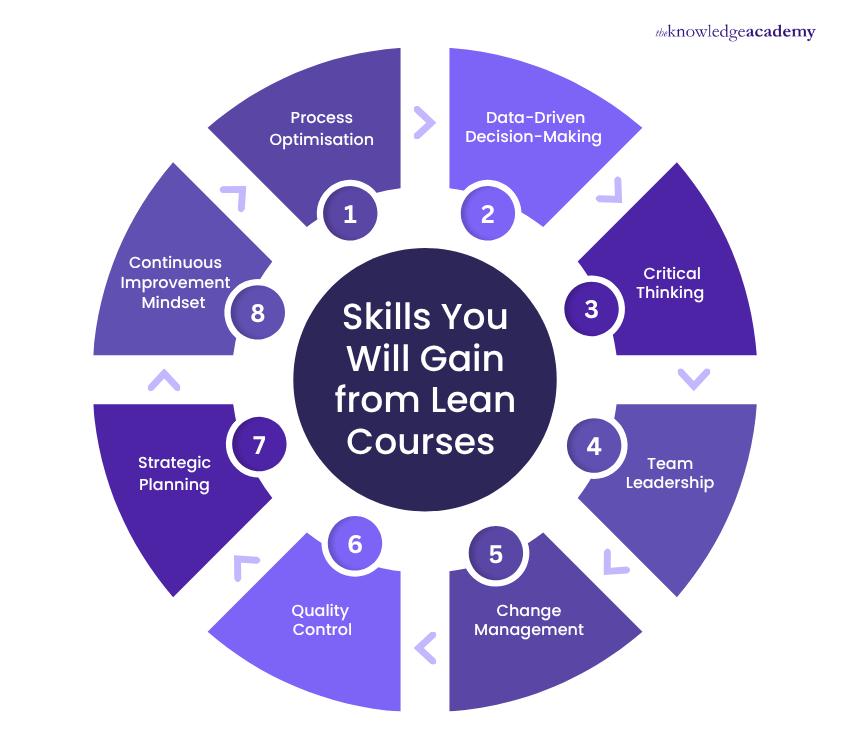
Skills You Will Gain from Lean Courses

Completing Lean Training equips professionals with analytical, problem-solving, and leadership skills essential for driving continuous improvement.

Skills You Will Gain from Lean Courses

  • Process Optimisation – Improve workflows by removing waste. This can boost efficiency by up to 30%.
  • Data-Driven Decision-Making – Use data and analytics to make smarter business and process decisions.
  • Critical Thinking – Identify real problems using simple tools like the 5 Whys method.
  • Team Leadership – Lead Lean projects effectively. Good teamwork can improve success rates by around 40%.
  • Change Management – Help teams adapt smoothly to new systems through clear communication and planning.
  • Quality Control – Maintain standards through regular checks. Six Sigma methods can cut errors by 25%.
  • Strategic Planning – Align Lean strategies with company goals to support long-term growth.
  • Continuous Improvement Mindset – Make small, steady changes. Daily improvements can raise productivity by about 25%.
Show more blue-arrow

Lean Training FAQs

Lean Training teaches methods to eliminate waste, improve efficiency, and optimise processes. It helps delegates build skills to enhance quality, productivity, and continuous improvement across organisations. 

Lean Certification validates your ability to improve processes and reduce inefficiencies. It enhances credibility, career prospects, and impact in operational and quality-focused roles. 

If you are unable to access your Lean Certification, contact the support team at The Knowledge Academy via our customer service email or phone number provided on our website for prompt assistance and resolution of your issue. 

Yes, after completing Lean Certification, you will receive a certificate of completion to validate your achievement and demonstrate your proficiency in the course material. 

Courses cover tools such as 5S, Kaizen, Kanban, Value Stream Mapping, and DMAIC. These techniques help identify waste and drive continuous improvement. 

The duration of each Lean Course is clearly stated on its individual course page. This allows learners to select a course that matches their learning objectives, availability, and desired depth of understanding. 

It equips professionals to streamline workflows and eliminate waste. This leads to faster processes, improved quality, and better resource utilisation. 

Lean focuses on eliminating waste and improving flow. Six Sigma emphasises reducing variation and defects using data-driven methods. 

Yes, Lean Training are available online with the same structured content and expert guidance. Delegates can learn flexibly from any location. 

Lean Training focuses on eliminating waste, improving efficiency, and optimising processes across operations. Agile Training centres on flexibility, iterative delivery, and rapid response to change, particularly in project and team environments, making each suited to different organisational goals. 

Lean Certification helps improve processes by teaching structured methods to identify waste, streamline workflows, and enhance efficiency. It equips professionals with tools to analyse performance, implement continuous improvement, reduce costs, and deliver greater value to customers through consistent, data-driven optimisation. 

These Lean Training Suit Managers, Team Leaders, Quality Professionals, and anyone involved in process improvement. They are ideal for roles focused on efficiency and change. 

 Yes, The Knowledge Academy offers 24/7 support via phone and email before attending, during, and after the course. Our customer support team is available to assist and promptly resolve any issues you may encounter. 

Yes, The Knowledge Academy provides flexible self-paced training option for this Lean Training. Self-paced training is beneficial for individuals who have an independent learning style and wish to study at their own pace and convenience. 

 Yes, we provide corporate training for this course, tailored to fit your organisation’s requirements. 

Lean Certification supports roles such as Process Improvement Specialist, Lean Practitioner, Operations Manager, Continuous Improvement Manager, Quality Analyst, and Business Excellence Lead. It also strengthens progression in manufacturing, services, healthcare, logistics, and operations-focused management careers. 

The Knowledge Academy stands out as a prestigious training provider known for its extensive course offerings, expert instructors, adaptable learning formats, and industry recognition. It's a dependable option for those seeking this certification.

Please see our Lean Training available in Honduras

The Knowledge Academy is one of the Leading global training provider for Lean Training.

The training fees for Lean Training in Honduras starts from $2295

Show more down

Why we're the go to training provider for you

icon

Best price in the industry

You won't find better value in the marketplace. If you do find a lower price, we will beat it.
icon

Trusted & Approved

Recognised by leading certification bodies, we deliver training you can trust.

icon

Many delivery methods

Flexible delivery methods are available depending on your learning style.

icon

High quality resources

Resources are included for a comprehensive learning experience.

barclays Logo
deloitte Logo
Thames Water Logo

"Really good course and well organised. Trainer was great with a sense of humour - his experience allowed a free flowing course, structured to help you gain as much information & relevant experience whilst helping prepare you for the exam"

Joshua Davies, Thames Water

santander logo
bmw Logo
Google Logo
cross

Exclusive Deals Big Savings This March!

Grab up to 40% OFF and level up your skills this spring! march-madness

WHO WILL BE FUNDING THE COURSE?

close

close

Thank you for your enquiry!

One of our training experts will be in touch shortly to go over your training requirements.

close

close

Press esc to close

close close

Back to course information

Thank you for your enquiry!

One of our training experts will be in touch shortly to go overy your training requirements.

close close

Thank you for your enquiry!

One of our training experts will be in touch shortly to go over your training requirements.