


 Top Rated Course


We may not have the course you’re looking for. If you enquire or give us a call on +852 2592 5349 and speak to our training experts, we may still be able to help with your training requirements.
What is Site Reliability Engineering?
Sienna Roberts 23 February 2026Site Reliability Engineering is a practice that helps keep websites, apps, and systems reliable, fast, and always available for users. It blends software development and IT operations to improve system performance, reduce downtime, and solve problems quickly. SRE uses tools and automation to build strong digital services.

Training Outcomes Within Your Budget!
We ensure quality, budget-alignment, and timely delivery by our expert instructors.
Table of Contents
At any point, did you wonder how your favourite apps stay lightning-fast and rarely crash, even with millions using them? That’s the power of Site Reliability Engineering (SRE); the silent force keeping systems steady behind the scenes. In case you are in tech or just curious, knowing What is Site Reliability Engineering reveals how modern systems stay online and efficient. In this blog, we’ll break down Site Reliability Engineering and why it’s now vital in keeping the digital world running smoothly.
Table of Contents
1) What is Site Reliability Engineering?
2) The Benefits of Site Reliability Engineering
3) Core Principles of Site Reliability Engineering
4) How Does Site Reliability Engineering Work?
5) Site Reliability Engineering Metrics
6) SRE and DevOps
7) Future of Site Reliability Engineering (SRE)
8) What are the Common Site Reliability Engineering Tools?
9) Conclusion
What is Site Reliability Engineering?
Site Reliability Engineering (SRE) is a way of working where software engineers focus on keeping websites, apps, or systems running smoothly. It combines software skills with operations work to make sure systems stay fast, reliable, and always available. The aim is to fix issues quickly and avoid downtime.
For example, consider a music app that millions of people use daily. If the app crashes or slows down, users may become frustrated. A Site Reliability Engineer helps prevent this by setting up tools to monitor the app, quickly fix problems, and even stop them before they occur. They may also write code to automate routine tasks, ensuring nothing gets missed.

The Benefits of Site Reliability Engineering
Here are the ways how Site Reliability Engineering helps improve systems and business performance:

1) Higher System Reliability
a) Reduces downtime and keeps services running
b) Finds and fixes problems before users notice
c) Helps avoid crashes with strong monitoring
d) Keeps systems healthy during updates or traffic spikes
2) Better User Experience
a) Makes websites and apps load faster
b) Reduces errors that affect users
c) Keeps features working as expected
d) Builds trust with reliable services
3) Faster Problem Solving
a) Automates tasks to fix issues quickly
b) Uses alerts to catch problems early
c) Finds root causes using smart tools
d) Saves time for engineers with clear systems
4) Stronger Collaboration Between Teams
a) Brings developers and operations together
b) Makes goals clear for everyone involved
c) Shares tools and knowledge across teams
Helps teams work better and faster together
Core Principles of Site Reliability Engineering
Here are the principles that help SRE teams keep systems reliable and easy to manage:

1) Accept Risk
Not every risk can be removed, so teams must learn to manage it. SRE teams decide how much failure is acceptable before it becomes a problem. This helps balance speed, cost, and reliability.
a) Define how much downtime is okay for each service
b) Plan for small failures instead of avoiding all risks
c) Balance safety with speed of updates
d) Accept that 100% uptime is not always practical
2) Service Level Objectives (SLOs)
SLOs set clear goals for how reliable a service should be. These goals help track if the service is performing well enough. They also guide decisions about improvements or changes.
a) Set targets for uptime, response time, and error rates
b) Track performance against those targets
c) Use data to see if users are satisfied
d) Review and update goals regularly
3) Eliminate Toil
Toil is the boring, manual work that adds no long-term value. SREs try to remove or reduce this by automating tasks. Less toil means more time to solve real problems.
a) Identify tasks that repeat often
b) Automate where possible to save time
c) Measure how much time is spent on toil
d) Focus energy on valuable engineering work
4) Monitoring and Observability
SREs must see what’s happening in the system at all times. Monitoring tools track system health, while observability helps find the cause of problems. Both are needed to act quickly when things go wrong.
a) Set up alerts for system issues
b) Use dashboards to track key data
c) Collect logs, metrics, and traces
d) Investigate issues with clear system data
5) Automation
Manual steps can lead to mistakes. SREs use automation to make work faster, safer, and more reliable. It’s a key way to scale systems without growing the team.
a) Automate software releases and rollbacks
b) Write scripts for regular maintenance
c) Reduce human error through automation
d) Use tools to manage large systems easily
6) Release Engineering
This is about how code is tested, packaged, and delivered. SREs work to make releases safe, quick, and easy to undo. A strong release process helps avoid downtime.
a) Create repeatable and safe release processes
b) Test before deploying to users
c) Use tools to manage versions and changes
d.) Plan for easy rollback if needed
7) Simplicity
Simple systems are easier to fix, understand, and grow. SREs try to reduce the complexity of tools, processes, and systems. Less complexity means fewer bugs and faster recovery.
a) Remove extra steps that don’t help
b) Use clear and clean code and tools
c) Choose simple solutions that work well
d) Keep documentation easy to follow
How Does Site Reliability Engineering Work?
Here are the ways Site Reliability Engineering (SRE) helps systems run smoothly and stay reliable:
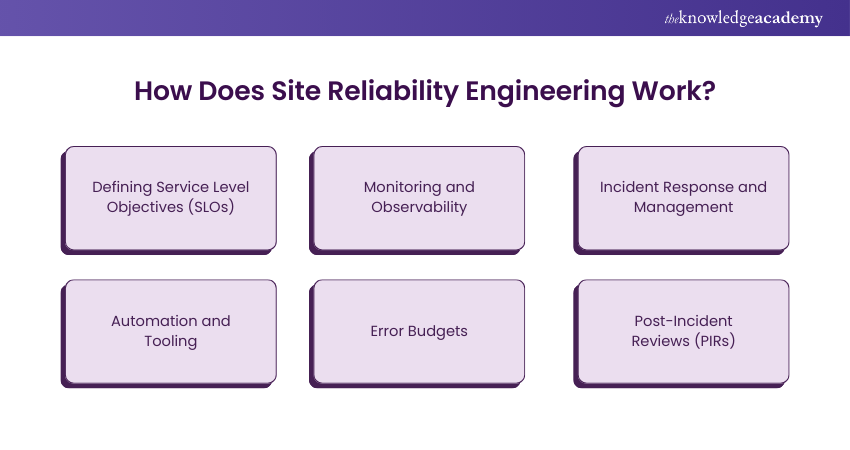
1) Defining Service Level Objectives (SLOs)
SLOs are goals that show how well a service should perform. They focus on things like speed, uptime, or response time. These goals help teams know if a service is doing well or needs fixing. SRE teams use SLOs to stay focused on what matters most to users.
a) Set clear goals for system performance
b) Focus on uptime, speed, and error rates
c) Use goals to measure service health
d) Guide improvement work with clear targets
2) Monitoring and Observability
SRE teams keep an eye on systems using special tools and dashboards. Monitoring shows if something goes wrong, like a server crash or slow response. Observability helps find out why it happened. These tools help teams fix problems quickly and understand system health better.
a) Use tools to watch system performance in real-time
b) Get alerts when problems happen
c) Check logs and data to find root causes
d) Improve visibility across services and apps
3) Incident Response and Management
When a service fails or slows down, SRE teams respond fast. They follow a clear plan to find and fix the issue. The goal is to reduce downtime and help users as quickly as possible. After fixing it, they record what happened for future learning.
a) Act quickly when problems arise
b) Use playbooks to handle common issues
c) alk with other teams to fix problems faster
d) Keep users updated during big incidents
4) Automation and Tooling
SRE teams use automation to save time and reduce mistakes. Instead of doing the same task over and over, they build tools to do it automatically. This helps services run better and gives teams more time to solve real problems. Automation also helps systems recover faster.
a) Create scripts to fix common issues
b) Automate testing and code releases
c) Reduce human error with smart tools
d) Save time by automating daily tasks
5) Error Budgets
An error budget is the amount of failure allowed before action is needed. It helps balance speed and safety. If teams use too much of the budget, they stop releasing new features to focus on fixing issues. It’s a smart way to manage risk.
a) Track how much downtime is acceptable
b) top changes if systems are too unstable
c) Balance innovation and reliability
d) Use data to decide what to fix next
6) Post-Incident Reviews (PIRs)
After a problem is fixed, the team holds a review to learn what went wrong. They talk about what caused it and how to stop it from happening again. These reviews are not about blaming anyone. They help improve the system and the team.
a) Write down what happened during the incident
b) Share what was learned with the whole team
c) Fix weak spots found during the review
d) Improve processes to prevent future issues
Transform how your team delivers software – sign up for our DevOps Foundation Course.
Site Reliability Engineering Metrics
Site Reliability Engineers use numerous metrics to help track the consistency of service delivery and reliability of software systems. These metrics include:
1) Service Level Agreements (SLA): SLAs set the terms and conditions between a customer and service provider. These agreements dictate the following:
a) Level of performance
b) Agreed-upon indicators for measuring performance
c) Repercussions for failing to deliver services.
A standard service that's outlined in an SLA is uptime which is the amount of time a service is available.
2) Error Budgets: This is a tool that SREs use to automatically reconcile the service reliability of a company with its pace of software development. Error budgets help with the following:
a) Establish a level of error risk that is in line with the service level agreements.
b) Help development teams and operations teams improve the stability and performance of services.
c) Help make data-driven decisions about deploying new features or applications
d) Maximise innovation by taking risks within acceptable limits.

3) Service Level Objectives (SLO): SRE teams help set service level objectives (SLOs) which is an agreed-upon performance target for a specific service over a specified period. SLOs define the expected status of services and enable stakeholders to manage particular services' health and meet SLAs.
4) Service Level Indicators (SLIs): SLOs are measured by service level indicators (SLIs), which are quantitative measurements presented as averages, percentages, or rates. They include the actual measurement of services such as:
a) Uptime.
b) Latency.
c) Throughput.
d) Error rates.
Know how top tech companies keep systems running at scale – join our Site Reliability Engineering Foundation Training.
SRE and DevOps
Here’s how Site Reliability Engineering (SRE) and DevOps compare in key areas:
1) Focus and Goals
SRE mainly focuses on system reliability, uptime, and performance. On the other hand, DevOps centres more on speeding up development and delivery. Both aim to improve service quality, but from different angles.
2) Approach to Problems
SRE uses software engineering to solve operational issues. In contrast, DevOps encourages team collaboration to bridge gaps between development and operations. SRE often applies strict rules and measures to maintain stability.
3) Use of Automation
SRE relies heavily on automation to reduce manual work and errors. On the other hand, DevOps uses automation broadly across testing, deployment, and monitoring. SRE automation focuses more on reliability and error reduction.
Secure your pipelines with confidence – join our Certified DevOps Security Professional (CDSOP) Course.
Future of Site Reliability Engineering (SRE)
Here are some trends shaping the future of Site Reliability Engineering:
a) More use of AI to detect and fix problems faster
b) Wider adoption of automation to reduce manual work
c) Stronger focus on building reliable cloud systems
d) Greater need for SREs in all types of businesses
e) Improved tools for faster incident response
What are the Common Site Reliability Engineering Tools?
Here are some tools used by SRE teams to manage systems and solve problems:
a) Prometheus: This tool helps collect and check system performance data.
b) Grafana: It is used to create dashboards and alerts that are easy to understand.
c) PagerDuty: This tool alerts the team when something goes wrong in the system.
d) Terraform: It helps manage and set up cloud systems automatically.
e) Jenkins: This tool automates testing and releasing new updates.
f) ELK Stack (Elasticsearch, Logstash, Kibana): It allows teams to search and review system logs in one place.
Conclusion
Site Reliability Engineering is what keeps your favourite apps smooth, stable, and stress-free; even under pressure. It's a smart mix of software and operations that stops issues before they begin. Want to know What is Site Reliability Engineering? It’s the silent force powering every seamless digital moment you enjoy.
Keep services smooth and scalable at all times with our DevOps Certification - Join today!
Frequently Asked Questions
What is the Primary Role of a Site Reliability Engineer?

A Site Reliability Engineer (SRE) makes sure websites and apps work well and stay online. They fix problems quickly and try to stop issues before they happen. Their goal is to keep systems reliable, fast, and easy to use.
How Does Site Reliability Engineering Differ From Traditional Operations or Development Roles?
SREs mix both development and operations skills to keep systems running smoothly. Unlike traditional roles, they focus more on automation and reliability. SREs also measure performance to find better ways to handle system issues.
What are the Other Resources and Offers Provided by The Knowledge Academy?
The Knowledge Academy takes global learning to new heights, offering over 3,000+ online courses across 490+ locations in 190+ countries. This expansive reach ensures accessibility and convenience for learners worldwide.
Alongside our diverse Online Course Catalogue, encompassing 17 major categories, we go the extra mile by providing a plethora of free educational Online Resources like Blogs, eBooks, Interview Questions and Videos. Tailoring learning experiences further, professionals can unlock greater value through a wide range of special discounts, seasonal deals, and Exclusive Offers.
What is the Knowledge Pass, and how Does it Work?
The Knowledge Academy’s Knowledge Pass, a prepaid voucher, adds another layer of flexibility, allowing course bookings over a 12-month period. Join us on a journey where education knows no bounds.
What are Related Courses and Blogs Provided by The Knowledge Academy?
The Knowledge Academy offers various DevOps Courses, including DevOps Foundation Certification, Site Reliability Engineering Foundation Training and Site Reliability Engineering Practitioner Training. These courses cater to different skill levels, providing comprehensive insights into DevOps vs SRE.
Our Programming & DevOps Blogs cover a range of topics related to Site Reliability Engineering, offering valuable resources, best practices, and industry insights. Whether you are a beginner or looking to advance your Site Reliability Engineering skills, The Knowledge Academy's diverse courses and informative blogs have you covered.

 If you wish to make any changes to your course, please


