


 Top Rated Course

We may not have the course you’re looking for. If you enquire or give us a call on +852 2592 5349 and speak to our training experts, we may still be able to help with your training requirements.
Domain constraints in DBMS: A Complete Guide
Lily Turner 11 February 2026Domain Constraints in DBMS ensure data accuracy and integrity by restricting the values that can be entered into a column. In this blog, we’ll explore the concept of constraints in DBMS and the different types that help maintain database consistency. Let’s explore how Domain Constraints work behind the scenes to protect your database!

Training Outcomes Within Your Budget!
We ensure quality, budget-alignment, and timely delivery by our expert instructors.
Table of Contents
Imagine your database as a vault holding precious information. Now, picture what would happen if there were no locks on that vault—any kind of data could slip in, leading to chaos and confusion. This is where Domain Constraints in DBMS step in, serving as the invisible locks and guards that protect your data from corruption.
But how do Domain Constraints in DBMS balance precision with flexibility? From the Not Null Constraint to the Check Constraint, Domain Constraints are the backbone of reliable Data Management. Ready to explore how they bring order to the digital world? Let’s unravel the hidden forces that keep your database operating flawlessly!
Table of Contents
1) Understanding Domain Constraints in DBMS
2) Type of Domain Constraints
a) Domain Constraints – Not Null
b) Domain Constraints – Check
3) Conclusion
Understanding Domain Constraints in DBMS
Domain Constraints are a fundamental aspect of Database Management Systems (DBMS). They ensure the integrity and validity of data within a database by restricting the values that can be stored in a column. Essentially, Domain Constraints define the permissible values for a given attribute, ensuring that the data adheres to specific rules and standards.
In a DBMS, Domain Constraints are crucial for maintaining data accuracy and consistency. They prevent invalid data from being entered into the database, which can lead to data anomalies and inconsistencies. By enforcing Domain Constraints, databases can ensure that the data remains reliable and meaningful.

Types of Domain Constraints
Here are the two primary types of Domain Constraints that help control the data within a database:
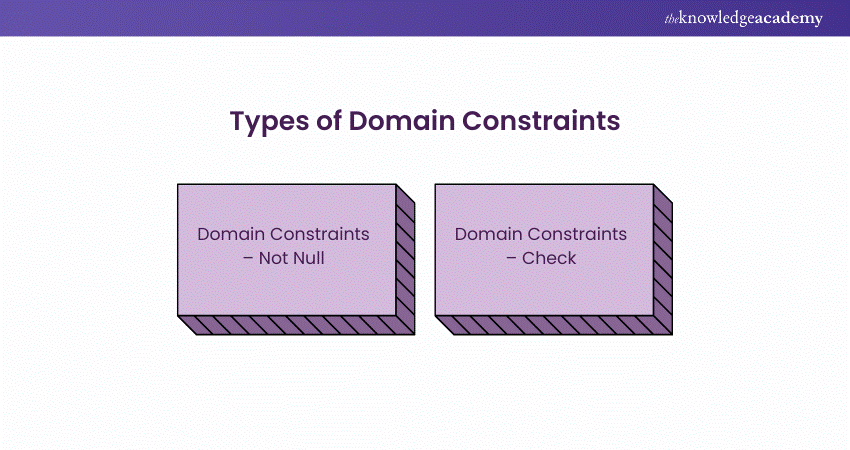
1) Domain Constraints – Not Null
The Not Null Constraint is one of the simplest yet most effective Domain Constraints used in DBMS. It ensures that a particular column cannot have a null or empty value, meaning that essential data must always be provided. This prevents the insertion of incomplete records into the database.
By enforcing the Not Null Constraint, databases prevent essential fields from being left blank, which ensures the integrity and reliability of the data.
Example:
Let’s look at an example to understand how the Not Null Constraint works in practice:

In this example, the “employee_id,” “first_name,” and “email” fields are defined with the Not Null Constraint. This means that when inserting a new record into the Employees table, values must be provided for these three fields, ensuring that no essential information is left out.

This query would return an error because the Not Null Constraint on the “employee_id” column prevents it from accepting a null value. Thus, Domain Constraints help ensure that crucial data is always present.
Importance of the Not Null Constraint:
a) Ensures data completeness by requiring values for important fields.
b) Prevents errors and inconsistencies that can arise from missing or incomplete data.
c) Helps maintain data integrity and reliability across the database.
Start your journey into Database Management and master foundational skills with expert Introduction To Database Training – sign up now!
2) Domain Constraints – Check
The Check Constraint is more flexible and powerful than the Not Null Constraint. It enables you to define custom rules for what data is allowed in a particular column. These rules can range from simple value comparisons to more complex logical expressions, making it one of the most versatile Domain Constraints in DBMS.
Example:
Let’s look at an example where the Check Constraint ensures that the age of an employee is always greater than zero:

In this example, the Check Constraint ensures that the value entered into the “age” column must be greater than zero. Any attempt to insert a negative age would result in an error.

This query would fail because the Check Constraint does not allow a negative value in the “age” column. The use of the Check Constraint thus helps maintain data consistency by ensuring that values conform to logical rules.
Importance of the Check Constraint:
a) Allows for customised data validation based on specific requirements.
b) Ensures data integrity by preventing the entry of invalid values.
c) Helps maintain logical consistency in the database by adhering to real-world rules (e.g., age, prices).
Learn essential Relational Databases & Data Modelling Training and strengthen your expertise in relational databases today!
Conclusion
Domain Constraints in DBMS are like the invisible guardians of your data, enforcing rules that keep everything precise, consistent, and trustworthy. By preventing chaos and ensuring smooth operations, they turn your database into a powerhouse of reliability—keeping it running flawlessly behind the scenes. They ensure your data remains secure, efficient, and always reliable. Embrace these constraints to unlock the full potential of your database and maintain unwavering data integrity.
Elevate your database skills with expert Database Training and unlock limitless career opportunities!
Frequently Asked Questions
What is the Difference Between Key and Domain Constraints?

Key Constraints ensure data uniqueness and entity identification within a table (e.g., primary key, foreign key), while Domain Constraints restrict the permissible values for a specific column to maintain data integrity.
What are Common Uses of Domain Constraints?
Common uses of Domain Constraints include:
a) Enforcing valid data entry within specific ranges or formats
b) Ensuring essential fields are not left empty (Not Null)
c) Applying custom conditions using the Check Constraint
d) Maintaining overall data accuracy, consistency, and integrity
What are the Other Resources and Offers Provided by The Knowledge Academy?
The Knowledge Academy takes global learning to new heights, offering over 3,000+ online courses across 490+ locations in 190+ countries. This expansive reach ensures accessibility and convenience for learners worldwide.
Alongside our diverse Online Course Catalogue, encompassing 19 major categories, we go the extra mile by providing a plethora of free educational Online Resources like Blogs, eBooks, Interview Questions and Videos. Tailoring learning experiences further, professionals can unlock greater value through a wide range of special discounts, seasonal deals, and Exclusive Offers.
What is The Knowledge Pass, and How Does it Work?
The Knowledge Academy’s Knowledge Pass, a prepaid voucher, adds another layer of flexibility, allowing course bookings over a 12-month period. Join us on a journey where education knows no bounds.
What are the Related Courses and Blogs Provided by The Knowledge Academy?
The Knowledge Academy offers various Database Training, including Introduction to Database Training, Relational Databases & Data Modelling Training and GraphQL Database Training With React. These courses cater to different skill levels, providing comprehensive insights into Deadlock in DBMS.
Our Programming & DevOps Blogs cover a range of topics related to DBMS, offering valuable resources, best practices, and industry insights. Whether you are a beginner or looking to advance your Programming and DevOps skills, The Knowledge Academy's diverse courses and informative blogs have got you covered.

Lily Turner


Senior AI/ML Engineer and Data Science Author
Lily Turner is a data science professional with over 10 years of experience in artificial intelligence, machine learning, and big data analytics. Her work bridges academic research and industry innovation, with a focus on solving real-world problems using data-driven approaches. Lily’s content empowers aspiring data scientists to build practical, scalable models using the latest tools and techniques.
View Detail
Upcoming Programming & DevOps Resources Batches & Dates
Date
 Introduction to Database Training
Introduction to Database Training
Fri 26th Jun 2026
Introduction to Database Training
Fri 28th Aug 2026
Introduction to Database Training
Fri 13th Nov 2026

 If you wish to make any changes to your course, please


