


 Top Rated Course

We may not have the course you’re looking for. If you enquire or give us a call on +30 2111995372 and speak to our training experts, we may still be able to help with your training requirements.
Problem-solving Skills: A Practical Development Guide
William Brown 15 July 2026Problem-solving Skills help individuals identify, analyse and resolve issues effectively, aiding smart decisions in personal and professional settings. These skills include Analytical Thinking, Creative Thinking, Decision Making, research and information gathering, emotional intelligence, and collaboration and communication.

Training Outcomes Within Your Budget!
We ensure quality, budget-alignment, and timely delivery by our expert instructors.
Table of Contents

Feeling stuck staring at a problem like it’s a puzzle with missing pieces is a common and quite a frustrating, patience-draining experience, isn't it? The best way to tackle such a situation is by cultivating the right Problem-solving Skills. These skills go beyond finding quick fixes and help you think critically, stay calm under pressure and create solutions that last.
Whether in the workplace or everyday life, strong problem-solving abilities can set you apart. This blog brings you a hands-on roadmap to sharpening your Problem-solving Skills. From decoding time-consuming challenges to thinking on your feet, this is your key to thinking smarter, not harder. So read on!
Table of Contents
1) What is Problem-solving Skills?
2) Various Problem-solving Skills
3) How to Improve Your Problem-solving Skills
4) Ways to Highlight Problem-Solving Skills
5) How Do I Say I Have Problem-solving Skills?
6) What are Examples of Problem-solving in the Workplace?
7) Conclusion
What is Problem-solving Skills?
Problem-solving Skills are essential abilities that enable individuals to analyse and resolve challenges they encounter in various aspects of life. These skills involve a combination of critical thinking, creativity, logical reasoning, and decision-making. Understanding Problem-solving Skills is vital for individuals seeking personal growth and professional success. These skills enhance decision-making capabilities and foster a proactive mindset.
By actively developing these skills, individuals become better equipped to overcome obstacles, and make informed choices. Achieving goals, too, becomes easier. Problem-solving Skills are essential cognitive abilities. These enable individuals to analyse and resolve problems effectively. They encompass analytical thinking, creativity, and adaptability. Understanding Problem-solving Techniques can therefore be a great idea.

Various Problem-solving Skills
Problem-solving Skills envelope a range of abilities that individuals can develop and apply in various situations. Here are some different Problem-solving Skills that are valuable in addressing diverse challenges:

1) Analytical Thinking
1) Analytical thinking means breaking complex problems into smaller, manageable parts.
2) It looks at each part carefully and understands how they connect.
3) This skill helps people spot important details, recognise patterns and find useful insights.
4) Using logic and data, analytical thinkers make better decisions and can create focused solutions.
2) Creative Thinking
1) Creativity in problem-solving means staying flexible and exploring many possible options.
2) It can be applied when researching, brainstorming ideas, drawing conclusions, or combining choices into a final solution.
3) Learning How to Improve Critical Thinking supports this by challenging assumptions, expanding perspectives, and inspiring innovative solutions.
4) Creative problem solvers embrace free thinking, brainstorming, and uncertainty.
5) This helps them uncover original answers to complex challenges.
3) Critical Thinking
1) Critical thinking helps people judge how valid and reliable information is.
2) It helps spot biases or errors and reach sound conclusions using Logical Thinking.
3) Critical thinkers ask questions, examine arguments, and consider different perspectives before making a decision.
4) This skill is especially valuable when careful analysis and balanced judgment are needed.
4) Decision Making
1) Decision Making involves choosing an option based on research, analysis and personal judgement.
2) During problem-solving, you may face several choices, and decision-making skills help you pick the best solution.
3) Essentially, Decision makers gather relevant information, weigh the pros and cons and measure the impact of their choices.
5) Research and Information Gathering
1) Research and information gathering are indispensable parts of problem-solving.
2) They involve collecting and analysing data from reliable sources to fully understand an issue.
3) Effective problem solvers utilise techniques such as surveys, interviews, online research, or company resources to gather useful insights.
4) They may also seek advice from colleagues or brainstorm with others.
5) By identifying the cause of a problem and extracting the right information, research provides the evidence needed to guide decisions and shape practical solutions.
Master the skills to navigate challenging behaviours in our Anti Social Behaviour Management Training - Sign up now and create safer spaces!
6) Collaboration and Communication
1) Communication is about clearly sharing problems, findings, and solutions with others
2) Various methods can be used including email, meetings, or video calls.
3) Effective problem solvers also listen actively, respect different viewpoints, and encourage open dialogue.
4) By articulating ideas clearly, they make it easier to develop and implement solutions.
5) Mastering the essential Communication Principles can strengthen teamwork, reduce confusion and ensure everyone works together towards effective outcomes.
7) Adaptability
1) Adaptability refers to the ability to adjust to changing circumstances.
2) If one solution doesn’t work, adaptable problem solvers stay flexible
3) They can rethink the issue and try new approaches without getting frustrated
4) They embrace change, respond to new information and see challenges as opportunities to learn and grow
8) Time Management
1) Good problem solvers understand the importance of managing time effectively.
2) They set priorities, give enough time to problem-solving tasks and stick to deadlines.
3) Strong time management can help you stay organised
4) It helps you stay focused and use resources properly throughout the problem-solving process
9) Emotional Intelligence
1) Emotional Intelligence refers to one's ability to recognise and manage emotions
2) This helps them stay calm and solve problems in a systematic manner
3) It is especially important in situations that involve teamwork, conflicts or collaboration.
4) Those with strong emotional intelligence can handle tough conversations
5) They can maintain positive relationships which results in better problem-solving outcomes
10) Persistence and Resilience
1) Persistence and resilience involve the ability to persevere through challenges, setbacks and obstacles without losing motivation.
2) Persistent individuals remain committed to finding solutions and are willing to put in the necessary effort.
3) Resilient problem solvers bounce back from failures, learn from their mistakes and tweak approach to overcome challenges effectively.
Master the art of Conflict Resolution in our Conflict Management Training and turn tension into teamwork - Sign up now!
How to Improve Your Problem-solving Skills?
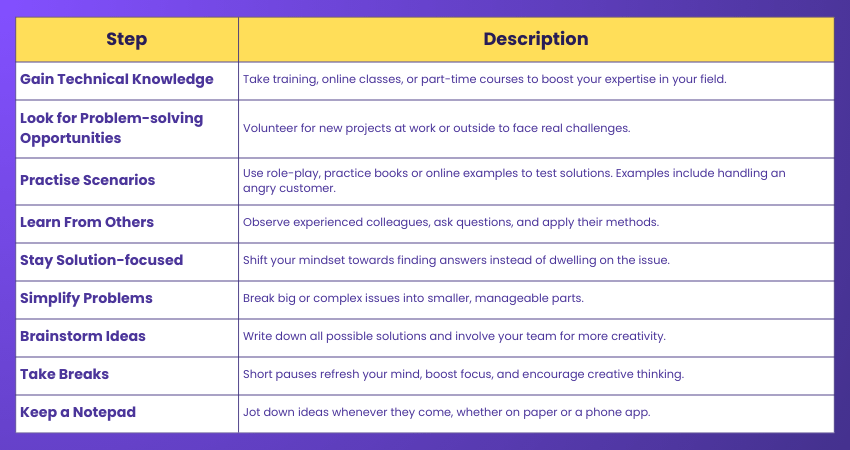
Cultivating Problem-solving Skills is a continuous process that allows individuals to enhance their ability to analyse and resolve challenges effectively. While some individuals may naturally possess these skills, these abilities can be developed and honed through deliberate practice and conscious effort.Here are some strategies on developing Problem-solving Skills:
Ways to highlight Problem-solving Skills
There are different ways to highlight your Problem-solving Skills, depending on the context and purpose. Here are some common ways to showcase your Skills in Problem-solving on your CV and cover letters:
Problem-solving Skills on Your CV
Your CV is a summary of your education, work experience, skills, and achievements. It is often the first impression that you make on a hiring manager, that is the game changer. So, it is important to make sure that it showcases your Problem-solving Skills effectively. Here are some tips to do that:
1) Use action verbs and specific examples to describe your Problem-solving Skills.
2) For example, instead of saying “solved problems”, you can say “resolved customer complaints”, “troubleshooted technical issues”, or “implemented new solutions”.
3) Quantify your achievements and results whenever possible.
4) For example, you can say “reduced costs by 15%”, “increased sales by 25%”, or “improved customer satisfaction by 10%”.
5) Highlight your Problem-solving Skills in different sections of your CV, such as your summary, skills, work experience, and education.
6) For example, you can mention your Problem-solving Skills in your summary statement, list them as one of your key skills
7) Provide examples of how you used them in your previous jobs or mention any relevant projects or courses that involved Problem-solving.
Problem-solving Skills for Cover Letters
Your cover letter is a document that accompanies your CV and explains why you are applying for a specific job and why you are a suitable candidate. It's an opportunity to spotlight your Problem-solving Skills in more detail and about the job requirements. Here are some tips to do that:
1) Research on the company and the job role to identify the main problems or challenges they face and expect you to solve.
2) For example, you can look at their website, social media, news articles, or job descriptions to learn more about their goals, values, needs, and expectations.
3) Explain how your Problem-solving Skills can help them address those problems or challenges.
4) For example, you can mention a specific problem you solved in a similar or relevant context, describe the steps you took to solve it, and highlight the outcome or impact you achieved.
5) Demonstrate your enthusiasm and interest in the job and the company.
6) For example, you can express your curiosity, creativity, or passion for Problem-solving and show your eagerness to learn, grow, and contribute to their success.
Our Management Training for New Managers is your fast track to Management mastery - Register now!
How Do I Say I Have Problem-solving Skills?
You can highlight Problem-solving Skills by explaining how you identify challenges, analyse them, and find effective solutions. Use phrases like “I can assess situations, think critically, and develop practical solutions”. Back it up with real examples in interviews or your CV.
What are Examples of Problem-solving in the Workplace?
Common examples include:
1) Resolving conflicts between team members
2) Handling customer complaints
3) Finding ways to reduce costs
4) Improving inefficient processes
5) Troubleshooting technical issues
Each situation shows your ability to stay calm, think logically and apply solutions that benefit the team or business.
Conclusion
The significance of Problem-solving Skills is too important to be ignored. They are crucial for navigating challenges and finding effective solutions. By developing these skills, individuals can approach problems with confidence and creativity and achieve successful outcomes in various areas of life.
Sharpen your strategy and elevate your leadership. Sign up for excellence with our comprehensive Management Courses now!
Frequently Asked Questions
What are Some Common Mistakes to Avoid in Problem-solving?

There are certain common mistakes that should be avoided while Problem-Solving. This includes – ignoring root causes, jumping to conclusions, neglecting follow ups, and avoiding further problems.
Can Problem-solving Skills be Developed, or are They Innate?
Yes, Problem-solving Skills can definitely be developed. While some people may have a natural ability for it, anyone can strengthen these skills through practice, learning and experience. Training, real-life challenges and feedback all help improve problem-solving over time.

William Brown


Senior Business Analyst and Strategic Advisor
William Brown is a senior business analyst with over 15 years of experience driving process improvement and strategic transformation in complex business environments. He specialises in analysing operations, gathering requirements and delivering insights that support effective decision making. William’s practical approach helps bridge the gap between business goals and technical solutions.
View Detail

 If you wish to make any changes to your course, please


