


 Top Rated Course

We may not have the course you’re looking for. If you enquire or give us a call on +30 2111995372 and speak to our training experts, we may still be able to help with your training requirements.
What is Data Science? Key Processes, Types, and Applications
Lily Turner 15 July 2026Data Science combines Math, statistics, programming, and domain knowledge to analyse structured and unstructured data and turn it into actionable insights. It helps predict trends, optimise processes, and solve complex problems through evidence-based analysis. It is used across industries such as healthcare, finance, technology, etc.

Training Outcomes Within Your Budget!
We ensure quality, budget-alignment, and timely delivery by our expert instructors.
Table of Contents
Data alone has no value; its insight is what makes it powerful. Every day, organisations collect vast amounts of information, yet without the right approach, this data remains unused and overwhelming. This is where Data Science comes in, transforming raw data into meaningful insights. But What is Data Science?
In this blog, you will explore What is Data Science, along with its key processes, tools, and core concepts that promote data-driven and informed decision-making. Let's dive in!
Table of Contents
1) What is Data Science?
2) Data Science Process
3) What Does a Data Scientist Do?
4) What are the Data Science Techniques?
5) Types of Data Science
6) What are the Benefits of Data Science for Business?
7) Applications of Data Science
8) Data Science Tools and Technologies
9) Challenges Faced by Data Scientists
10) Conclusion
What is Data Science?
Data Science is the study of data to find useful insights and make better decisions. It combines Maths, statistics, programming, Artificial Intelligence (AI), Machine Learning (ML), Computer Engineering and subject knowledge to study different types of data, including text, numbers, and images. The goal is to understand patterns and turn data into clear, meaningful insights.
In everyday use, Data Science helps businesses and organisations solve problems and plan for the future. It is used to predict trends, improve processes, and support smarter decisions for your business.
Why is Data Science Important?
The importance of Data Science includes:
a) Informed Decision-making: With this, organisations can make informed choices that drive growth, efficiency, and competitiveness by analysing historical and real-time data.
b) Predictive Power: Data Science's predictive modelling capabilities enable organisations to anticipate trends, customer behaviours, and market shifts. This facilitates proactive strategies, allowing businesses to stay ahead and capitalise on emerging opportunities.
c) Driving Innovation: Data Science fuels innovation by revealing hidden patterns and correlations within data. Innovators can identify unmet needs, develop new products, and enhance existing offerings based on data-driven insights.

The Data Science Lifecycle
Now that you have an idea about What is Data Science, let's get into the Data Science lifecycle. This lifecycle has five stages. Each of these has different tasks:
1) Capture: This is the first stage. It is about gathering raw data from various sources, like sensors or databases.
2) Maintain: In the second stage, the raw data is cleaned, stored, and organised. It is done so that it can be used later.
3) Process: Here in this stage, Data Scientists look for different patterns and trends in the prepared data. It is done to see how useful it can get for predictions.
4) Analyse: This stage involves digging into the data. This is done to make predictions and find proper insights using different analysis techniques.
5) Communicate: Finally, the findings are presented in an easy format. It includes charts, graphs, and reports to help with decision-making. These formats are easy to understand.
Data Science Process
The Data Science process is a systematic method to extracting insights from data, encompassing several key stages. It begins with problem definition, understanding business objectives, followed by data collection from various sources. The Data Scientist predominantly follows the OSEMN framework to solve the problem:
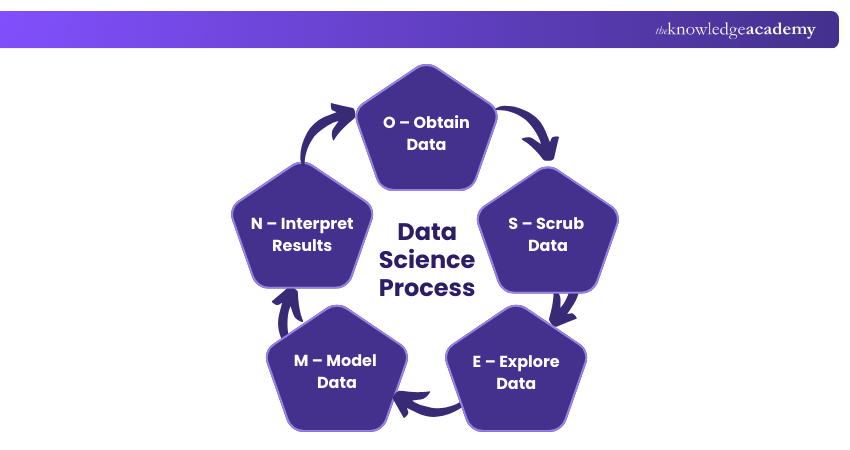
1) O – Obtain Data
The Data Scientist collects relevant data from various sources, such as internal or external databases, web servers, social media, or third-party vendors. The data can be existing or new, structured or unstructured, depending on the problem.
2) S – Scrub Data
The Data Scientist cleans and formats the data to make it ready for analysis. It involves dealing with missing data, data errors, and data outliers. Some examples of data scrubbing are:
a) Converting all date values to a consistent format.
b) Correcting spelling errors or extra spaces.
c) Removing commas from large numbers or fixing calculation errors.
3) E – Explore Data
The Data Scientist performs exploratory Data Analysis to understand the data and discover patterns or insights. It involves using descriptive statistics and data visualisation tools to summarise and display the data. The Data Scientist also identifies the relationships between the variables and the factors that influence the target variable.
4) M – Model Data
The Data Scientist applies Machine Learning algorithms and techniques to build predictive or prescriptive models based on the data. Machine Learning methods such as association, classification, and clustering are used to train the models on the data. The models are then evaluated against a test data set to measure their accuracy and performance. The models can be adjusted and optimised to improve the results.
5) N – Interpret Results
The Data Scientist communicates the results and recommendations to the business stakeholders using charts, graphs, and diagrams. The Data Scientist also provides data summaries and explanations to help the stakeholders understand and act on the results.
What Does a Data Scientist Do?
A Data Scientist works with large amounts of data to help organisations make better decisions. They collect data from different sources, clean and organise it, and ensure it is ready for analysis. Once the data is prepared, a Data Scientist analyses it to find patterns, trends, and useful insights.
They use statistical methods, programming, and Machine Learning techniques to make predictions or solve problems. Finally, they present their findings using charts, reports, or dashboards so that non-technical teams can easily understand and act on the results.
Upgrade your Skills with Data Science Courses. Sign-up Now!
What are the Data Science Techniques?
Let’s have a look at Data Science techniques:
1) Classification
These professionals use computing systems to follow the Data Science process. A major technique is classification. It involves sorting data into specific groups or categories. Computers are trained to recognise and categorise data using known data sets to build decision algorithms.
2) Regression
An alternative technique is regression. This technique finds relationships between somewhat unrelated data points.
These relationships are often represented as a graph or curve. They use mathematical formulas.
3) Clustering
Clustering groups closely related data together to find patterns and anomalies. Unlike sorting, clustering does not classify data into fixed categories. Instead, it groups data based on likely relationships, revealing new patterns.
Types of Data Science
Data Science can be applied in different ways depending on the goals of analysis. Each type focuses on a specific purpose. Here are the most common types of it:
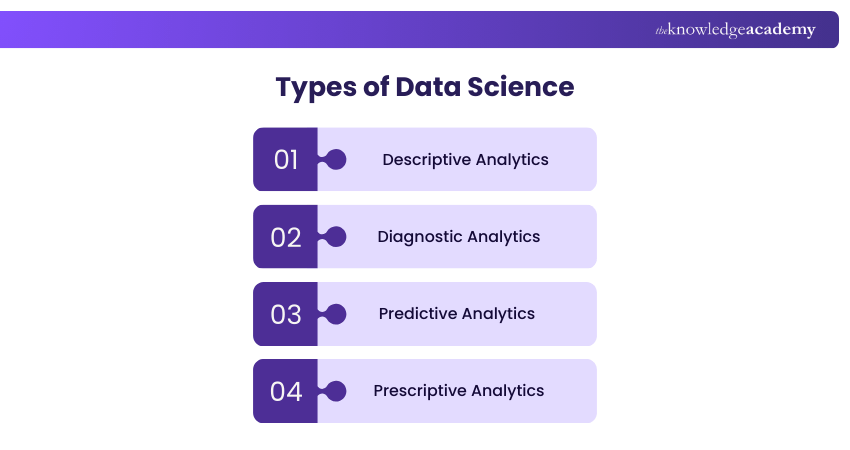
1) Descriptive Analytics
Descriptive analytics focuses on understanding the historical data of what has already happened. It summarises past data using simple reports, charts, and averages. This helps organisations see trends, patterns, and performance over a specific period.
2) Diagnostic Analytics
Diagnostic analytics goes a step further by mentioning why something happened. It analyses data to find the root cause of results or issues with correlation analysis and root cause analysis techniques. This type helps organisations understand the reasons behind successes or problems.
3) Predictive Analytics
Predictive analytics uses historical data to forecast or predict future outcomes. By identifying patterns and trends, it helps organisations predict what is likely to happen next with statistical models and ML techniques. It is commonly used for forecasting demands and risk assessment.
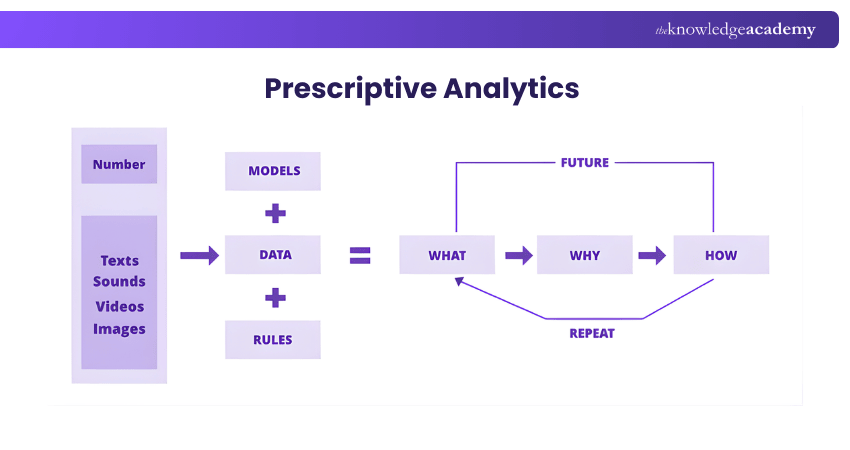
4) Prescriptive Analytics
Prescriptive analytics suggests actions to achieve the best possible outcome. It uses insights from data to recommend decisions or solutions for your problems. This type of analytics helps organisations choose the most effective course of action.
What are the Benefits of Data Science for Business?
Data Science Tools are transforming the way companies operate. Many businesses, regardless of size, require a robust Data Science strategy to drive growth and maintain a competitive edge. By leveraging Data Science Business Ideas, organisations can unlock innovative solutions and gain valuable insights to optimise their operations. Some key benefits include:
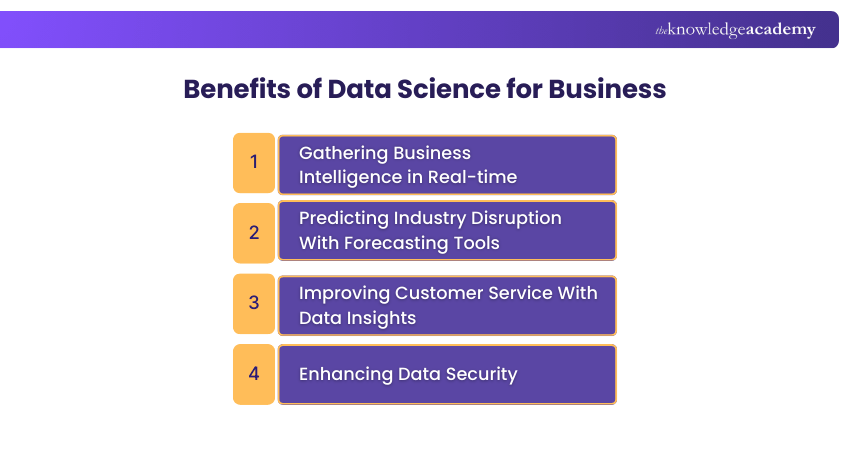
1) Gathering Business Intelligence in Real-time
1) Helps businesses monitor performance in real-time
2) Enables faster and more informed decision-making
3) Identifies trends and issues immediately
4) Supports quick response to market changes
5) Improves operational efficiency
2) Predicting Industry Disruption With Forecasting Tools
1) Anticipates market trends and future demand
2) Identifies potential risks and opportunities early
3) Supports strategic planning and long-term goals
4) Helps businesses stay competitive
5) Reduces uncertainty in decision-making
3) Improving Customer Service With Data Insights
1) Understands customer behaviour and preferences
2) Personalises products and services
3) Improves response times and service quality
4) Identifies common customer issues
5) Increases customer satisfaction and loyalty
4) Enhancing Data Security
1) Detects unusual activities and potential threats
2) Strengthens fraud prevention measures
3) Protects sensitive business and customer data
4) Supports compliance with data protection regulations
5) Reduces the risk of data breaches
Forecast trends and make data-driven decisions with our Predictive Analytics Course – Sign up soon!
Applications of Data Science
Data Science is the process of extracting insights and value from data using various methods and techniques. It has many applications in different domains and industries, such as:
1) Healthcare: Data Science helps healthcare companies to develop advanced medical devices and systems that can diagnose and treat diseases.
2) Gaming: Data Science enables Game Developers to create realistic and immersive games that enhance the gaming experience.
3) Image Recognition: Data Science allows computers to recognise and identify objects and patterns in images, which has many uses in security, surveillance, and entertainment.
4) Recommendation Systems: Data Science powers recommendation systems that suggest products and services based on the user’s preferences and behaviour. Examples of such systems are Netflix and Amazon.
5) Logistics: Data Science optimises logistics operations and eCommerce by finding the best routes and schedules for delivering goods and services.
6) Fraud Detection: Data Science detects and prevents fraud by analysing transactions and identifying anomalies and suspicious activities. Banks and financial institutions use Data Science for this purpose.
7) Internet Search: Data Science improves internet searches by providing relevant and accurate results for users' queries. Google and other search engines use Data Science algorithms for this purpose.
8) Speech Recognition: Data Science enables speech recognition, which is the technology that converts spoken language into text. Speech recognition has many applications, such as virtual assistants, voice-controlled devices, customer service systems, and transcription services.
9) Targeted Advertising: Data Science enhances targeted advertising by showing personalised ads based on the user’s interests and behaviour. Digital platforms use Data Science in Marketing for this purpose, allowing for more effective and tailored advertising strategies.
10) Airline Route Planning: Data Science improves airline route planning by predicting flight delays and finding the optimal routes and stops for flights. Data Science helps the airline industry to save costs and increase customer satisfaction.
11) Augmented Reality (AR): Data Science supports Augmented Reality, which overlays digital information and images in the real world. Augmented Reality has many applications, such as gaming, education, and tourism. Pokemon GO is a popular example of an augmented reality game that uses data from a previous app to locate Pokemon and gyms.
Data Science Tools and Technologies
Let's explore the necessary tools and technologies that enable Data Scientists to navigate the intricate landscape of Data Analysis and Modelling:
Python and R
Python and R are widely used programming languages under Natural Language Processing in Data Science. They help Data Scientists analyse data, perform statistical calculations, and build models. Their simplicity and large number of libraries make them suitable for handling complex data tasks.
SQL
SQL is used to store, manage, and retrieve data from databases. It allows Data Scientists to work with structured data efficiently and extract relevant information for analysis. SQL is essential when dealing with large datasets stored in relational databases.
Big Data Technologies
Big data technologies are used to process and manage very large volumes of data. They help handle data that is too large or complex for traditional tools. These technologies support faster data processing and better scalability.
Data Visualisation Tools
Data visualisation tools help present data in an easy-to-understand format. They use charts, graphs, and dashboards to communicate insights clearly. This makes it easier for decision-makers to understand results and take action.
Machine Learning Platforms
Machine Learning platforms support building and deploying predictive models. They help data scientists automate analysis and improve accuracy over time. These platforms are widely used for forecasting, pattern recognition, and decision support.
Challenges Faced by Data Scientists
Data Scientists encounter numerous challenges in their work, ranging from technical issues to collaboration hurdles. Below are some of the key challenges they face:
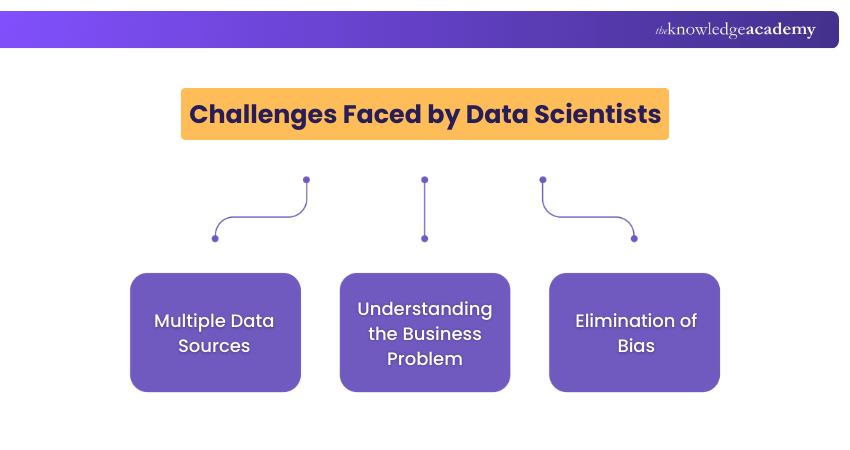
1) Multiple Data Sources:
Various applications and tools generate data in different formats. Data Scientists must clean and prepare this data to ensure consistency. This process can be both tedious and time-consuming.
2) Understanding the Business Problem:
Data Scientists need to collaborate with multiple stakeholders and Business Managers to define the problem that needs solving. This can be challenging in large companies with numerous teams, each with varying requirements.
3) Elimination of Bias:
Machine Learning tools are not wholly accurate, and some degree of uncertainty or bias may exist. The final step in Data Preprocessing is to split the data into Training Data groups, such as age or income bracket.
Conclusion
In conclusion, understanding What is Data Science is crucial for leveraging its potential to drive innovation and efficiency in any organisation. By mastering key processes, businesses can unlock valuable insights and stay ahead in a data-driven world. With Data Science, you can turn raw data into actionable strategies that propel your business forward.
Acquire the skills to analyse and visualise data like a pro – join our Python Data Science Course now
Frequently Asked Questions
What Kinds of Problems do Data Scientists Solve?

Data Scientists solve issues such as:
1) Contagion patterns
2) Loan risk mitigation
3) Resource allocation
4 ) Effectiveness of different online advertisement
What is the Difference Between Data Science, Artificial Intelligence, and Machine Learning?
Artificial Intelligence (AI) can make a computer act and think like a human. Whereas, Data Science is an AI subset. It deals with data methods, scientific analysis, and statistics. ML is again the subset of AI that educates computers through provided data to learn things.

Lily Turner


Senior AI/ML Engineer and Data Science Author
Lily Turner is a data science professional with over 10 years of experience in artificial intelligence, machine learning, and big data analytics. Her work bridges academic research and industry innovation, with a focus on solving real-world problems using data-driven approaches. Lily’s content empowers aspiring data scientists to build practical, scalable models using the latest tools and techniques.
View Detail

 If you wish to make any changes to your course, please


