


 Top Rated Course

We may not have the course you’re looking for. If you enquire or give us a call on +30 2111995372 and speak to our training experts, we may still be able to help with your training requirements.
Difference Between Supply Chain and Logistics: Easy Explanation
The Knowledge Academy 02 March 2026The supply chain covers the full process from sourcing materials to delivering products, while logistics focuses on moving and storing goods within it. Together, they ensure products reach customers efficiently and reliably. Understanding both functions helps organisations improve operations and reduce overall costs.

Training Outcomes Within Your Budget!
We ensure quality, budget-alignment, and timely delivery by our expert instructors.
Table of Contents
Smooth product flow is a must for businesses; nonetheless, a lot of them suffer when it comes to identifying the different roles in that process. Supply chain and logistics are two words that are frequently confused with one another, but each has its own specific function. The purpose of this article is to analyse the Difference Between Supply Chain and Logistics and to present the basic concepts you need to grasp.
Table of Contents
1) What is a Supply Chain?
2) What is Logistics?
3) Supply Chain vs Logistics: Key Differences
4) Types of Jobs in Supply Chain and Logistics
5) How do Supply Chain and Logistics Work Together?
6) What Industries Rely Heavily on Supply Chain and Logistics?
7) Conclusion
What is a Supply Chain?
A supply chain refers to the collective network of suppliers, manufacturers, distributors, and retailers who collaborate to convert raw materials into final products that reach the customers’ hands. This entire process covers all stages like sourcing, production, storage, transport, and final delivery.
The interconnected processes guarantee that the products transit effortlessly from the source to the consumer. Properly handled supply chains not only cut the expenses of the companies but also make them more efficient and helps them to have the products available all the time.
What is Logistics?
Logistics is the overall management of the movement, storage, and distribution of merchandise from their point of origin to the end-user through proper planning, execution and supervision. The objective is to get the product to the customer in the most efficient manner possible, that is, without delay and with minimal handling.
Warehousing, transport, inventory control, and order processing are all part of logistics. By employing efficient logistics practices, companies will be able to eliminate bottlenecks, optimise their expenses, and eventually win over customers with their prompt services.
Supply Chain vs Logistics: Key Differences
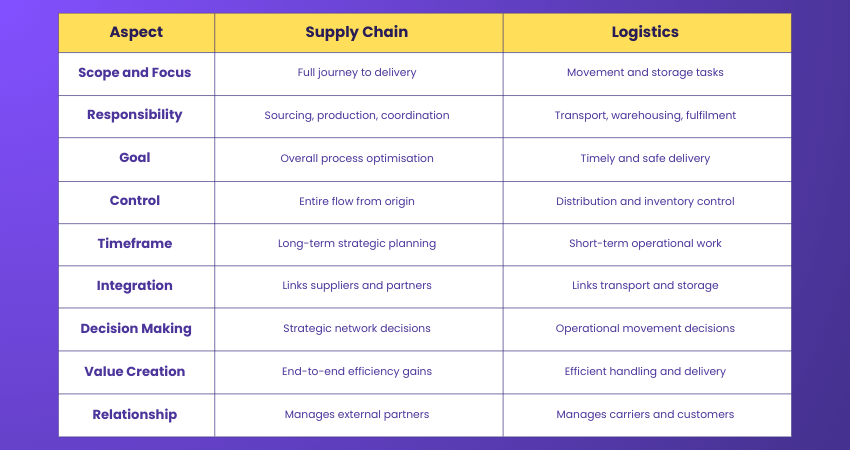
There are various differences that separate Logistics and Supply Chain from each other. Some of the major differences are discussed below:
1) Scope and Focus
In a supply chain, all steps are included, starting from the acquisition of raw materials till the final sale to the consumer, whereas logistics deals with the effective transportation and warehousing of products within that network.
2) Responsibility
Supply Chain manages the entire journey of a product from raw materials to the final product, including production and distribution. It makes sure all stages are well coordinated. On the other hand, Logistics handles the transportation, storage, and warehousing of goods. It focuses on moving products efficiently and managing inventory.
3) Goal
Supply Chain works to make the whole production process smooth, efficient, and cost-effective, meeting customer needs. Good Supply Chain management improves overall operations. In contrast, Logistics ensures goods are moved and stored efficiently, reducing transportation costs and managing inventory well. Effective Logistics ensures the timely and safe delivery of products.
4) Control
Supply chain management oversees the complete movement from raw materials to finished products, and logistics take care of the efficient transfer and distribution of those products.
5) Timeframe
Supply Chain involves long-term planning and strategy to ensure efficient production and delivery over extended periods. It aims for continuous improvement and optimisation. On the other hand, Logistics often deals with short-term, day-to-day operations like managing shipments, inventory, and transportation schedules. It ensures timely delivery and efficient handling of goods.
6) Integration
Supply Chain integrates various functions such as procurement, production, and distribution to create a seamless Supply Chain Management Process. It requires coordination across different departments and external partners. In contrast, Logistics integrates transportation and storage activities within the Supply Chain.
7) Decision Making
Supply Chain covers strategic decisions related to sourcing, production, and distribution networks. It focuses on long-term efficiency and cost-effectiveness. On the other hand, Logistics includes operational decisions such as routing, warehousing, and inventory management. It focuses on optimising day-to-day activities for timely and efficient delivery.
8) Value creation
Supply Chain creates value by optimising the entire production and delivery process, reducing costs, and improving customer satisfaction. It enhances overall business performance. In contrast, Logistics adds value by ensuring goods are delivered on time and in good condition, reducing transportation costs, and managing inventory effectively. It contributes to the efficiency of the Supply Chain.
9) Relationship
Supply Chain includes Logistics as part of its larger process. It connects various steps to ensure products move smoothly from start to finish. On the other hand, Logistics is a key part of the Supply Chain, dealing with transportation and storage. It helps the Supply Chain by managing the physical movement of goods.
Learn the types of products for importation with our Import Export Course – Join today!
Types of Jobs in Supply Chain and Logistics
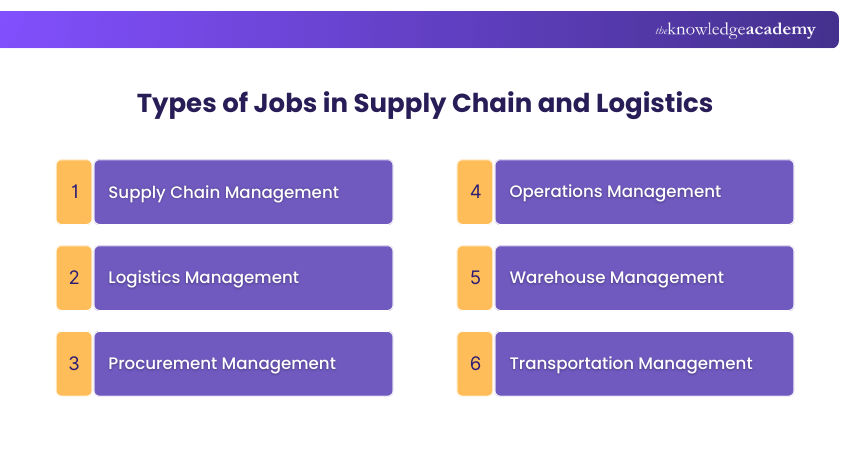
There are many career opportunities in Supply Chain and logistics, each crucial for the smooth and efficient movement of goods and services. Let's explore these roles:
1) Supply Chain Management
Supply Chain Management (SCM) involves the strategic coordination of a complex network that includes various stakeholders, such as distributors and transportation providers, all working together to deliver a finished product to the consumer.
Supply Chain Managers specialise in:
a) Demand planning: Aligning the supply chain with consumer demand.
b) Strategy development: Enhancing production and delivery efficiency while maintaining quality.
c) Relationship building: Forming and sustaining partnerships that benefit the company’s financial health.
2) Logistics Management
Logistics Management is focused on managing the movement of goods within the supply chain, which encompasses:
a) Developing business partnerships.
b) Contract negotiation.
c) Scheduling for transport logistics.
d) Keeping a robust network that includes suppliers, storage, and transport services.
Procurement Management
Procurement Management is the initial stage of the supply chain, ensuring that companies have consistent sources for their products. Responsibilities include:
a) Vendor selection based on cost-effectiveness, availability, and material quality.
b) Scheduling purchases to align with market demand and supply chain trends.
c) Cost analysis and optimisation.
3) Procurement Management
Procurement Management is the initial stage of the supply chain, ensuring that companies have consistent sources for their products. Responsibilities include:
a) Vendor selection based on cost-effectiveness, availability, and material quality.
b) Scheduling purchases to align with market demand and supply chain trends.
c) Cost analysis and optimisation.
4) Operations Management
Operations Management sits at the core of the supply chain, involving internal business management and, often, supply chain responsibilities. Key tasks involve:
a) Managing production, sales, and distribution.
b) Overseeing budget, cost, and profitability.
c) Balancing supply and demand.
d) Forecasting and staff management.
e) Operations managers may have varying degrees of supply chain involvement based on company size.
5) Warehouse Management
Warehouse Management is crucial for logistics and supply chain efficiency, ensuring timely and quality delivery without increasing costs. Warehouse Managers are responsible for:
a) Inventory and staff management.
b) Enhancing operational efficiency.
c) Coordinating workflows.
d) Collaborating with logistics teams.
6) Transportation Management
Transportation Management plays a vital role in logistics by coordinating the transportation of goods, especially in manufacturing sectors. Transportation Managers are tasked with:
a) Selecting optimal transportation methods.
b) Setting cost and delivery expectations.
c) Working with transportation service providers.
How do Supply Chain and Logistics Work Together?
The supply chain and logistics work together to move the products from suppliers to the consumers in a good way. The supply chain deals with the planning and procurement aspects; meanwhile, logistics is in charge of the physical movement and the availability of the goods. They both help each other, thus making the operations more fluent and customer service better.
Understand current trends and technologies with our Industry Training – Join today!
What Industries Rely Heavily on Supply Chain and Logistics?
Many sectors rely heavily on the successful and scaled-up operations of efficient supply chains and logistics systems. The most dependent ones, according to the latest statistics, are E-commerce and retail, manufacturing, automotive, pharmaceuticals, agriculture, and electronics.
a) E-commerce & Retail: Fast delivery and order fulfillment are fundamental for online stores and retailers, thus logistics are very important to meet customers' demands.
b) Manufacturing & Automotive: The sectors depend on a quick supply of raw materials and parts, and proper distribution networks to keep the production lines smooth.
c) Pharmaceuticals & Healthcare: The safe and regulated transfer and storage of drugs and medical supplies entirely rely on trustworthy logistics and supply-chain regulations.
d) Food, Agriculture & Perishables: For these industries, due to the very strict freshness and shelf-life requirements, they need strong supply-chain and cold-chain logistics to deal with storage, transport, and delivery.
e) Technology & Electronics: Consumer goods that are highly sensitive and very often time-critical, such as electronics, take advantage of perfect synchronisation in the supply chain, warehousing, and the entire global distribution
Conclusion
Grasping the Difference Between Supply chain and Logistics enables companies to increase their performance and delight their customers. If these two sectors cooperate perfectly, businesses can lower their expenses and guarantee product availability more often. Excellent collaboration establishes the basis for uninterrupted business and growth over time.
Learn essential logistics principles and strategies with our Logistics Management Training – Join today!
Frequently Asked Questions
What are the Biggest Challenges in Supply Chain Management?

The foremost challenge is inconsistency in demand as inaccurate forecasts can lead to situations wherein there is an overabundance of stock or empty shelves.
What Challenges Does Logistics Face Today?
One main difficulty of modern logistics is managing supply chain disturbances that can cause delays, shortages, and variables in costs.
What are the Other Resources and Offers Provided by The Knowledge Academy?
The Knowledge Academy takes global learning to new heights, offering over 3,000+ online courses across 490+ locations in 190+ countries. This expansive reach ensures accessibility and convenience for learners worldwide.
Alongside our diverse Online Course Catalogue, encompassing 17 major categories, we go the extra mile by providing a plethora of free educational Online Resources like Blogs, eBooks, Interview Questions and Videos. Tailoring learning experiences further, professionals can unlock greater value through a wide range of special discounts, seasonal deals, and Exclusive Offers.
What is The Knowledge Pass, and How Does it Work?
The Knowledge Academy’s Knowledge Pass, a prepaid voucher, adds another layer of flexibility, allowing course bookings over a 12-month period. Join us on a journey where education knows no bounds.
What are the Related Courses and Blogs Provided by The Knowledge Academy?
The Knowledge Academy offers various Industry Courses, including the Facilitation Skills Training, Product Management Training, and SCADA Training. These courses cater to different skill levels, providing comprehensive insights into Sourcing.
Our Business Skills Blogs cover a range of topics related to Supply Chain vs Logistics, offering valuable resources, best practices, and industry insights. Whether you are a beginner or looking to advance your Business skills, The Knowledge Academy's diverse courses and informative blogs have got you covered.

The Knowledge Academy


Global Training Provider
The Knowledge Academy is a world-leading provider of professional training courses, offering globally recognised qualifications across a wide range of subjects. With expert trainers, up-to-date course material, and flexible learning options, we aim to empower professionals and organisations to achieve their goals through continuous learning.

Upcoming Business Skills Resources Batches & Dates
Date
 Supply Chain Management Training
Supply Chain Management Training
Fri 31st Jul 2026
Supply Chain Management Training
Fri 23rd Oct 2026

 If you wish to make any changes to your course, please


