


 Top Rated Course

We may not have the course you’re looking for. If you enquire or give us a call on +44 1344 203 999 and speak to our training experts, we may still be able to help with your training requirements.
What Is Magento? Features, Uses, and How It Works
Lily Turner 16 July 2026Want to know how you can leverage Magento for your business? This E-commerce Platform offers a flexible shopping cart system, extensive customisation options, and powerful product management tools. This blog is a detailed exploration on What is Magento and illuminates how it can expand your business beyond the brick-and-mortar format.

Training Outcomes Within Your Budget!
We ensure quality, budget-alignment, and timely delivery by our expert instructors.
Table of Contents
Nothing spotlights the convenience factor of the modern online experience quite like E-commerce, doesn’t it? It’s a world where convenience and innovation converge, where every shop is just a click away, and whose endless aisles can be accessed from the comfort of your home. In this landscape, Magento has been serving as a powerful gateway for businesses to reach global audiences and create captivating shopping experiences. If you are a business owner, it’s important that you learn What is Magento.
Acquired by Adobe Inc. in 2018, Magento is a dynamic E-commerce Platform built on open-source technology. It offers online merchants a versatile shopping cart system and complete control over their store's content, appearance, and functionality. This blog offers insight into What is Magento and what makes it a powerful solution for any online business.
Table of Contents
1) What is Magento?
2) What is Magento 2?
3) Different Types of Magento
4) Key Features of Magento
5) Why Use Magento?
6) Magento Pricing
7) Advantages of Utilising Magento
8) Disadvantages of Magento
9) Difference Between Magento 1 and Magento 2
10) Conclusion
What is Magento?
Magento is an open-source E-commerce Platform written in PHP and its source code is distributed under the Open Software License. This powerful platform allows businesses to easily build and manage online stores, offering robust features, scalability, and customisable templates to enhance online sales for businesses of all sizes.
Magento supports everything from small boutiques to large enterprises, offering extensive customisation through a wide range of themes and plugins. In essence, Magento transforms digital storefronts into dynamic, customer-centric marketplaces.

What is Magento 2?
Magento 2 is an extended version of the previously described Magento platform that is intended for the development of various types of online stores. It provides a great range of tools for creating unique and fully responsive websites that allow businesses to create an effective online shop and guarantee customers a pleasant and efficient shopping experience.
Despite it being an upgraded version of Magento 1, Magento offers even better performance, and security features and has a redesigned interface.
They include adaptability of the layout, programmable products, multi-language interface, and high analytics. It also links smoothly with other applications, which makes it one of the best software for small, medium, and large companies.
Different Types of Magento
As an E-commerce solution, Magento offers various versions for merchants to choose from. Below we explore the four main versions of Magento that bring their own distinct functionalities to elevate the E-commerce landscape:
1) Magento Open Source
Magento Open Source is the free, community-driven edition, ideal for small businesses. It comes packed with essential tools and capabilities, with the flexibility to add more integrations or extensions as needed. If the merchants possess coding skills, they can create custom solutions, or a developer can be hired for assistance. Out of the box, this open-source platform includes:

a) Product browsing
b) Site search
c) Instant purchase
d) Integrated checkout, payment, and shipping
e) Mobile commerce
f) Global selling catalogue management
g) Promotion and pricing
h) Customer accounts
2) Magento Commerce
Magento Commerce (now known as Adobe Commerce) is the premium, enterprise-level E-Commerce Platform. Built on the same core as Magento Open Source, it provides enhanced functionalities not found in the free version. it includes advanced capabilities such as:
a) B2B features like bespoke catalogues, quotations, and control over buyer roles and rights
b) Product recommendations
c) Customer segmentation
d) Customer loyalty tools, including easy-to-redeem coupons
e) Hosting, content staging, and preview
f) BI dashboard with visualisation and a custom report builder
g) Live chat
h) Advanced marketing tools
i) Visual merchandising
3) Magento Order Management
The Magento Order Management System (OMS) provides a flexible, affordable solution for managing and fulfilling inventory from any sales channel. OMS enhances customer experience, boosts sales, reduces costs, and speeds up time to market.
The capabilities of OMS include:
a) Global visibility and management of all inventory
b) Easier and more responsive customer service
c) Ability to ship to and from anywhere
d) Better customer experience and loyalty
e) Real-time inventory tracking
Stand out in the E-commerce landscape with our Magento Course – Sign up now!
4) Magento Commerce Cloud
Magento Commerce Cloud is a robust PaaS (Platform-as-a-Service) solution that combines Magento Commerce's unmatched features and runs on Amazon Web Services. Magento Commerce Cloud supports a set of additional features that elevates it in comparison to Magento Commerce and Open Source editions:
a) Customisable Environment
b) High Scalability
c) Rapid Development
d) Continuous Deployment
e) Enhanced Security
Key Features of Magento
The following are the key features of Magento:
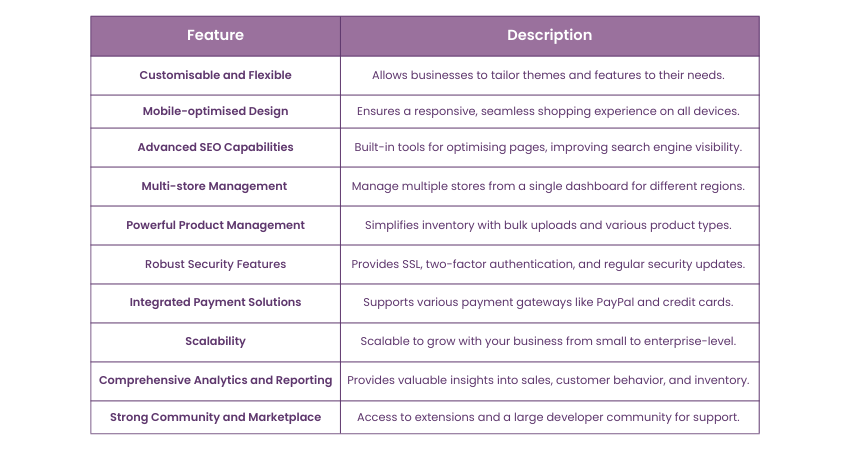
a) Customisable and Flexible: The degree of flexibility is high offering business capabilities to address specific needs of web-based stores. In review, Magento offers the ability to create unique themes and to work with specialized functions needed to achieve exactly what a brand envisions for the store.
b) Mobile-optimised Design: Given the growing popularity of mobile commerce, Magento also makes your store mobile first and mobile friendly. It has friendly themes suitable for both desktops, tablets, and smartphones, making buying experiences on the site a seamless affair.
c) Advanced SEO Capabilities: Magento comes equipped with integrated SEO tools since business owners can customize settings including product page, URL, and meta tags. This helps in enhancing the websites ranking on the search engines thus increasing the number of visits from the word-of-mouth traffic thus increasing sales.
d) Multi-Store Management: Magento is designed in such a way that it enables businesses to run multiple stores from a central point. It is possible to host various websites for various regions, language or money type, which help in reaching the world market.
e) Powerful Product Management: Magento makes Inventory Management easy through tool such as multiple product upload, configurable products and additional product attributes. It covers all types of products, namely: simple, configurable, bundled, and virtual products as well.
Why Use Magento?
Magento is a well-known platform for building e-stores that boasts extensive functionality in association with the great freedom of customisation. Due to its capability in meeting specific necessities in client companies, from design templates and customisable product features to complex integrated features, businesses of all sizes can take advantage of using it.
Optimised SEO tools help boost website traffic, while responsive designs ensure a mobile-friendly experience. The difference between Magento and WordPress lies in their scalability—Magento offers a robust scalability feature, allowing businesses to expand without compromising store performance, making it an ideal choice for growing enterprises.
Furthermore, Magento provides e-business functionality such as multi-stores, multiple payment options, and greater inventory control. It is extremely safe and has measures such as using a pin and password besides the frequent updates to ensure your material is secure. Built on a strong developer community, backed up with numerous extensions and equipped with rich analytics tools. The growing demand for skilled developers has also led to an increase in Magento Developer Salary.
Magento Pricing
Magento pricing plans encompass the Open Source and Adobe Commerce versions. Here are some points to consider regarding the pricing:
a) For the Open Source, you’ll need to pay separately for general website upkeep, backups, web hosting, your domain name, and any customisation.
b) The open-source product doesn’t include Payment Card Industry compliance, so payment must be made separately for that as well.
c) Web hosting will cost £11.59 to £30.93 per month.
d) Choosing and gaining control over the domain name will cost £7.73 to £15.47 per year.
e) SSL certificate price ranges between £39 to £464 per year.
f) Hiring a web developer involves hourly cost based on expertise of developer.
g) For transaction fees you must factor in 2% to 4% per transaction for payment platforms and credit card processing fees.
h) Choosing a theme will cost £13 to £309 for store theme and £3867 or more for customised theme.
i) The cost of extensions and add-ons range from free to £1,547 (in Adobe Commerce store).
Looking to expand your business presence in the Mobile App space? Sign up for our Mobile App Development Course now!
Advantages of Utilising Magento
As one of the most well-touted and widely used E-commerce systems, Magento comes packed with benefits. Ranging from content management to intelligent search, these benefits are listed below:
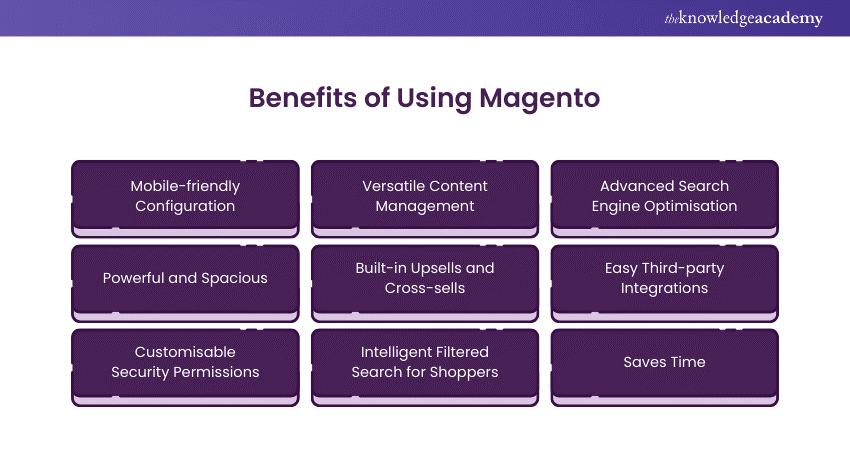
1) Mobile-Friendly Configuration: Magento shopping carts are responsively developed and ensures seamless viewing on smartphones, tablets, and other mobile devices, catering to the growing trend of mobile shopping.
2) Versatile Content Management: The visual-based and intuitive page editor enables business owners to build and customise offerings quickly. The WYSIWYG content management interface is perfect for those unfamiliar with coding, as it enables easy manipulation of basic shopping cart functions.
3) Advanced Search Engine Optimisation: Magento increases organic traffic through its SEO-friendly design, improving product visibility on search engines like Bing and Google. Additionally, it supports custom SEO implementations for advanced users.
4) Powerful and Spacious: Magento offers ample space for future growth with its Capability of supporting up to 500,000 products and handling over 80,000 orders per hour. However, its size and complexity require special hosting for optimal performance, so prepare for additional hosting expenses.
5) Built-in Upsells and Cross-sells: Magento makes it easy to add prompts for related options on product and checkout pages. This enhances the user experience (UX) and boost sales by presenting relevant accessories and similar products.
6) Easy Third-party Integrations: You can Integrate your e-commerce site with Ebay, PayPal, QuickBooks, Google Shopping, and more. Magento also supports adding Google Analytics and other third-party tools for better data analysis.
7) Customisable Security Permissions: You can manage internal access and ensure site safety with customisable security permissions. Standard features include PCI Data Security, CAPTCHA-equipped login screens, and a secondary password prompt for extra protection.
8) Intelligent Filtered Search for Shoppers: Magento improves user experience (UX) with dynamic search features that filter products based on diverse parameters. These parameters include a search terms Cloud, product reviews, product tag filters, recently compared and viewed products, and auto-suggested search terms.
9) Saves Time: As an open-source platform, Magento has a broad library of custom extensions developed by the global Magento community. This enables you to use and share tools with other users, thus reducing the need to build from scratch.
Expand your Web Development skills with our Web Application Testing with PHPUnit Framework Course – Sign up now!
Disadvantages of Magento
While Magento offers a wide range of benefits, this platform is not without its drawbacks. Here's a list of some common drawbacks of Magento:
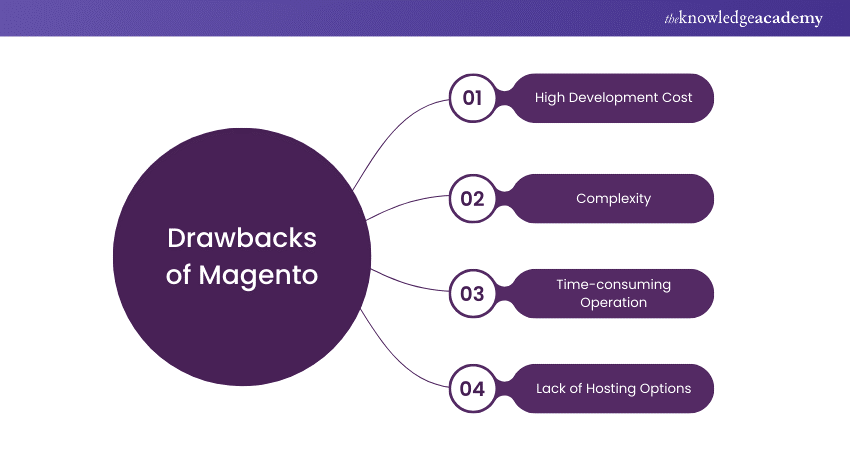
a) High Development Cost: Magento is an expensive eCommerce solution compared to other platforms. Even with Magento Open Source, businesses must set aside significant budget for custom development, maintenance, integrations, support, and extensions.
For further services, there are licensing costs to consider for Magento Commerce and Commerce Cloud. The additional expense for further customisation and maintenance makes Magento burdensome for those with limited resources.
b) Complexity: Magento's high flexibility and customisation come with complexity as well, containing over 20,000 files and 200 database tables. This can be confusing even for skilled developers. This requires a steep learning curve and additional development resources, making it unsuitable for beginners lacking technical skills.
c) Time-Consuming Operation: Magento’s layered architecture and high flexibility make its operation more time-consuming compared to other platforms. Setting up, customising, and integrating with third-party software requires significant effort.
d) Lack of Hosting: Cheap hosting providers are not a good option for Magento as it will lead to downtime and performance issues. Robust hosting solutions like VPS, Cloud, or dedicated servers are needed to handle its large database This adds to the high cost with considerations for hosting providers, domain registration, and SSL Security Certificates.
Difference Between Magento 1 and Magento 2
Magento was upgraded to version 2.0 in 2015 and then in 2018, Magento 2 was developed. Let’s explore the differences between these two versions:
1) Architecture and Performance: Magento 2 features a more modern architecture than Magento 1, offering improved performance, including better scalability and faster page load times. The use of technologies like PHP 7, NGINX, and Varnish caching enhances speed and efficiency.
2) Admin Interface: Magento 2 has a better intuitive and user-friendly admin interface compared to Magento 1. This makes it easier for store owners to manage products, orders, and customer data, even with limited technical knowledge.
3) Security: Magento 2 offers enhanced security features, including improved password management and stronger data encryption. Regular security patches ensure that stores remain protected against vulnerabilities.
4) Checkout Process: The checkout process in Magento 2 is streamlined and simplified, reducing the steps needed to complete a purchase. This leads to a greater user experience (UX) and higher conversion rates.
5) Extensions and Integrations: Even though Magento 1 had a strong ecosystem of extensions, Magento 2’s improved architecture enables more efficient and reliable integrations with third-party services and extensions. Magento 2 also supports modern APIs for easier integration with external systems.
6) Mobile Responsiveness: Magento 2 provides improved mobile responsiveness and a better mobile shopping experience compared to Magento 1. This is crucial as more consumers shop using mobile devices.
7) SEO and Marketing Tools: Magento 2 provides advanced SEO and marketing tools to aid businesses improve their search engine visibility and gain more traction. Features such as improved URL structures, rich snippets and better meta tag management are included.
8) Community and Support: Magento 2 benefits from a larger and more active community as it is the current supported version, new features, receiving regular updates and security patches. On the other hand, Magento 1 is no longer officially supported, which may pose security risks.
Conclusion
Magento is a versatile e-commerce platform and ideal for businesses of all sizes. By leveraging Magento's robust capabilities, businesses can create dynamic, scalable online stores that cater to a global online market. We hope this blog provides a strong foundation for your online venture and enhances your ecommerce success.
Looking for guidance regarding App Development? Sign up for our Full-Stack App Development Training With Meteor Course now!
Frequently Asked Questions
What are the Factors that Make Magento Website Slow?

Magento websites may degrade because of issues such as having overloaded code, huge or numerous images, improper servers, and old extensions. Other causes are excessive numbers of HTTP requests, no caching, bad indexing of the database, and use of shared host instead of dedicated hosting.
What is the Best Magento Extension for SEO?
Good Magento extensions for SEO to consider are BSS Commerce Magento 2 SEO Extension, Magento 2 SEO Extension by Mageplaza, and Magefan’s Magento 2 SEO Suite Ultimate Extension

Lily Turner


Senior AI/ML Engineer and Data Science Author
Lily Turner is a data science professional with over 10 years of experience in artificial intelligence, machine learning, and big data analytics. Her work bridges academic research and industry innovation, with a focus on solving real-world problems using data-driven approaches. Lily’s content empowers aspiring data scientists to build practical, scalable models using the latest tools and techniques.
View Detail

 If you wish to make any changes to your course, please


