


 Top Rated Course


We may not have the course you’re looking for. If you enquire or give us a call on +44 1344 203 999 and speak to our training experts, we may still be able to help with your training requirements.
Top 16 Data Mining Techniques for Extracting Valuable Insights
Lily Turner 24 February 2026Data Mining Techniques include classification, clustering, regression, association rule mining, decision trees, neural networks, and anomaly detection. These methods help in identifying patterns, predicting trends, and making data-driven decisions across various industries like marketing, finance, and healthcare.

Training Outcomes Within Your Budget!
We ensure quality, budget-alignment, and timely delivery by our expert instructors.
Table of Contents

Let’s assume that you run an online store where some customers buy regularly while others leave without a purchase. What if you could predict their next move? That’s the power of Data Mining Techniques, turning scattered data into meaningful insights.
From clustering and decision trees to sentiment analysis and anomaly detection, these techniques help organisations enhance customer experiences and even prevent risks. In this blog, we’ll explore 16 Data Mining Techniques that can transform the way you interpret data. Let’s get started!
Table of Contents
1) What is Data Mining and Its Importance?
2) Data Mining Techniques
3) Applications of Data Mining
4) Challenges in Data Mining
5) Future Trends of Data Mining
6) What are the Major Mining Technologies?
7) Is Excel a Data Mining Tool?
8) Conclusion
What is Data Mining and its Importance?
Data Mining involves analysing large datasets to discover patterns, correlations, trends, and valuable insights. This process uses techniques like classification, clustering, association rule mining, and anomaly detection to convert raw data into actionable knowledge.
By leveraging statistical methods, machine learning, and artificial intelligence, Data Mining aids organisations in making data-driven decisions.
Importance of Data Mining
Data Mining is vital across various industries for several reasons:
1) Enhanced Decision-making: Facilitates informed strategic decisions based on data insights.
2) Fraud Detection: Identifies unusual patterns in financial transactions to prevent fraud.
3) Personalisation & Marketing: Enables targeted marketing by analysing customer behaviour and preferences.
4) Healthcare Advancements: Assists in disease prediction, drug discovery, and patient care improvements.
5) Operational Efficiency: Optimises supply chain management, inventory control, and resource allocation.

Data Mining Techniques
Let us explore the key Data Mining Techniques, each contributing to a nuanced understanding of patterns, trends, and relationships within data.
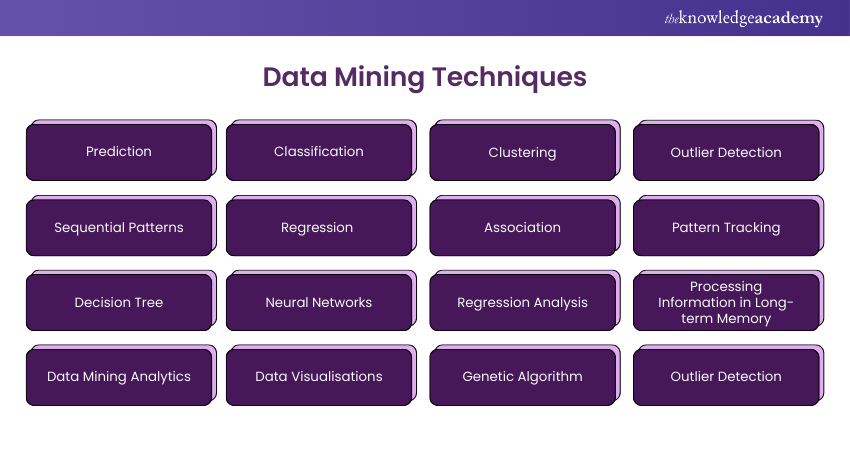
1) Prediction
Prediction in Data Mining entails using historical data to forecast future trends. Applied across various domains, such as finance and weather forecasting, statistical algorithms analyse past patterns to predict outcomes. For instance, predicting stock prices in finance involves analysing historical market trends to anticipate future fluctuations.
Features:
a) Time series analysis
b) Trend identification
c) Regression models
d) Forecast accuracy metrics
e) Scenario analysis
2) Classification
Classification categorises data into predefined classes, a fundamental aspect of machine learning. Models are trained to assign new data points to these categories, making them invaluable for applications like spam detection. The model can accurately classify new data as spam or non-spam by discerning patterns based on previously labelled examples.
Features:
a) Model training
b) Feature selection
c) Decision boundaries
d) Confusion matrix
e) Precision-recall analysis
3) Clustering
Clustering involves grouping similar data points based on inherent patterns. It aids in uncovering structures or relationships within a dataset that might not be immediately apparent. In marketing, clustering can identify distinct customer segments with similar purchasing behaviours, enabling targeted strategies for each group.
Features:
a) Similarity metrics
b) Centroid-based clustering
c) Density-based clustering
d) Hierarchical clustering
e) Cluster validation measures
4) Outlier Detection
Outlier detection is vital for identifying anomalies or outliers within a dataset. In fraud detection, this technique helps pinpoint unusual transactions that deviate significantly from typical patterns, facilitating early detection and prevention.
Features:
a) Z-score analysis
b) Distance-based methods
c) Density-based methods
d) Isolation forests
e) Novelty detection
Uncover valuable insights from complex datasets with our Data Mining Training. Join today!
5) Sequential Patterns
Sequential patterns focus on identifying trends or patterns in a specific sequence. Analysing customer purchase sequences in retail helps understand buying behaviour and optimise product placement or promotions based on the observed order and timing of purchases.
Features:
a) Sequence mining algorithms
b) Temporal pattern recognition
c) Pattern growth methods
d) Sequential rule visualisation
e) Time series pattern analysis
6) Regression
Regression analysis assesses the relationship between variables, predicting the value of one variable based on others. In healthcare, regression can predict patient outcomes based on various medical parameters, aiding in treatment planning and resource allocation.
Features:
a) Linear regression models
b) Multiple regression
c) Polynomial regression
d) Residual analysis
e) Regression diagnostics
7) Association
Association rule mining identifies relationships or associations between variables. Applied in market basket analysis, it reveals patterns such as products frequently purchased together. Retailers leverage this information for strategic product placement and marketing.
Features:
a) Support and confidence metrics
b) Apriori algorithm
c) FP-growth algorithm
d) Association rule visualisation
e) Rule pruning techniques
Harness the power of data to foresee future trends and outcomes with our comprehensive Predictive Analytics Course – sign up now!
8) Pattern Tracking
Pattern tracking monitors changes or trends over time. In climate analysis, for instance, tracking weather patterns helps predict long-term climate changes. In business, it aids in sales forecasting by identifying evolving consumer trends.
Features:
a) Trend analysis methods
b) Change point detection
c) Seasonal decomposition
d) Time series forecasting
e) Adaptive learning models
Elevate your text mining skills with our specialised Text Mining Training and unlock the insights hidden within textual data.
9) Decision Tree
Decision trees visually represent decision-making processes. Effective for classification tasks, they break down complex decisions into simpler ones. In customer service, a decision tree can guide support agents through troubleshooting steps and streamline issue resolution.
Features:
a) Tree-splitting criteria
b) Pruning techniques
c) Information gain
d) Gini index
e) Decision tree visualisation
10) Neural Networks
Neural networks simulate the human brain's functioning to recognise patterns. Widely used in image and speech recognition, they excel in tasks requiring learning from experience. In healthcare, neural networks can analyse medical images for disease diagnosis.
Features:
a) Layers and neuron activation
b) Backpropagation algorithm
c) Activation functions
d) Deep learning and Data Mining Architectures
e) Transfer learning
11) Regression Analysis
Regression Analysis delves into the relationship between variables, aiding in pattern identification and predictions. In finance, regression can model the impact of interest rates on investment returns, guiding investment decisions. With Regression Analysis in Excel, these models become more manageable, allowing you to perform complex calculations quickly and accurately.
Features:
a) Residual analysis
b) Coefficient interpretation
c) Variable transformation
d) Heteroscedasticity testing
e) Model selection techniques
12) Processing Information in Long-term Memory
Processing information in long-term memory involves storing and retrieving information for future use. Data Mining contributes to understanding how historical data shapes current patterns, providing context for decision-making. For instance, educational analytics helps assess the long-term impact of teaching methods on student performance over successive academic years.
Unlock insights with our Text Mining Guide!
Features:
a) Memory storage mechanisms
b) Retrieval algorithms
c) Forgetting curve analysis
d) Memory consolidation processes
e) Context-dependent memory retrieval
13) Data Mining Analytics
At the core of Data Mining Analytics are statistical techniques that support various analytical models. These models produce customised numerical outputs to fulfil specific business objectives. From neural networks to Machine Learning (ML), statistical principles drive these techniques, shaping the evolving landscape of Artificial Intelligence (AI).
Features:
a) Uses statistics for modelling
b) Generates tailored numerical outputs
c) Includes neural networks and Machine Learning (ML)
d) Advances in Artificial Intelligence (AI)
14) Data Visualisations
Data Visualisations are integral to data mining, providing insights through sensory perception. Modern visualisations, characterised by vibrant colours, excel in handling real-time streaming data. Dashboards, with varied metrics and visuals, reveal insights from data mining by vividly illustrating trends and patterns beyond numerical outputs.
Features:
a) Provides insights through senses
b) Handles real-time data with visuals
c) Uses vibrant colours for clarity
d) Highlights trends and patterns on dashboards
Boost your data analysis skills to new heights with extensive Decision Tree Modeling Using R Training- sign up now!
15) Genetic Algorithm
Genetic Algorithms (GAs) are inspired by natural evolution and are utilised for optimisation problems in Data Mining. These algorithms generate multiple potential solutions, evaluate them, and evolve them over generations using techniques such as selection, crossover, and mutation. GAs are effective in feature selection, classification, clustering, and rule mining.
Features:
a) Population-based Search
b) Selection Process
c) Crossover & Mutation
d) Global Optimisation
e) Parallel Processing
16) Outlier Detection
Outlier Detection identifies data points that significantly deviate from the rest of the dataset. It is crucial for detecting anomalies, fraud, and data errors. Common techniques include statistical methods (e.g., Z-score), clustering-based approaches (e.g., DBSCAN), and Machine Learning-based methods (e.g., Isolation Forest). Outlier detection is widely used in fraud detection, network security, and healthcare.
Features:
a) Identifies Anomalies
b) Multiple Detection Methods
c) Data Integrity Check
d) Scalability
e) Improves Accuracy
Applications of Data Mining
Data Mining is widely used across industries to extract valuable insights from large datasets, optimise processes, and enhance decision-making. Below is a detailed explanation of how it is applied in different sectors:
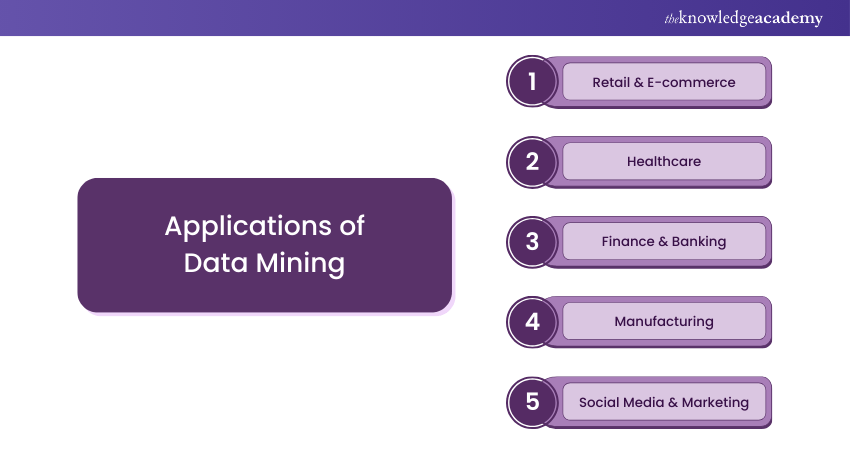
a) Retail & E-commerce:
Retailers and online stores use Data Mining to analyse customer behaviour, purchase patterns, and product preferences. By applying recommendation algorithms, they can suggest personalised products to customers, increasing sales and engagement.
b) Healthcare:
In healthcare, Data Mining helps diagnose diseases, predict patient outcomes, and identify risk factors based on historical data. It enables early disease detection and personalised treatment plans by analysing electronic health records (EHRs).
c) Finance & Banking:
Financial institutions leverage Data Mining to detect fraudulent transactions, assess credit risks, and predict stock market trends. It helps banks and insurance companies identify suspicious activities and improve financial security.
d) Manufacturing:
Manufacturers apply Data Mining to optimise production processes, reduce waste, and predict equipment failures. Predictive maintenance powered by data analysis minimises downtime and enhances operational efficiency.
e) Social Media & Marketing:
Social Media platforms and marketers utilise Data Mining to analyse user sentiments, track engagement, and deliver targeted advertisements. Customer segmentation helps companies create personalised campaigns to boost conversions.
Challenges in Data Mining
Despite its advantages, Data Mining encounters several obstacles:
a) Data Quality Issues: Incomplete, inconsistent, or noisy data can result in inaccurate insights.
b) Scalability: Managing massive datasets with high-dimensional features is complex.
c) Privacy & Security: Extracting patterns from sensitive data raises ethical concerns.
d) Interpretability: Understanding and explaining complex models remains challenging.
e) Computational Complexity: Some algorithms demand significant resources and time.
Future Trends of Data Mining
Data Mining is advancing with new trends that enhance its capabilities:
a) AI-Driven Data Mining: Integrating AI and deep learning for more precise predictions.
b) Automated Data Mining: Utilising AI-powered tools to minimise human intervention in data processing.
c) Big Data Integration: Efficiently managing vast amounts of data with cloud computing.
d) Real-time Data Mining: Processing and analysing data streams for immediate insights.
e) Ethical & Explainable AI: Creating transparent and responsible mining methods to address privacy concerns.
What are the Major Mining Technologies?
Key mining technologies encompass Machine Learning, Artificial Intelligence, Big Data Analytics, Neural Networks, Natural Language Processing (NLP), Cloud Computing, and Blockchain. These technologies significantly enhance data extraction, pattern recognition, and predictive analytics.
Is Excel a Data Mining Tool?
Yes, Excel can be utilised for basic Data Mining through features such as PivotTables, Solver, Data Analysis ToolPak, and Power Query. It aids in trend analysis, regression, clustering, and visualisation. However, it lacks the advanced AI-driven capabilities found in specialised Data Mining tools.
Conclusion
Data Mining Techniques are not just tools—they're the key to unlocking insights hidden within vast datasets. These techniques empower organisations to transform raw data into strategic gold, driving innovation, efficiency, and smarter decision-making. Harnessing the power of data mining allows us to predict trends, uncover hidden patterns, and shape a smarter, more connected future.
Unlock the power of data with our comprehensive Data Science Courses and embark on a rewarding journey!
Frequently Asked Questions
What is the Most Common Form of Data Mining?

The most common form of data mining is classification, which involves categorising data into predefined classes. It is widely used in various applications such as spam detection, fraud detection, and customer segmentation to make informed decisions.
What are the Seven Steps in Data Mining?
Here the following are the seven steps of Data Mining:
a) Data Cleaning
b) Data Integration
c) Data Selection
d) Data Transformation
e) Data Mining
f) Pattern Evaluation
g) Knowledge Representation
What are the other resources and offers provided by The Knowledge Academy?
The Knowledge Academy takes global learning to new heights, offering over 3,000+ online courses across 490+ locations in 190+ countries. This expansive reach ensures accessibility and convenience for learners worldwide.
Alongside our diverse Online Course Catalogue, encompassing 17 major categories, we go the extra mile by providing a plethora of free educational Online Resources like Blogs, eBooks, Interview Questions and Videos. Tailoring learning experiences further, professionals can unlock greater value through a wide range of special discounts, seasonal deals, and Exclusive Offers.
What is Knowledge Pass, and how does it work?
The Knowledge Academy’s Knowledge Pass, a prepaid voucher, adds another layer of flexibility, allowing course bookings over a 12-month period. Join us on a journey where education knows no bounds.
What are the Related Courses and Blogs Provided by The Knowledge Academy?
The Knowledge Academy offers various Data Science Courses, including Data Mining Training, Text Mining Training, Python Data Science Course and Probability and Statistics for Data Science Training. These courses cater to different skill levels, providing comprehensive insights into Top 12 Data Mining Tools.
Our Data, Analytics & AI Blogs cover a range of topics related to Data Mining, offering valuable resources, best practices, and industry insights. Whether you are a beginner or looking to advance your Data Science skills, The Knowledge Academy's diverse courses and informative blogs have got you covered.

Lily Turner


Senior AI/ML Engineer and Data Science Author
Lily Turner is a data science professional with over 10 years of experience in artificial intelligence, machine learning, and big data analytics. Her work bridges academic research and industry innovation, with a focus on solving real-world problems using data-driven approaches. Lily’s content empowers aspiring data scientists to build practical, scalable models using the latest tools and techniques.
View Detail

 If you wish to make any changes to your course, please


