


 Top Rated Course

We may not have the course you’re looking for. If you enquire or give us a call on +44 1344 203 999 and speak to our training experts, we may still be able to help with your training requirements.
Business as Usual (BAU): A Foundation for Operational Stability
Scarlett Adams 16 July 2026Business as Usual refers to standard day-to-day operations of a business that continue uninterrupted despite changes, projects, or external factors. It includes tasks, processes, customer service, system maintenance and internal operations of a business. BAU focus on making operations stable, consistent and reliable.

Training Outcomes Within Your Budget!
We ensure quality, budget-alignment, and timely delivery by our expert instructors.
Table of Contents

Stability is a powerful advantage in a world driven by constant change, Business as Usual (BAU) represents the everyday operations that keep organisations running smoothly, even amid disruption. It forms the backbone of consistency, making sure processes remain reliable and aligned with strategic goals.
While innovation steals the spotlight, BAU ensures stability and continuity, day after day. In this blog, we’ll explore how BAU forms the foundation of operational stability and why it matters now more than ever. So read on and focus on growth without stumbling over daily disruptions.
Table of Contents
1) What is Business as Usual (BAU)?
2) What Does Business as Usual (BAU) Mean for Employees?
3) Common Examples of Changes to Business as Usual (BAU)
4) Key Factors for Sustaining BAU in BPO Environment
5) Benefits of Optimisation with Business as Usual (BAU)
6) Drawbacks of the Business as Usual Approach (BAU)
7) How to Encourage Your Team to Embrace a New BAU?
8) How to Cultivate an Adaptive Culture Alongside Business as Usual (BAU)?
9) Conclusion
What is Business as Usual (BAU)?
Business-as-usual refers to the daily activities and routinely task that keeps seamless continuity of a business. It involves standard task and processes performed by employees to fulfil their specific roles. Such tasks include maintaining services, fulfil customer needs, team support, and continuity of core operations.
These activities are the backbone for maintaining organisational stability. They are not always visible but, without them, businesses cannot deliver consistent value and produce desirable results.

What Does Business as Usual (BAU) Mean for Employees?
For employees, Business as Usual means the routine task, responsibilities and workflows that shape daily working life. Through understanding BAU, employees can identify what responsibilities and duties are expected from them and how their roles help meet organisational goals.
This creates a sense of stability and confidence amongst the employees. They receive clarity on the tasks needed to complete, the systems to rely on and the outcomes to deliver. This keeps employees engaged and brings pride in their role. It helps organisations to ensure stability and security is maintained for sustaining long-term success.
Common Examples of Changes to Business as Usual (BAU)
In a workplace, any adjustment to daily working practices can come under Business as usual. These changes are employed to adapt an organisation’s new goals, market demands and operational improvements. Some common examples of changes to BAU include:
1) Change in employee shift patterns to match new business hours and customer demands.
2) Updating responsibilities of job, such as helpdesk staff managing phone calls and live chat support.
3) Introduction of new workflows, such as adding a stage for quality assurance during a production process.
For employing changes, organisations must undertake clear communication to make transitions smooth. Providing suitable training, support and space for feedback will help employees to feel valued and confident when adapting to the change.
Key Factors for Sustaining BAU in BPO Environment
In a Business Process Outsourcing (BPO) environment, it is essential to maintain Business as Usual. It helps to keep seamless continuity in the delivery of services, meet customer expectations and maintain operational stability. Some key factors for sustaining BAU in a BPO setting are:
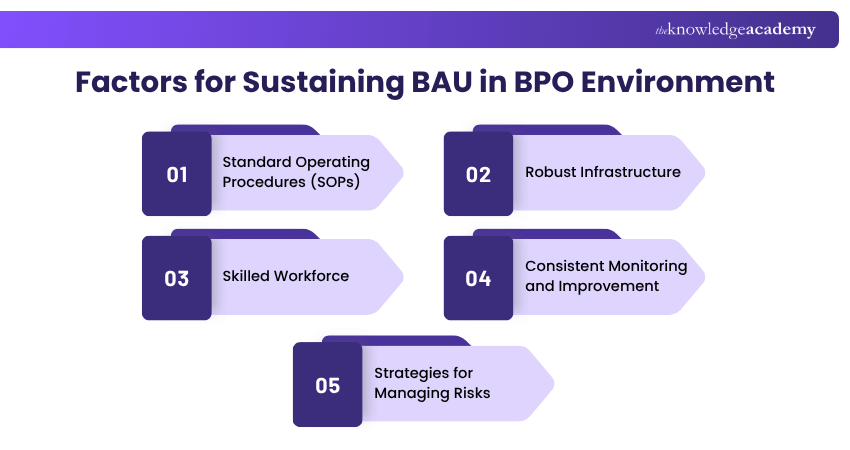
1) Standard Operating Procedures (SOPs):
By clearly documenting SOPs, it provides a systematic guide for performing routine tasks. They ensure consistency, accuracy and efficiency in the various daily processes. This allows teams to follow set workflows and avoid hindrances in daily work life.
2) Robust Infrastructure:
A durable foundation for operations includes reliable technology usage, secure networks, communication tools and well-kept facilities. A robust infrastructure minimises downtime, prevents hindrances in service and client expectations.
3) Skilled Workforce:
Business as Usual is effective when employees are well-trained, knowledgeable and competent for performing their tasks. A skilled workforce completes task accurately, effectively resolves customer needs and performance efficiency is intact.
4) Consistent Monitoring and Improvement:
By conducting regular reviews, tracking performances and collecting feedback from clients keeps performance standards high. It helps to identify gaps or weaknesses proactively. This makes implementing improvement tactics quicker and operations efficient.
5) Strategies for Managing Risks:
Through a proactive identification of risk, from cybersecurity to compliance challenges, keeps business operations in momentum. Such preparation aids BPO environments in thriving and staying stable even during unexpected arise of challenges.
Learn the essentials of Benefits Management with Managing Benefits™ Foundation Course – register today!
Benefits of Optimisation with Business as Usual (BAU)
Maintaining Business as Usual along with optimising processes helps organisations to have competitive edge and enhance efficiency. Some key benefits are mentioned below:
1) Efficiency Increased:
Through workflows being streamlined and principles, such as Lean applied, it eliminates unnecessary steps and redundant activities. This helps businesses to improve productivity levels, reduce cycle and response times and enhance utilisation of resources.
2) Saving of Cost:
An excellent operational performance is accomplished through optimisation. It helps businesses lower their cost and allows them to reduce waste, improve output quality and reduce operation expenses.
3) Increased Employee Motivation:
By integrating optimisation into Business as Usual, you can encourage employees to engage in improvement efforts. It enhances ownership and accountability amongst employees. They are confident to contribute more and feel valued.
Drawbacks of the Business as Usual (BAU)
Business as Usual enhances efficiency, stability and brings consistency. But it also comes with limitations that must be noted. Some of them are:
1) Limits Innovation and Flexibility
If Business as Usual approaches are strict, it limits creating space for creativity. This discourages employees from sharing new ideas and experiment with different approaches of working. When innovation is inhibited, organisations face issues to respond to growing market demands and adjust customer expectations.
2) BAU Can Reduce Competitive Edge
Companies need to constantly evolve with the dynamic shifts of market demands. If businesses remain going with their old ways of performing task, they can become outdated. Without adapting and improving their capabilities, businesses can lose a competitive edge. Thus, it is crucial to modernise their operations and improve their daily operations.
3) Negatively Affects Customer Experience
A strict adherence to Business as Usual approach can delay the requirement of meeting customer expectations. This results in businesses failing to satisfy customer expectations, personalise services and engage in interactions seamlessly. This creates gap between what customers need and organisations provide.
Take your Benefits Management skills further with Managing Benefits™ Practitioner Course - Join now!
How to Encourage Your Team to Embrace a New BAU?
For shifting to a new Business as Usual, it requires key actions as mentioned below:
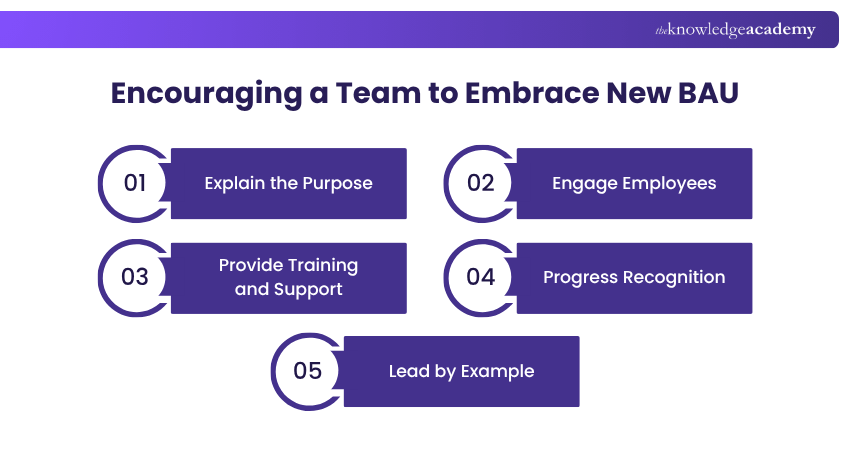
1) Explain the Purpose:
Clearly communicate the reason for the change and how it will benefit the organisation, its customers and employees.
2) Engage Employees:
Collect feedback from the team. This builds ownership and reduces uncertainty during the adopting process.
3) Provide Training and Support:
By equipping employees with the necessary training, you prevent confusion and build confidence during change.
4) Progress Recognition:
By acknowledging small victories during the transition, it helps to keep employees motivated and re-enforce the value of the change.
5) Lead by Example:
Senior leaders and Managers must follow and adopt to the change effectively. This makes employee follow the change ardently.
How to Cultivate an Adaptive Culture Alongside Business as Usual (BAU)?
For creating an adaptive culture alongside Business as usual means to encourage consistent improvement and ensure stability. Some ways to accomplish it are:
1) Addressing Resistance to Change
During change, employees might be hesitant to adapt to it. Employees might fear uncertainty, fear of job security or uncomfortable, in general. To make them prepared and ready for change clear communication regarding the change is essential. Also, provide necessary training and encourage open communication where new ideas are heard and welcomed.
2) Promoting Organisational Agility
This refers to adapting the shift in market demands and customer expectations. This requires embracing digital tools, adopting agile methodologies, and encouraging teams to work collaboratively. By fostering culture where experimentation and feedback is valued, organisations can boost competitiveness and resilience.
Conclusion
Business as Usual is the backbone of operational stability, customer service and consistent performance. Organisations that use BAU can cultivate an agile environment where innovation is welcomed and improvements are promptly implemented. By helping teams to embrace change, they will be confident and motivate to contribute meaningfully. This helps companies to thrive in modern market demands and tomorrow’s changes.
Learn how to maximise outcomes and minimise guesswork with our Managing Benefits™ Courses - Sign up now!
Frequently Asked Questions
What is the BAU Process Flow?

The Business as Usual process flow is the systematic sequence of task and processes for seamless running of operations. It ensures consistency, efficiency and minimal disruption in day-to-day business activities.
What is the Difference Between a Project and a BAU?
A project is an initiative with a duration, scope, resources and outcome. On the other hand, BAU refers to operation work that is continuously repeated to support business operations. Projects focus on change and innovation, whereas BAU maintains stability and ongoing performance.

 If you wish to make any changes to your course, please


