


 Top Rated Course

We may not have the course you’re looking for. If you enquire or give us a call on +44 1344 203 999 and speak to our training experts, we may still be able to help with your training requirements.
15 Benefits of Playing the Piano
The Knowledge Academy 05 March 2026Playing the Piano boosts cognitive, physical, and emotional health by improving memory, coordination, focus, creativity, confidence, and stress relief. It is a powerful activity that nurtures the mind, body, and soul. It is not only an instrument but also can be a lifelong companion for personal growth, creativity, and well-being.

Training Outcomes Within Your Budget!
We ensure quality, budget-alignment, and timely delivery by our expert instructors.
Table of Contents
Whether you’re a beginner learning your first melody or an experienced player developing complex pieces, the Piano offers a transformative experience. The Benefits of Playing Piano touch every aspect of life, from sharpening your mind to soothing your emotions. It’s not just about learning notes, but about discovering a deeper connection with yourself.
The benefits extend into your daily well-being. It improves memory, boosts focus, enhances creativity, and even relieves stress after a long day. No matter your age or skill level, the Piano has the potential to become a lifelong companion for growth, joy, and balance. In this blog, you will comprehensively explore the Benefits of Playing Piano. Keep reading to learn more!
Table of Contents
1) Benefits of Playing Piano
a) Improve the Body
b) Sharpen the Intellect
c) Accelerate Brain Processing Speed
d) Refine Concentration and Focus
e) Reduce Stress and Anxiety Levels
f) Boost Happiness Levels
g) Strengthen Hand-eye Coordination
h) Strengthen Hand Muscles and Dexterity
i) Boosts Self-esteem
j) Contribute to Better Health (by Increasing HgH Levels)
2) Conclusion
Benefits of Playing Piano
Playing Piano has numerous benefits on a person’s body and mind. The movement of fingers while playing Piano, can strengthen your hand muscles and improve your dexterity. This sends signals up to your brain, increasing your brain activity relating to your hand-eye coordination.
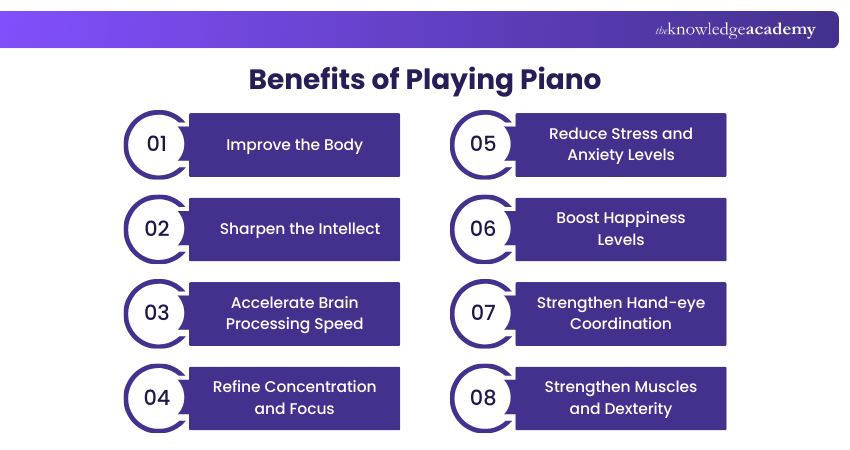
Consistent practice can also significantly improve your hand-eye coordination over time. Apart from this the calming sounds of the Piano, have also shown to reduce stress levels and promote better mental health. If that isn't enough to convince you, here are 15 Benefits of Playing Piano that you should know:
1) Improve the Body
Even though you’re seated while playing, the piano provides a physical workout. The act of coordinating both hands, reading music, and pressing keys with precision strengthens fine motor skills and enhances hand-eye coordination, especially in children. For older adults, Piano lessons have been linked to increased levels of Human Growth Hormone (HgH).
Also, it contributes to better health outcomes. It helps to regulate heart and respiratory rates, reducing the risk of cardiac complications. In this way, Piano playing becomes a holistic activity that nurtures physical well-being across all ages.

2) Sharpen the Intellect
Playing the Piano boosts cognitive and intellectual abilities. It activates brain regions tied to spatial reasoning and mathematics, making players sharper and more adept at problem-solving. Regular practice builds habits of focus, perseverance, and creativity, while also strengthening memory.
Adults who studied piano as children retain stronger abilities to process and remember information from lectures or speeches. Also, it enhances spatial-temporal skills, which are crucial in fields such as math, science, and engineering. Consistent training can even lead to structural changes in the brain, making it more efficient in everyday learning.
3) Accelerate Brain Processing Speed
As you now know, playing the Piano improves your memory and helps you retain what you have read. But what if you were told that it can also accelerate your brain’s processing speed. That's right! It can increase the speed of your brain’s cognition using your myelinated nerves.
Myelinated nerves are a part of your nervous system that send and receive signals to your brain. These nerves that govern your brain’s processing speed usually stop developing during adolescence. When you play the Piano, it helps develop these nerves better, in turn increasing your brain’s processing speed.
4) Refine Concentration and Focus
Do you have trouble focusing on your work? Playing Piano can help! When you play Piano, your brain is multitasking as your fingers are moving continuously from one key to the other. Moreover, you learn to focus on rhythms and tempos, pitch and volume, and melodies and harmonies all at the same time.
This helps you practice your ability to concentrate, differentiate, and focus on several elements at the same time. So, Playing the Piano can help you focus on your work and the workplace drama without losing the integrity of your work.
5) Reduce Stress and Anxiety Levels
You probably have heard that playing calming music to plants helps them grow. Similarly, creating a calm and pleasant environment free of stress and anxiety helps you grow, too. This is where learning how to play a Piano can benefit you. Not only does the calming sounds of the Piano help reduce stress and anxiety, but it is also a very therapeutic practice to learn.
The act of playing Piano itself is deeply meditative. Focusing on the rhythm, melody, and movement of your fingers helps shift attention away from worries, creating a mindful state. This immersion provides a healthy emotional outlet, allowing players to release tension and express feelings through music.
6) Boost Happiness Levels
Among the Benefits of Playing Piano, one that often stands out is the effect it has on your mood. Most people have negative noises in their heads that no one can hear. Playing the Piano can help elevate your mood and make you happier by replacing the negative noises.
This results in a happier lifestyle. If you also struggle with noises in your head, Playing the Piano is highly recommended. Even if you do not struggle with noises in your head, you can still play the Piano to elevate your mood.
Produce music like a pro with the Music Production Course today!
7) Strengthens Hand-eye Coordination
Playing the Piano demands a high level of synchronisation between the eyes, hands, and brain. As you read sheet music, your eyes must process notes while your brain translates them into precise finger movements across the keys. This constant multitasking naturally sharpens motor skills and dexterity, helping players develop better control and coordination.
The challenge of coordinating two hands independently while following musical notation trains the brain to manage multiple actions simultaneously. This ability to multitask turns into improved focus and efficiency in other areas of life. Over time, it strengthens neural connections, making hand-eye coordination more fluid and instinctive.
8) Strengthen Hand Muscles and Dexterity
Who knew playing music could also be a workout? When you play the Piano, your hand muscles are at work. These muscles, being worked out, improve your dexterity. Dexterity is your ability to do things, especially with your hands.
Better dexterity allows you to further learn how to play other musical instruments. Apart from playing music, it also makes you more capable of doing other tasks, such as opening jars for your partner and defusing bombs.
9) Boosts Self-esteem
The process of learning, practicing, and achieving milestones at the Piano directly contributes to a stronger sense of self-worth. The excitement of playing a piece correctly after weeks of effort gives learners a tangible sense of accomplishment that boosts their confidence both in and out of their personal and professional lives.
Each new skill learned at the Piano reinforces the belief that growth and progress are possible at any stage of life. It becomes a source of empowerment, reminding players that dedication and perseverance lead to success. This confidence spills over into other areas of life, from professional endeavours to personal relationships.
Discover passions, spark creativity with Hobbies & Interests Courses – Register now!
10) Contribute to Better Health (by Increasing HgH Levels)
Have you ever felt like you are too young to have problems that should ideally occur only in old age, such as back pain and slower metabolism? Guess what? Playing the Piano can help with that, too.
Adults who take Piano lessons are likely have increased levels of human growth hormone (HgH). HgH helps regulate body fluids, muscle and bone growth, metabolism and even heart functioning. When your body produces more HgH, your body starts to feel younger and more fit overall.
11) Cultivate Better Listening Skills
Playing the Piano trains your ears as much as your fingers. Regular practice sharpens your ability to recognise pitch, tone, and rhythm. Over time, Pianists gain the skill to identify notes, chords, and intervals simply by hearing them. This heightened auditory awareness improves your performance but also makes you more versatile as a musician.
Cultivating better listening skills through Piano practice deepens your appreciation for music. You notice subtle nuances in other artists’ work that might otherwise go unnoticed. This enriched listening experience enhances your enjoyment of music and strengthens your connection to it.
12) Build Social Connections
Playing the Piano can open doors to rewarding social experiences. Whether you’re joining a band or playing duets with a friend, the Piano naturally brings people together. These shared musical moments foster teamwork, communication, and a sense of belonging, making the instrument a gateway to meaningful connections.
Piano playing creates opportunities to engage with wider communities. Each interaction strengthens social bonds and builds confidence in expressing yourself. In this way, the piano transforms into a bridge that connects you to others through the universal language of music.
Compose your story in sound with the Music Composition Course – Join now!
13) Expand Cultural Awareness
Emerging in the 18th century from Italy, the Piano made for a grand symbol of status among the European Nobels. It further made its way to jazz clubs in New Orleans and concert halls in Vienna. A staple of Western classical music, women were encouraged to take private lessons to learn the Piano even before they could vote or attend schools.
Did you know? Even Queen Elizabeth had her own Piano in Buckingham Palace. With such a rich cultural significance, learners are motivated to be more aware of its history and relevance. It also makes a great conversational point on a date.
14) Enhance Multitasking Abilities
As discussed before, playing the Piano helps you focus on several elements at the same time. In addition to that, the process of learning how to play the Piano itself involves multitasking. You would need to read the music sheets and play the keys in accordance with learning the ballads. Practicing the piano inherently promotes multitasking, and maintaining it well is essential, learn How to Clean Piano Keys to keep them in top condition.
Multitasking at the Piano enhances your overall cognitive flexibility. The constant need to balance reading sheet music, coordinating both hands, and keeping rhythm trains your brain to process multiple streams of information simultaneously. This ability carries over into everyday life, helping you juggle tasks more effectively and stay focused under pressure.
15) Improve Academic Performance
As discussed earlier in this blog, playing the Piano helps enhance your memory, focus, and brain processing speed. If you are a student, all these benefits further transition into your academics as well. It helps you focus on your lessons, understand them better, and retain your course knowledge better.
Students who play Piano as an extra-curricular activity have better chances to score well in their examinations. If you are an aspiring musician, colleges like Julliard also offer scholarships to students that show exceptional talents in the field of music.
Conclusion
The Piano is a lifelong companion that enriches your mind, body, and soul. From sharpening intellect and coordination to reducing stress and building social connections, the Benefits of Playing Piano extend into every corner of life. Whether you’re a beginner or a seasoned Piano player, each note you strike is a step toward personal growth, creativity, and joy, making the piano one of the most rewarding skills you can embrace.
Transform into a Rockstar! Learn to play the Guitar with our Guitar Course – sign up now!
Frequently Asked Questions
Keyboard vs Piano: Which instrument is better for a beginner?

Pianos offer a more authentic experience and are more beneficial for developing proper techniques from scratch. However, a Keyboard is more budget-friendly and more versatile in sound options. Piano requires you to learn more organically, while Keyboards come with built-in lessons to assist your learning process.
How does Playing the Piano effect the brain?
Playing the Piano enhances the brain's ability to function by increasing the brain’s processing speed. It also helps retain more knowledge as it positively affects memory. Further, it also has great effects on mental health by lowering anxiety and stress levels.
What are the other resources and offers provided by The Knowledge Academy?
The Knowledge Academy takes global learning to new heights, offering over 3,000+ online courses across 490+ locations in 190+ countries. This expansive reach ensures accessibility and convenience for learners worldwide.
Alongside our diverse Online Course Catalogue, encompassing 17 major categories, we go the extra mile by providing a plethora of free educational Online Resources like Blogs, eBooks, Interview Questions and Videos. Tailoring learning experiences further, professionals can unlock greater value through a wide range of special discounts, seasonal deals, and Exclusive Offers.
What is the Knowledge Pass, and how does it work?
The Knowledge Academy’s Knowledge Pass, a prepaid voucher, adds another layer of flexibility, allowing course bookings over a 12-month period. Join us on a journey where education knows no bounds.
What are related courses and blogs provided by The Knowledge Academy?
The Knowledge Academy offers various Hobbies and Interests courses, including a Piano Course, Guitar Course, and Music Production Course. These courses cater to different skill levels, providing comprehensive insights into Essential Guitar Techniques.
Our Business Skills Blogs cover a range of topics related to Musical Instruments, offering valuable resources, best practices, and industry insights. Whether you are a beginner or looking to advance your skills as a Music Skills , The Knowledge Academy's diverse courses and informative blogs have you covered.

The Knowledge Academy


Global Training Provider
The Knowledge Academy is a world-leading provider of professional training courses, offering globally recognised qualifications across a wide range of subjects. With expert trainers, up-to-date course material, and flexible learning options, we aim to empower professionals and organisations to achieve their goals through continuous learning.

Upcoming Business Skills Resources Batches & Dates
Date
 Keyboard Instrument Course
Keyboard Instrument Course
Fri 24th Jul 2026
Keyboard Instrument Course
Fri 9th Oct 2026

 If you wish to make any changes to your course, please


