


 Top Rated Course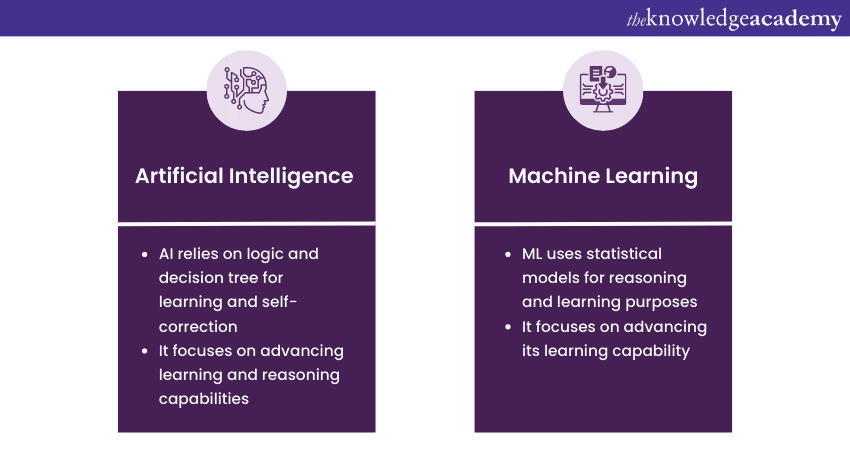



We may not have the course you’re looking for. If you enquire or give us a call on +44 1344 203 999 and speak to our training experts, we may still be able to help with your training requirements.
Artificial Intelligence and Machine Learning : A Complete Guide
The Knowledge Academy 17 April 2026This blog will tell you all about Artificial Intelligence and Machine Learning, as well as the differecnes between the two. Keep reading to learn more!

Training Outcomes Within Your Budget!
We ensure quality, budget-alignment, and timely delivery by our expert instructors.
Table of Contents
In this world of digitalization, the concepts of Artificial Intelligence (AI) and Machine Learning (MI) are the hot topic in trend. Even though they might sound the same, in reality, Machine Learning is a subset of Artificial Intelligence. AI can impersonate or mimic human intelligence to conduct real-world activities, whereas Machine Learning is implementing technology to automate machines’ learning from all the experiences and data.
Artificial Intelligence and Machine Learning help bring growth in a vast range of business operations. According to Statista, in 2021, Artificial Intelligence and Machine Learning improved the customer experience, accounting for 57%.
Artificial Intelligence can impersonate/mimic human intelligence to conduct real-world activities, whereas Machine Learning is implementing technology to automate machines’ learning from all the experiences and data. Even though Artificial Intelligence and Machine Learning appear to be the same, they are different. Read this blog to learn the differences between them.
Table of Contents
1) What is Artificial Intelligence
a) Classification of Artificial Intelligence
2) What is Machine Learning
a) Categories of Machine Learning Algorithms
3) Differences between AI and ML
4) Conclusion
What is Artificial Intelligence?
Artificial Intelligence is the concept of computer science that creates machines and computers capable of mimicking human intelligence. These machines are bound by rules and codes that help to analyse and make decisions. The AI domain includes the concepts of Robotics, Machine Learning, Natural Language Processing (NLP), and applications like Character AI.
One of the earliest Artificial Intelligence programs was named DENDRAL. It was developed by Carl Djerassi in 1965 and used Artificial Intelligence to find new types of drugs. One of the fascinating facts of AI is that it will surpass human intelligence by 2045. At that point, AI will begin entirely automating numerous industries. However, it will also create almost two million new jobs simultaneously.
Classification of Artificial Intelligence
AI can be classified into the following three types:
a) Weak AI: These systems are designed to perform simple and singular tasks.
b) General AI: It can perform multiple tasks just like a human.
c) Strong AI: Although it does not exist today, it is considered the future of AI. This AI will be more intelligent than existing AI models and more efficient than human intelligence.
Many corporations are utilizing and integrating their operations with AI to automate, accelerate, process tasks, and make human-like decisions. This brings in room for development and innovation as AI helps research and develop projects with all the data available to you.
What is Machine Learning?
Machine Learning is a subfield of AI and helps develop programs that can learn independently from the relevant data provided and the experience it gains from these data. These machines are efficient in identifying and analysing data and its pattern. This helps to understand and make decisions and also allows for making predictions.
It is anticipated that Machine Learning to become more automated. Agriculture, cybersecurity, fintech, manufacturing, and many more industries are some that best illustrate this interesting fact about technology.
Categories of ML algorithms
The ML algorithms can be divided into the following four categories:
a) Supervised learning: These ML algorithms are programmed on labeled data. Thus, implying that all the results are already known. This helps to predict the outcomes of any new data based on previous experiences.
b) Unsupervised Learning: It trains on unlabelled data with unknown outcomes. Generally, these are used to map data patterns and derive insights from the data provided.
c) Semi-supervised Learning: At times, the data provided may or may not contain labels. Semi-supervised model is implemented here, helping in labeling the unlabelled data.
d) Reinforcement Learning: Machine learning through a trial-and-error method. Thus, making it possible to achieve results and make decisions based on previous experience.
Differences between AI and ML
The basic difference between Artificial Intelligence and Machine Learning is how they are developed. AI is created with programming rules and mimics human intelligence, whereas ML is a programme trained to learn from all the data provided and its past experiences. AI can be used to make decisions, whereas ML learns new things from the provided data. Another notable difference is that AI works to have a higher chance of success rate, whereas ML works to increase accuracy and not success rate.
Let’s look at other differences between Artificial intelligence and Machine Learning.
|
S.No. |
Artificial Intelligence (AI) |
Machine Learning (ML) |
|
1 |
AI comprises different aspects such as Machine Learning, Deep Learning, and more. |
ML is a component of AI. |
|
2 |
AI is trained to behave in different circumstances. |
ML is trained by providing data to learn by self. |
|
3 |
AI is complex as it tries to understand human intelligence and behavior to mimic. |
ML is rather relaxed and simple and learns based on data and patterns. |
|
4 |
Problem-solving, data mining, data science, and programming design are a few basic AI skills required. |
Applied mathematics, statistics, probability, programming languages, and data modeling are a few skills required for ML. |
|
5 |
AI is capable of performing in different sectors |
ML is tasked with specific duties based on the training it has received. |
|
6 |
The decision is made on rules and logic. |
Decisions are based on patterns and experience. |
|
7 |
Siri, Google Translate, and the humanoid robot Sophia incorporate AI |
Stock forecasting, Facebook’s friend suggestion, and Google search algorithm utilize ML |
|
8 |
AI is programmed to operate automatically or with little human interaction. |
ML requires human intervention to train and set up the system. |
|
9 |
Uses structured, semi-structured, and unstructured data |
Utilises structured and semi-structured data |
|
10 |
AI applications include Speech recognition and autonomous driving. bbbgnhbgg |
ML applications include Data Mapping, Predictions. |
Get ready for success with key Machine Learning Interview Questions for your interview prep.
Conclusion
AI and ML have revolutionized how we live, work, and grow. Thus, understanding the difference between Artificial Intelligence and Machine Learning helps you to appreciate and utilize them to their fullest.
Master and comprehend the aspects of Machine Learning. Join our Machine Learning Training today!
Frequently Asked Questions

The Knowledge Academy


Global Training Provider
The Knowledge Academy is a world-leading provider of professional training courses, offering globally recognised qualifications across a wide range of subjects. With expert trainers, up-to-date course material, and flexible learning options, we aim to empower professionals and organisations to achieve their goals through continuous learning.


 If you wish to make any changes to your course, please


