


 Top Rated Course

We may not have the course you’re looking for. If you enquire or give us a call on 800600725 and speak to our training experts, we may still be able to help with your training requirements.
What is an Extended Trial Balance? Explained
Olivia Taylor 24 April 2026An Extended Trial Balance is an accounting worksheet that expands the trial balance by including adjustments, revised balances, and final account allocations. This comprehensive accounting tool ensures financial records are accurate by listing all ledger balances and adjusting entries in one place, making it a sound accounting practice.

Training Outcomes Within Your Budget!
We ensure quality, budget-alignment, and timely delivery by our expert instructors.
Table of Contents
Understanding financial statements can feel confusing, especially when multiple adjustments need to be recorded before preparing final accounts. This is where Extended Trial Balance becomes helpful. It acts as a working worksheet that allows accountants to organise balances, apply adjustments, and clearly see how figures will appear in the financial statements.
It helps businesses move from basic account balances to accurate financial reports in a structured way. Arranging figures into columns for adjustments and final statements, it makes the accounting process easier to review and correct. In this blog, you will explore what an Extended Trial Balance is, how to extend one, and examples.
Table of Contents
1) What is an Extended Trial Balance?
2) How Do I Extend a Trial Balance?
a) Step 1: Divide the ETB into the accounts that go on each financial statement
b) Step 2: Extend the highlighted SPL accounts across to the SPL columns, adjusting them as required
c) Step 3: Calculate the profit or loss
d) Step 4: Extend the SFP rows, adjusting as necessary
e) Step 5: Finally, add up the SFP columns which should match
3) Example of an Extended Trial Balance
4) Conclusion
What is an Extended Trial Balance?
Extended Trial Balance is a detailed version of the trial balance that shows how ledger balances are adjusted and classified into financial statements. It includes columns for original balances, adjustments, and separates accounts into income statements and balance sheet actions. This makes tracking profits and calculation of final balances easier.

How Do I Extend a Trial Balance?
Extending a trial balance means taking initial balances from the general ledger and carrying them through a series of steps until they are ready for financial statements. The steps required in the process are provided below to help you understand the procedure clearly:
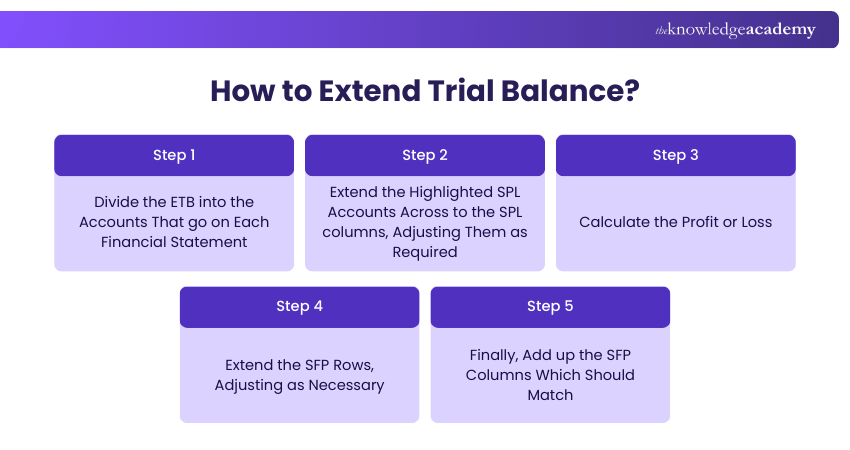
Step 1: Divide the ETB into the Accounts That go on Each Financial Statement
In this step, review the Extended Trial Balance and determine which accounts belong to each financial statement. Income and expense accounts are recorded in the Statement of Profit or Loss (SPL), while assets, liabilities, and equity appear in the Statement of Financial Position (SFP). Some items, such as inventory, must be handled carefully because they can affect both revenue and cost of sales.
Step 2: Extend the Highlighted SPL Accounts Across to the SPL columns, Adjusting Them as Required
After identifying which accounts come under the SPL, carry them across to the SPL columns. At this stage, you must adjust any necessary entries, such as accruals, pre-payments, depreciation or provisions and apply them into relevant accounts. In practice, the balance of an SPL account is adjusted where necessary, and the net amount is recorded in the appropriate SPL debit or credit column.
Step 3: Calculate the Profit or Loss
In this step, the task is to find the balancing figure that represents either net profit or loss. If the credit side exceeds the debit side, the different is entered as profit in the debit column to balance two sides of the column. Conversely, if total debits exceed credits, the excess is a net loss, which would be entered as a credit in the SPL column and debit in the SFP side.
Step 4: Extend the SFP Rows, Adjusting as Necessary
After completion of SPL, you need to go ahead with transferring the remaining balances, such as asset, liabilities, and equity into the Statement of Financial Position (SFP) columns. During the process, apply any required adjustments, such as allowances for receivables or updated liability figures, so that extended balances reflect accurate annual values.
Step 5: Finally, Add up the SFP Columns Which Should Match
Lastly, total the Statement of Financial Position (SFP) debit and credit columns. If all earlier steps classifying accounts, applying adjustments, extending balances, and incorporating profit or loss are done correctly, the two columns' totals must be identical. This matching result demonstrates that the Extended Trial Balance is balanced and consistent.
Make smarter financial decision with Wave Accounting Training- sign up now!
Example of An Extended Trial Balance
An Extended Trial Balance (ETB) provides a comprehensive view of a company’s financial position by incorporating both unadjusted trial balances and necessary adjustments made annually.
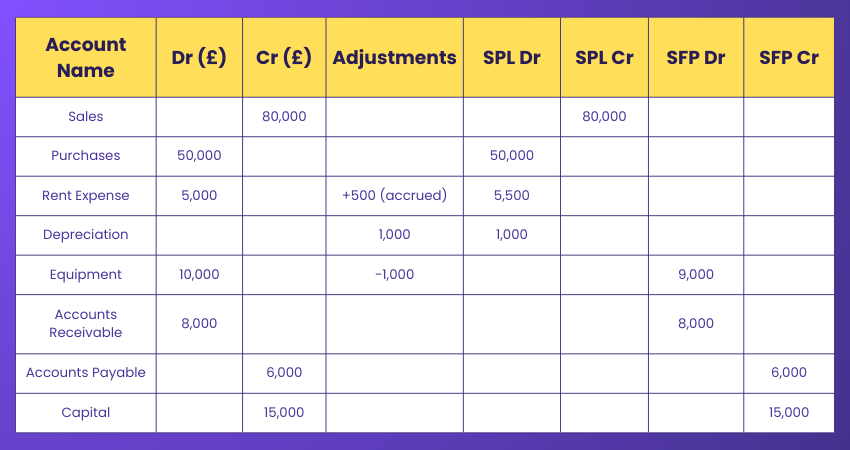
Now Calculate:
Profit or Loss = Total SPL Cr - Total SPL Dr = (80,000) - (56,500) = £23,500 (Profit)
This profit is transferred to the SFP credit side under capital.
Then, Total SFP:
Assets (9,000 + 8,000) = £17,000
Liabilities + Capital (6,000 + 15,000 + 23,500) = £44,500
The Extended Trial Balance ensures all adjustments are reflected correctly before preparing the final accounts.
Conclusion
An Extended Trial Balance helps organise account balances, record adjustments, and prepare accurate financial statements. By arranging figures into structured columns, it makes it easier to review entries, identify errors, and ensure financial information is presented correctly.
Enhance your financial expertise with Accounting Software Training- enrol now!
Frequently Asked Questions
What is an ETB in Finance?

An Extended Trial Balance in finance is a detailed accounting report that lists out all ledger balances along with the adjustments., separating accounts into income statements, and balance sheet columns. It helps to maintain accuracy and provides a clear basis for preparing financial statements.
What is SFP and SPL?
Statement of Financial Position (SFP) shows a company’s assets, liabilities, and equity at a specific date, reflecting its financial positions. Statement of Profit and Loss (SPL) summarises a company’s profit or loss. Together, they lay out a complete overview of financial performance.
What are the Other Resources and Offers Provided by The Knowledge Academy?
The Knowledge Academy takes global learning to new heights, offering over 3,000+ online courses across 490+ locations in 190+ countries. This expansive reach ensures accessibility and convenience for learners worldwide.
Alongside our diverse Online Course Catalogue, encompassing 17 major categories, we go the extra mile by providing a plethora of free educational Online Resources like Blogs, eBooks, Interview Questions and Videos. Tailoring learning experiences further, professionals can unlock greater value through a wide range of special discounts, seasonal deals, and Exclusive Offers.
What is The Knowledge Pass, and How Does it Work?
The Knowledge Academy’s Knowledge Pass, a prepaid voucher, adds another layer of flexibility, allowing course bookings over a 12-month period. Join us on a journey where education knows no bounds.
What are the Related Courses and Blogs Provided by The Knowledge Academy?
The Knowledge Academy offers various Accounting Software Training, including Wave Accounting Training, Tally Training, and QuickBooks Training. These courses cater to different skill levels, providing comprehensive insights into Accounting Software.
Our Accounting and Finance Blogs cover a range of Finance and Accounting, offering valuable resources, best practices, and industry insights. Whether you are a beginner or looking to advance your Finance skills, The Knowledge Academy's diverse courses and informative blogs have got you covered.

Olivia Taylor


Chartered Accountant and Financial Training Specialist
Olivia Taylor is a qualified chartered accountant with over a decade of experience in financial management, auditing and corporate reporting. Having worked with leading firms in both the public and private sectors, Olivia brings clarity to complex financial topics. Her writing focuses on helping professionals build confidence in key areas of accounting, compliance and financial planning.
View Detail
Upcoming Accounting and Finance Resources Batches & Dates
Date
 Wave Accounting Training
Wave Accounting Training
Fri 24th Jul 2026
Wave Accounting Training
Fri 23rd Oct 2026

 If you wish to make any changes to your course, please


