


 Top Rated Course

We may not have the course you’re looking for. If you enquire or give us a call on 800600725 and speak to our training experts, we may still be able to help with your training requirements.
Compliance Officer Roles and Responsibilities Explained
Hailey Davis 02 March 2026A Compliance Officer ensures firms follow laws, policies, and regulations by monitoring risks, updating processes, training staff, and investigating violations. They act as a crucial link between the organisation and regulatory bodies, promoting ethical conduct and shielding the company from financial and legal repercussions.

Training Outcomes Within Your Budget!
We ensure quality, budget-alignment, and timely delivery by our expert instructors.
Table of Contents
Have you ever wondered who keeps organisations safe from the storm of ever-changing regulations and ethical challenges? In these situations, a Compliance Officer steps in, taking on the role of Investigator, Strategist, and ethical compass. They do more than protect companies from legal pitfalls and reputational risks; they also build a culture of accountability and integrity.
If you are curious about stepping into this crucial profession, this blog will guide you. Together, we will explore the dynamic Compliance Officer Roles and Responsibilities that help organisations of every size thrive. Let’s get started!
Table of Contents
1) Who is a Compliance Officer?
2) Understanding the Role of Compliance Officer
3) Compliance Officer Responsibilities
4) Skills and Qualities of an Effective Compliance Officer
5) How Much Does a Compliance Officer Earn?
6) How to Become a Compliance Officer?
7) The Challenges of the Compliance Officer in Performing Their Role
8) What are the Three Requirements for the Position of Compliance Officer?
9) Who Does a Compliance Officer Report to?
10) Conclusion
Who is a Compliance Officer?
A Compliance Officer is a professional who makes sure that a company follows legal requirements as well as its own internal policies. Their job is to actively monitor and manage compliance. Without them, businesses risk breaking laws or rules, which can lead to fines and serious damage to their reputation.
As compliance rules become stricter, more companies, both medium and large, depend on Compliance Officers. They act as in-house experts, staying updated on regulations, monitoring changes, and making sure compliance processes are followed. Because of this important role, there is strong demand for skilled Compliance Officers.

Understanding the Role of Compliance Officer
Compliance Officer duties and responsibilities are the ethical compass guiding an organisation through the complexities of regulations and ethical standards. As the name implies, their fundamental duty is to ensure that the company's actions remain within the boundaries set by the law and ethical principles. Some of the most crucial roles of a Compliance Officer are as follows:
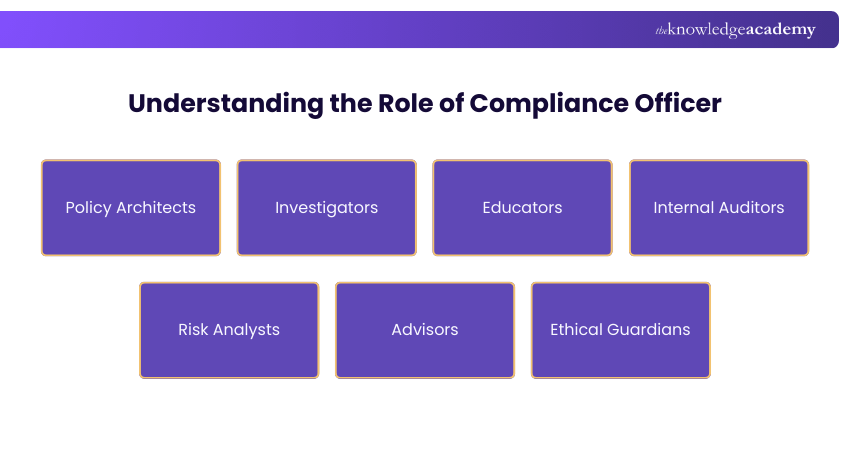
Policy Architects
1) Compliance Officers act as Policy Architects as they design detailed compliance policies.
2) Through clear documentation, they address the complexities of regulatory frameworks.
3) These policies guide the employees by outlining expected behaviour and responsibilities.
4) This helps make sure that the organisation’s activities remain legal and ethical.
5) They simplify complex regulations into actionable steps for staff.
6) Their work promotes a culture of integrity and transparency.
Risk Analysts
1) Risk assessment is a key responsibility of a Compliance Officer.
2) They carefully evaluate the risks and vulnerabilities in business operations.
3) The strategies are developed to reduce compliance-related threats.
4) Their strong analytical skills help them predict potential issues.
5) They enable the organisation to address risks proactively.
6) This helps avoid the risks of legal problems and reputational damage.

Investigators
1) Compliance Officers serve as Investigators when any instance of non-compliance crops up.
2) They examine the issues closely to identify their root causes.
3) They conduct thorough analyses to understand the problem fully.
4) They introduce corrective measures to stop the recurrence of such issues.
5) Their proactive approach ensures swift resolution of every compliance breach.
Advisors
1) Compliance Officers offer management guidance on compliance-related strategies.
2) Their expertise can shape policies and procedures to meet regulatory requirements.
3) They provide deep insights into the possible compliance implications of business choices.
4) This ensures that the leaders make responsible strategic decisions.
5) Compliance stays integrated into the organisation’s overall direction.
Compliance Officer Responsibilities
Compliance Officer Roles and Responsibilities help companies be open, responsible, and honest. Some of the key responsibilities of a Compliance Officer are as follows:
Developing and Implementing Policies
Compliance Officer duties and responsibilities are charged with the critical task of creating and putting into action comprehensive Compliance policies. These policies act as guidelines that dictate ethical behaviour and ensure the organisation's alignment with legal regulations. By crafting and implementing these policies, Compliance Officers lay the groundwork for a culture of lawful conduct and integrity within the company.
Monitoring and Assessment
Monitoring forms a core responsibility of Compliance Officers. They consistently track the organisation's activities to confirm adherence to regulations and ethical standards. This involves regular assessments, internal audits, and vigilant scrutiny to identify potential non-compliance areas. The meticulous monitoring process provides insights into operational practices and enables early detection of any deviations from established norms.
Gain insight into the different levels of assessing organisational Cyber Security governance in our Security Governance and Compliance Training - Sign up now!
Training and Education
Compliance Officers play an instrumental role in educating employees about Compliance expectations. They organise training sessions to familiarise staff with the organisation's Compliance policies, codes of conduct, and industry-specific regulations. By imparting this knowledge, Compliance Officers empower employees to make informed decisions and take actions that align with the organisation's ethical framework.
Risk Assessment and Mitigation
Identifying and mitigating risks is crucial to a Compliance Officer’s responsibilities. They assess the organisation's processes, operations, and external factors to determine potential vulnerabilities. Based on this assessment, they strategies and implement measures to minimise the impact of risks, safeguarding the organisation's reputation and financial stability.
Reporting and Communication
Compliance Officers are the bridge between internal stakeholders and external authorities. They regularly communicate the organisation's Compliance status to Senior Management and relevant stakeholders. Effective reporting ensures transparency, keeps all parties informed about Compliance efforts, and helps make well-informed decisions.
Responding to Non-compliance
In instances of non-compliance, Compliance Officers initiate prompt action. They investigate the root causes of the breach, analyse the extent of the violation, and recommend corrective measures. Their proactive approach ensures that non-compliance is swiftly addressed, preventing reccurrence and minimising potential negative consequences.
Learn how to turn complex policies into everyday practices with our Effective Compliance Training – Sign up now!
Skills and Qualities of an Effective Compliance Officer
The role of Compliance Officer necessitates a unique blend of skills and inherent qualities that contribute to their effectiveness in upholding ethical standards and ensuring legal adherence within an organisation. Here are some of the most essential skills of a Compliance Officer:
Analytical and Critical Thinking
The ability to analyse intricate regulatory frameworks and assess potential Compliance gaps is paramount. Effective Compliance Officers exhibit sharp analytical skills, enabling them to identify areas of vulnerability and proactively devise strategies to address them. Critical thinking empowers them to craft comprehensive solutions that anticipate potential challenges.
Strong Communication Skills
Communication is key for Compliance Officers, who must translate complex regulations into clear directives for employees at all levels. Effective communication fosters understanding, ensuring Compliance policies are disseminated effectively and embraced by the workforce.
Attention to Detail
The role demands a meticulous eye for detail. Effective Compliance Officers scrutinise policies, procedures, and operations to identify even the most minute deviations from Compliance standards. This attention to detail is instrumental in preventing oversights that could lead to non-compliance.
Ethical Integrity
Exemplifying ethical behaviour is non-negotiable for a Compliance Officer. Effective Officers uphold moral principles and act as role models for ethical conduct. Their integrity resonates throughout the organisation, reinforcing the importance of Compliance at all levels.
Empower your organisation’s success with our Corporate Governance Training– Sign up now!
How Much Does a Compliance Officer Earn?
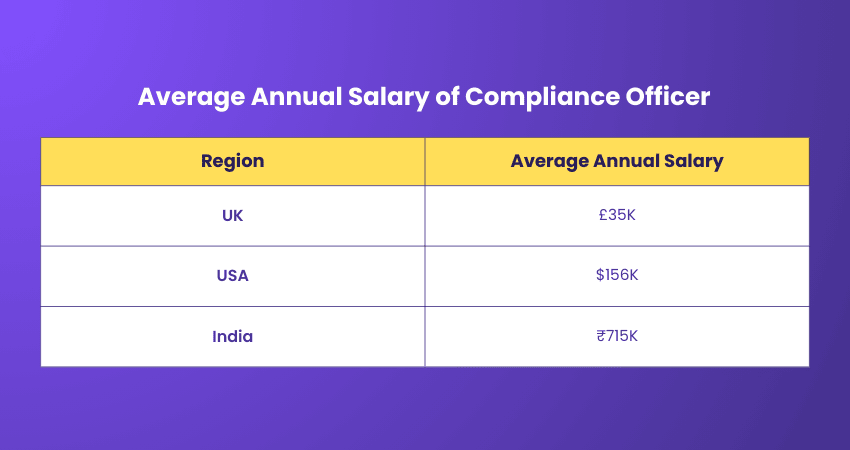
The greater their professional experience, the higher their salary. The role demands elevated standards of integrity, exceptional communication skills, and managerial expertise. Consequently, it is uncommon for companies to appoint Compliance Officers to junior positions.
Here’s a breakdown of the average annual salary earned by a Compliance Officer across three major regions:
How to Become a Compliance Officer?
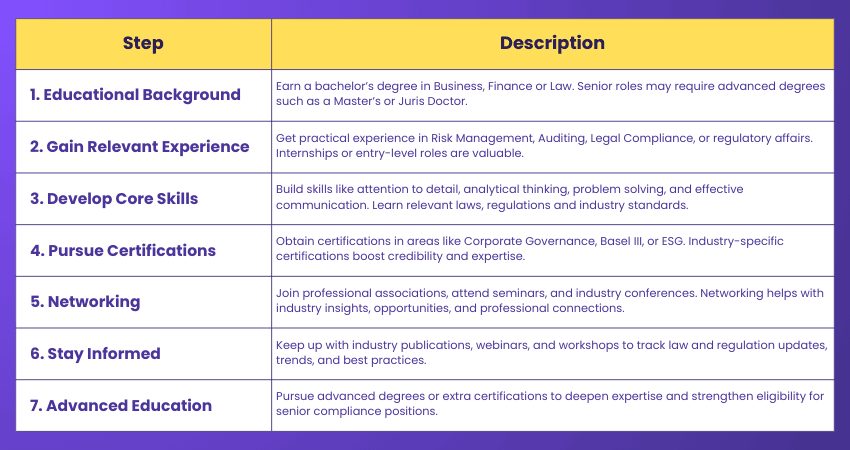
Becoming a Compliance Officer typically involves a combination of education, relevant experience, and obtaining specific skills. The following provides a step-by-step outline on how to become a Compliance Officer:
The Challenges of the Compliance Officer in Performing Their Role
Here are some of the challenges that Compliance Officers face in their role:
1) Regulatory Environment: One of the primary challenges a Compliance Officer might experience is navigating the Complex Regulatory Environment. With fresh regulations being introduced and existing ones evolving rapidly, these professionals must stay updated on these changes and ensure the organisations remain compliant.
2) Criminal Activities: With the growing complexity of financial crimes, such as money laundering, financial crimes are becoming increasingly sophisticated daily. Since COVID-19, the dependency on digital systems and cybercrime has increased multifold. Compliance Officers have to work closely with IT and Cybersecurity teams to implement strong controls and protocols.
3) Budgeting: Compliance departments often face resource constraints in terms of staff, budget, and technology infrastructure. This limits their ability to address regulatory challenges.
4) Integrating New Technologies: As more customers grow comfortable performing online transactions, compliance functions increasingly depend on new technology for reporting, monitoring, and managing regulatory compliance. However, integrating these technologies can be challenging and needs significant training and infrastructure investment.
What are the Three Requirements for the Position of Compliance Officer?
The three requirements for the position of a Compliance Officer are:
1) Reliability: A Compliance Officer must be dependable and committed to following company regulations.
2) Unity: They should align with organisational standards and lead by example for colleagues.
3) Attention to detail: They must have a strong focus to spot and manage compliance issues effectively.
Who Does a Compliance Officer Report to?
Depending on the company’s structure, a Compliance Officer may report to the Board of Directors, the Chief Executive Officer (CEO) or the Audit and Risk Committee. In many organisations, they may also report to the Chief Compliance Officer (CCO) or General Counsel.
Conclusion
A Compliance Officer is the backbone of an organisation’s ethical and regulatory framework. Their role is significant in today’s complex business landscape, from safeguarding operations to strengthening trust. As organisations grow, the demand for skilled Compliance Officers grows as well. So, understanding the Compliance Officer Roles and Responsibilities as outlined in this blog is essential for anyone aiming for a career path in it.
Learn to navigate rules, reduce risks, and build a culture of integrity. Sign up for our comprehensive Compliance Training now!
Frequently Asked Questions
What is a Compliance Officer Responsible for?

A Compliance Officer is responsible for:
a) Identifying and managing regulatory risk.
b) Ensuring internal controls measure and manage risks.
c) Safeguarding ethical integrity and legal conformity.
d) Assessing and managing a company's regulatory risks.
e) Advising management on compliance matters.
What Does a Compliance Officer do Daily?
A Compliance Officer's daily responsibilities often include:
a) Monitoring compliance.
b) Reviewing compliance policies and procedures.
c) Conducting compliance training sessions for employees to raise awareness and prevent violations.
d) Performing regular audits.
e) Responding to any compliance-related concerns.
f) Liaison Work.
What are the Other Resources and Offers Provided by The Knowledge Academy?
The Knowledge Academy takes global learning to new heights, offering over 3,000+ online courses across 490+ locations in 190+ countries. This expansive reach ensures accessibility and convenience for learners worldwide.
Alongside our diverse Online Course Catalogue, encompassing 17 major categories, we go the extra mile by providing a plethora of free educational Online Resources like Blogs, eBooks, Interview Questions and Videos. Tailoring learning experiences further, professionals can unlock greater value through a wide range of special discounts, seasonal deals, and Exclusive Offers.
What is The Knowledge Pass, and How Does it Work?
The Knowledge Academy’s Knowledge Pass, a prepaid voucher, adds another layer of flexibility, allowing course bookings over a 12-month period. Join us on a journey where education knows no bounds.
What are Related Courses And Blogs Provided by The Knowledge Academy?
The Knowledge Academy offers various Compliance Courses, including Corporate Governance Course and Security Governance and Compliance and Chief Compliance Officer Training. These courses cater to different skill levels, providing comprehensive insights into various Compliance Frameworks.
Our ISO & Compliance Blogs cover a range of topics related to ISO and Compliance, offering valuable resources, best practices, and industry insights. Whether you are a beginner or looking to advance your Compliance skills, The Knowledge Academy's diverse courses and informative blogs have you covered.

Hailey Davis


Compliance Officer
Hailey Davis is an ISO compliance expert with over 10 years of experience in audit, quality management systems (QMS), and regulatory compliance. She has worked with various industries, including manufacturing, healthcare, and technology, ensuring organisations achieve and maintain ISO certifications. Hailey’s content provides practical, actionable insights on navigating compliance challenges and improving business processes.
View Detail
Upcoming ISO & Compliance Resources Batches & Dates
Date
 PCI DSS Implementer
PCI DSS Implementer
Thu 16th Apr 2026
PCI DSS Implementer
Thu 6th Aug 2026
PCI DSS Implementer
Thu 26th Nov 2026

 If you wish to make any changes to your course, please


