


 Top Rated Course

We may not have the course you’re looking for. If you enquire or give us a call on +08000201623 and speak to our training experts, we may still be able to help with your training requirements.
Session Fixation: A Hidden Threat to Your Web Sessions
John Davies 29 April 2026Session Fixation is a web security attack where an attacker sets a user's session ID in advance, allowing them to hijack the session after login. This attack puts user accounts and sensitive data at serious risk. Strong Session Management, like regenerating IDs after login, is key to stopping such online threats effectively.

Training Outcomes Within Your Budget!
We ensure quality, budget-alignment, and timely delivery by our expert instructors.
Table of Contents

Have you noticed that once you log into Facebook, Instagram, or your bank account, you don’t need to type your password on every page? That’s because websites use a session ID to keep you logged in. But if a hacker already had that ID, they could enter your account. This attack is called Session Fixation, where hackers trick you into using an ID they already know.
Because of this, it’s important to understand how Session Fixation works and why it’s dangerous. In this blog, we’ll explain this attack in simple words, how it works, its risks, why web apps are vulnerable, real-life examples, prevention tips, challenges, and how it compares with session hijacking.
Table of Contents
1) What is Session Fixation?
2) How Session Fixation Works?
3) Major Risks Associated with Session Fixation
4) How to Prevent Session Fixation?
5) How to Identify Session Fixation Vulnerabilities?
6) What are the Challenges of Session Fixation?
7) Real-life Example of a Session Fixation Attack
8) Why are Web Applications Susceptible to Session Fixation?
9) Comparing Session Fixation and Session Hijacking
10) Conclusion
What is Session Fixation?
Session Fixation is an online attack where a hacker tricks a website’s login system. When you log in, the website gives you a special code called a session ID. This code helps the site know it is you while you use it. But if the site is not safe, a hacker can make you use a code they already know. With that code, they can later enter your account without needing your password.
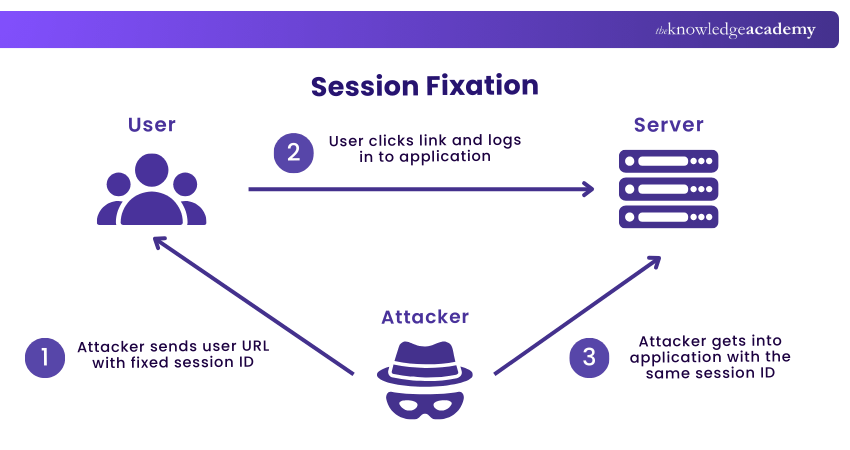
Here’s how it happens: the hacker first visits the website and gets a session ID. Then they trick you into using that same code, often by sending you a fake link. When you log in, the website accepts the hacker’s code. Because you and the hacker now share the same code, the hacker can get into your account and use it as if it were theirs.

How Session Fixation Works?
In a Session Fixation attack, the hacker controls the user’s session ID before the user logs onto a website. The hacker then tricks the user into using this session ID. Later, when the user logs in, the hacker can use the same ID to get into the account.
1) Giving Session ID: The hacker gives the user a session ID, usually through a link or a fake website.
2) User Login: The user login with their username and password, but the login gets linked to the hacker’s session ID.
3) Taking Over: Now the hacker uses the same session ID to enter the account, see private data, and do things without permission.
Learn about real-world experience in Cyber Security. Join our Certified Cybersecurity Technician Certification now!
Major Risks Associated with Session Fixation
Session Fixation can cause big security problems, mainly because hackers can get into accounts and steal information. These are the major risks in it:
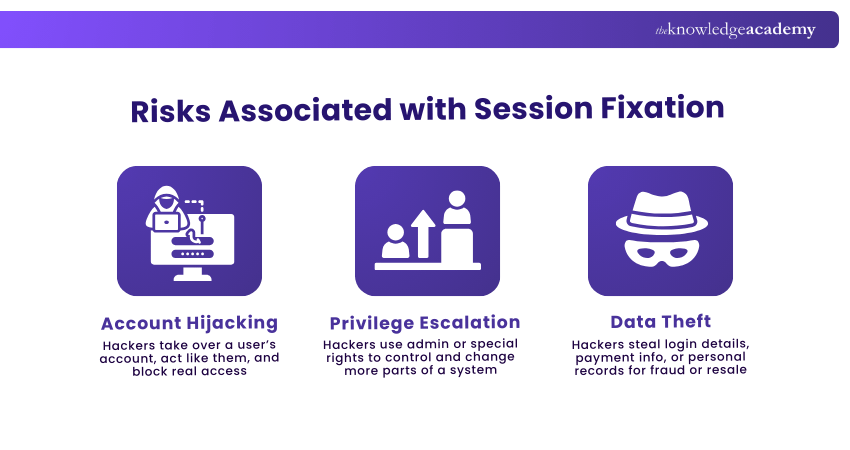
1) Account Hijacking
The hacker can take over the user’s account and act like them. They can see private information or make changes without permission. This can also lock the real user out of their own account.
Example: A hacker gets into your email account and sends messages pretending to be you.
2) Privilege Escalation
If the user has special rights, like admin access, the hacker can also use those rights to control more parts of the system. This could allow them to change settings or delete important data.
Example: A hacker breaks into an admin’s account on a school website and changes student grades.
3) Data Theft
Hackers can steal important information such as login details, payment info, or personal records by using the session ID. This stolen data can later be sold or misused for fraud.
Example: A hacker accesses your shopping site account and steals your saved credit card details.
How to Prevent Session Fixation?
Session Fixation attacks occur due to poor session handling and weak security. Developers must fix flaws like XSS, CSRF, weak passwords, and broken access controls.
Here are some simple best practices for prevention:
1) Use strong, random session IDs that are hard to guess
2) Always use Hypertext Transfer Protocol Secure (HTTPS) to protect data in transit
3) End expired or invalid sessions quickly
4) Make sessions expire after some time
5) Change the session ID right after login
6) Use token-based sessions with built-in time limits and security checks
Learn advanced techniques to protect networks from cyber threats. Join our Ethical Hacking Essentials Certification now!
How to Identify Session Fixation Vulnerabilities?
You can find if a website is vulnerable to Session Fixation by checking a few things:
1) Session ID in Links or Forms: If the website takes the session ID from the web address or a form, it is not safe. Hackers can set this ID and trick users.
2) No New Session ID After Login: If the website does not change the session ID when you log in, hackers can reuse the old one.
3) Session ID Set in Page Code: If the session ID comes from hidden page code, headers, or tags, it can be fixed by attackers.
4) Accepting IDs from GET or POST: If the site allows session IDs in links (GET) or forms (POST), it is risky.
5) Testing with Tools: Security tools and scanners can be used to test if the site has Session Fixation problems.
What are the Challenges of Session Fixation?
Even though prevention methods for Session Fixation work well, there are some problems to think about:
1) Old Systems: Many old websites don’t support safe session features. Updating them to use new methods like session ID changes or secure cookies can take a lot of time and money.
2) User Experience: If sessions expire too quickly or IDs change too often, users may get logged out in the middle of their work. This can be annoying during long tasks.
3) Compatibility: Some security methods, like SameSite cookies, may not work on all browsers, especially older ones. This can stop some users from using the site safely.
4) Extra Load: Always changing and checking session IDs can make the server work harder. If not managed well, this may slow down the website.
Attain in-depth knowledge about network security controls and protocols. Join our Certified Network Defender Certification now!
Real-life Example of a Session Fixation Attack
These are the real-life examples of a Session Fixation attack:
1) Hacker Gets a Session ID: The hacker visits the website and gets a session ID. On some sites, they can even set one through a link or form without visiting.
2) Hacker Sends a Fake Link: The hacker sends the victim a special link, like:
http://example.com/login?SID=KNOWNSID123
This link puts the hacker’s session ID into the victim’s browser.
3) Victim Logs In: The victim clicks the link and logs in. The site uses the hacker’s session ID for the login.
4) Hacker Takes Over: Because both are using the same session ID, the hacker can now enter the victim’s account and act like them.
Why are Web Applications Susceptible to Session Fixation?
Session Fixation is not one clear weakness like Structured Query Language (SQL) injection. It happens when a website has poor security in Session Management.
1) Some sites don’t check if a session ID is valid, so hackers can use any code
2) Some give a session ID before login and never change it
3) Some allow session IDs in links or forms, making it easy for hackers to set them
Comparing Session Fixation and Session Hijacking
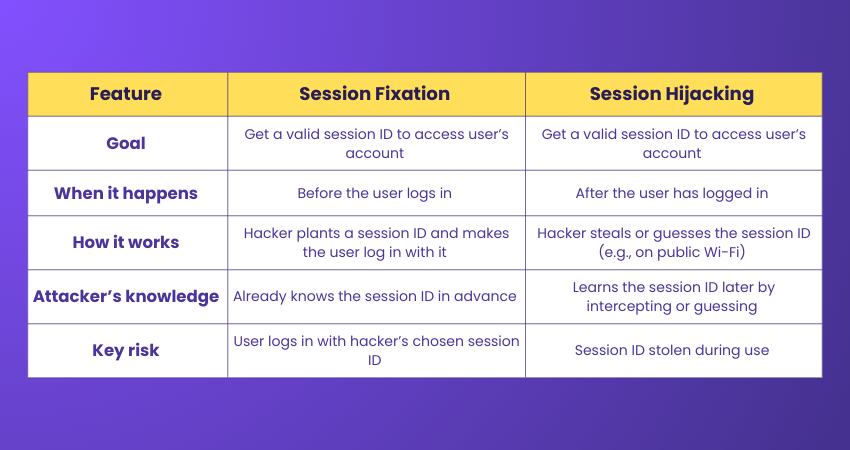
Both attacks target weak Session Management to steal a valid session ID. Here’s a side-by-side comparison:
Conclusion
Session Fixation is a serious web security risk that lets attackers take over user accounts by exploiting weak Session Management. While it may seem less known than other attacks, its impact can be just as damaging, leading to data theft and account misuse. By using secure coding, strong session handling, and regular testing, businesses and users can stay safe against this hidden web session threat.
Learn to implement robust security policies and protocols. Join our EC – Council Certification Training now!
Frequently Asked Questions
What are the Best Practices for Session Fixation?

Best practices include regenerating session IDs after login, using secure cookies, setting timeouts, avoiding IDs in URLs, and applying HTTPS. Developers should also audit sessions regularly. Users should log out after use and avoid unsafe links.
What is Session Fixation OWASP?
According to the Open Web Application Security Project (OWASP), Session Fixation is a web vulnerability where an attacker sets a user’s session ID before login. To prevent it, OWASP advises regenerating session IDs after authentication and using secure cookie handling.
What are the Other Resources and Offers Provided by The Knowledge Academy?
The Knowledge Academy takes global learning to new heights, offering over 3,000+ online courses across 490+ locations in 190+ countries. This expansive reach ensures accessibility and convenience for learners worldwide.
Alongside our diverse Online Course Catalogue, encompassing 17 major categories, we go the extra mile by providing a plethora of free educational Online Resources like Blogs, eBooks, Interview Questions and Videos. Tailoring learning experiences further, professionals can unlock greater value through a wide range of special discounts, seasonal deals, and Exclusive Offers.
What is The Knowledge Pass, and How Does it Work?
The Knowledge Academy’s Knowledge Pass, a prepaid voucher, adds another layer of flexibility, allowing course bookings over a 12-month period. Join us on a journey where education knows no bounds.
What are the Related Courses and Blogs Provided by The Knowledge Academy?
The Knowledge Academy offers various EC – Council Certification Training, including the Certified Ethical Hacker (CEH) Certification, Certified Network Defender Certification, and the Certified Cybersecurity Technician Certification. These courses cater to different skill levels, providing comprehensive insights into Multi-Factor Authentication.
Our IT Security & Data Protection Blogs cover a range of topics related to Session Fixation, offering valuable resources, best practices, and industry insights. Whether you are a beginner or looking to advance your IT Security & Data Protection skills, The Knowledge Academy's diverse courses and informative blogs have got you covered.

John Davies


Cyber Security Governance & Assurance Specialist
John Davies is a cybersecurity expert specialising in governance, risk management, and compliance. With over 15 years in the field, he has led enterprise-wide security programmes across finance, healthcare and public sector organisations. His content provides practical guidance on building secure environments, managing risk and aligning with regulatory frameworks.

Upcoming IT Security & Data Protection Resources Batches & Dates
Date
 Certified Ethical Hacker (CEH) Certification
Certified Ethical Hacker (CEH) Certification
Mon 19th Oct 2026

 If you wish to make any changes to your course, please


