


 Top Rated Course


We may not have the course you’re looking for. If you enquire or give us a call on +08000201623 and speak to our training experts, we may still be able to help with your training requirements.
Agile Project Management with Scrum for Team Success
David Evans 12 January 2026Agile Project Management with Scrum helps teams deliver projects efficiently. Learn Scrum roles, events, and practices to drive collaboration and success. It provides structure through defined roles like Scrum Master and Product Owner, events like sprint planning and daily Scrum and artefacts like Product Backlog and Sprint Backlog.

Training Outcomes Within Your Budget!
We ensure quality, budget-alignment, and timely delivery by our expert instructors.
Table of Contents
Agility is nothing short of a survival skill in the speedy business world. Success today requires teams that adapt to change quickly and effortlessly while still delivering exceptional results. This is where the idea of Agile Project Management with Scrum comes in to blend flexibility with structure. Scrum empowers teams to innovate and adapt with ease by breaking big goals into manageable steps.
This blog explores what makes Agile Project Management with Scrum so valuable to every leader, whether they are launching a startup or already scaling enterprise solutions. So read on and establish the foundation for organisational success one sprint at a time!
Table of Contents
1) Agile Project Management with Scrum: An overview
2) What is Scrum?
3) Benefits of Agile Project Management with Scrum
4) How to Implement Agile Project Management with Scrum?
5) Can Scrum and Agile be Used Together?
6) Can You Have Agile Without Scrum?
7) Conclusion
Agile Project Management with Scrum: An overview
Agile Project Management with Scrum brings an iterative and flexible approach to the table. It empowers teams to adapt to shifting requirements without compromising on consistent value delivery. Its lightweight structure makes it a popular framework for managing even the most complex projects.
Scrum is about an empirical mindset, where decisions stem from observation and experimentation rather than upfront planning. At its core, this framework stands on three guiding pillars:
1) Transparency: Everyone gains a clear view of the project’s goals, progress and challenges. This creates stronger trust and informed decision-making.
2) Inspection: Regular reviews help teams identify deviations early and take timely corrective action. This helps ensure that potential issues are addressed before they escalate.
3) Adaptation: Scrum embraces change by encouraging teams to refine the plans as new insights pop up. This flexibility helps minimise risks and respond to evolving needs.
What is Scrum?
Scrum is an Agile framework to accomplish iterative and incremental product delivery. It helps teams respond to change quickly. To manage the requirements while maintaining control over time and cost, Scrum relies on the following:
1) Time-boxed events
2) Product backlogs
3) Regular feedback loops
A major strength of Scrum is the active involvement of business stakeholders. This is because successful delivery depends on open communication and collaboration between teams and customers.
History of Scrum
Let’s explore where it all began for Scrum and what evolution it went through:
1) 1986: Hirotaka Takeuchi and Ikujiro Nonaka introduced the foundations of Scrum in their Harvard Business Review article “The New New Product Development Game”.
2) 1993: The framework took its modern shape when Jeff Sutherland, John Scumniotales and Jeff McKenna at Easel Corporation implemented Scrum concepts.
3) 1995: Ken Schwaber formally presented Scrum to the public in the paper “The Scrum Development Process” at the OOPSLA Conference in Austin, Texas.
4) 2001: 17 pioneers drafted and signed the ‘Agile Manifesto’. With its four core values and twelve guiding principles, it provided the foundation for modern Agile practices.
5) 2006: Jeff Sutherland established Scrum Inc., to offer consulting and training while continuing to contribute to the wider Scrum movement.
6) 2010: Ken Schwaber and Jeff Sutherland published the inaugural ‘Scrum Guide’ in offering a concise, globally recognised definition of Scrum.
Start your Agile leadership journey with us through our comprehensive Scrum Master Certification – Register now!
The Scrum Framework
The Scrum Framework is a proven way of organising and managing work based on the principles of empiricism. It means that decisions are made based on observation, experience, and experimentation. The Scrum Framework also provides opportunities for feedback and improvement throughout the process.
The Scrum Framework consists of a team of people who have different roles and responsibilities. The framework also consists of a set of events and artefacts that help the team structure and manage their work. Let's explore them below:
1) Events: The events are sprint planning, where the team plans what to do in the next Sprint.
2) Daily Scrum: This is where the team coordinates their daily activities.
3) Sprint Review: Here, the team inspects the product increment and gets feedback from stakeholders.
4) Sprint Retrospective: This is where the team review their performance and identifies areas for improvement.
5) Artefacts: The artefacts are Product Backlog, where the Product Owner maintains a list of the work to be done
6) Sprint Backlog: Here, the developers select and plan the work for the current Sprint.
7) Increment: This is where the developers produce a product increment at the end of each and every sprint.
Roles and Responsibilities
Scrum is a popular framework for the management of complex projects in an Agile way. Scrum has three major roles: the Product Owner, the Scrum Master, and the Development Team. Each role has different responsibilities and works together to deliver value to the customer. Here is a brief explanation of each role and its responsibilities:
1) Product Owner
The Product Owner is the individual who represents the needs of the customer and the business. They are responsible for prioritising the product backlog, which is a list of key features and requirements for the product.
Product Owners also communicate the vision and goals of the product to the Scrum Team and stakeholders. They cooperate with the Development Team and the Scrum Master to ensure that the product fulfils the expectations and delivers value.
2) Scrum Master
The Scrum Master is the person who facilitates the Scrum process and makes sure that the Scrum Team follows the Scrum values and principles. They are responsible for coaching and mentoring the Scrum Team, removing any impediments or obstacles that might hinder the team’s progress.
Besides, they organise and lead the Scrum events, such as the sprint planning, the daily Scrum, the sprint review, and the sprint retrospective. They also work with the Product Owner and the stakeholders to create a productive and collaborative environment.
3) The Development Team
The Development Team is the group of people who do the actual work of developing and delivering the product. They are responsible for planning and executing the sprints, which are short iterations of work that result in a potentially releasable product increment.
The Development Team is self-organising, cross-functional, and accountable for the quality and functionality of the product. The Development Team also collaborates with the Product Owner and the Scrum Master to provide feedback and suggestions for improvement.
4) The Stakeholder
The Stakeholder is anyone who has an interest or influence in the product or the project, such as the customer, the user, the sponsor, the Manager, the Analyst, the Tester, etc. The stakeholder is not part of the Scrum Team, but they may provide feedback, requirements, or support to the team.
The Stakeholder may also attend some Scrum events, such as the Sprint review, to inspect the product and share their opinions. They should respect the Scrum values and principles and collaborate with the Scrum Master and the Product Owner to make sure the project is a success.
5) The Agile Coach
The Agile Coach has extensive experience and knowledge in Agile Methodologies, such as Scrum. They can help the organisation and its teams adopt and improve their agile practices. The Agile Coach is not part of the Scrum Team, but they may work with the team, Scrum Master, Product Owner and the stakeholders to provide mentoring and facilitation. The Agile Coach may also help resolve any conflicts or challenges that the team may face and grow a better culture of innovation and learning.
Tracking Progress
After the sprint planning meeting is done and the team commits to the work, it's time to monitor the progress. The monitoring happens through clear and highly visible information radiators, such as the burndown chart and task board. The task board helps the team visualise and manage the status of tasks linked to each feature.
At its simplest, it contains three columns: To Do, Doing and Done. During daily scrum meetings, the team gathers at the board. They move tasks across columns while discussing what was accomplished yesterday, the plan for today, and any challenges currently faced.
Upgrade your Developer skills for the Agile era and bring order to your sprints with our Scrum Developer Training – Sign up now!
Benefits of Agile Project Management with Scrum
As part of Agile Project Management, Scrum offers numerous benefits that contribute to good project outcomes. Let’s explore the Benefits of Agile Project Management with Scrum:
1) Improved Flexibility: Scrum in Agile Project Management lets teams to adapt quickly to changing requirements and business priorities. This enhances project flexibility and responsiveness.
2) Enhanced Collaboration: The Framework promotes close collaboration and communication between stakeholders, customers and team members. This helps foster a shared understanding and increases project success.
3) Faster Delivery: By delivering value incrementally in short iterations (sprints), Scrum enables faster delivery of tangible results, ensuring that stakeholders receive value sooner.
4) Increased Customer Satisfaction: Scrum in Agile Project Management ensures regular stakeholder involvement and feedback. This helps improve customer satisfaction and alignment with expectations.
5) Higher Quality: Scrum’s iterative and incremental approach enables continuous inspection and adaptation, resulting in higher-quality deliverables and reduced risks of defects.
6) Transparency: Scrum in Agile Project Management emphasises transparency by making project progress, challenges, and objectives visible to all stakeholders. As a result, itfosters trust and informed decision-making.
7) Efficient Resource Utilisation: Scrum also enables optimal resource allocation and utilisation through self-organising teams, ensuring that project resources are effectively utilised.
8) Continuous Improvement: The framework promotes a culture of continuous improvement through regular retrospectives. This allows teams to identify areas for growth and implement changes to enhance future performance.
9) Reduced Project Risks: Scrum’s iterative nature allows teams to identify and mitigate project risks early, reducing the likelihood of significant issues or failures.
10) Empowered Teams: Agile Project Management, along with Scrum, empowers the team to take ownership and make decisions, resulting in increased engagement, motivation, and accountability.
Make sure your team sprints their way to the project finish line with ease. Sign up for our Agile and Scrum Awareness Training now!
How to Implement Agile Project Management with Scrum?
Implementing Scrum in Agile Project Management involves several steps to ensure a smooth transition. Here is the proven step-by-step approach:
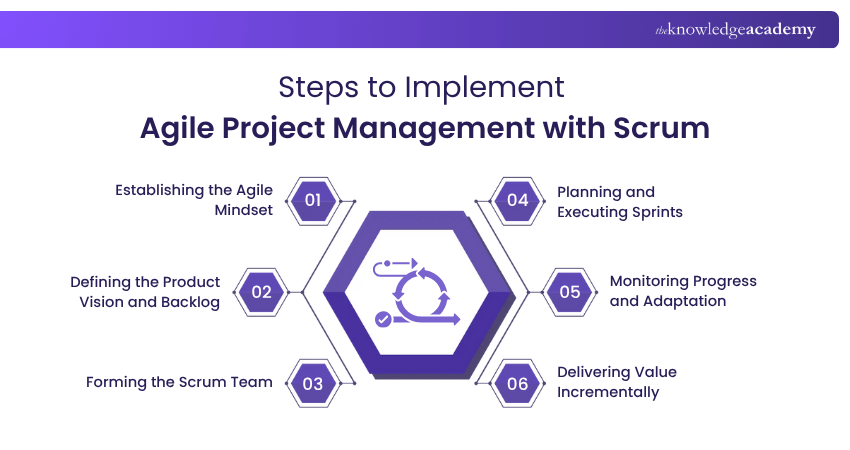
Step 1: Establishing the Agile Mindset
To begin with, it's crucial to establish an Agile mindset within the organisation. This involves the following:
1) Embracing change and adaptability as inherent aspects of the project
2) Encouraging self-organising teams
3) Empowering teams to make informed decisions and take ownership of their work
Step 2: Defining the Product Vision and Backlog
Clearly defining the project's goals, objectives, and vision. This step in Agile Project Management includes performing the following activities:
1) Identifying the desired outcomes and benefits the project aims to achieve.
2) Creating a product backlog that represents all the requirements, features, and enhancements needed for the project.
3) Prioritising backlog items based on business value and stakeholder needs.
Step 3: Forming the Scrum Team
Assembling a dedicated Scrum Team that will work collaboratively throughout the project involves:
1) Outlining the roles and responsibilities of each team member, including the Product Owner, Scrum Master, and Development Team
2) Selecting team members with the required skills and expertise to deliver the project increment
3) Encouraging cross-functional collaboration.
4) Ensuring that the team has the right mix of skills to address all project requirements.
Step 4: Planning and Executing Sprints
Scrum Sprints are time-boxed iterations where the Scrum Team works to release a potentially shippable product increment. The key activities are as follows:
1) Conducting a sprint planning meeting to define the scope of the sprint.
2) Selecting the backlog items to be addressed.
3) Creating a sprint backlog that outlines the tasks required to complete the selected backlog items.
4) Holding daily Scrum meetings to provide updates.
5) Discussing progress, identifying and addressing any obstacles.
6) Conducting a sprint review to showcase the completed increment to stakeholders and gather feedback.
7) Facilitating a sprint retrospective to reflect on the sprint.
8) Identify areas for improvement in future sprints.
Step 5: Monitoring Progress and Adaptation
In this step, it is essential to monitor the team's progress and adapt accordingly. This includes:
1) Tracking Scrum Team’s velocity and using burndown charts to visualise the progress and identify any deviations.
2) Conducting regular retrospectives to evaluate the team's performance and identify opportunities for improvement.
3) Adapting and improving processes based on the insights gained from retrospectives to enhance productivity and delivery efficiency.
Get Scrum Professional and become the Agile force your team needs, Sign up for our comprehensive range of Scrum Certifications now!
Step 6: Delivering Value Incrementally
The ultimate goal of Scrum in Agile Project Management is to deliver value incrementally. This involves the following:
1) Adopting an incremental approach to product development
2) Delivering and ensuring that stakeholders receive tangible value at the end of each sprint
3) Actively seeking customer feedback
4) Incorporating it into the product development procedure to ensure customer satisfaction and alignment with their expectations

Can Scrum and Agile be Used Together?
Yes, they can be used together. In fact, they already are. Agile is the overarching philosophy built on flexibility, collaboration, and iterative delivery. Scrum is one of the most popular frameworks that puts Agile principles into practice. Using them together means applying Agile values while following Scrum’s defined roles, events and artefacts.
Can You Have Agile Without Scrum?
Absolutely. The Agile philosophy can be applied through many frameworks, not just Scrum. Teams can follow Agile principles using alternatives like Kanban, Extreme Programming (XP), Crystal or Lean. Even without a formal framework, organisations can still embrace Agile values to improve outcomes and respond to change effectively.
Conclusion
Agile Project Management with Scrum empowers teams to deliver value step by step with clarity. By incorporating transparency, adaptability and collaboration, the Scrum Values and Principles transform every challenge into a milestone. It serves as a pathway to lasting team success and continuous improvement.
Ignite your potential in the dynamic world of Agile methodologies with our AgilePM® Foundation & Practitioner (AgilePM® V3) Course - Sign up now!
Frequently Asked Questions
How does Agile Scrum helps in better Project Management?

Scrum is a popular framework that allows teams to deliver products using Agile methodology by following an iterative and incremental approach. Scrum is often considered a way of managing projects in a flexible and effective manner.
Is Scrum good for Project Management?
Scrum is a framework for delivering a product that meets the customer’s needs and expectations in an Agile way. Scrum can be good for Project Management depending on the type, size, and complexity of the project, as well as the skills, experience, and preferences of the team and the stakeholders.
What are the other resources and offers provided by The Knowledge Academy?
The Knowledge Academy takes global learning to new heights, offering over 3,000 online courses across 490+ locations in 190+ countries. This expansive reach ensures accessibility and convenience for learners worldwide.
Alongside our diverse Online Course Catalogue, encompassing 19 major categories, we go the extra mile by providing a plethora of free educational Online Resources like Blogs, eBooks, Interview Questions and Videos. Tailoring learning experiences further, professionals can unlock greater value through a wide range of special discounts, seasonal deals, and Exclusive Offers.
What is The Knowledge Pass, and How Does it Work?
The Knowledge Academy’s Knowledge Pass, a prepaid voucher, adds another layer of flexibility, allowing course bookings over a 12-month period. Join us on a journey where education knows no bounds.
What are the Related Courses and Blogs Provided by The Knowledge Academy?
The Knowledge Academy offers various Scrum Certification, including Managing Agile Projects with Scrum , Scrum Master Certification and Scrum Product Owner Certification. These courses cater to different skill levels, providing comprehensive insights into Sprint Retrospective.
Our Project Management Blogs cover a range of topics related to Scrum, offering valuable resources, best practices, and industry insights. Whether you are a beginner or looking to advance your Project Management skills, The Knowledge Academy's diverse courses and informative blogs have got you covered.

David Evans


Certified Project Trainer and Agile Delivery Expert
David Evans brings over a decade of hands-on experience in project delivery, Agile transformation, and team leadership. With a background in technology and business consulting, David has led cross-functional teams through Agile and Waterfall projects in both public and private sectors. He combines technical knowledge with practical insights to help readers navigate the challenges of modern project environments.


 If you wish to make any changes to your course, please


