


 Top Rated Course

We may not have the course you’re looking for. If you enquire or give us a call on +44 1344 203 999 and speak to our training experts, we may still be able to help with your training requirements.
Talent Acquisition Strategy: Build a High-Growth Team
Amelia Williams 27 April 2026A Talent Acquisition Strategy involves planning and executing methods to attract, identify, and hire top talent effectively, aligning with long-term business goals. It helps organisations anticipate their hiring needs and proactively engage with potential candidates. Read this blog to learn effective Talent Acquisition Strategies.

Training Outcomes Within Your Budget!
We ensure quality, budget-alignment, and timely delivery by our expert instructors.
Table of Contents

Ever wondered why some companies effortlessly attract top talent while others face challenges? The secret lies in a well-crafted Talent Acquisition Strategy. This strategy is essential for building a workforce that aligns with your organisation’s long-term goals. It involves strategic planning and execution to identify and engage the right candidates.
Dive into this blog to learn how to create an effective Talent Acquisition Strategy. By applying these insights, you can revolutionise your hiring process and drive your business toward success.
Table of Contents
1) What is a Talent Acquisition Strategy?
2) Effective Talent Acquisition Strategies
3) Examples of Talent Acquisition Strategy
4) Difference Between Talent Acquisition and Recruitment
5) Conclusion
What is a Talent Acquisition Strategy?
A Talent Acquisition Strategy is a systematic approach to identifying, evaluating, and hiring the best candidates. This method aligns with an organisation’s long-term goals to ensure sustained growth and success. Here are some key elements and best practices of this method:
Key Elements:
1) Strong Employer Branding: Build a positive image to attract top talent.
2) Positive Candidate Experience: Ensure a smooth and engaging recruitment process.
3) Sense of Community: Foster a supportive and inclusive workplace culture.
4) Strategic Talent Sourcing: Be deliberate about where and how you find talent.
Best Practices:
1) Avoid Quick Hires: Don’t hire just to fill positions quickly.
2) Align with Company Goals: Assess your unique goals and think beyond immediate needs.
3) Understand Department Needs: Know the specific skills and traits required by each department.
By focusing on these elements, you can cultivate an engaged and effective organisation.
Effective Talent Acquisition Strategies
As a company grow, it’s important to regularly review and improve the applicant process. This will address if there are any gaps in your recruiting efforts.

1) Align Your Talent Acquisition with Business Objectives
Consider your business goals for the next one to five years and develop a Talent Acquisition Strategy that aligns with those objectives. To streamline this process and ensure effective workforce planning, leveraging Talent Management Software can help optimise recruitment, retention, and overall talent development. You may also refer to the points below to build your own Talent Acquisition Strategy.
a) Use your long-term goals to shape your Talent Acquisition Strategy.
b) If you are planning to expand into new regions, attract candidates with relevant international or regional experience.
c) If you have any plans to develop new products, focus on hiring talented software developers and coders.
d) Consider the types of talent you’ll need for future growth, even for roles that don’t yet exist.
e) Prioritise long-term benefits by investing in candidates who align with your strategic goals.
These strategies can ensure your talent acquisition efforts are aligned with your company’s growing needs and long-term success.
2) Leverage Data and Marketing to Improve Recruitment Materials
If you get a chance to launch a marketing campaign, will you do it without proper data? No right? So, why should your recruitment process be any different? Talent acquisition deserves the same focus as marketing efforts. Attracting the right candidates is just as important as convincing customers to buy your products.
Here are some ways to use data in your Talent Acquisition Strategy:

a) Identify Sources of Top Talent: Use data to discover where your best candidates originate. This insight can help you target specific academic programs or professional networking sites.
b) Collaborate with Marketing: Work with your marketing team to enhance job descriptions, career pages, and recruitment emails. Their expertise can help create more appealing content.
c) Optimise Application Processes: Analyse data to determine if specific questions discourage candidates from applying. Remove or rephrase those questions to make the application process smoother.
d) Enhance Company Culture Visibility: Consider adding images or videos showcasing your company culture. This can make your job listings more attractive and encourage more candidates to apply.
e) A/B Testing: Test different job descriptions to see which one attracts more applicants. This data-driven approach can refine your recruitment messaging.
3) Strengthen Your Employer Brand
Millennials and older Gen Z candidates, who grew up with the internet and social media, dominate the job market. They research your business through social media, websites, and job boards to understand your work culture. Consider the points below to strengthen your employer brand:
a) Address Candidate Questions: Showcase workplace atmosphere, employee happiness, and growth potential.
b) Leverage Employees: Use images and videos of employees at work, encourage online interaction, and celebrate internal promotions.
c) Focus on Well-being: A company that prioritises staff well-being attracts top talent.
d) Build a Positive Identity: Reflect on a positive, growth-oriented environment to enhance your Talent Acquisition Strategy.
4) Broaden Your Outreach Efforts
To find better talent, diversify your sourcing strategies. Different skill sets require different outreach methods. For example, your best marketers and programmers are likely found in different places. Here are some tips to consider:
a) Don’t rely solely on LinkedIn. Explore specialised job boards, academic programs, and networking events.
b) Use some tools to streamline recruiting and calendar coordination.
c) Decide where your top talent is found—professional events, conferences, online forums, or social networks.
d) Strengthen relationships and network with the right people to grow your talent pool and enhance brand awareness.
5) Foster Internal Diversity
Even though we are in the 21st century, many industries remain male-dominated, leading to women feeling underrepresented. Despite more women joining the workforce, men still hold most leadership roles. Racial disparities also persist in corporate America. However, the Advantages of Internal Recruitment can play a key role in addressing these disparities, as HR can help by forming internal coalitions to boost morale and enhance diversity and inclusion.
To build a diverse and inclusive culture:
a) Start at the Top: Leaders should educate themselves on various cultural traditions and backgrounds.
b) Value Different Perspectives: Create a workplace where diverse viewpoints are encouraged and respected.
c) Lead by Example: Employees often follow their leaders’ examples, so setting a positive example can significantly improve internal diversity.
d) Form Internal Coalitions: HR can create groups to boost morale and drive diversity and inclusion efforts from within the workforce.
Learn to inspire, motivate, and lead diverse teams successfully with our in-depth People Management Courses – Register today!
6) Provide Flexible Work Options
Talent acquisition specialists have adapted to online onboarding, reflecting the evolving workforce’s preference for better work/life balance and remote work, which boosts productivity. To stay competitive, companies should leverage Talent Acquisition Software to streamline hiring, enhance candidate experience, and optimise recruitment strategies.
a) Embrace Flexibility: Offer remote or hybrid work options.
b) Invest in Technology: Use advanced talent acquisition software.
c) Focus on Work/Life Balance: Implement policies supporting well-being and productivity.
d) Update Recruitment Strategies: Adopt modern, data-driven approaches.
e) Promote a Positive Culture: Foster an inclusive, supportive environment.
7) Allocate More Resources to the DE&I Department
Diversity, equity, and inclusion (DE&I) are crucial for a successful Talent Acquisition Strategy. Key points include:
a) Implement DE&I Training: Show commitment to current trends.
b) Prioritise Retention: Focus on retaining diverse talent for ROI.
c) Eliminate Bias in Resume Reviewing:
i) Remove Identifiers: Exclude names and photos.
ii) Anonymous Applications: Review resumes anonymously.
iii) Diverse Hiring Team: Ensure multiple perspectives in selection.
8) Develop a Competitive and Comprehensive Benefits Package
When considering compensation packages, employees might accept a lower salary if it includes comprehensive health benefits. Here are some key points to consider:
a) Health Benefits: Offer medical, vision, and dental insurance.
b) Mental Health Support: Provide programs like Employee Assistance Programs (EAP).
c) Work/Life Balance: Ensure your business model supports a healthy work/life balance.
d) Healthcare: Make sure employees can receive sufficient healthcare.
e) Retirement and Investment Opportunities: Offer attractive retirement or investment options.
Potential candidates will ask these questions about your company. Therefore, it’s essential to provide comprehensive answers with a well-rounded benefits plan.
9) Introduce Additional Incentives
Large to mid-size corporations often use attractive bonuses and employee benefits to compete in the global market and attract top talent. However, financial incentives aren’t the only factors that matter.
When talented candidates compare companies, they consider values, culture, and work-life balance. By cultivating an impressive employer brand, you can attract better talent and achieve long-term success.
To excel in talent acquisition, you need to answer the question, “Why choose your company over others?” This is why employer branding is crucial for finding the best employees.
Key Strategies for Effective Employer Branding:
1) Highlight Company Values and Culture:
a) Showcase your company’s values and culture, emphasising collaboration and a positive work environment.
b) Mention flexible remote policies and work-life balance perks.
2) Promote Growth Opportunities:
a) Emphasise career development and growth opportunities within your company.
3) Leverage Employee Review Sites:
a) Use platforms like Glassdoor to broadcast your company’s unique attributes.
b) Ensure your “About Us” page on your website reflects your company’s strengths.
When highly qualified candidates are considering your company, these reviews and highlights can be the deciding factor.
Enhance your team performance and productivity with our Successful People Management and Team Leadership – Sign up today!
Examples of Talent Acquisition Strategy
Businesses employ various strategies to attract and retain top talent. Here are three notable examples:
1) Ben & Jerry’s
Employer Branding Since 1985, Ben & Jerry’s has donated 7.5% of pretax earnings to social causes. They have been a vocal supporter of voting rights and racial justice. Their company website features a dedicated section highlighting their values and commitment to social responsibility. This reinforces their strong employer brand.
2) PURE
The American property insurance company PURE boasts an impressive employee referral rate of 40-60%. New hires are asked within their first few weeks if they know anyone who could be a good fit for the company. This strategy increases referrals and underscores the importance of employee recommendations in attracting qualified candidates and saving time and resources.
3) IBM
Talent Pipelining IBM has established partnerships with several universities in the United States for teaching and research. This approach allows IBM to build relationships with potential candidates while they are still studying. This enables the company to attract top talent upon graduation and improve retention rates.
Difference Between Talent Acquisition and Recruitment
While talent acquisition and recruitment may seem similar, they have several key differences. Understanding these distinctions can help you optimise your hiring strategy:
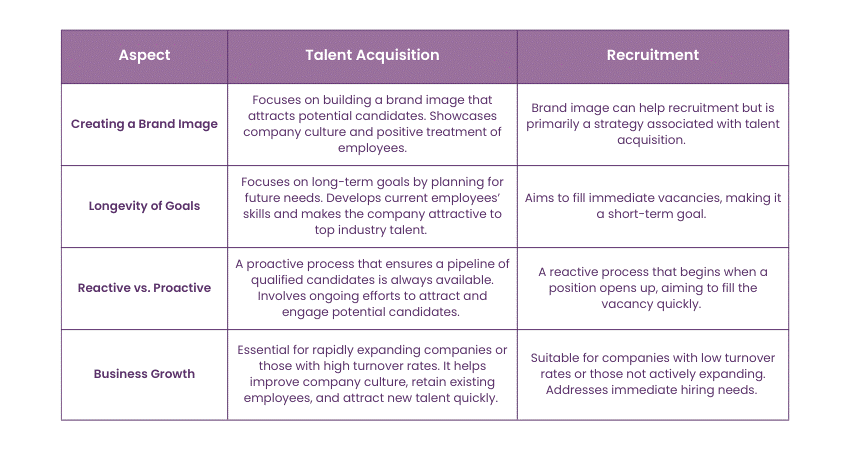
Develop advanced skills in sourcing, evaluating, and hiring talent to meet your company’s needs with our Talent Acquisition Training – Join now!
Conclusion
A well-executed Talent Acquisition Strategy is key to attracting and retaining top talent that is aligned with your long-term business goals. By leveraging data, refining processes, and enhancing employer branding, you can create a strong foundation for sustainable growth and a high-performing workforce.
Frequently Asked Questions
What is Included in a Talent Strategy?

A talent strategy includes workforce planning, employer branding, talent acquisition, employee engagement, development programs, and retention strategies. It aligns with business goals to ensure the right talent is in place to drive organisational success.
How do you Measure Talent Strategy?
Measure talent strategy through key metrics like time-to-hire, quality of hire, employee retention rates, candidate satisfaction, and diversity metrics. Regularly reviewing these metrics helps assess the effectiveness of the strategy and identify areas for improvement.
What are the Other Resources and Offers Provided by The Knowledge Academy?
The Knowledge Academy takes global learning to new heights, offering over 3,000+ online courses across 490+ locations in 190+ countries. This expansive reach ensures accessibility and convenience for learners worldwide.
Alongside our diverse Online Course Catalogue, encompassing 19 major categories, we go the extra mile by providing a plethora of free educational Online Resources like Blogs, eBooks, Interview Questions and Videos. Tailoring learning experiences further, professionals can unlock greater value through a wide range of special discounts, seasonal deals, and Exclusive Offers.
What is The Knowledge Pass, and How Does it Work?
The Knowledge Academy’s Knowledge Pass, a prepaid voucher, adds another layer of flexibility, allowing course bookings over a 12-month period. Join us on a journey where education knows no bounds.
What are Related Courses and Blogs Provided by The Knowledge Academy?
The Knowledge Academy offers various People Management Courses, including Talent Acquisition Training, Talent Management Training and Successful People Management and Team Leadership Training. These courses cater to different skill levels, providing comprehensive insights into Talent Management.
Our HR Resources Blogs cover a range of topics related to Talent Acquisition, offering valuable resources, best practices, and industry insights. Whether you are a beginner or looking to advance your HR Management skills, The Knowledge Academy's diverse courses and informative blogs have you covered.

Amelia Williams


Senior Human Resources Consultant and Learning Specialist
Amelia Williams is a highly respected HR professional with over 12 years of experience in human capital management, talent development and workplace policy. She has worked across sectors including education, healthcare and corporate services, focusing on aligning people strategies with organisational goals. Amelia’s writing blends current HR trends with practical solutions for modern workplace challenges.

Upcoming HR Resources – Learn about Human Resources Batches & Dates
Date
 Talent Acquisition Training
Talent Acquisition Training
Fri 28th Aug 2026
Talent Acquisition Training
Fri 27th Nov 2026

 If you wish to make any changes to your course, please


