


 Top Rated Course

We may not have the course you’re looking for. If you enquire or give us a call on +44 1344 203 999 and speak to our training experts, we may still be able to help with your training requirements.
Magento vs Shopify: Which eCommerce Platform is Better?
Lily Turner 16 July 2026Magento and Shopify are two of the most popular E-commerce platforms today. They help businesses create and manage their E-commerce websites, which allows them to sell products, manage inventory, and handle easy transactions. Read on as we dive into the differences between Magento vs Shopify and choose for your e-commerce portfolios.

Training Outcomes Within Your Budget!
We ensure quality, budget-alignment, and timely delivery by our expert instructors.
Table of Contents
Do you possess the passion to manage and create online stores? Can you seamlessly navigate E-commerce platforms? Magento and Shopify are some of the E-commerce platforms that are made for you. In this blog, you will learn about Magento vs Shopify and unveil their critical differences. This will help you decide which platform is suitable for your business needs. Wasting very little time, let's dive straight into the topic!
Table of Contents
1) What Is Magento?
a) Advantages of Magento
2) What Is Shopify?
a) Advantages of Shopify
3) Difference Between Magento and Shopify
4) Conclusion
What is Magento?
Magento is an E-commerce platform designed to create and manage an online store. It serves as a comprehensive toolkit for building a website where you can sell products, track inventory, and handle payments. Whether you're exploring E-commerce business ideas for a small startup or managing a large corporation, Magento offers scalable solutions to fit your needs.
To help you understand better, let's take an example. Suppose you want to start selling your baked goods online.
You download Magento from their website and install it on your web server.
Then, you choose a theme that matches the look and feel of your bakery, possibly something with warm colors and a residential design.
You upload pictures and descriptions of your baked goods and organise them into categories, such as "Cookies," "Cupcakes," and "Breads."
You then add the product description that enables customers to choose different flavours.
Lastly, you configure payment options where customers can purchase your products through credit cards, PayPal, or other methods.
After everything is set up, you can launch your online store using Magento 2. Customers can now visit your website, browse your baked goods and place orders.

Advantages of Magento
Magento covers several benefits for businesses and corporations. A few of those benefits are described below:
a) Highly Customisable:
Magento offers extensive customisation options, which help you to customise your online store to meet specific business needs.
b) Supports Various Business Sizes:
Magento is suitable for all business sizes, ranging from small startups to large enterprises. It can handle complex product catalogues, multiple stores, and significant traffic volumes.
c) SEO-Friendly:
Magento is constructed using SEO best practices to enhance your online store's search engine ranking. This includes features like customisable URLs, meta tags, and sitemaps, improving your store’s online visibility.
d) Scalable and Flexible:
Magento is highly scalable. It can easily grow with your business. Whether you want to expand your product line or look to enter new markets, Magento can handle increased traffic and larger inventories without compromising on performance and reliability.
e) Strong Security Features:
Magento offers robust security features to make your online store and customer data stay protected. These features include regular updates, security patches, and SSL certificate support for a safe shopping experience.
Become a web application expert with our CakePHP Framework Training—register today!
What is Shopify?
Shopify is a user-friendly platform that helps users in creating and managing online stores. These steps can range from selling products online by choosing your website templates and payment processing to managing inventory and dispatching orders. The good part about the platform is that it's user-friendly and doesn’t require expert technical skills.
To help you understand better, let’s go over it again with an example. Suppose you wish to start an online store to sell handmade jewellery. You go to Shopify’s website and sign up for an account. Then, you choose the template for your store design. For a quicker start, referring to a Shopify Cheat Sheet can help guide you through key features and shortcuts to set up your store efficiently.
After the website is set up, you add products by uploading their photos and descriptions. Later, you organise them into categories, such as necklaces, bracelets, etc.
You set up a payment system where customers can pay using credit cards, PayPal, or Cash On Delivery (COD). Shopify then tracks your inventory, so you know the number of pieces you have in your store.
Once the user purchases your product, you will receive a notification from Shopify. You then pack the order and ship it to the customer.
Advantages of Shopify
Shopify, being a user-friendly platform, comes with an abundance of advantages. Those advantages are as follows:
a) Easy to Use E-commerce Platform:
As mentioned earlier, Shopify is user-friendly. It doesn’t require a high level of expertise. You can easily add products, enable discounts, and process orders. Moreover, it utilises a simple drag-and-drop tool, like the traditional online platforms.
b) Support for a Wide Range of Businesses:
Shopify supports different types of E-commerce businesses, ranging from handcrafted goods to digital products like eBooks. Its users can sell physical and digital products and enable dropshipping. The only hard and fast rule is that you cannot sell illegal products.
c) Cost-effective:
In contrast to other E-commerce platforms, Shopify is affordable and has low startup costs. It generally has a 14-day free trial period. The most basic plan starts at £22 per month and goes up to £231 monthly. All these plans include SSL and web hosting.
d) Beautiful and Customisable Themes:
After you register your account, Shopify gives you immediate access to over 70+ free and several one-time fee themes. These themes possess good quality and are easy to implement, making Shopify a preferable choice for customising your E-commerce dashboard.
e) Hassle-free Support:
You can easily access technical support 24/7 through phone, live chats, and emails. In addition, users have self-help options as well.
Become a web application expert with our CakePHP Framework Training—register today!
Difference Between Magento and Shopify
Magento and Shopify are both E-commerce platforms that seem similar to the naked eye. Yet, there are a few crucial differences between Magento vs Shopify. Those differences are described below:
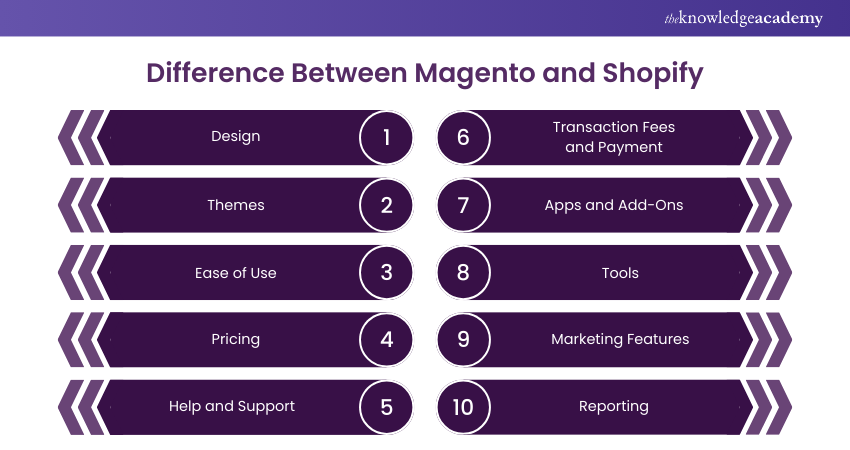
1) Design
Magento: It offers highly customisable design options, allowing developers to create unique and complex layouts. However, to fully leverage its capabilities, the user requires technical expertise. Given the specialized nature of Magento, those who master its features often earn a higher Magento Developer Salary.
Shopify: Provides user-friendly, customisable design tools with drag-and-drop functionality. This makes it easy for non-technical users to create attractive stores quickly.
2) Themes
Magento: It offers a variety of free and premium themes
Shopify: It provides over 70 free and paid professional themes
3) Ease of Use
Magento: It requires technical expertise for setup and customisation.
Shopify: It is incredibly user-friendly, with an intuitive interface.
4) Pricing
Magento: The open-source version is free, but hosting, development, and maintenance can increase costs.
Shopify: The open-source version is chargeable. The monthly subscription plans start at $29, with higher tier plans available.
5) Help and Support
Magento: It supports community support for the open-source version and dedicated support for Magento Commerce users.
Shopify: 24/7 customer support is available via phone, live chat, and email.
6) Transaction Fees and Payment Processors
Magento: No built-in transaction fees, but costs may vary depending on the payment gateway used.
Shopify: Charges transaction fees unless Shopify Payments is used.
7) Apps and Add-Ons
Magento: Extensive marketplace with thousands of extensions and add-ons for additional functionality.
Shopify: It comes with an app Store with over 6,000 apps to enhance store functionality.
8) Tools
Magento: Offers powerful, advanced tools for SEO, marketing, and customisation.
Shopify: It provides a wide range of easy-to-use built-in tools, including SEO, marketing, and analytics tools, suitable for all skill levels.
9) Marketing Features
Magento: Robust marketing features with advanced customisation options for campaigns, SEO, and promotions. Ideal for businesses with complex needs.
Shopify: User-friendly marketing tools, including email marketing, social media integration, and SEO optimisation. Designed for ease of use and effectiveness.
10) Reporting
Magento: Advanced reporting capabilities with detailed analytics and customisable reports.
Shopify: Comprehensive reporting tools with built-in analytics that are easy to access and understand.
Elevate your game development skills with our Unreal Engine 4 Game Development Training- join today!
Conclusion
Magento and Shopify are two of the most popular E-commerce platforms, each with a unique set of benefits. Where Magento is highly customisable and scalable, Shopify is user-friendly and ideal for beginners or those seeking a quick setup. Understanding these key differences between Magento vs Shopify helps you decide how to manage your E-commerce portfolio and drive business success effectively. Additionally, for those exploring a career in E-commerce development, familiarising yourself with Shopify Interview Questions can help you prepare for potential roles in this dynamic field.
Develop games with Python through our comprehensive Python Game Development Training—register today!
Frequently Asked Questions
Can Shopify and Adobe Commerce be Used Together?

No, Shopify and Adobe Commerce (Magento) cannot be used together. However, businesses might use them separately for different product lines or regions.
Does Magento Have a Future?
No, Shopify and Adobe Commerce (Magento) cannot be used together. However, businesses might use them separately for different product lines or regions.

Lily Turner


Senior AI/ML Engineer and Data Science Author
Lily Turner is a data science professional with over 10 years of experience in artificial intelligence, machine learning, and big data analytics. Her work bridges academic research and industry innovation, with a focus on solving real-world problems using data-driven approaches. Lily’s content empowers aspiring data scientists to build practical, scalable models using the latest tools and techniques.
View Detail

 If you wish to make any changes to your course, please


