


 Top Rated Course

We may not have the course you’re looking for. If you enquire or give us a call on +33 805638382 and speak to our training experts, we may still be able to help with your training requirements.
What is Revenue: A Complete Guide to Types and Formula
The Knowledge Academy 02 April 2026Revenue is the total income a business earns from goods or services before expenses. Known as the top line, it shows overall business performance and growth. It also reflects how effectively a company generates sales within a given period. By tracking Revenue, businesses can plan budgets, forecast growth, and improve strategy.
Training Outcomes Within Your Budget!
We ensure quality, budget-alignment, and timely delivery by our expert instructors.
Table of Contents
Related Courses

Can you guess the most crucial element for a business’s survival? It’s not the flashy marketing campaigns or cutting-edge technology. It’s Revenue that truly decides a company’s profitability. But What is Revenue exactly? It’s the income a company earns from selling its goods or services within a specific accounting period. Essentially, it tells the story of how money flows into a system, powering growth, operations, and future plans.
So, High Revenue ensures a healthy cash flow, which is critical for keeping business operations running smoothly. Understanding Revenue isn’t just for accountants. It’s a key skill for entrepreneurs, investors, and learners who want to understand financial health. In this blog, we’ll explore What is Revenue, it's different types, formula to calculate it and how it differs from the income and profit.
Table of Contents
1) What is Revenue?
2) Different Types of Revenue
3) Revenue Formula and Calculation
4) Factors Affecting Revenue
5) Differences Between Revenue and Income
6) Special Considerations
7) Future Trends in Revenue Management
8) The Importance of Revenue for Profitability
9) Is Revenue the Same as Profit?
10) What is Accrued and Deferred Revenue?
11) Conclusion
What is Revenue?
Revenue represents the total value of goods or services a company sells within a specific period. Also known as Sales or income, it appears at the top of the income statement and is commonly referred to as the “Top Line.” After deducting expenses from Revenue, a company arrives at its profit or net income.
Revenue is a key indicator of a company’s market performance and customer demand. Consistent Revenue growth often signals business expansion and financial health. It can substantially impact investor’s confidence.

Different Types of Revenue
Companies can separate their Revenue into various divisions. Let’s explore the significant types of Revenue to get a better idea of how money flows into a business:
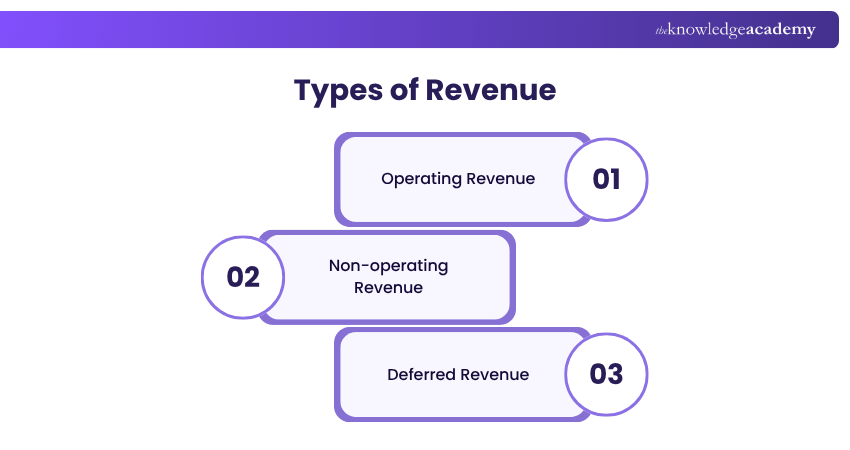
1) Operating Revenue
Operating Revenue means the money coming from a company’s primary line of business. It’s an important metric that shows how much cash is generated from daily business operations. A company with high Operating Revenue can easily maintain its operations and might expand into other areas for profit. This includes:
a) Sales: Sales refer to the exchange of a product or service for money between two parties
b) Rent: Rent refers to the Revenue coming from renting out office space
c) Consulting: Companies often charge prospects for Consulting
2) Non-operating Revenue
When a business generates money from a secondary source, it is said to be a Non-operating Revenue. The most common sources of earning can be:
a) Dividend Income: Dividends are part of a company’s profit distributed to its shareholders
b) Interest on Loans: Interest on loans taken by the company to expand into the global market is the interest incurred on loans taken by the company.
c) Asset Impairment: Every business owns physical items like property, inventory and machinery. When the market value of these assets becomes less than the original listing, it is said to be Asset impairment.
d) Taxes: Companies need to pay various taxes to fund government spending. This includes tax on employment, fuel, business structure and communication taxes.
e) Natural Calamities: Natural storms like hurricanes, floods, and firestorms can affect a business. This contributes to lost Revenue from loss of customers, loss of personnel, etc.
2) Deferred Revenue
Deferred Revenue refers to payments a company receives in advance for goods or services yet to be provided. It is recorded as a liability until the service is fulfilled or the product is provided. Common sources of deferred Revenue include:
a) Subscription-based Services: Customers pay upfront for recurring access, and Revenue is recognised over time.
b) Software Licenses: Payments are made in advance for usage rights, and the income is spread across the license period.
c) Membership Fees: Organisations receive fees ahead of time and earn Revenue gradually as benefits are offered.
d) Prepaid Insurance: Insurers collect premiums in advance and recognise Revenue month by month as coverage is provided.
e) Advance Ticket Sales: Tickets are sold before events occur, and Revenue is recorded once the event takes place.
Decode market signals and make winning investment decisions with our Investment and Trading Training - Sign up now!
Revenue Formula and Calculation
Every business is different, so is the Revenue formula and calculation. A retail business might have a different formula than a service company. However, both follow a basic formula to find out the net Revenue.

Source: Amazon.com
Net Revenue = (Number of Units Sold x Unit Price) - (Discounts + Allowances + Returns)
Instead of calculating it manually, you can easily calculate net Revenue using an Accounting Software. The software will work out the totals and provide a report.
Factors Affecting Revenue
Revenue is influenced by market conditions, business strategies, and operational efficiency, which determine how much a business earns and how steadily it grows. Below are the main factors that directly impact Revenue:
1) Market Demand:
Customer demand drives Revenue. Changes in preferences, trends, and economic conditions can increase or reduce sales.
2) Pricing Strategy:
Pricing affects how much is earned per sale and influences customer buying decisions.
3) Competition:
Competition impacts pricing and market share, often requiring businesses to adjust strategies.
4) Sales and Marketing Execution:
Effective campaigns and sales efforts help convert leads into customers and boost Revenue.
5) Customer Retention:
Loyal customers ensure repeat purchases, supporting consistent Revenue growth.
6) Product and Service Innovation:
New or improved offerings attract customers and create additional Revenue opportunities.
Differences Between Revenue and Income
Revenue refers to the funds a company receives from its services and sales. On the flip side, income refers to the money a business makes after deducting its running costs. Both describe a company’s profitability. Let’s explore some differences between Revenue and income:
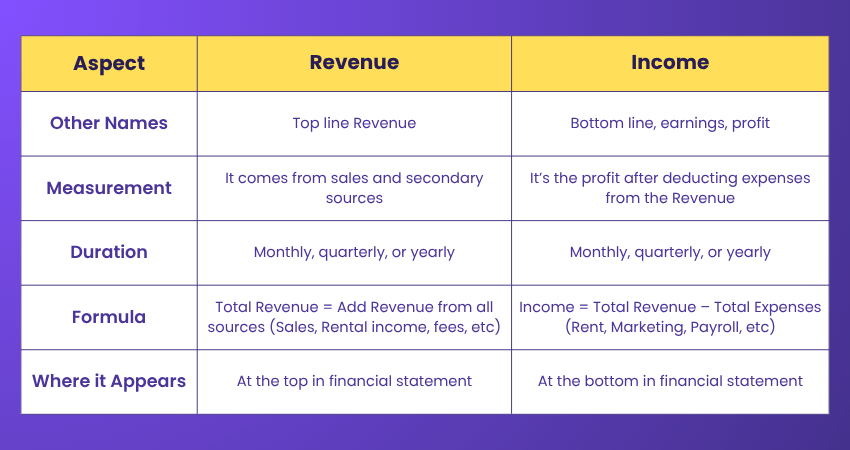
By comprehending your business Revenue and Income, you can streamline your business accounting and follow tasks like auditing your cash flow, etc.
Discover how smart investing can turn every uncertainty into a lucrative opportunity. Sign up for our Investment and Portfolio Management Course now!
Special Considerations
Revenue isn’t limited to business sales alone. It varies across sectors like government bodies, nonprofit organisations and real estate investments. Each sector has unique income sources and reporting methods. let's explore them:
1) Government Revenue
For governments, Revenue includes income collected through taxes, fines, fees, inter-governmental grants or transfers, the sale of securities, and earnings from natural resource rights or government-owned services. These funds may come from citizens within the jurisdiction or from other government bodies.
2) Nonprofit Revenue
Nonprofit organisations generate Revenue through gross receipts, which include donations from individuals, foundations, and corporations, along with grants, investments, membership fees, and event-based earnings. Revenue may come through organised fundraising or voluntary contributions without solicitation.
3) Real Estate Revenue
In real estate, Revenue refers to the income a property generates, commonly through rent, lease payments or parking fees. After deducting operational expenses, the remaining income is known as Net Operating Income (NOI). Even if a property is vacant, its fair market value adjustments may still affect the reported income.
Future Trends in Revenue Management
Revenue Management is evolving with smarter technologies and better data, enabling more strategic and customer-focused pricing decisions. The key trends driving this shift are outlined below:
1) AI and Machine Learning Integration:
AI is improving predictive analytics by analysing demand patterns, customer behaviour, and market conditions. This enables faster and more accurate real-time pricing decisions.
2) Dynamic Personalisation:
Businesses are moving beyond broad segmentation to offer personalised pricing, packages, and services based on individual customer behaviour, improving both experience and Revenue.
3) Total Revenue Management (TRevPAR):
The focus is expanding from single Revenue sources to total customer spend. Businesses now aim to maximise Revenue across multiple areas such as add-ons and services.
4) Strategic Revenue Leadership:
Revenue Managers are evolving into strategic leaders, aligning pricing decisions with marketing, sales, and overall business objectives to drive profitability.
5) Automation and Agility:
Automated systems are taking over routine tasks, allowing teams to focus on forecasting, planning, and strategic decision-making.
6) Subscription and Recurring Revenue Models:
More organisations are adopting subscription models to create predictable Revenue streams while enhancing customer loyalty through added value and benefits.
Discover the tools to manage liquidity and fuel business success in our Cash Flow Management Course - Sign up now!
The Importance of Revenue for Profitability
Revenue is essential for profitability as it forms the foundation of a business’s financial performance and determines its ability to grow sustainably. It supports key aspects of business success, as outlined below:
1) Covers Costs and Break-even:
Revenue enables businesses to meet fixed and operating expenses and reach the break-even point before generating profit.
2) Drives Profit Generation:
Higher Revenue increases the potential for profit when costs are controlled effectively.
3) Improves Profit Margins:
Growing Revenue helps spread fixed costs across more sales, improving overall profit margins.
4) Supports Growth and Expansion:
Strong Revenue allows businesses to invest in expansion, innovation, and future opportunities.
5) Provides Financial Stability:
Consistent Revenue helps maintain stability and manage risks during uncertain periods.
Is Revenue the Same as Profit?
Revenue and profit are two different components of a business. Revenue refers to the income that a company generates through business activities like sales of services and goods. Profit is the remaining income after subtracting operational costs, Revenue, and expenses.
Both metrics reflect a business's financial health, offering stakeholders crucial data to make well-informed decisions for boosting Cash Flow vs Profit. Additionally, they contribute to competitive positioning and enhance the overall financial performance of a business.
What is Accrued and Deferred Revenue?
Accrued Revenue refers to the income earned from goods or services already delivered but not yet paid for. It’s recorded at the time of the transaction, even without cash received. Deferred Revenue is the payment received in advance for goods or services not yet delivered and is recognised only upon fulfilment.
Conclusion
Revenue is the lifeblood of any organisation and a reflection of growth, performance and opportunity. By understanding What is Revenue, its types, formulas, and practical examples, you can gain a much clearer insight into how businesses measure their success. With this knowledge, you’ll be better equipped to analyse financial statements, craft a Revenue Model and make informed decisions.
Looking to empower your financial thinking? Our comprehensive Financial Management Course will help you out - Sign up now!
Frequently Asked Questions
How Does Revenue Impact Stock Prices?

All companies release their earnings report on a quarterly basis. A company’s strong earnings report might result in boosting its share price. If the earnings report doesn’t meet the expectations of shareholders, the stock price might scatter.
Does Revenue Mean Tax?
No, Revenue does not mean tax. Revenue refers to the total income a business, organisation or government earns from its activities. For businesses, this comes from sales or services. On the other hand, Taxes are just one source of Revenue, specifically for governments, alongside fees, fines and other income streams.
What are the Other Resources and Offers Provided by The Knowledge Academy?
The Knowledge Academy takes global learning to new heights, offering over 3,000+ online courses across 490+ locations in 190+ countries. This expansive reach ensures accessibility and convenience for learners worldwide.
Alongside our diverse Online Course Catalogue, encompassing 17 major categories, we go the extra mile by providing a plethora of free educational Online Resources like Blogs, eBooks, Interview Questions and Videos. Tailoring learning experiences further, professionals can unlock greater value through a wide range of special discounts, seasonal deals, and Exclusive Offers.
What is The Knowledge Pass, and How Does it Work?
The Knowledge Academy’s Knowledge Pass, a prepaid voucher, adds another layer of flexibility, allowing course bookings over a 12-month period. Join us on a journey where education knows no bounds.
What are the Related Courses and Blogs Provided by The Knowledge Academy?
The Knowledge Academy offers various Investment and Trading Training, including the Revenue Management Training, Investor Relations Course, and the Foreign Exchange Training. These courses cater to different skill levels, providing comprehensive insights into Revenue Forecasting.
Our Business Skills Blogs cover a range of topics related to Revenue, offering valuable resources, best practices, and industry insights. Whether you are a beginner or looking to advance your Revenue Management skills, The Knowledge Academy's diverse courses and informative blogs have got you covered.

The Knowledge Academy


Global Training Provider
The Knowledge Academy is a world-leading provider of professional training courses, offering globally recognised qualifications across a wide range of subjects. With expert trainers, up-to-date course material, and flexible learning options, we aim to empower professionals and organisations to achieve their goals through continuous learning.

Upcoming Batches & Dates
Date


 If you wish to make any changes to your course, please


