


 Top Rated Course

We may not have the course you’re looking for. If you enquire or give us a call on +33 805638382 and speak to our training experts, we may still be able to help with your training requirements.
What is Bureaucratic Leadership: A Complete Guide
Benjamin Walker 26 February 2026Bureaucratic Leadership is a management style based on formal rules, structured procedures, and defined hierarchies that guide decision-making. It emphasises consistency, accountability, and clear authority within an organisation. It is effective in highly regulated or large-scale environments where stability and control are essential.

Training Outcomes Within Your Budget!
We ensure quality, budget-alignment, and timely delivery by our expert instructors.
Table of Contents

Leadership is key to any successful organisation, steering it through challenges and opportunities. But not every leadership style fits every goal. One unique style is Bureaucratic Leadership. Before you decide to use it, it's important to understand what it involves. Check out this blog to learn about What is Bureaucratic Leadership, its main features, pros and cons, and how it can bring discipline to your workplace. Let's get started!
Table of Contents
1) What is Bureaucratic Leadership?
2) Exploring the Characteristics of Bureaucratic Leadership
3) Qualities of Bureaucratic Leadership
4) Advantages and Disadvantages of Bureaucratic Leadership
5) Key Examples of Bureaucratic Leadership
6) How is Bureaucratic Leadership Different From Autocratic Leadership?
7) Is Bureaucratic Leadership Suitable for Modern Organisations?
8) Conclusion
What is Bureaucratic Leadership?
Bureaucratic Leadership is a style where leaders follow a strict chain of command, adhere to established regulations, and ensure their followers do the same.
While the term might seem unappealing at first, many organisations have thrived under this leadership framework. Bureaucratic Leadership can be particularly beneficial for businesses that rely on efficient management structures.
Bureaucracy itself involves appointing individuals through a rigorous selection process. These individuals handle official matters and execute business orders, including laws, rules, and policies.
This leadership style showcases attributes like professionalism, a clear hierarchy, selective authority, assigned responsibilities, and rule-based decision-making. These qualities make Bureaucratic Leadership disciplined and structured.

Exploring the Characteristics of Bureaucratic Leadership
Now that you have learnt What is Bureaucratic Leadership, it’s time to learn about its key characteristics. Maximillian Karl Emil Weber, the founding father of Bureaucratic Leadership, German Sociologist, Historian, Jurist and Political Economist, has a strong hold over the defining factors of Bureaucratic Leadership. Max was confident about the positive impact of this Leadership style in any organisation.
Additionally, he also envisioned the transformation of businesses into large factories and massive establishments. He then devised the following characteristics of Bureaucratic Leadership:
Decision-making Hierarchies
The hierarchical structure is the defining characteristic of Bureaucratic Leadership. The stringent protocol between officers and their subordinates of various departments forms the firm and robust backbone of the hierarchy.
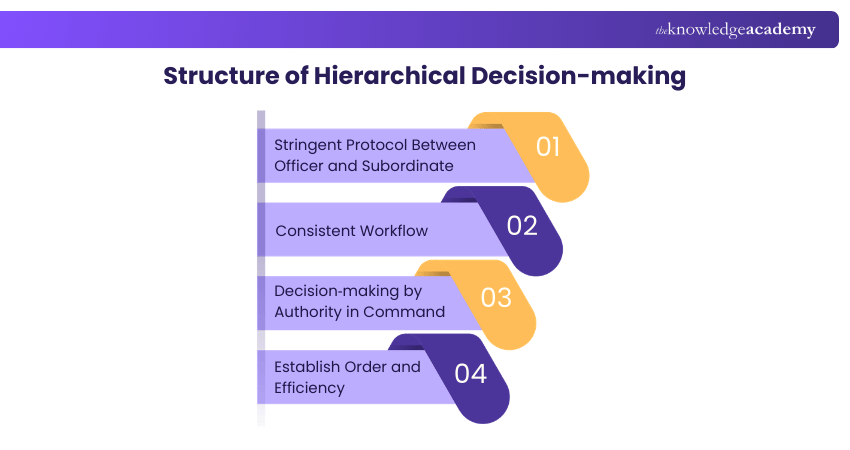
This structure maintains consistency in the workflow throughout the system. More importantly, the authority in command of the bureaucracy hands down the decision-making schedule, which helps establish order and efficiency in a business establishment.
Transactional Relationships
Bureaucratic relationships in an organisation always remain transactional because they help employees from various departments to maintain a healthy balance between professional relationships and their personal lives. Transactional relationships are essentially based on mutual benefit and needs between two individuals.
Both individuals have certain expectations that they want the other to fulfil, during which they typically exchange some service or support. Any human emotions such as love, compatibility or chemistry are generally out of the equation of a transactional relationship.
In a Bureaucratic management system, professionals typically depend on their colleagues or other professionals to accomplish tasks before they can proceed to new ones. For example, if professional ‘X’ has an expectation that professional ‘Y’ can fulfil, ‘Y’ may agree to help ‘X’ on the condition of a barter-based system where each helps the other with a favour.
These relationships entail that professional ‘X’ has to finish the task for ‘Y’ before ‘Y’ can finish the task for ‘X’. This translates to a more transactional than personal nature of the relationship between X and Y, which helps improve the understanding of their responsibilities in an organisation.
Role-based Specialisations
Seasoned and experienced individuals can accomplish only certain responsibilities in a Bureaucratic management system. This means that the Bureaucratic Leadership style official appoints only those individuals who are best suited for the position in the organisation. The employees of any department must be equipped with a comprehensive understanding and expertise in the subject.
Well Defined Responsibilities
Every employee in a Bureaucratic-style organisational structure is obligated to abide by certain rules and protocols. Bureaucratic Leaders generally assign responsibilities to their subordinates along with a framework for performing their daily activities. This ensures that they hold a good understanding of their stature and keeps them in the know-how about their job functions.
Professionalism
A Bureaucratic Leadership style maintains a high level of professionalism with a practice of impartial decision-making. It is because it believes in not favouring any one individual over the other, which is one of the pillars of its organisational status.
Enhance your Leadership abilities, by signing up for our Leadership Skills Course now!
Qualities of Bureaucratic Leadership
A system that functions on a Bureaucratic style of management generally appoints its leader panel only after an extensive examination and evaluation of their attributes, their experience with positions of authority and professionalism. This type of Leadership requires a properly defined skill set to fulfil the job role’s responsibilities.
Here is a list highlighting the qualities required for an individual to be deemed the right fit for a Bureaucratic Leader’s role:
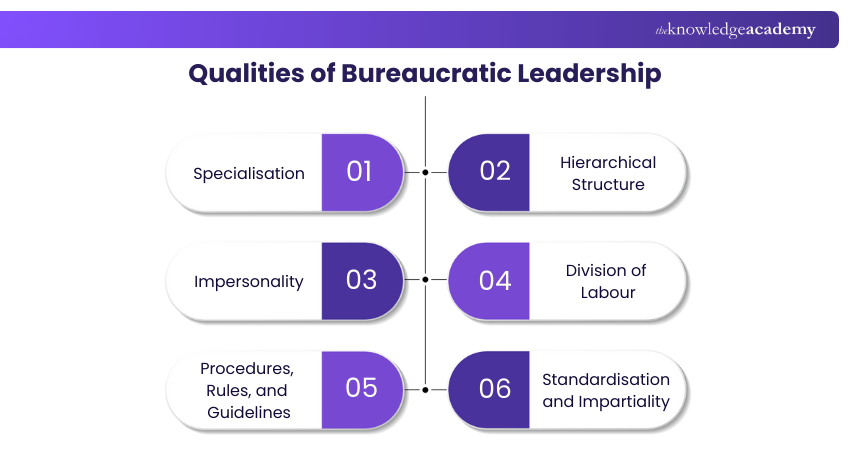
Specialisation
Employees are assigned specific roles and duties based on their skills and expertise. This ensures that the right individuals are in the right positions, leading to improved performance through structured repetition.
Hierarchical Structure
Bureaucratic management follows a strict hierarchy with clear arrangements between departments and individuals. Decisions are made centrally and communicated downwards, allowing managers to allocate duties and monitor progress effectively.
Impersonality
The focus is on collective achievement rather than individual accomplishments. This approach prioritises equality, performance, and consistency, ensuring that operations are rational and free from personal biases or emotions.
Division of Labour
Responsibilities and tasks are clearly demarcated among employees, eliminating ambiguity and enhancing efficiency. Each team or individual knows their specific duties, contributing to the organisation's overall objectives.
Procedures, Rules, and Guidelines
A comprehensive set of rules and guidelines directs employee conduct and daily tasks. These regulations provide a framework for handling various issues, ensuring that both minor and major tasks are performed consistently and effectively.
Standardisation and Impartiality
Bureaucratic Leadership ensures fair and impartial treatment of all employees. By managing conduct and behaviour without favouritism, it minimises discrimination and promotes fairness. Employees are subject to the same rules and disciplinary measures, fostering a sense of equality and contentment within the organisation.
Learn to make important decisions by signing up for our Decision Making Course now!
Advantages and Disadvantages of Bureaucratic Leadership
Now that you are aware of What is Bureaucratic Leadership, below is a detailed explanation of its key advantages and disadvantages:
Advantages of Bureaucratic Leadership
1) Clear Structure and Order: Everyone knows their role, responsibilities, and reporting lines. This reduces confusion and ensures smooth coordination across departments.
2) Consistency in Decision-making: Because decisions follow established rules and procedures, outcomes are predictable and fair. This minimises bias and personal favouritism.
3) Accountability: Defined authority and documentation make it easier to track decisions and identify responsibility. This strengthens transparency within the organisation.
4) Efficiency in Routine Tasks: Standardised processes improve workflow, especially in large organisations or highly regulated industries such as government, healthcare, or finance.
5) Stability and Control: The structured nature of Bureaucratic Leadership provides stability, which is particularly useful in environments where compliance and risk management are critical.
6) Job Security: Employees adhering to guidelines and performing well have strong career growth prospects.
Disadvantages of Bureaucratic Leadership
1) Limited Flexibility: Strict rules can make it difficult for employees to adapt quickly to change or unexpected situations.
2) Slower Decision-making: Decisions often need approval from higher authorities, which can delay action and reduce responsiveness.
3) Reduced Creativity and Innovation: Employees may feel restricted by rigid procedures, limiting their ability to think creatively or suggest improvements.
4) Low Employee Morale: A top-down approach can leave employees feeling overlooked or disconnected, particularly during minimal involvement in decision-making processes.
5) Overemphasis on Rules: Focusing too heavily on procedures can sometimes overshadow practical solutions or human judgment.
Learn the techniques to effectively handle a team by signing up for our Introduction to Supervising a Team Course now!
Key Examples of Bureaucratic Leadership
Here is a list of important examples that are a great representation of Bureaucratic Leadership:
Bureaucratic Leadership can be observed across government, public institutions, and large corporations where structure, discipline, and formal authority are essential. The following examples of leaders highlight how this leadership approach operates in real-world contexts:
1) Winston Churchill
As Prime Minister of the United Kingdom during the Second World War, Winston Churchill operated within a highly structured governmental and military hierarchy. His leadership relied heavily on formal authority, established war protocols, and clearly defined chains of command.
He maintained strict coordination between military leaders, government officials, and departments. Decisions flowed through official channels, ensuring discipline and order during a time of national crisis. His leadership reflected Bureaucratic principles through structured governance and adherence to institutional processes.
2) Sinjo Sogo of the Japanese National Railways
Sinjo Sogo, the fourth President of the Japanese National Railways, is known for overseeing the development of the Shinkansen bullet train system. His leadership depended on structured procedures, detailed documentation, and hierarchical coordination across departments.
The successful execution of the Shinkansen project reflected his disciplined planning within a Bureaucratic framework. His leadership style helped the country go through a revolution in its railway networks.
3) Steve Easterbrook of McDonald’s
A food establishment as massive and globally spread out as McDonald’s has a foundation in Bureaucratic Leadership style. He relied heavily on strict corporate policies, consistent workflows, and clearly defined reporting structures across franchises worldwide.
Under his leadership, decisions were implemented through formal channels, ensuring consistency across thousands of outlets. This structured approach helped maintain brand uniformity and quality control on a global scale.
How is Bureaucratic Leadership Different From Autocratic Leadership?
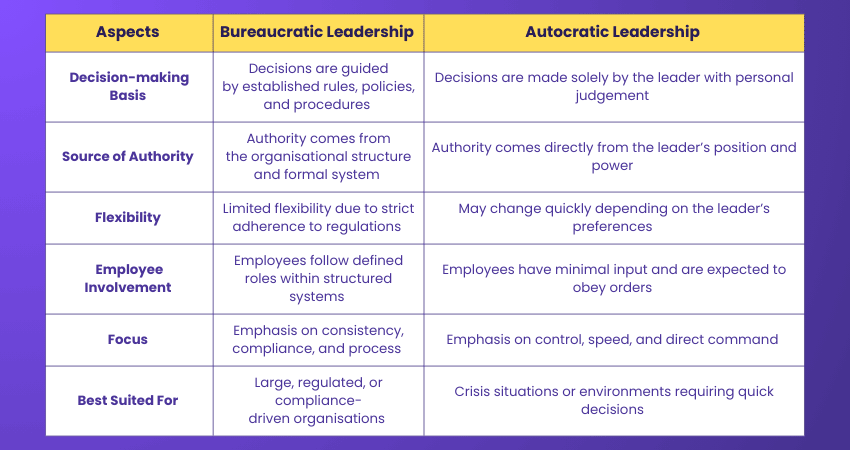
Bureaucratic Leadership and autocratic leadership may appear similar because both involve strong authority and top-down control, but they differ in their foundation. Bureaucratic Leadership is driven by formal rules, structured procedures, and established policies.
In contrast, autocratic leadership is centred on the individual leader’s power. Decisions are based on personal judgement rather than institutional rules, and subordinates are expected to follow without question. In simple terms, bureaucracy is rule-driven, whereas autocracy is leader-driven. Below is a detailed difference between Bureaucratic Leadership and autocratic leadership:
Is Bureaucratic Leadership Suitable for Modern Organisations?
Bureaucratic Leadership can be effective in certain modern organisations, but it may not be appropriate for every situation. In industries driven by innovation, rapid technological change, or creative problem-solving, a strictly Bureaucratic approach may feel restrictive.
Modern organisations often need faster decision-making, collaboration, and adaptability to remain competitive. Excessive layers of approval and rigid procedures can slow progress and limit employee initiative. For this reason, many organisations adopt a balanced model. They retain bureaucratic elements for governance and operational control while encouraging flexibility and innovation in other areas.
Conclusion
We hope that you have now understood the concept of What is Bureaucratic Leadership. An organisation has a higher chance of achieving business success from a Bureaucratic form of management. This Leadership style is pivotal to authority and a hierarchical chain of command, along with a robust set of regulations and protocols to be followed by all employees. Moreover, such a management system ensures maximum levels of efficiency and productivity at the workplace.
Enrich your leadership integrity and decision-making skills with our Ethical Leadership Training – Start today!
Frequently Asked Questions
What are the Big 5 Leadership Styles?

Following are the five big Bureaucratic Leadership Styles:
a) Autocratic: Centralised control, quick decisions
b) Democratic: Collaborative decision-making
c) Laissez-faire: Minimal supervision, self-driven teams
d) Transformational: Inspires innovation and change
e) Transactional: Rewards-based leadership
What are the Strengths of Bureaucratic Leadership?
Structured societies, well defined roles and responsibilities, and employment securities make Bureaucratic Leadership strong on discipline. The division of labour based on the level of expertise is effective; a programmatic approach guarantees operability. Regarding other benefits, it also has implications for flexibility and growth.
What are the Other Resources and Offers Provided by The Knowledge Academy?
The Knowledge Academy takes global learning to new heights, offering over 3,000+ online courses across 490+ locations in 190+ countries. This expansive reach ensures accessibility and convenience for learners worldwide.
Alongside our diverse Online Course Catalogue, encompassing 17 major categories, we go the extra mile by providing a plethora of free educational Online Resources like Blogs, eBooks, Interview Questions and Videos. Tailoring learning experiences further, professionals can unlock greater value through a wide range of special discounts, seasonal deals, and Exclusive Offers.
What is The Knowledge Pass, and How Does it Work?
The Knowledge Academy’s Knowledge Pass, a prepaid voucher, adds another layer of flexibility, allowing course bookings over a 12-month period. Join us on a journey where education knows no bounds.
What are the Related Courses and Blogs Provided by The Knowledge Academy?
The Knowledge Academy offers various Leadership Courses, including the Leadership Skills Training, Design Thinking Course and the Technical Team Leading Training. These courses cater to different skill levels, providing comprehensive insights into Creative Leadership.
Our Business Skills Blogs cover a range of topics related to Bureaucratic Leadership, offering valuable resources, best practices, and industry insights. Whether you are a beginner or looking to advance your Leadership Skills, The Knowledge Academy's diverse courses and informative blogs have got you covered.

Benjamin Walker


Leadership Development Coach and Management Consultant
Benjamin Walker is a leadership coach and business consultant with over 18 years of experience in guiding organisations through strategic growth and transformation. He specialises in developing leadership capabilities at all levels, from emerging managers to executive teams. Benjamin’s work focuses on practical leadership, team dynamics, and performance management.
View Detail
Upcoming Business Skills Resources Batches & Dates
Date
 Leadership Skills Training
Leadership Skills Training
Fri 27th Mar 2026
Leadership Skills Training
Fri 29th May 2026
Leadership Skills Training
Fri 31st Jul 2026
Leadership Skills Training
Fri 2nd Oct 2026
Leadership Skills Training
Fri 27th Nov 2026

 If you wish to make any changes to your course, please


