


 Top Rated Course

We may not have the course you’re looking for. If you enquire or give us a call on +33 805638382 and speak to our training experts, we may still be able to help with your training requirements.
What is Bitcoin Mining? The Complete Guide for Beginners
Richard Harris 24 April 2026Bitcoin mining verifies transactions and adds new blocks to the blockchain using proof of work, allowing miners to earn bitcoin rewards and transaction fees. It secures the network and supports decentralised trust worldwide. It also keeps records transparent, resists fraud, and ensures confirmed payments can be independently verified.

Training Outcomes Within Your Budget!
We ensure quality, budget-alignment, and timely delivery by our expert instructors.
Table of Contents
Ever wondered how people actually mining Bitcoin? It’s not printed like money or handed out by banks; it’s earned through Bitcoin Mining. Think of it like a giant digital treasure hunt, where computers around the world race to solve puzzles, unlock coins, and keep the Bitcoin network safe.
In this blog, you’ll discover what Bitcoin Mining is, how it works, the different methods for mining Bitcoin, Proof of Work, costs, risks, scams, taxes, and rewards. By the end, you’ll know exactly what goes on behind the scenes and whether mining could be worth your time and effort.
Table of Contents
1) What is Bitcoin Mining?
2) How Does Bitcoin Mining Work?
3) Methods of Bitcoin Mining
4) What are the Bitcoin Mining Risks/Security Risks?
5) Requirements for Bitcoin Mining
6) Cost of Bitcoin Mining
7) Risks of Bitcoin Mining
8) Taxes on Bitcoin Mining
9) Bitcoin Mining Rewards Over the Last Decade
10) Avoiding Bitcoin Mining Scams
11) Is it Illegal to Mine Bitcoin?
12) Can a Normal Person do Bitcoin Mining?
13) Conclusion
What is Bitcoin Mining?
Bitcoin Mining is the process of confirming cryptocurrency transactions on the Blockchain while also creating new Bitcoins. A global network of computers competes to resolve complex puzzles set by the Bitcoin system, ensuring that each block of transactions is verified and securely recorded.
For mining Bitcoin use specialised machines, often Application-specific Integrated Circuits (ASICs), to solve these puzzles. The first to succeed adds a new block to the Blockchain and earns Bitcoins plus fees. This reward keeps miners motivated, but mining is highly competitive, requires costly equipment, and can be difficult for beginners to start.
Key Takeaways:
1) Mining Bitcoin secures transactions and introduces new Bitcoins into circulation.
2) Bitcoin Miners are rewarded with Bitcoins and transaction fees for solving puzzles.
3) Mining Bitcoin is highly competitive and depends on the network’s total computing power.
4) Powerful hardware like, ASIC machines is needed to mine efficiently.

How Does Bitcoin Mining Work?
Mining is the main feature of Bitcoin’s functionality: it generates new coins, as well as checks the prospective transactions and adds them to the Blockchain. It is a process of using processors that are designed for mathematical computation in order to secure the Blockchain that underlies the Bitcoin system. Here's a step-by-step breakdown of how Bitcoin Mining works:
a) Transaction Collection: Every time Bitcoin users make a transaction; the transaction is announced to the network by the users. Miners get the transactions done and put them in a block so that it will be unique.
b) Solving Cryptographic Puzzles: Miners can solve an algorithm, which is creating a hash, an alphanumeric solution, that is accomplished by the rules set forth in the Bitcoin protocol. This process is called “proof of work”. Mining is computationally exhaustive, making mining resources demanding.
c) Adding Blocks to the Blockchain: The first miner whose terminal has computed the hash appears to the other members of the network and proclaims it has solved the puzzle. Others must validate the solution, and when approved, the group of transactions is incorporated into the Blockchain. It is a permanently stored record, thus optimising its security and transparency level.
d) Mining Rewards: To mine a block successfully, the miner earns Bitcoins and the transaction fee. As of 2025 the block reward was 6.25 Bitcoins per block. These rewards make other miners agree to play a part in sustaining the network.
e) Difficulty Adjustment: In an endeavour to keep a standard block production time of about 10 minutes, the Bitcoin network usually adjusts the level of difficulty every 2016 blocks or about two weeks. If mining is becoming faster with better hardware or more miners, then the difficulty rises and vice versa.
Here are some key components of Bitcoin Mining:
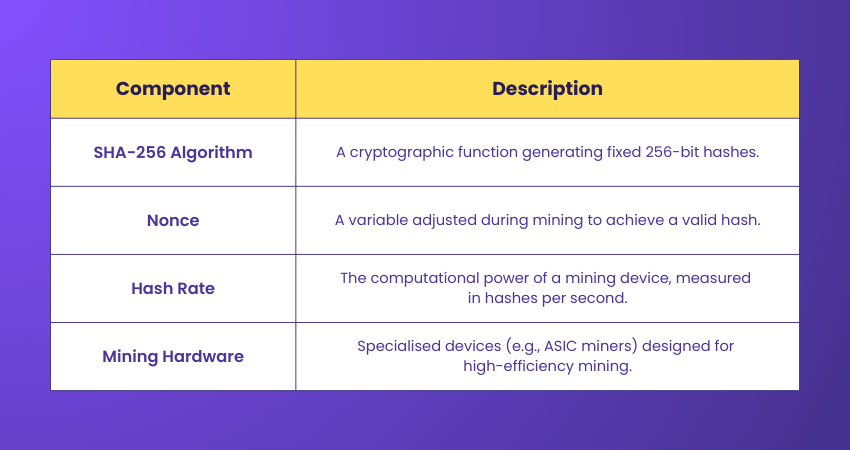
The Hash
A hash is a fixed-size alphanumeric string produced by a mathematical operation on input data such as text or files. Generally, each hash is different from the previous one and cannot be incomprehensibly reversed to get the original data back. Even the slightest alteration made to the input will yield an entirely new hash value.
Hash Example
The content of a file is converted into a distinct hash string when it is processed. If the file is altered or damaged, the newly calculated hash will differ from the original one, hence indicating the very fact that the data has been altered or even manipulated.
Methods of Bitcoin Mining
Here, we have discussed several methods available to Bitcoin Miners to mine BTC:
a) Application-specific Integrated Circuits (ASIC) Mining: These computers have been designed to serve only one purpose: To mine Cryptocurrency like Bitcoin. It is a highly effective means of mining cryptocurrencies.
Boost your digital performance with Conversion Rate Optimisation Training and maximise conversions.
b) Graphic Processing Unit (GPU) Mining: This mining method serves more purposes than ASIC mining. This method is helpful because a GPU can serve as a lower model of entry in the cryptocurrency mining world, making it an ideal choice for beginners, as highlighted in the Cryptocurrency Mining. These are more affordable than the ASICs and can also support standard hardware.
c) Central Processing Unit (CPU) Mining: A CPU is the main part of any computer system. The method of CPU mining allows miners to use the idle power of their systems to mine Cryptocurrency. In the beginning, Bitcoins were mined using CPU power only.
d) Mining Pools: This is another method of mining where several miners join their resources to form a pool and mine the Cryptocurrencies. As many miners work together, finding a new block increases. Once the new block is found, these miners share the profit, and thus, collectively, they also increase their earnings.
e) Solo Mining: While solo mining differs from Mining Pools, understanding Bull vs Bear Market trends can be equally crucial for those investing in crypto assets. The single individual bears all the costs and profits of mining alone.
f) Cloud Mining: In this method, the miner outsources their computational work to a cloud mining farm. The miner or the user pays someone else to mine on their behalf. Starting the mining process becomes easier with cloud mining because the miner does not have to procure or arrange specialised hardware for mining.
Understand the various roles and responsibilities of a Data Scientist. Join our Data Science and Blockchain Training now!
What are the Bitcoin Mining Risks/Security Risks?
Bitcoin Mining can be rewarding, but it also carries several risks. Apart from high energy costs and hardware challenges, miners and investors face security threats such as scams, fraud, and hacking. Here are some of the most common risks:
1) Wallet Scams
Fake Wallets: Scammers create fake online wallets and trick users into sending funds, which get redirected to the scammer’s wallet.
Vulnerable Hardware Wallets: Some hardware wallets are designed with hidden weaknesses that allow thieves to steal your Bitcoins once you use them.
2) Mining Scams
Fraudulent Cloud Mining Services: Fake companies claim to rent out computing power for mining. They promise high returns but never actually mine, simply taking people’s money.
Ponzi Mining Schemes: Some platforms use money from new investors to pay earlier ones, pretending its mining profit. Eventually, the scheme collapses, and most people lose their money.
3) Exchange Scams
Fake Exchanges: Scammers set up fake crypto exchanges that steal money or personal details from users.
Phishing: Emails or links lead to fake websites that capture private keys and sensitive information.
Accelerate growth with MarTech Training and connect marketing technology to measurable business results.
Why Bitcoin Needs Miners?
To keep Bitcoin transactions valid and recorded in the blockchain, the participation of miners is necessary. Through the solving of difficult math problems, miners ensure that double spending cannot happen; the network is secure against attacks, and the public maintains a clear view of all recognized payments through an openly accessible record.
Time Taken to Mine One Bitcoin
The creator of Bitcoin, Satoshi Nakamoto, designed the system to mine a new block every 10 minutes. To keep this pace, the difficulty of solving the puzzles adjusts based on the number of miners: more miners mean higher difficulty and vice versa.
Factors Affecting Mining Time
The following are the factors affecting mining time:
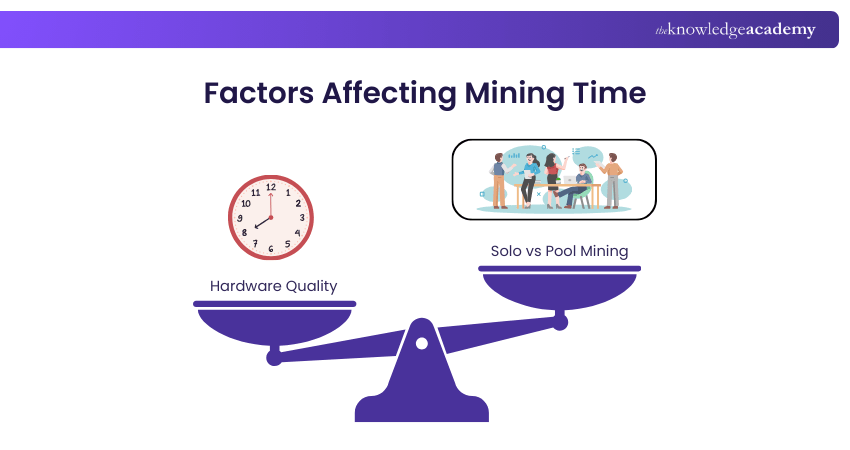
Hardware Quality: Advanced mining equipment can solve puzzles faster, earning Bitcoins more quickly.
Solo vs Pool Mining: Solo mining takes more time since you work alone. Joining a mining pool speeds up the process as miners combine resources for better equipment and share the workload.
Learn how to use Solidity to develop smart contracts. Join our Blockchain Course now!
Requirements for Bitcoin Mining
Bitcoin Mining is a complex process, as it requires technical knowledge and access to various hardware and software. It involves three main components:

a) Cryptocurrency Wallet:
1) A miner needs a cryptocurrency wallet to store the keys for tokens or coins obtained from mining.
2) Wallets have unique addresses for sending, receiving, and securely storing tokens.
3) Options include online wallets and 'cold storage' wallets (offline). Each has its pros and cons.
b) Mining Software:
1) Mining software, usually free and available for different Operating Systems (OS), is essential for the mining process.
2) The miner must choose compatible software to avoid issues that could affect mining efficiency.
c) Mining Hardware:
1) Miners select hardware based on their needs and budget. Options range from personal computers (slow) to specialised, high-performance equipment (expensive and sometimes imported).
2) The right hardware simplifies and enhances the mining process.
Cost of Bitcoin Mining
The cost of mining is shaped by electricity prices, hardware expenses, and operating efficiency. These challenges set the stage for other important factors like risks, taxes, and rewards.
a) Mining Cost: The cost of mining a single Bitcoin depends heavily on electricity rates and hardware efficiency. At 4.7p per kWh, one Bitcoin costs about £4,140 to mine, while at 10p per kWh, the cost rises to around £8,800. For example, an ASIC miner using 3,032 watts can lead to costs of roughly £8,160 at 5p per kWh.
b) Hash Rate Growth: As more miners join the network, the hash rate increases, making Bitcoin Mining more difficult and costly. This reduces individual profitability, so many miners join pools to share resources, though rewards are then divided among members.
c) Cost Components: Mining costs include capital expenses (CapEx), such as purchasing and maintaining equipment, and operational expenses (OpEx) like electricity, cooling, and overheads. An ASIC miner can cost around £3,680, making the effective cost per Bitcoin about £11,440. Electricity adds roughly £8,160, bringing the total cost close to £21,000 per Bitcoin.
d) Profitability Challenge: Profitability depends on production costs, Bitcoin’s market price, and the network hash rate. For small-scale miners, it is often difficult to reduce costs enough to remain profitable. Many miners join pools to share resources, though rewards are split. Others depend on cheap electricity or advanced hardware to stay profitable.
Taxes on Bitcoin Mining
It is important to consider the impact of taxes on Bitcoin Mining. With the recent surge in cryptocurrency prices, tax authorities, including His Majesty's Revenue and Customs (HMRC), have become more focused on regulating owners and traders of cryptocurrencies. Below are the key tax considerations for Bitcoin miners in the UK.
Advance insights with Consumer Behaviour Course to understand buyers and drive sales.
Are You Operating a Business?
If you are conducting Bitcoin Mining as a business, you may be able to offset certain tax expenses. The value of the Bitcoins you mine would be treated as sales income. However, if mining is more of a hobby, you may not be able to claim expenses associated with it.
Mined Bitcoin as Income
The fair market value of the Bitcoin or other cryptocurrencies you mine will be considered taxable income in the year you receive them. This is treated as ordinary income, and you will need to report it on your tax return.
Capital Gains
If you sell the Bitcoins you mined for a higher price than what you originally paid (or mined them at), the profit will be subject to capital gains tax, like to other forms of investment like stocks and bonds.
Advance your skills with the Marketing Budget Course and manage campaign spend with confidence.
Bitcoin Mining Rewards Over the Last Decade
The nature of Bitcoin Mining rewards has shifted significantly since the creation of Bitcoin in 2009. The rewards are intended to defuse through time by a mechanism known as the halving, which takes place almost every four years (after 210,000 blocks).
Halving events decrease the block reward by 50 %; therefore, the total supply of Bitcoins is capped at 21 million to ensure scarcity. Here's an overview of mining rewards over the last decade:
1) 2009–2012: The Early Days:
Block Reward: 50 BTC per block.
Total Mined: Early miners could mine Bitcoin using ordinary Central Processing Units and Graphics Processing Units.
Impact: Frequent emission of Bitcoin, which encourages use and guarantees the Blockchain.
2) 2012–2016: First Halving:
Block Reward: Cut down to 25 BTC per block by the end of November in 2012.
Mining Evolution: To improve the efficiency of the mining process ASICs were introduced employing which has proved to be costly.
Economic Impact: Halving also made Bitcoin known to be a deflationary currency and the worth of mined Bitcoin also rose.
3) 2016–2020: Second Halving:
Block Reward: Cut down to 12.5 BTC per block in July 2016.
Network Growth: They increased during the last bull run and institutional adoption of Bitcoin.
Profitability: Higher coin rewards compensated for the lowered profits, making mining for optimum efficiency possible with Bitcoins.
4) 2020–2025: Third Halving:
Block Reward: Decidedly cut to 6.25 BTC per block in May 2020.
Market Impact: This halving occurred in a period of a bull market causing the price of Bitcoin to skyrocket to record levels.
Mining Trends: Mining pools were the primary force, and energy consumption was now important.
5) Future: Post-2025 and Beyond:
Next Halving: Projected for mid-2025, a decrease of the rewards to 3.125 BTC per block.
Implications: The experts are expecting that miners are going to extract their income from the transaction fees as block rewards are decreasing over time.
Some summaries of halving events:

Avoiding Bitcoin Mining Scams
What does it mean? Nothing new under the sun, naturally; as with anything that involves money, Bitcoins and Bitcoin Mining are not immune to attracting bad parties. In case you decide to embark on it, you will probably want to be cautious of mining scams before you decide on the software, tools, or networks. Here are some of the more common scams:
a) Cloud Mining Platforms: These are websites that claim to rent mining power to customers. It’s not that all these services are scams, but always ensure you read some reviews, talk to people, and generally ensure you are doing enough research before choosing a particular service.
b) Fake Wallets: Cryptocurrency wallets are the place where your private keys are stored. However, thieves can take time to replicate these wallets with the intention of taking your keys. Where you get your wallet from is important.
c) Fake Exchanges: There are numerous cases when people receive emails and messages from fake exchanges in which they are pressured or can be deceived into depositing money.
What's the Future of Bitcoin Mining?
As block rewards continue to shrink, mining will rely more heavily on transaction fees. Future developments are likely to include:
a) Greener and more energy efficient mining technology
b) Tighter regulation around electricity consumption
c) Potential exploration of hybrid consensus approaches
d) Faster and more efficient ASIC hardware
Mining’s role is evolving, but it will remain central to Bitcoin’s security and network stability.
Conclusion
Bitcoin Mining's future will be decided by technological advancements, energy-related innovations, and unceasing regulations. Miners' adaptation will be their main response to the dwindling rewards and increasing competition. However, the evolution of the network in terms of security and sustainability is guaranteed.
Advance your decision making with Marketing Research Training for smarter customer insights.
Frequently Asked Questions
Is Bitcoin Mining Legal?

The legality of Bitcoin Mining varies worldwide. It is allowed in regions like the US, UK, and EU, but banned in countries such as China due to energy concerns and laws. Citizens must stay alert, as regulations can change quickly.
How Many Bitcoins are Left to Mine?
21million Bitcoins can be mined in total and following this computation, about 2.1 million Bitcoins are still available for mining. As seen above, the remaining supply is to be gradually released through block rewards though the amount decreases after every four years resulting in halvings until approximately 2140.
What are the Other Resources and Offers Provided by The Knowledge Academy?
The Knowledge Academy takes global learning to new heights, offering over 3,000+ online courses across 490+ locations in 190+ countries. This expansive reach ensures accessibility and convenience for learners worldwide.
Alongside our diverse Online Course Catalogue, encompassing 19 major categories, we go the extra mile by providing a plethora of free educational Online Resources like Blogs, eBooks, Interview Questions and Videos. Tailoring learning experiences further, professionals can unlock greater value through a wide range of special discounts, seasonal deals, and Exclusive Offers.
What is The Knowledge Pass, and How Does it Work?
The Knowledge Academy’s Knowledge Pass, a prepaid voucher, adds another layer of flexibility, allowing course bookings over a 12-month period. Join us on a journey where education knows no bounds.
What are the Related Courses and Blogs Provided by The Knowledge Academy?
The Knowledge Academy offers various Marketing Courses, including the Marketing Budget Course, Email Marketing Course, and Passive Income Course. These courses cater to different skill levels, providing comprehensive insights into Top-Down Estimating.
Our Digital Marketing Blogs cover a range of topics related to Bitcoin Mining, offering valuable resources, best practices, and industry insights. Whether you are a beginner or looking to advance your Digital Marketing skills, The Knowledge Academy's diverse courses and informative blogs have got you covered.

Richard Harris


Senior Full Stack Developer and Technology Educator
Richard Harris is a highly experienced full-stack developer with deep expertise in both frontend and backend technologies. Over his 12-year career, he has built scalable web applications for startups, enterprises and government organisations. Richard’s writing combines technical depth with clear explanations, ideal for developers looking to grow in modern frameworks and tools.

Upcoming Business Skills Resources Batches & Dates
Date
 Bitcoin and Cryptocurrency Course
Bitcoin and Cryptocurrency Course
Thu 20th Aug 2026
Bitcoin and Cryptocurrency Course
Thu 5th Nov 2026

 If you wish to make any changes to your course, please


