


 Top Rated Course

We may not have the course you’re looking for. If you enquire or give us a call on +33 805638382 and speak to our training experts, we may still be able to help with your training requirements.
Quick Sort Algorithm: How it Works and When to Use It
The Knowledge Academy 12 December 2025Quicksort is a fast divide-and-conquer algorithm that selects a pivot, partitions the array, and recursively sorts subarrays for efficient in-place sorting. It minimises comparisons and swaps, making it ideal for large datasets. Its efficiency and simplicity make it a favourite in both academic and real-world applications.

Training Outcomes Within Your Budget!
We ensure quality, budget-alignment, and timely delivery by our expert instructors.
Table of Contents

Sorting is an essential operation in programming, and selecting the appropriate algorithm can greatly affect the performance. The Quick Sort Algorithm is one of the powerful algorithms that divide and conquer the problem efficiently, making it a go-to choice not only for developers but also for computer scientists.
If you learn the working of Quick Sort, its benefits and the conditions under which it performs better, you will be able to do faster coding and deal with large amounts of Data precisely. This blog will take you through the operation, advantages, and practical applications of Quick Sort in today's programming.
Table of Contents
1) What is a Quick Sort Algorithm
2) How Does Quicksort Work?
3) Complexity of Quicksort Algorithm
4) Quicksort Implementation in Python, Java, and C
5) Benefits of Using Quicksort
6) Drawbacks of Quicksort
7) Applications of the Quicksort Algorithm
8) What are the Different Partition Algorithms
9) Conclusion
What is a Quick Sort Algorithm
Quicksort is an exceptionally effective sorting algorithm derived from the divide-and-conquer principle. It performs by breaking down the initial issue into simpler parts, sorting each of them one after the other, then combining their results into a sorted list.
Key Steps of Quicksort:
a) Pivot Selection: Choose a pivot element from the array.
b) Partitioning: Rearrange the array so elements less than the pivot are on one side, and elements greater are on the other.
c) Recursive Sorting: Recursively apply the same process to the sub-arrays.
d) Combining: Combine the sorted sub-arrays to form the final sorted array.

How Does Quicksort Work?
Quick Sort Algorithm is a very fast and efficient sorting algorithm that partitions sub-lists around a chosen pivot recursively and rearranges elements based on their relationship with the pivot. The whole procedure can be succinctly outlined in the three core steps:
1) Pick: Choose a pivot element from the array.
2) Divide: Divide the array into two groups: elements smaller than the pivot on the left and larger elements on the right.
3) Repeat and Combine: Recursively apply these steps to the sub-lists and combine them into a fully sorted array.
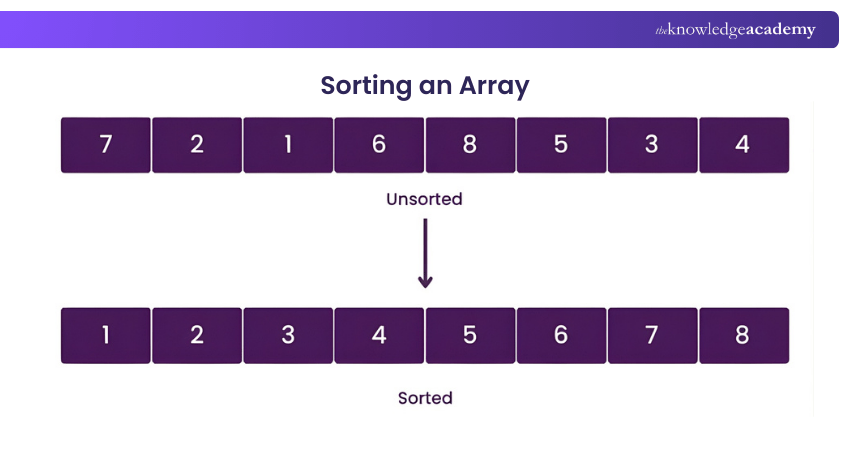
Let’s walk through an example to illustrate how Quicksort works. We will use the algorithm to sort an unsorted array, demonstrating its step-by-step process and efficiency.
Selecting a Pivot
The Quick Sort Algorithm process begins by selecting an element from the list, referred to as the pivot. The pivot can be selected in diverse ways, such as:
a) A randomly selected element.
b) The first or last element in the array.
c) The middle element.
In this example, we will use the last element, 4, as the pivot to demonstrate how the algorithm works.
Rearranging Elements
In this step, we aim to rearrange the array so that all elements smaller than the pivot are placed on its left, and those greater than the pivot are on its right. Here’s how the process works:
a) Start by comparing the pivot element with each item, beginning from the first index. If an element is greater than the pivot, a pointer is placed on that element.
b) As you continue comparing the remaining elements, if an element smaller than the pivot is found, swap it with the larger element previously identified by the pointer.

Dividing the Subarrays
Once the array is partitioned, we can divide the problem into two smaller sub-problems:
1) Sort the left segment: Focus on the array portion to the left of the pivot, where all elements are smaller than the pivot.
2) Sort the right segment: Similarly, sort the array portion to the right of the pivot, which contains elements more significant than the pivot.

We gradually sort the entire array by recursively applying the Quicksort algorithm to these two sub-arrays, refining the sorting process with each partition. Similarly, the Bucket Sort Algorithm can also be used in certain scenarios, where it effectively partitions the data into smaller groups, further enhancing the sorting process until the array is fully ordered.

Complexity of Quicksort Algorithm
Let’s explore the time complexity of Quicksort in the best case, average case, and worst case scenarios. Additionally, we’ll examine the space complexity of Quicksort.

Time Complexity Analysis
Time Complexity helps analyse an algorithm's efficiency and performance in different cases (best, average, and worst).
a) Best Case (O(n log n)): Occurs when the pivot divides the array into two nearly equal halves, resulting in efficient sorting.
b) Average Case (O(n log n)): This happens when the array is randomly ordered, leading to balanced partitions and typical performance.
c) Worst Case (O(n²)): Occurs when the pivot is poorly chosen (e.g., always the smallest or largest element), leading to unbalanced partitions, as seen when the array is already sorted in ascending or descending order.
Acquire the practical skills needed to create apps, websites, and software with our Programming Courses– Start your journey today!
Space Complexity Overview
O(log n) is used for in-place implementations due to the recursion stack. It can be O(n) if auxiliary space is used.
Stability: Quicksort is unstable, meaning equal elements may not retain relative order after sorting.
Quicksort Implementation in Python, Java, and C
Here are sample implementations of the Quicksort algorithm in Python, Java, and C. These examples demonstrate the algorithm’s versatility and adaptability across various programming languages.
Quicksort in Python
Here’s an example of Quicksort Implementation in Python:

Quicksort in Java
Now, let’s look at an example of Quicksort Implementation in Java:
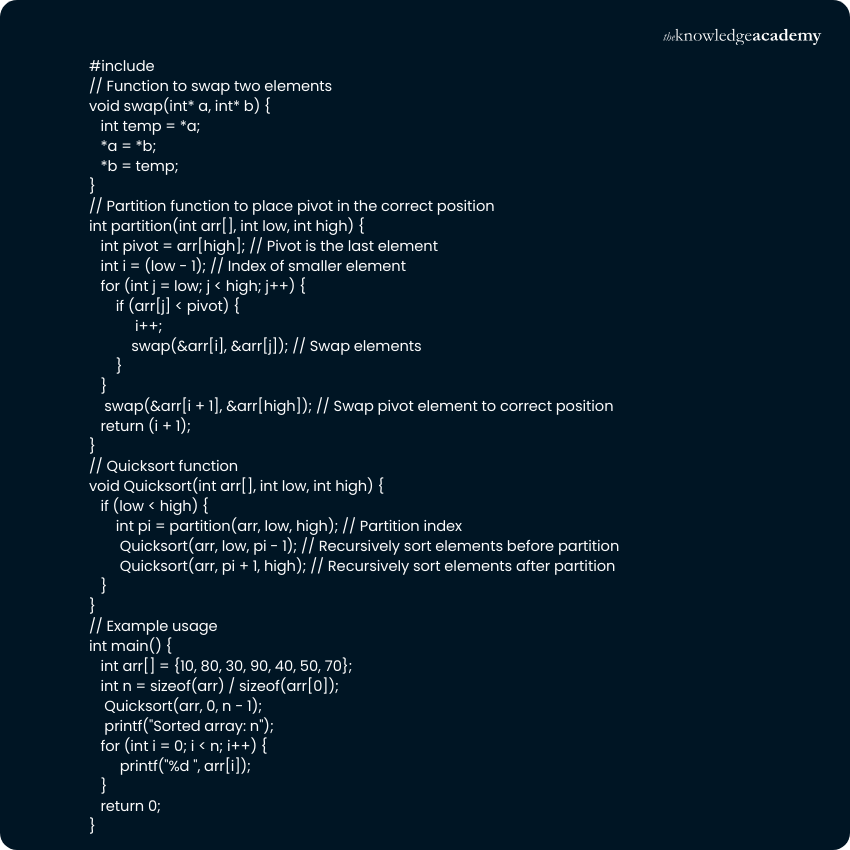
Quicksort in C
Here’s an example of Quicksort Implementation in C:

Benefits of Using Quicksort
Benefits of using Quick Sort Method include:
1) Efficient Average-Case: Fast, with an average time complexity of O(n log n).
2) In-Place Sorting: Minimal additional memory required, with O(log n) space complexity.
3) High Performance: Works well with large datasets.
4) Cache-Friendly: Optimal memory access patterns enhance speed.
5) Versatile: Suitable for internal and external sorting.
6) Adaptive: Performs well on different input distributions.
7) Parallelisable: Can leverage multi-core processors for better performance.
8) Ideal for Arrays: Particularly effective for sorting arrays over linked lists.
Drawbacks of Quicksort
Drawbacks of using Quicksort include:
1) Worst-Case O(n²): Poor pivot selection can degrade performance.
2) Not Stable: Doesn't preserve the order of equal elements.
3) Stack Overflow: Deep recursion can cause overflow on significant inputs.
4) Pivot Sensitivity: Efficiency relies heavily on good pivot choice.
5) Less Efficient for Small Datasets: Overhead can make it slower than Insertion Sort.
6) High Swapping Overhead: Frequent swaps can reduce performance.
7) Poor Performance on Skewed Data: Needs optimisations like random pivots for already sorted inputs.
Unlock your coding potential with our Python Course- Join today the versatile programming languages!
Applications of the Quicksort Algorithm
Due to its speed and flexibility, Quick Sort Algorithm is applied in many areas, such as:
1) Sorting Algorithms: Regularly functions as a basis for hybrid sorting techniques like Timsort, which is responsible for Python's internal sort.
2) Database Systems: Very important for the swift sorting of records and the smooth handling of data in database management systems.
3) Computer Graphics: Helps optimise rendering and graphics operations by handling sorting tasks effectively.
4) Network Routing: Applied in networking algorithms, including the organisation of routing tables.
5) File Systems: Assists in organising and managing files efficiently for faster access and retrieval.
What are the Different Partition Algorithms
The most important function in Quick Sort Algorithm is partition(), which works by rearranging the elements around the pivot. There are three different partition techniques used widely, and they are:
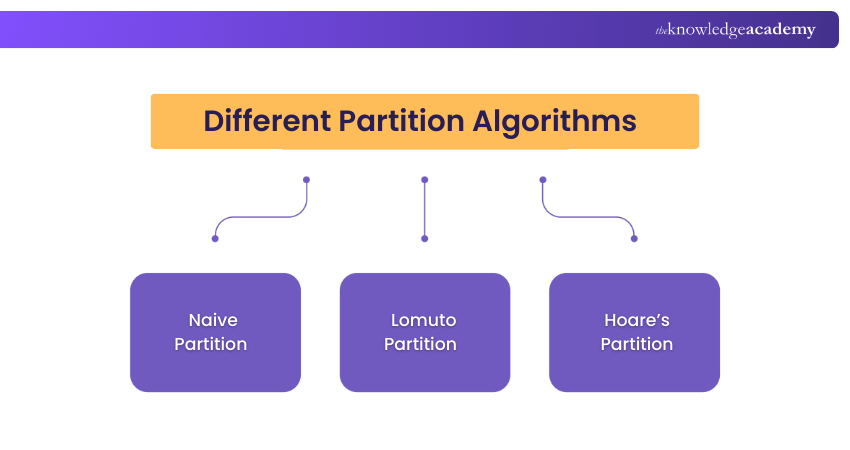
1) Naive Partition
This approach produces a temporary copy of the array, puts all the smaller elements first, then the large ones, and finally, the array is copied back again. It needs O(n) additional space.
2) Lomuto Partition
Lomuto’s way is quite easy and very logical. It tracks the index of smaller elements and swaps values, accordingly, making it easy to implement.
3) Hoare’s Partition
The quickest of all, Hoare’s method, goes through the array from both sides and keeps on interchanging elements till the partition condition is met.
Conclusion
Quick Sort Algorithm continues to be a go-to algorithm for efficient and flexible sorting in programming. Its speed, adaptability, and wide range of applications make it indispensable for developers working with large datasets. Understanding Quick Sort alongside other algorithms equips you to write faster, more effective code and tackle complex problems with confidence.
Explore the programming skills to build dynamic applications with our PHP Course-Join today!
Frequently Asked Questions
Is Quicksort Better Than Other Sorting Algorithms?

Yes, Quick Sort Algorithm is a fast, divide-and-conquer sorting algorithm ideal for large datasets. It recursively partitions arrays around a pivot, sorting smaller and larger elements. And with O(n log n) average time complexity and O(log n) space usage, it’s highly efficient. Quicksort often outperforms other algorithms like Heapsort.
Why is Quicksort Unstable?
Quicksort is unstable because it can change the relative order of equal elements during partitioning. Unlike stable sorts, it doesn’t preserve initial order, as elements with equal keys may be placed on opposite sides of the pivot.
What are the Other Resources and Offers Provided by The Knowledge Academy?
The Knowledge Academy takes global learning to new heights, offering over 3,000+ online courses across 490+ locations in 190+ countries. This expansive reach ensures accessibility and convenience for learners worldwide.
Alongside our diverse Online Course Catalogue, encompassing 19 major categories, we go the extra mile by providing a plethora of free educational Online Resources like Blogs, eBooks, Interview Questions and Videos. Tailoring learning experiences further, professionals can unlock greater value through a wide range of special discounts, seasonal deals, and Exclusive Offers.
What is The Knowledge Pass, and How Does it Work?
The Knowledge Academy’s Knowledge Pass, a prepaid voucher, adds another layer of flexibility, allowing course bookings over a 12-month period. Join us on a journey where education knows no bounds.
What are the Related Courses and Blogs Provided by The Knowledge Academy?
The Knowledge Academy offers various Programming Training, including the Basic Perl Programming Training, J Python Course, and Bootstrap Training. These courses cater to different skill levels and provide comprehensive insights into Functions in R Programming.
Our Programming & DevOps Blogs cover a range of topics related to Programming, offering valuable resources, best practices, and industry insights. Whether you are a beginner or looking to advance your Programming Skills, The Knowledge Academy's diverse courses and informative blogs have got you covered.

The Knowledge Academy


Global Training Provider
The Knowledge Academy is a world-leading provider of professional training courses, offering globally recognised qualifications across a wide range of subjects. With expert trainers, up-to-date course material, and flexible learning options, we aim to empower professionals and organisations to achieve their goals through continuous learning.

Upcoming Programming & DevOps Resources Batches & Dates
Date
 Data Structure and Algorithm Training
Data Structure and Algorithm Training
Fri 28th Aug 2026
Data Structure and Algorithm Training
Fri 27th Nov 2026

 If you wish to make any changes to your course, please


