


 Top Rated Course

We may not have the course you’re looking for. If you enquire or give us a call on +33 805638382 and speak to our training experts, we may still be able to help with your training requirements.
10+ Key GDPR Requirements: General Data Protection Regulation
John Davies 14 July 2026GDPR Requirements set strict rules for how organisations collect, process, store, and protect personal data, with transparency, security, and accountability. Understanding the key Requirements of GDPR, including consent, data protection principles, and individuals' rights under the regulation, is essential for Business Owners in the EU.
Home
 Resources
IT Security & Data Protection
10+ Key GDPR Requirements: General Data Protection Regulation
Resources
IT Security & Data Protection
10+ Key GDPR Requirements: General Data Protection Regulation
Resources
IT Security & Data Protection
10+ Key GDPR Requirements: General Data Protection Regulation

Training Outcomes Within Your Budget!
We ensure quality, budget-alignment, and timely delivery by our expert instructors.
Table of Contents

Data is very powerful. It tells stories, grows business, and connects people. But it is also important to protect it. That is why GDPR, i.e. General Data Protection Regulation, was created, which gives every business rules for handling personal data. If your organisation handles the data of individuals in the European Union (EU), complying with GDPR Requirements becomes essential.
In this blog, we will break down the key GDPR Requirements along with the rights individuals have, and how to protect data in effective ways. Let's get started!
Table of Contents
1) What are GDPR Requirements?
2) GDPR Requirements: Individual Rights
3) When can GDPR be Broken?
4) What is GDPR Required by Law?
5) Conclusion
What are GDPR Requirements?
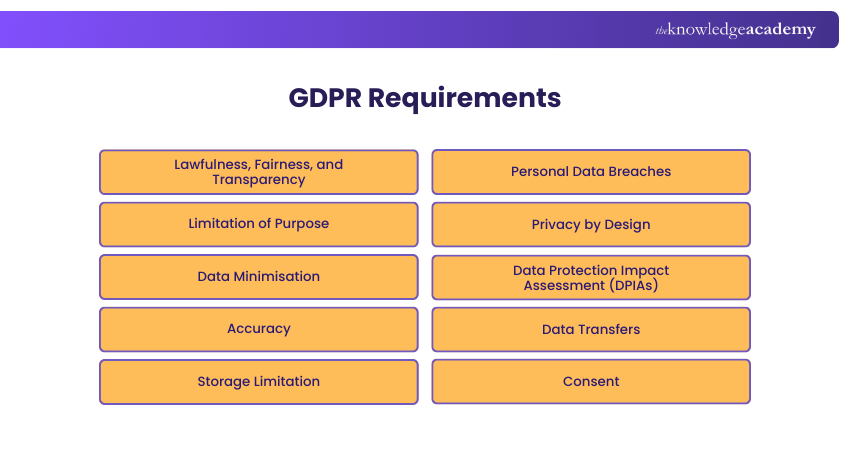
GDPR Requirements are the legal obligations set by the General Data Protection Regulation (GDPR) that organisations need to follow when collecting, processing, storing, or sharing personal data of individuals in the European Union.
These requirements are designed to protect people’s privacy, ensure transparency, and give individuals greater control over how their personal information is used. In simple terms, GDPR ensures that organisations handle personal data responsibly and ethically, not just legally. Below are the GDPR Requirements that you need to comply with:
1) Lawfulness, Fairness, and Transparency
Under GDPR Requirements, personal data must be processed lawfully, fairly, and in a transparent manner. This means organisations must have a valid legal basis for collecting and using data, such as consent, contractual necessity, or legal obligation. Individuals must be clearly informed about what data is being collected, why it is needed, how it will be used, and who it may be shared with.
What Should be Done:
1) You must first tell what data you are collecting and why
2) You must use the data honestly and without bias
3) Everything must be communicated clearly, such as in a privacy notice
Example:
If you are collecting emails for a newsletter, you must tell the user that their email will be used only for that purpose.

2) Limitation of Purpose
The principle of purpose limitation means that personal data must be collected for specific, explicit, and legitimate purposes. Organisations cannot collect data “just in case” it may be useful later. Data should also be limited to the original purpose. When the need is over, the data needs to be deleted as per the GDPR Requirements.
What Should be Done:
1) Collect data only for a clear purpose
2) Do not collect extra data
3) When the work is done, delete the data
Example: Keep the customer's address only for delivery. It is best practice to delete it after delivery.
3) Data Minimisation
Data minimisation requires organisations to collect only the data that is genuinely necessary for the intended purpose. Collecting excessive or irrelevant information increases risk and goes against GDPR Requirements and principles. By limiting data collection to what is essential, organisations reduce privacy risks and improve overall data security.
What Should be Done:
1) Regularly review and remove outdated or unused data
2) Define a clear purpose before collecting any information
3) Limit internal access to only those who truly need the data
Example: If only name and email are required for event registration, then do not ask for phone number.
4) Accuracy
Data should always be correct and updated. Using incorrect or old data can cause problems for the customer. The user has the full right to check and correct their data.
What Should be Done:
1) Review the data from time to time
2) Update the data immediately on the user's request
3) Correct the mistakes without delay
Example: If the customer changes their address, update it to avoid a delay in delivery.
5) Storage Limitation
Personal data should be kept only as long as necessary. It is necessary to delete it after the work is done. Keeping old data increases the risk of misuse or breach.
What Should be Done:
1) Set a fixed time for data retention
2) Delete data after the work is completed
3) Implement an auto-delete system
Example: If a job application is rejected, delete its data after a set period.
Sign up for our Data Privacy Awareness Course and gain expertise in navigating the complexities of Data Protection – Join now!
6) Consent
Consent means that the user has freely and clearly said yes to giving the data. Consent should not be confusing, and the user should have the option to take it back at any time.
What Should be Done:
1) Take consent in simple language
2) Avoid pre-ticked checkboxes
3) Give an option to withdraw consent
Example: If you want to send promotional emails, first make the user click on a clear “I agree” button.
7) Personal Data Breaches
A data breach occurs when personal information is accidentally leaked or falls into the hands of the wrong person. In such cases, immediate action has to be taken so that the risk is reduced.
What Should be Done:
1) Inform the appropriate authority within 72 hours
2) If necessary, inform the users as well
3) Have an internal breach response process ready
Example: If an employee accidentally sends a confidential file to someone else, reporting should be done immediately.
Master the skills to become a guardian of data and the architect of trust – Join our Certified Data Protection Officer (CDPO) Training now!
8) Privacy by Design
This being one of the GDPR Requirements means that data protection and privacy should be built into systems, processes, and products from the beginning stage. Organisations should integrate privacy considerations into project planning, system development, and business operations. This includes limiting data collection and ensuring default settings protect user privacy.
What Should be Done:
1) Plan to collect minimum data
2) Make default settings secure
3) Follow a privacy-first approach
Example: When creating an app, ask the user for only essential data, such as name and email, and keep the rest optional.
9) Data Protection Impact Assessment (DPIAs)
DPIA is a process through which you can check whether data processing is putting someone's privacy at risk. It is mandatory for high-risk activities.
What Should be Done:
1) Do a DPIA before processing sensitive or large-scale data
2) Identify the risk and plan a solution
3) Consult the supervisory authority if necessary
Example: If you are installing new CCTV cameras, do a DPIA to assess the risk.
10) Data Transfers
When you send data outside the EU, the safety of the data has to be ensured there too. Not every country follows a strong law like GDPR, so safeguards are important.
What Should be Done:
1) Send data only to approved countries
2) Or apply legal protection like Standard Contractual Clauses (SCCs)/ Binding Corporate Rules (BCRs)
3) Ensure that the partner handles data securely
Example: If EU user data is to be sent to India, protect data by using Standard Contractual Clauses.
GDPR Requirements: Individual Rights
GDPR has defined eight important rights to give EU citizens full control over their personal data. The main goal of these rights is to give people data privacy, give clear information about the use of their data, and prevent misuse.
Every organisation must understand and follow these rights so that it can become GDPR compliant and build trust with users. Let's check those individual rights below:
1) Right to be Informed
Individuals have the right to know how their personal data is being collected and used. Organisations have to provide clear, accessible privacy notices explaining what data is collected, the purpose of processing, legal basis, retention period, and whether data will be shared or transferred.
The user should get all the following information:
1) Who collected the data
2) For what purpose is the data being used
3) Contact of the Data Protection Officer
4) If the data has been taken from someone else, then the name of the source
5) Is the user legally or contractually bound to give the data
This information should be available to the user within one month, or at the time of the first communication. If the data is being shared with someone else, then the user has to be informed before that.
2) Right to Access
Also known as a Subject Access Request (SAR), this right allows individuals to request a copy of their personal data and information about how it is being processed. Organisations should provide this information without delay, typically within one month and without any fee or charge.
The organisation has to provide:
1) Confirmation that the data is being processed
2) Copy of the data
3) Purpose of the data
4) Retention period
5) Right to file a complaint
The request can be in any format, email, phone or social media. A reply must be given within one calendar month, usually without any fee.
3) Right to Rectification
If the user feels that his data is incorrect or incomplete, they can request correction. The organisation then has to verify the data and make it correct, or the user has to give a reason that the data is already correct.
In this process, one has to keep in mind:
1) The level of checking according to how important the data is
2) While the data is being checked, it should be avoided
3) The user's arguments and proof have to be considered
If the request is not found, then the user also has to be answered within one month, with a reason and an appeal option.
4) Right to Erasure
This right is also called "Right to be forgotten". The user can request to delete their data if:
1) The need for data is over
2) Consent has been taken back
3) Data has been collected illegally
But in some cases, deleting data is not compulsory, such as:
1) There is a legal obligation
2) Data is being used in the public interest
The request can be in any format, and the organisation has to respond within one calendar month.
Join our Certified EU General Data Protection Regulation (EU GDPR) Foundation Course and gain a solid understanding of data privacy regulations!
5) Right to Restrict Processing
Sometimes the user wants their data to be used, but in a limited way. Under this right, they can ask that their data be processed only for a specific purpose.
The organisation has to:
1) To flag or mark the data and handle it separately
2) If the data has been shared with someone else, inform them about the restriction
3) If the restriction is rejected, inform them about the option of appeal, along with the reason
This right is useful when the user wants to stop the data until it is verified.
6) Right to Data Portability
This right gives the user the power to easily move their data from one service provider to another. It means that the user can transfer their data to another IT system without losing the data.
Data portability includes:
1) Identity data such as name, email
2) Activity data such as search history, website use
3) Traffic or location data
If the data contains third-party information (such as a joint account), consent from all parties is required.
7) Right to Object
Individuals have the right to raise an objection to the processing of their personal data at any time. If someone objects to marketing, the organisation must stop processing their data for that purpose immediately. Objections may also apply to processing based on legitimate interests or public tasks.
Such objections may arise as:
1) Blocking phone marketing calls, but allowing emails
2) Opposing specific data use
If the processing is being done in the legal or public interest, the organisation can continue, but it is necessary to explain the reason to the user.
8) Rights Related to Automated Decision-making, Including Profiling
This right protects users when a decision is being made on their behalf by a machine or software, without human involvement. Profiling means guessing someone's behaviour from their personal data.
This is allowed only when:
1) It is necessary for the contract
2) The law allows
3) The user has clearly given consent
In such a case, the organisation has to:
1) Provide information to the user about the system
2) Provide the option of human review
3) Regularly check the accuracy of the system
When can GDPR be Broken?
Situations where GDPR may not apply are:
1) Non-EU entities without EU data processing activities.
2) Personal or household activities such as maintaining a personal address book or using social media for private purposes.
3) Law enforcement and national security.
4) Anonymised data.
5) Certain journalistic, academic, artistic, and literary purposes.
What is GDPR Required by Law?
The General Data Protection Regulation (GDPR) is a law protecting people’s data privacy and security. Knowing who does GDPR apply to is important, as it covers businesses in the European Economic Area (EEA) and certain companies outside the EEA if they handle the data of individuals living there.
Conclusion
Understanding the key GDPR Requirements is essential for protecting personal data and staying compliant. By following these rules, you can avoid penalties and build trust with your customers. Ultimately, GDPR is about balance, enabling organisations to use data effectively while ensuring individuals remain in control of their personal information.
Enhance your organisation’s compliance with our GDPR Awareness Training – Join us and safeguard sensitive information today!
Frequently Asked Questions
What is GDPR Questionnaire?

A GDPR Questionnaire is a tool used by organisations to assess their compliance with the General Data Protection Regulation. It typically includes questions on data processing activities, security measures, and data subject rights to identify areas needing improvement.
What is GDPR Checklist?
A GDPR Checklist is a comprehensive list of tasks and requirements that organisations must follow to seek compliance with the General Data Protection Regulation. It covers Data Protection principles, individual rights, data breaches, and documentation to help maintain GDPR adherence.

John Davies


Cyber Security Governance & Assurance Specialist
John Davies is a cybersecurity expert specialising in governance, risk management, and compliance. With over 15 years in the field, he has led enterprise-wide security programmes across finance, healthcare and public sector organisations. His content provides practical guidance on building secure environments, managing risk and aligning with regulatory frameworks.


 If you wish to make any changes to your course, please


