


 Top Rated Course

We may not have the course you’re looking for. If you enquire or give us a call on +33 805638382 and speak to our training experts, we may still be able to help with your training requirements.
Difference Between Corporate Law and Commercial Law
Amelia Williams 16 July 2026Corporate law covers company formation, governance, mergers and shareholder rights, while commercial law focuses on contracts, trade, IP and disputes. Together, they shape how businesses operate and manage legal risk. Understanding both helps organisations stay compliant and make informed commercial decisions.

Training Outcomes Within Your Budget!
We ensure quality, budget-alignment, and timely delivery by our expert instructors.
Table of Contents
Every business decision, no matter the size, has a legal aspect and issue behind it. Understanding the Difference Between Corporate and Commercial Law not only gets you to the point of knowing how companies are organised but also gives a guarantee of protection for daily transactions. Let's go ahead and explore both areas in order to see their respective places in the business world.
Table of Contents
1) What is Corporate Law?
2) What is Commercial Law?
3) What Do Corporate Legal Services Involve?
4) What Do Commercial Legal Services Involve?
5) What is the Difference Between Corporate and Commercial Law?
6) Are Corporate Law and Commercial Law the Same?
7) Which Pays More, Corporate or Commercial Law?
8) Conclusion
What is Corporate Law?

Corporate Law governs the formation, management, and dissolution of companies. It focuses on ensuring that corporations operate within the legal framework set by governments and regulatory bodies. This branch of law addresses issues such as mergers, acquisitions, shareholder rights, and fiduciary duties. Essentially, Corporate Law defines how businesses are structured, how they function, and how they should behave legally.

Example of a Corporate Law Scenario
a) A company’s board of directors proposes a merger with another firm
b) The merger must follow legal procedures outlined under Corporate Law
c) Stakeholder interests, including those of employees and minority shareholders, must be safeguarded
d) Financial disclosures must be made public to ensure transparency throughout the process
e) The merger must align with both companies’ articles of association
f) If shareholders disagree on the merger, Corporate Law offers a legal route for dispute resolution
What is Commercial Law?
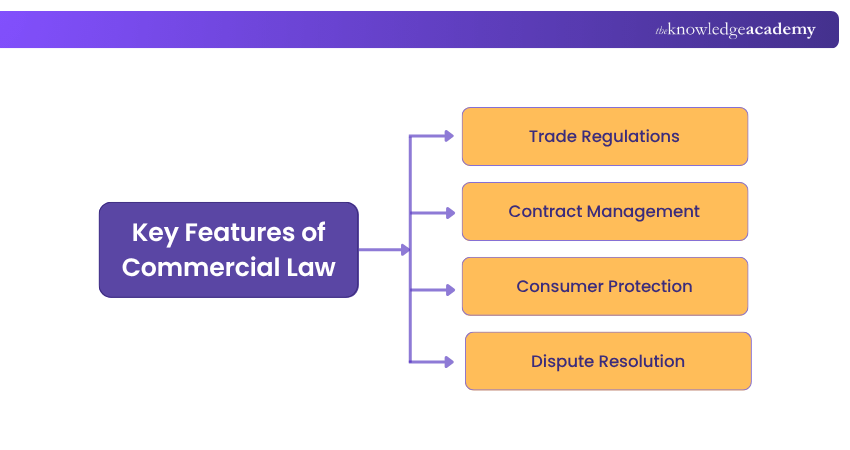
Commercial Law, or Business Law, involves commercial and trade practices. It encompasses different matters that pertain to the buying or selling of goods. This includes preparation of contracts, settlement of disputes, and establishment of business. Other aspects include intellectual property, consumer protection, and E-Commerce. Essentially, Commercial Law is the framework by which most commercial activities are driven.
Example of a Commercial Law Scenario
a) A manufacturing company signs a contract with a supplier for raw materials
b) The supplier fails to deliver the agreed materials within the stipulated timeframe
c) The manufacturing company suffers a loss due to the delayed or failed delivery
d) Commercial Law governs the terms of the contract and the rights of both parties
e) The company may pursue legal action for breach of contract
f) Compensation can be sought to recover financial losses resulting from the supplier’s failure
Protect your business and employees with our comprehensive Employment Law Training – enhance your expertise now!
What Do Corporate Legal Services Involve?
Corporate law services from an international business law firm are essential when entering a new venture, restructuring existing investments to accommodate new funding, or seeking legal guidance on matters such as shareholder relations and investment opportunities. An experienced corporate solicitor, like Paddle & Cocks LLP Solicitors, can offer tailored legal advice across a wide range of corporate matters, including:
a) Business acquisitions and disposals, covering all key areas such as warranties, indemnities, disclosures, and transactional documentation
b) Shareholder and partnership agreements are designed to foster growth and promote long-term stability, reducing the risk of future disputes
c) Security arrangements for deferred payment structures, including personal guarantees, legal charges, debentures, or the issuance of loan notes
d) Assistance with drafting Articles of Association, maintaining statutory registers, and preparing board resolutions and meeting minutes
Working with corporate solicitors who are commercially focused and pragmatic ensures legal advice is aligned with your business strategy. A solicitor who understands both the legal and commercial landscape is better equipped to support structural decisions that lead to successful business outcomes.
Quality corporate legal services should be flexible, client-focused, and carefully calculated, helping you weigh costs and risks to make informed decisions that support your business objectives.
What Do Commercial Legal Services Involve?
Commercial legal services play a vital role in resolving a wide range of business-related disputes, including contractual issues, partnership and company disagreements, financial claims, shareholder disputes, property litigation, professional negligence, insolvency matters, warranty claims, injunctive relief, and disputes over assets.
Engaging a skilled commercial litigation team ensures that contracts and agreements are drafted to the highest standard. Such legal experts take into account evolving legislation and the specific needs of your business, reducing the risk of future legal challenges by formulating essentail Settlement Agreements. In the absence of a commercial solicitor, business agreements may lack clarity and consistency, often leading to misunderstandings or costly disputes.
A reputable commercial law firm, such as Paddle & Cocks LLP Solicitors, provides expert guidance on a wide range of critical commercial terms and agreements, including:
a) Terms and Conditions of Sale or Purchase
b) Website Terms of Use
c) Privacy Notices and Policies
d) Data Protection Compliance
e) Supply of Service Agreements
f) Master and Framework Agreements
g) Intellectual Property Licences, including Trademark and Patent Licences
h) Web, App, and Software Development Agreements
i) Consultancy and Contractor Agreements
j) Bespoke Commercial Agreements tailored to your business
Failing to have a clear, professionally drafted contract in place leaves your business exposed to significant risk. In the event of a dispute, the absence of formal terms may result in the outcome being decided by the courts, potentially ignoring the intentions and protections a written agreement would have otherwise secured.
Working with a commercial law firm ensures that your agreements are legally sound, clearly defined, and aligned with your operational and strategic goals.
What is the Difference Between Corporate and Commercial Law
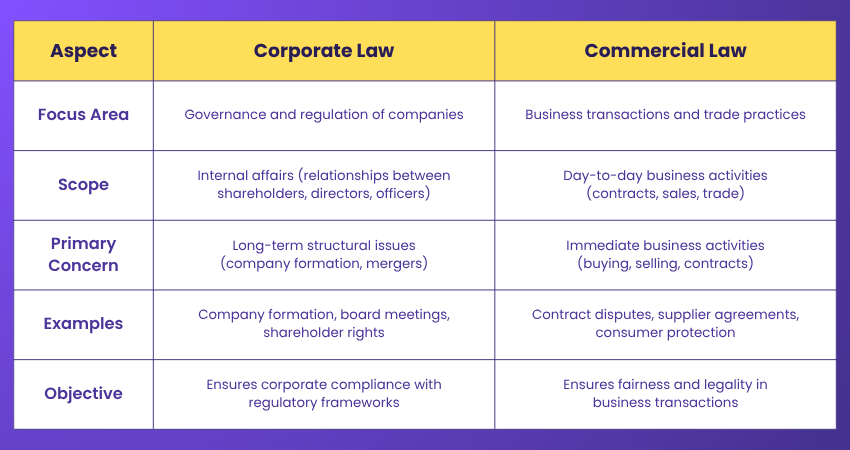
Corporate and Commercial Law are two vital areas of legal practice, both essential for businesses but with distinct functions. Corporate Law focuses on the internal structure and governance of companies, dealing with matters such as formation, shareholder rights, and mergers.
On the other hand, Commercial Law governs business transactions, ensuring that trade, contracts, and commerce are conducted fairly and legally. While these areas often overlap, understanding their differences is crucial for navigating the complexities of business law effectively.
1) Focus Area
Corporate Law deals with the governance and regulation of companies, focusing on internal aspects such as relationships between shareholders, directors, and officers.
Commercial Law, on the other hand, focuses on business transactions, ensuring that trade and commerce are carried out fairly and legally.
2) Scope
Corporate Law addresses structural issues within a company, including formation, governance, and management, and mergers and acquisitions.
Commercial Law regulates everyday business operations, including contracts, sales, Corporate Sales, trade practices, and dispute resolution.
3) Primary Concern
Corporate Law is concerned with the long-term establishment and functioning of businesses, including their creation and dissolution.
Commercial Law Is concerned with the immediate legalities surrounding buying, selling, and other trade transactions.
4) Examples
Corporate Law deals with company formation, board meetings, and shareholder rights.
Law addresses contract disputes, supplier agreements, and Consumer Protection Act PDF to safeguard consumer rights.
5) Objective
Corporate Law aims to ensure corporate compliance with regulatory frameworks, focusing on internal governance.
Commercial Law ensures fairness and legality in business transactions and commercial operations.
Are Corporate Law and Commercial Law the Same?
Although they are closely related and often overlap, Corporate Law and Commercial Law are not the same. Corporate Law, a subsidiary of business law, mainly caters to the incorporation, management, and winding up of the companies. Commercial Law is more of an overall term that comprises all legal issues covered under trade, commerce, and transactions.
For instance, a Corporate Law Lawyer may assist in drafting articles of association, guide mergers or acquisitions, or even deal with shareholder disputes, while a Commercial Lawyer would most probably draft and negotiate contracts, ensure compliance with trade regulations or deal with disputes arising from business transactions.
Stay compliant and excel with UAE Labour Law Training – empower your knowledge today!
Which Pays More, Corporate or Commercial Law?
In general, corporate law has a small advantage over commercial law regarding pay, particularly in top-notch companies dealing with significant mergers and acquisitions. Senior commercial roles can also offer high salaries, shaped by firm size, location, and experience.
Conclusion
The Difference Between Corporate and Commercial Law is a major factor in deciding the career that best fits your goals. Both sectors provide individual hardships along with the possibility of high incomes. Your personal preferences and future plans should be the ones that influence your choice.
Safeguard your business integrity with our Anti-Bribery Course – Start protecting today!
Frequently Asked Questions
Are corporate and commercial law both important for businesses?

Yes, both are essential. Corporate law supports business structure and governance, while commercial law manages day-to-day transactions and contracts. Together, they ensure legal compliance, reduce risk, and support long-term business success.
What role do commercial law firms play in businesses?
Commercial law firms help businesses draft clear contracts, resolve disputes, protect intellectual property, and comply with regulations. Their legal guidance supports smooth operations and helps prevent costly legal issues or misunderstandings in business dealings.

Amelia Williams


Senior Human Resources Consultant and Learning Specialist
Amelia Williams is a highly respected HR professional with over 12 years of experience in human capital management, talent development and workplace policy. She has worked across sectors including education, healthcare and corporate services, focusing on aligning people strategies with organisational goals. Amelia’s writing blends current HR trends with practical solutions for modern workplace challenges.


 If you wish to make any changes to your course, please


