


 Top Rated Course

We may not have the course you’re looking for. If you enquire or give us a call on +33 805638382 and speak to our training experts, we may still be able to help with your training requirements.
Business Analyst vs Data Analyst: Key Differences You Need to Know
William Brown 14 July 2026Data Analysts interpret complex datasets to uncover trends, while Business Analysts use insights to solve business problems and support strategic decisions. Both help organisations make better decisions, but their focus is different. Understanding their differences helps organisations choose the right role for their needs.

Training Outcomes Within Your Budget!
We ensure quality, budget-alignment, and timely delivery by our expert instructors.
Table of Contents
Business Analysts and Data Analysts are two of the most common and in-demand careers in the data field. They both work with data to help businesses make better decisions and achieve their goals. However, Business Analysts and Data Analysts have different backgrounds, interests, and responsibilities that suit different projects and requirements. Therefore, one question is natural to arise: “Business Analyst vs Data Analyst, which one is right for you?”
To understand the Business Analyst vs Data Analyst comparison clearly, it is important to look at their roles, responsibilities, skills, and even similarities. While both professionals work with data to support decision-making, their approach and focus differ. This blog explains the key differences between these roles and helps you decide which career path may suit you better.
Table of Contents
1) Business Analyst vs Data Analyst
2) Differences Between Business Analyst and Data Analyst
3) Similarities Between Data Analyst and Business Analyst
4) Key Skills for Data Analysts and Business Analysts
5) Choosing the Right Career Path Between Business Analyst vs Data Analyst
6) Conclusion
Business Analyst vs Data Analyst
To understand which career path you should choose, it is crucial to first understand the differences between Business Analyst and Data Analyst, their job roles, skills, and qualifications. So, why wait longer? Here's a clear distinction between the two:
1) What Do Data Analysts Do?
Data Analysts work with data to help organisations understand trends, solve problems, and support better decision-making. Their role involves collecting, organising, analysing, and presenting data to help businesses utilise insights for improving strategies and operations. The core responsibilities of Data Analysts are listed below:
a) Define Business Problems: Work with business leaders and stakeholders to understand the problem that needs to be analysed.
b) Identify and Collect Data: Find and gather relevant data from different internal or external sources.
c) Clean and Prepare Data: Organise raw data, remove errors, and structure it properly so it can be analysed accurately.
d) Analyse Data: Study datasets to identify patterns, trends, and useful insights that can support decision-making.
e) Visualise Data: Use charts, graphs, and dashboards to make complex data easier to understand.
f) Present Insights: Share findings with stakeholders in a clear way so they can make informed business decisions.

2) What Do Business Analysts Do?
Business Analysts help organisations improve processes, solve business problems, and identify opportunities for growth. They study how a business operates and suggest solutions that improve efficiency, performance, and decision-making. The core responsibilities of Business Analysts are listed below:
a) Evaluate Business Operations: Examine a company’s current processes, systems, and IT structures to understand how the organisation functions.
b) Identify Improvement Areas: Review workflows and interview team members to find problems, inefficiencies, or opportunities for improvement.
c) Give Recommendations: Share findings and practical solutions with management and key stakeholders to support better decisions.
d) Create Business Models: Develop visual diagrams, reports, and financial models that explain potential business solutions.
e) Support Change and Training: Help employees understand and adopt new systems or processes by providing training and guidance.
Fulfil your potential in the field of Business Analytics and Analysis by registering for the Business Analyst Green Belt Training!
Differences Between Business Analyst and Data Analyst
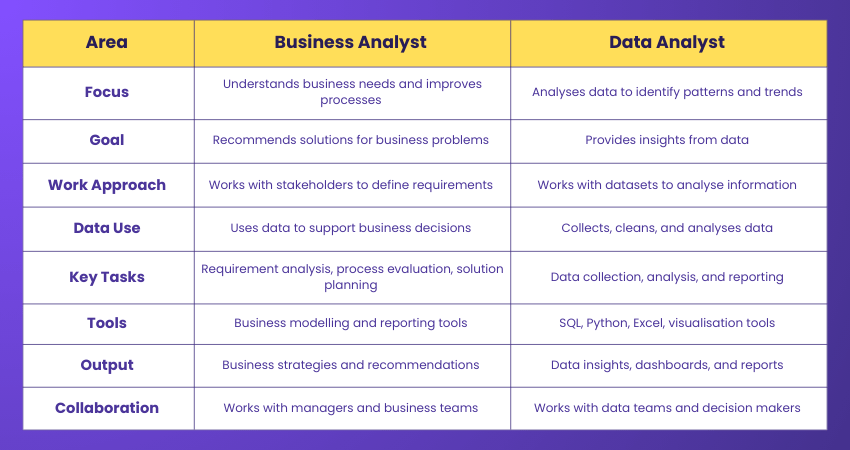
Although Business Analysts and Data Analysts both work with data to support decision-making, their focus is different. Data Analysts concentrate on analysing datasets to discover patterns, trends, and insights.
In contrast, Business Analysts focus on understanding business needs and using insights to suggest solutions that improve business processes, products, or strategies. Let’s look at their differences insightfully in the table below:
Similarities Between Data Analyst and Business Analyst
Data Analysts and Business Analysts have different responsibilities, but their roles often overlap in many areas. Both professionals work with data to support business decisions and improve organisational performance. They also require strong analytical thinking, technical knowledge, and the ability to communicate insights clearly to stakeholders. Some common areas where Data Analysts and Business Analysts share similarities include:
a) Customer Segmentation Analysis:
Data Analyst: Segments customer data based on behaviour, demographics, or engagement metrics.
Business Analyst: Uses these insights to design targeted marketing strategies and identify valuable customer groups.
b) Sales Forecasting:
Data Analyst: Builds models using historical sales data to predict future sales trends.
Business Analyst: Evaluates these forecasts and suggests changes to sales strategies or inventory planning.
c) Process Optimisation:
Data Analyst: Examines operational data to identify inefficiencies in workflows or systems.
Business Analyst: Recommends improvements or new processes to solve operational issues and increase efficiency.
Register for the Business Analyst Fundamentals Training now and take the first step towards a successful career in Business Analysis!
Key Skill for Data Analysts and Business Analysts
Data Analysts and Business Analysts require a combination of technical, analytical, and communication skills to perform their roles effectively. While Data Analysts focus more on technical and data-driven tools, Business Analysts concentrate on interpreting data and improving business processes. Let's look at some of their key skills below:
1) Key Skills for Data Analysts
The essential skills for Data Analysts include:
a) SQL Proficiency: Ability to query databases and retrieve relevant data for analysis.
b) Programming Skills: Knowledge of languages such as Python for cleaning, transforming, and analysing data.
c) Data Mining and Statistical Analysis: Ability to identify patterns, trends, and relationships in datasets.
d) Data Visualisation: Skills in using Business Intelligence tools to create dashboards, charts, and reports.
e) Problem-solving Skills: Ability to analyse complex data problems and provide useful insights.
2) Key Skills for Business Analysts
The essential skills for Business Analysts include:
a) Strong Communication Skills: Ability to explain insights and recommendations clearly to stakeholders.
b) SQL Knowledge: Basic ability to query company databases and retrieve relevant information.
c) Data Interpretation: Skills to analyse data and translate insights into business strategies.
d) Critical Thinking and Problem-solving: Ability to evaluate problems and recommend effective solutions.
e) Process Improvement: Skills to improve workflows and support business projects.
f) Business Understanding: Awareness of industry trends and how they affect organisational goals.
Become proficient in business analysis with the Certified Business Analyst Professional (CBA-PRO) Training now!
Choosing the Right Career Path Between Business Analyst vs Data Analyst
Determining the right career path between Business Analyst and Data Analyst involves considering three key factors, which include the following:
a) Educational and Professional Background:
Business Analysts typically hold a business-focused undergraduate degree and collaborate between business and technical teams to improve operations. Data Analysts often come from Science, Technology, Engineering, and Mathematics (STEM) majors with advanced degrees and expertise in statistics and programming.
b) Interests:
Business Analysts thrive on problem-solving and communication skills, focusing on corporate workflow improvements. Data Analysts excel in numbers and programming, diving deep into databases to extract insights.
c) Career Trajectory:
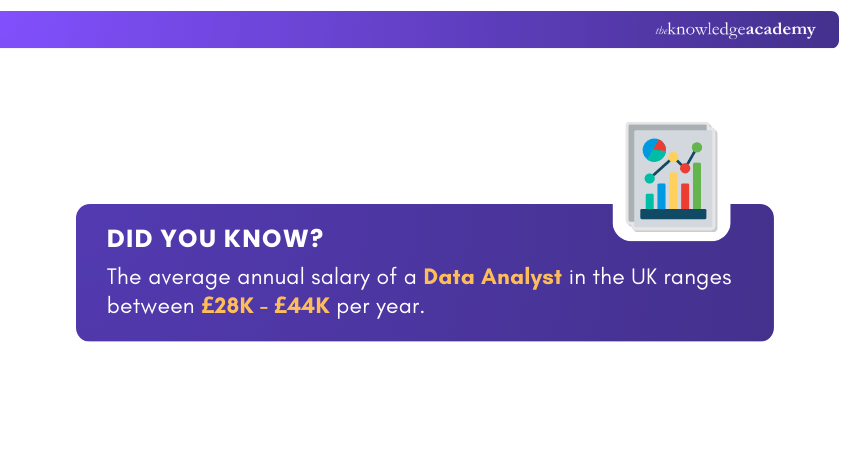
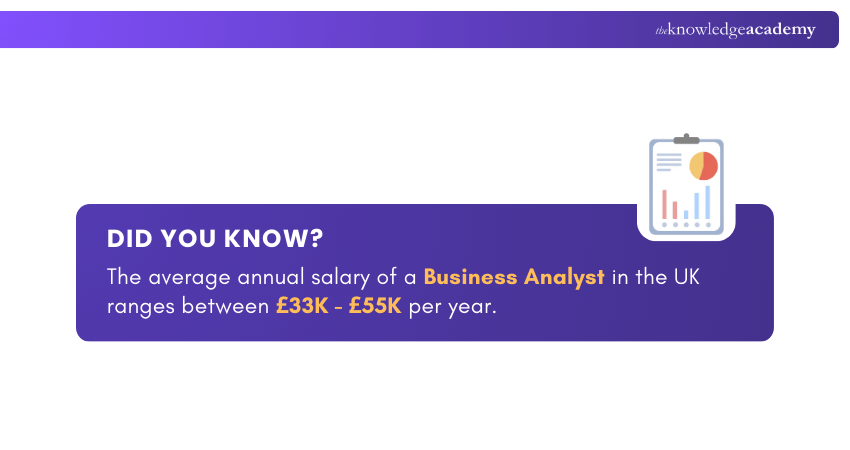
While Business Analysts may start with slightly lower salaries, advanced roles can yield six-figure incomes. Advanced degrees and certifications can lead to analytics-focused careers. Data Analysts also enjoy high job security and competitive pay, with opportunities for advancement into developer or data science roles.
Conclusion
The Business Analyst vs Data Analyst comparison shows how both roles support better decision-making using data. However, their focus differs as Business Analysts concentrate on understanding business needs and improving processes, while Data Analysts specialise in analysing datasets to find trends and insights. Choosing the right career depends on your skills, interests, and whether you prefer solving business problems or enjoy working with data.
Enhance your skills in the field of Business Analysis with our professional courses from Business Analyst Course!
Frequently Asked Questions
How do Business analyst and Data analyst roles contribute to project management?

Business Analysts and Data Analysts are in demand across industries, such as IT, finance, healthcare, e-commerce, telecom, marketing, and government. They analyse data, improve processes, and support better decisions, helping organisations increase efficiency, plan strategies, and achieve business goals.
Can a Business Analyst be a Data Analyst?
Yes, a Business Analyst can become a Data Analyst. Although the roles have different focuses, they share several similar skills. With knowledge of data tools and analytical techniques, many Business Analysts successfully transition into Data Analyst roles.

William Brown


Senior Business Analyst and Strategic Advisor
William Brown is a senior business analyst with over 15 years of experience driving process improvement and strategic transformation in complex business environments. He specialises in analysing operations, gathering requirements and delivering insights that support effective decision making. William’s practical approach helps bridge the gap between business goals and technical solutions.
View Detail

 If you wish to make any changes to your course, please


